Translating Georg Heym’s ‘Berlin II’

Michael Hofmann’s Faber Book of Twentieth Century German Poems includes four pieces by Georg Heym – not bad for someone who died at the age of 24 (in 1912 – an accidental drowning in the frozen Havel River, probably while trying to save a friend). Heym is generally regarded as an early Expressionist writer (of poems and short prose/novellas), though his early poems are very much under the influence of Hölderlin, then much of the surviving work suggests the powerful influence of Baudelaire (in both form and content), though in his final months there seems to have been a return to the looser forms of Hölderlin. His best-known poems combine a gothic, morbid imagination, often with extremes of Expressionistic distortion, with a counterbalancing devotion to regular forms. The sonnet ‘Berlin II’, when it appeared in Der Demokrat, in November 1910, led to the publication of Heym’s only collection published during his lifetime: Der ewig Tag (The Eternal Day).

Antony Hasler’s translations, published by Libris in 2004 (Hofmann also includes translations by Babette Deutsch and Avrahm Yarmolinsky, and Christopher Middleton), are the best to be had at the moment and I’d definitely recommend searching them out (Libris has since folded). I’ve been in a bit of a translation lull for a few months so thought I’d try a few of Heym’s poems myself. The challenge is to make something readable in English, while not toning down the dark brutality, yet also staying close to his classical chosen forms.

In ‘Berlin II’, Heym’s Petrarchan rhyme scheme is ABBA CDDC EFE GHG. The opening quatrain is fairly straightforward. A literal transcription might be: ‘Betarred barrels rolled from the thresholds / of dark warehouses onto the high barges/boats). / The tugboats moved in. The smoke’s mane / hung sooty above the oily waters’.

Hasler has:

From the dim warehouse thresholds barrels caulked

with tar went rolling down to the tall lighters.

The tugboats started. On the oily waters

a mane of soot was trailing from the smoke.

The ‘lighters’ / ‘waters’ rhyme is a stroke of genius (a lighter is a river boat) but the opening line and the fourth seemed to me less successful. I kept the opening line simple and turned ‘waters’ into a possessive and I rather saw the (lion’s) mane more visually linked to the billowing of the smoke which is ‘soot-filled’ (I also tried ‘sooty’, even ‘smutty’). This is what I ended up with:

The tarred barrels rolled from open doorways

of dark warehouses onto the tall lighters.

The tugboats closed in. Across the waters’

oily surface hung the smoke’s soot-filled mane.

I went for the tugboats ‘closing in’ – not merely approaching, but something more threatening – as it seemed in keeping with the ominous atmosphere which develops as the poem goes on (the drumming in line 11).

The second quatrain might be given as: ‘Two steamers came with musical bands. / Their funnels cut/clipped the arch of the bridge. / Smoke, soot, stink lay on the dirty waves / of the tanneries with their brown skins’.

Hasler has:

Two pleasure-steamers came with music playing.

They dipped their funnels at the bridge’s curve.

Smoke, soot, stench lay on the dirty waves

by tanneries where the brown hides were drying.

I couldn’t quite see the funnels being dipped under the bridges (though I believe some boats do this) and I feel the bridge’s ‘curve’ (for roof or arch?) not quite right. So I went with the sense of the funnels actually scraping the roof of the bridges (as if these pleasure steamers did not really fit the generally grim, sordid scene). I was very happy to arrive at the bridge/stench half-rhyme for the middle couplet because the sounds there conveyed more of the Heymian ugliness of the scene. Like Hasler, I felt the need to explain a little what the pelts/skins/hides were doing hanging up at the tanneries. Here’s my second quatrain:

With music playing, two steamers passed by:

their funnels clipped the roof of the bridge.

On the filthy waves, smoke, smut, and stench

at the tanneries, where brown pelts hung to dry.

Lines 9-11 probably caused me the greatest difficulty, not so much in getting the word order and form right, but in simply grasping what was being said in relation to the bridges, the barge, and the narrator’s position. Literally they might read: ‘In/at/all the bridges, beneath us the barge / Carried through, the signals sounded / As if in drums, growing in the silence’.

As I see it, the speaker is being carried on a barge, through and under bridges, and there are signals/sirens sounding that bring to his mind an ominous drumming. So Hasler has:

Every time the barge that bore us travelled

beneath a bridge, the signal’s sudden parley

swelled out of stillness like a deep drum’s rattle.

The ‘barge that bore us’ has echoes of TS Eliot (perhaps not irrelevant in context, and I felt I couldn’t better it in the end) but I’m not sure Hasler makes sense (to me) of the signals and the ‘parley’ metaphor he introduces here is not there in the original. The ‘deep drum’ also seems to be picking up on the ‘ominousness’ of the scene but (for me) a bit heavy-handedly. In the end, I went for:

Through all the bridges, the barge that bore us

made its way, signals resounding as if

a drum’s beat grew louder in the stillness.

In the final 3 lines I made the biggest alteration, the biggest interference with the original poem. Literally, the lines might read: ‘We let go and drifted in the canal / Alongside the gardens slowly. In the idyll / We saw the giant chimneys’ night beacons’. Hasler loses the ‘letting go’ idea, but otherwise keeps the order of these lines well:

We entered the canal, and drifting journeyed

slowly alongside gardens. In the idyll

we saw the night-flares of the giant chimneys.

‘In the idyll’ is perhaps puzzling, though it’s pretty clear there is a bitter irony at work – this is no idyllic scene, and Heym’s other Berlin poems confirm this, the city is a monstrous megalopolis. But there has been a slight shift of scene with the boat moving along a canal now, between gardens. Perhaps this (more bourgeois?) setting might be thought of as more idyllic? But even so, the massive smoking and flaring chimneys of industrial Berlin can still be seen. I confess that I shifted the ‘idyll’ to the final lines to get the final rhyme with ‘canal’. But I have left it – translators, like poets, have the power of veto, whether we exercise it or not. And I have persuaded myself that the savagery of the irony comes out better if the final phrase of the poem contains it. So I went with:

We cut loose, went drifting along the canal,

gradually, between gardens, glimpses of

the vast chimneys’ night-flares in the idyll.
So – to sum up (though translations are always really a work in progress) – here is Heym’s original German followed by my own version of the poem:

Berlin II

Beteerte Fässer rollten von den Schwellen

Der dunklen Speicher auf die hohen Kähne.

Die Schlepper zogen an. Des Rauches Mähne

Hing rußig nieder auf die öligen Wellen.

Zwei Dampfer kamen mit Musikkapellen.

Den Schornstein kappten sie am Brückenbogen.

Rauch, Ruẞ, Gestank lag auf den schmutzigen Wogen

Der Gerbereien mit den braunen Fellen.

In allen Brücken, drunter uns die Zille

Hindurchgebracht, ertönten die Signale

Gleichwie in Trommeln wachsend in der Stille.

Wir ließen los und trieben im Kanale

An Gärten langsam hin. In dem Idylle

Sahn wir der Riesenschlote Nachtfanale.

Berlin II (tr. Martyn Crucefix)

of dark warehouses onto the tall lighters.

The tugboats closed in. Across the waters’

oily surface hung the smoke’s soot-filled mane.

With music playing, two steamers passed by:

their funnels clipped the roof of the bridge.

On the filthy waves, smoke, smut, and stench

at the tanneries, where brown pelts hung to dry.

Through all the bridges, the barge that bore us

made its way, signals resounding as if

a drum’s beat grew louder in the stillness.

We cut loose, went drifting along the canal,

gradually, between gardens, glimpses of

the vast chimneys’ night-flares in the idyll.
Goethe’s poetry – some new translations by John Greening

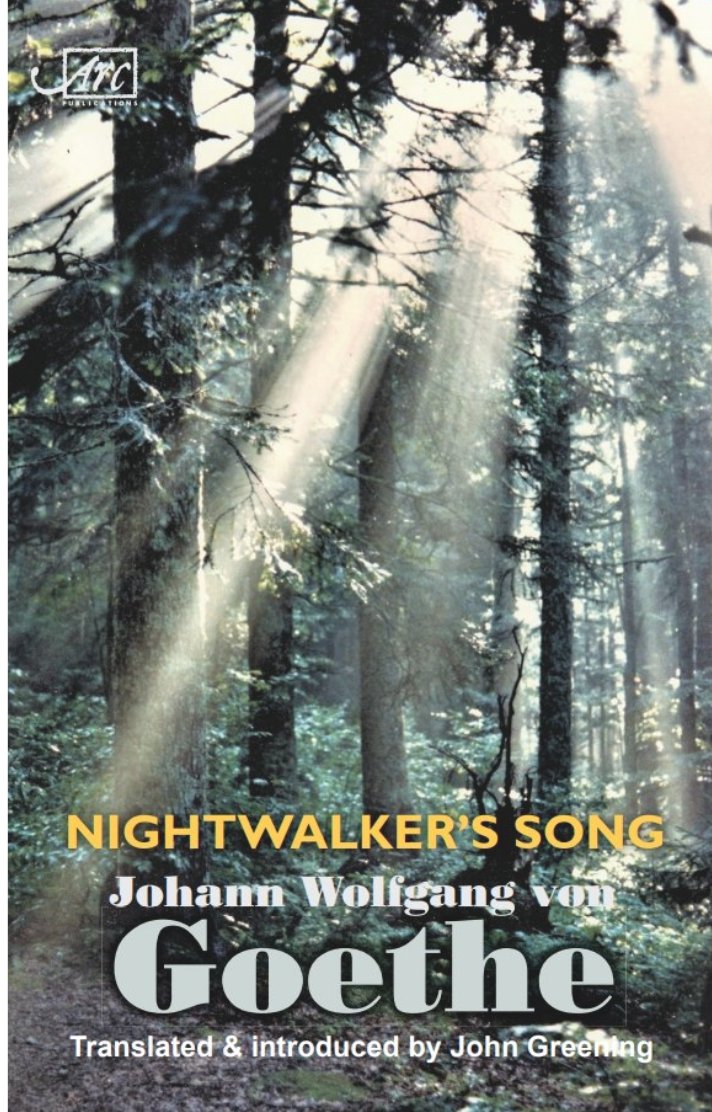
In this blog post, I am discussing John Greening’s new translations of a small selection (9 poems in all) from the works of Johann Wolfgang von Goethe. With the original German texts provided on facing pages, these translations are published as Nightwalker’s Song, by Arc Publications (2022). This review was originally commisioned and published by Acumen poetry magazine early in 2023. By the way, Acumen will be presenting a free to attend on-line celebration of its latest issue on Friday September 1st at 18.30 BST. It will include a brief reading of new work by yours truly, Gill McEvoy, Anthony Lawrence , Sarah Wimbush, Simon Richey, Dinah Livingstone, Michael Wilkinson, Jill Boucher, Jeremy Page, and others.

John Greening’s recent, self-confessedly ‘tightly-focused’ little selection from Goethe’s vast output is, in part, a campaigning publication. In his Introduction, Greening notes the difficulties surrounding the great German poet’s presence in English: the sheer volume of work, the range of that work, the man’s polymathic achievements (as poet, playwright, novelist, scientist, statesman, theatre director, critic), the long life untidily straddling all neat, period pigeon-holing. Christopher Reid has called him ‘the most forbidding of the great European poets’, but perhaps the English have come to see him as a mere jack-of-all-trades? And where do we turn to read and enjoy the poetry? Michael Hamburger’s and Christopher Middleton’s translations look more and more dated. David Luke’s Penguin Selected (1964; versified in 2005)is the most reliable source. But tellingly, as Greening says, one does not find young, contemporary poets offering individual translations of Goethe in their latest slim volume in the way we do with poems by Rilke or Hölderlin.

John Greening

So here Greening sets out a selection box of various Goethes to encourage other translators: we find nature poetry, romance, the artist as rebel, meditations on fate, erotic love poems, a rollicking ballad, dramatic monologue and a very fine sonnet. I like Greening’s determination not to lose the singing. Here, he has ‘shadowed’ the original metres and retained rhyme schemes, though he sensibly makes more use of pararhyme than Goethe’s full rhyming. While not approaching Lowellesque ‘imitations’, Greening has also sought a ‘contemporary texture’ by venturing to ‘modernise an image or an idea if it helped the poem adapt to a different age’. For example, in ‘Harz Mountains, Winter Journey’ (‘Harzreise im Winter’) Goethe’s buzzard has become the more familiar image, in southern England at least, of a red kite. The carriage or wagon (‘Wagen’) driven by Fortune becomes a car in a ‘motorcade’ and another vehicle is imagined ‘winking on to / the slip-road’. There’s also an enjoyable touch of Auden in Greening’s updating of ‘crumbling cliffs / and disused airfields’ (Middleton has ‘On impassable tracks / Through the void countryside’).

Walt Disney’s Sorcerer’s Apprentice

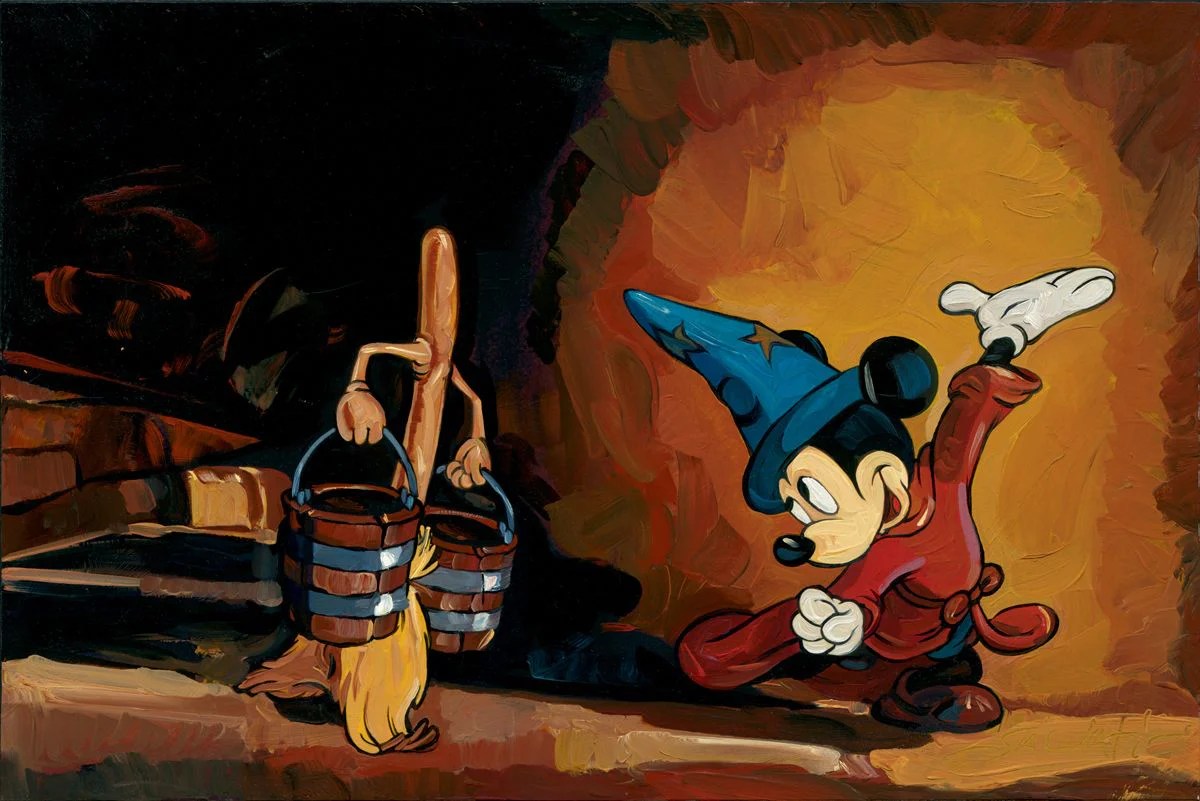
Greening’s skills in versification are well known and he deploys them all – and you can hear him enjoying himself – in ‘The Sorcerer’s Apprentice’: ‘Broomstick – up, it’s show time, haul your / glad rags on, so grey and grimy. / Seems you’ve seen long service, all you’re / fit for now is to obey me’. Though grace notes and fillers slow Goethe’s headlong verse (the opening line in German is simply ‘Und nun komm, du alter Besen!’ – ‘And now come on, you old broom!’), Greening’s rhyming is delightful and the modernising phrases (show time, glad rags) drive the poem along with a colloquial energy which is absolutely right.

Goethe’s ‘Prometheus’ – published in 1789, the year of revolution in France – is a growling dramatic monologue in which the rebel Titan (who stole fire from the gods to give to humankind) sneers and mocks the authority figure, Zeus. He belittles the top god in the opening lines by comparing him to a boy, thoughtlessly knocking the heads off thistles. Greening catches the mocking tone in the series of rhetorical questions later in the poem: ‘Honour you? For what? / Have you ever offered to lift / this agony?’ Prometheus ends – following one version of his story – by explaining he is creating the human race in his own image, ‘a new range’ translates Greening, neatly updating once more, ‘programmed / to suffer and to weep, or whoop and punch the air – / but who, like me, won’t care / about you’. In comparison, Luke’s version sounds rather fusty and less bolshie: ‘A race that shall suffer and weep / And know joy and delight too, / And heed you no more / Than I do!’

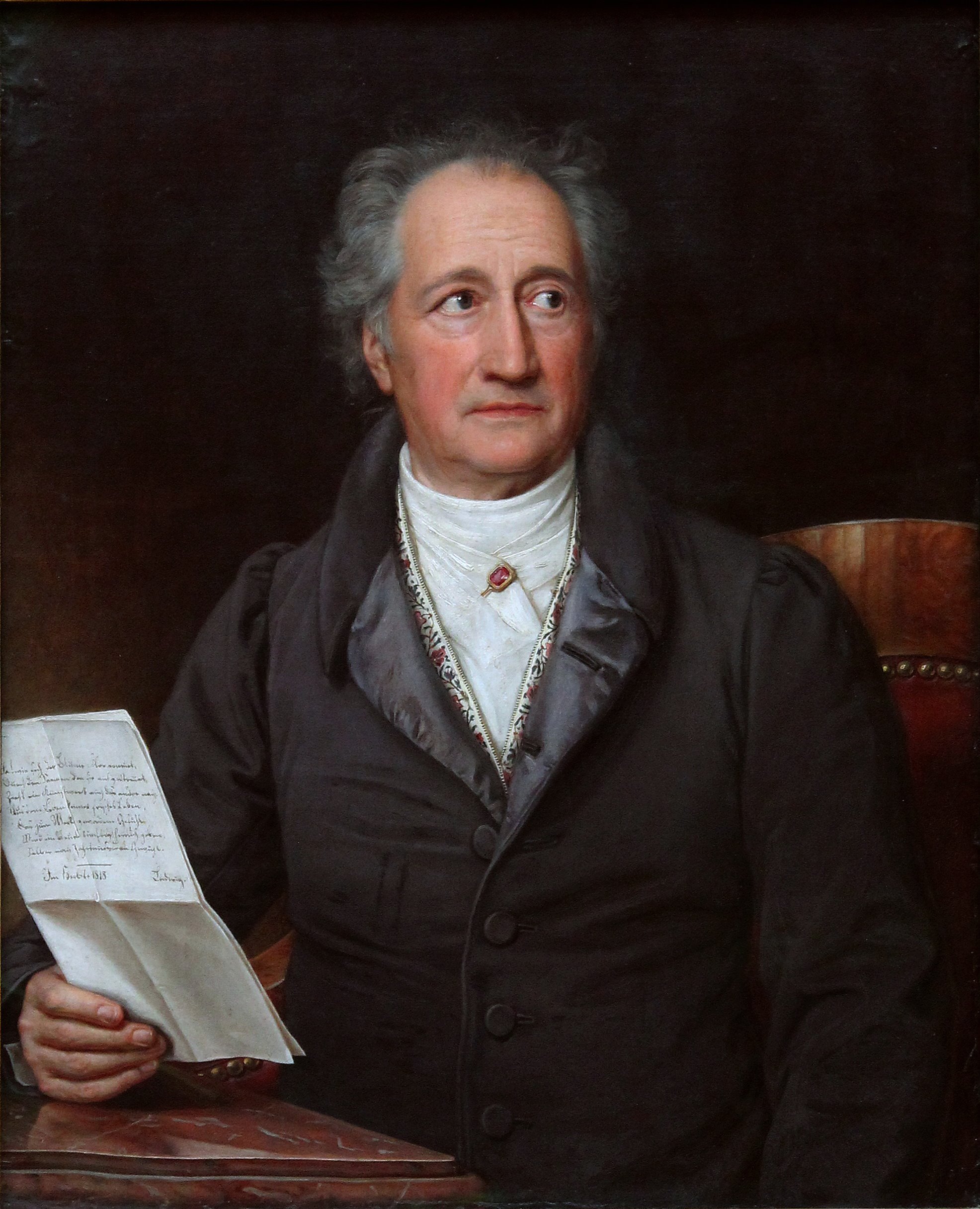
Johann Wolfgang von Goethe

Goethe is a great love poet. ‘Welcome and Farewell’ (‘Willkommen und Abschied‘) has a man approaching on horseback (Greening does not motorise on this occasion) through a moonlit landscape and the lover is spied at last: ‘how / I’d dreamt of (not deserved) all this’. The moment of union passes unspoken between stanzas three and four. As if instantaneously, now ‘the sun had risen’ and the parting must take place: ‘And yet, to have been loved – to love, / ye gods, such utter happiness’. It’s curious that Greening retains the rather archaic ‘ye gods’. One still hears the phrase, of course, but with more irony than I would have imagined here. The fifth of Goethe’s ‘Roman Elegies’ is a fabulous erotic piece. Written during the poet’s travels to Italy in the late 1780s, the narrator is studying classical culture by day and his female lover’s body by night. The latter nourishes the former: ‘I find I appreciate marble all the better for it, / and see with a feeling eye, feel with a seeing hand’. As he goes on, ‘compare and contrast’, I find Greening a little cool here. There is a selection of translations by D M Black (Love as Landscape Painter, from FRAS Publications in 2006) which generates more heat:

Yet how is it not learning, to scan that delectable bosom,

  Or when I slither my hands pleasantly over her hips?

Then I understand marble; then I discover connections,

  See with a feeling eye, feel with a seeing hand.

Faustus (by Eugene Delacroix)

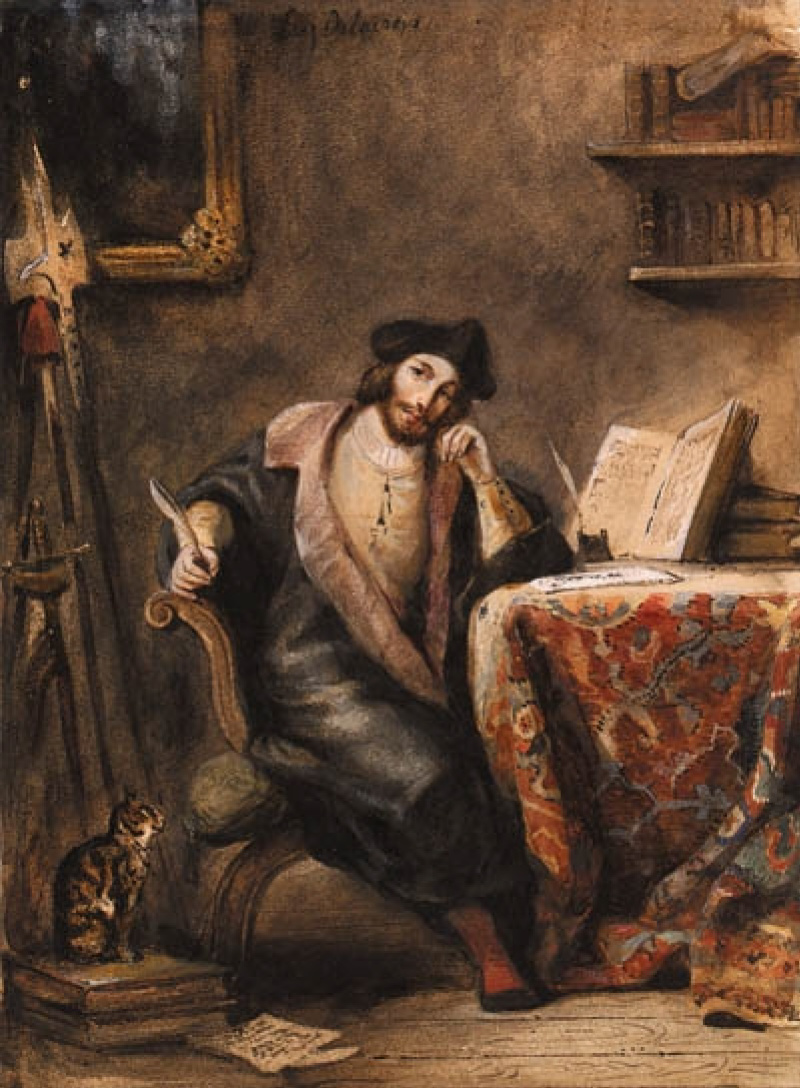
Goethe’s Faust is represented here by the scholar’s opening speech to Part One (versioned, as it were, by Christopher Marlowe in the opening soliloquy of his Doctor Faustus). Greening excels in the handling of rhyme and line length, even compared to David Constantine’s 2005 Penguin translation. Perhaps most impressive of all is the sonnet ‘Nature and Art’ (‘Natur und Kunst’). Greening has the motor car in mind again in his updating of Goethe’s exploration of how the artist must labour incessantly to achieve the preparedness, the readiness to respond to Nature, to what is natural. Reading these lines, you feel Greening is translating as a skilled and experienced artist himself, triumphantly bringing a poem written in 1800 bang up to date:

It’s just a case of working long and late.

So once we’ve spent, let’s say, ten thousand hours

on steering, footwork, shifting through the gears,

it may be then some natural move feels right.

x

Creative though you be, you’ll strive in vain

to reach perfection if you’ve no technique,

however wired and woke your gifts may be.

x

You want a masterpiece? You’ll need to strain

those sinews, set your limits, drill and hack.

The rules are all we have to set us free.

For anyone yet to make the leap into Goethe-world, this little book is a terrific way into the great German writer’s work and such a reader will find Greening’s Introduction and his prefatory remarks to each of the chosen poems very helpful indeed. I recommend this collection.

Charlie Louth’s Rilke + new Rilke Translations (Part II)

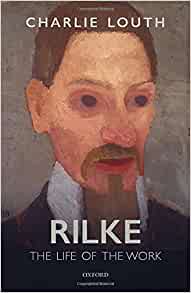
This is the second and final part of an uncut version of my recent review of Charlie Louth’s excellent book on Rilke, Rilke: the Life of the Work (OUP, 2020). A shorter version of this review appeared in the latest Agenda magazine, ‘Altered Distances’ (Vol 54, Nos. 1/2). Many thanks to the editor, Patricia McCarthy for asking me to write it. As I mentioned last week, much of my time through lockdown has been taken up with translation. One of these projects is a commission by Pushkin Press to complete a new selection and translation of the work of Rainer Maria Rilke, scheduled to appear in 2023. Some of you will be aware of my earlier published versions of the Duino Elegies and the Sonnets to Orpheus (both available from Enitharmon Press). This new project will contain selections from those sequences and a significant number of earlier poems – from the Book of Hours, the Book of Images and the New Poems. I am including a few of my new translations in these two posts (or at least these are reasonably progressed drafts – just as with original work, translations need to sit a drawer for a while before they can be more fairly judged)

Part II

Louth argues Rilke’s journey towards the poetics of the New Poems began in the period he resided in the artists’ community in Germany at Worpswede. A lot of his thinking there concerned images of man and landscape. For the majority of the time, humans and nature live “side-by-side with hardly any knowledge of one another” and it is in the ‘as if’ of the work of art that they can be brought closer, into a more conscious relation. These are the thoughts that preoccupied Rilke when he moved, in 1902, to Paris, in part to observe Rodin at work. Louth is right that the poet’s move towards a poetry that cultivated the “earthly”, the world of “things”, was already well under way. He then looked to Rodin’s methods for “dependability, concentration and craft” and in a poem like ‘The Panther’ the fruits of more compactness of diction, a more supple articulation of syntax, a lexis of more precise, everyday words and an increased emphasis on the visual are clearly seen.

Here is my translation of ‘The Panther’:

The Panther

in the Jardin des Plantes, Paris

With this pacing the bars’ back and forth, his gaze

grows so weary there is nothing it can hold.

To him, there appears to be a thousand bars

and beyond the thousand bars, no world.

x

The lithe, smooth steps of his powerful gait

(in the narrowest of circles he spins round)

is like a dance of power around a point

at which an immense will stands, stunned.

x

In moments only does the pupil’s curtain

sway noiselessly open – an image enters

and drives through the mute tension of each limb

into the heart, where it disappears.

Under Rodin’s influence, Rilke became a more self-conscious labourer in language. These are the poems that are held up as examples of ‘Kunst-Ding’ (art-thing). In August 1903, Rilke wrote to Lou: “The thing is definite, the art-thing must be even more definite; taken out of the realm of chance, removed from every unclarity, relieved of time and given to space’.

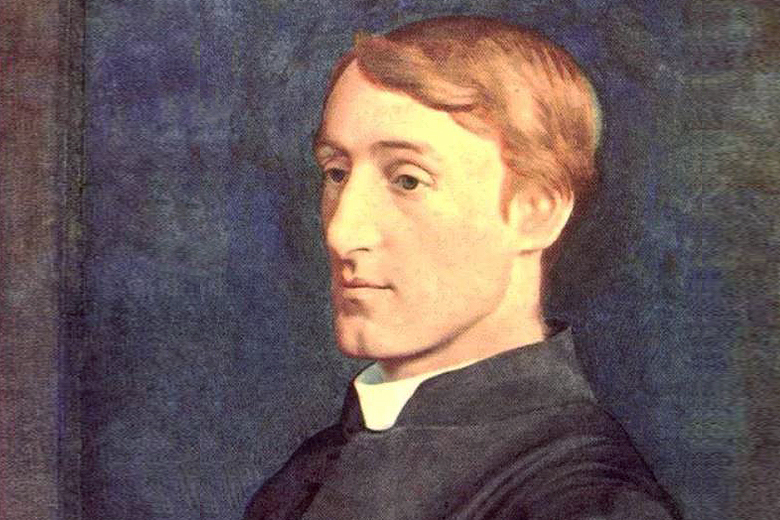
Gerard Manley Hopkins

Louth often draws comparisons between Rilke’s work and poets from the English language poetry sphere. Here he compares Hopkins’ ideas of ‘inscape’ and ‘instress’ as “akin” to Rilke’s ideas of object/form and its impact on the observing individual. Certainly, with Hopkins, Rilke valorises the moment of perception, the process of looking. This, from a letter to Clara Rilke in 1907, is worth quoting at length: “Looking is such a wonderful thing, and we know so little about it; with it, we are turned completely outwards, but precisely, when we are most so turned, things seem to go on inside us that have been longingly waiting not to be observed, and while, intact and curiously anonymous, they take place inside us, without us, their meaning grows in the object outside [. . .] without ourselves getting anywhere near it, grasping it only very faintly, from a distance, under the sign of a thing that was foreign to us and the next moment is estranged once more”. These are little contacts with God, transient though they may be. The way we are to put our conscious self into our gaze and let it stream out of us, so enabling us to ‘receive’ the object without, recalls the idea of kenosis. Louth’s account of it is cool and clear: “the whole process can be thought of as two parabolas intersecting at their tips, the mind going out as the gaze summons the object into its focus”. He goes on to say that the details of the process may seem mystical, or indeed oddly physical, but the point is that the precise perception and discovery of things is also self-discovery, suggesting that the New Poems are not objective (as is often blithely observed) and not subjective either, but complicatedly both at once.

T E Hulme

Another of Louth’s interesting contextualisations is the link he makes between Rilke’s practice and the Imagists in general and, in particular, T.E. Hulme’s essay from around 1911, ‘Romanticism and Classicism’. There, Hulme also associates poetry with “an extraordinary interest in a thing”, described with an accuracy that avoids “falling into the conventional curves of ingrained technique [. . .] from gliding through an abstract process”. For Hulme, the artist is one who simply can’t bear the idea of [. . .] ‘approximately’”; hence one who always struggles to get “the exact curve of the thing”. Rilke’s New Poems are on the same trail, though he complicated and extended it with what he learned about ‘surface’ from Rodin. Gazing at the sculptor’s work, Rilke began to understand that surface “consisted of infinitely many encounters of the light with the thing [. . .] There is no point on the surface of a statue that is dead, no point isolated from the others, not participating in the total effect and life of the whole”. In a Rodin sculpture – and this is what he wished for his poetry – Rilke saw that “[n]o part of the body was insignificant or slight: it lived”. Yet such an interconnected, encompassing vision is inevitably transient. Louth brilliantly concludes that the New Poems are “things which record moments that are over, at the very least strongly imply their loss”, hence revising the accepted reading of this work: “the collection is haunted by things rather than full of them”.

Here’s an example of close observation not a thing but an individual:

Going Blind

There she sat with the others, taking tea.

And beside the others, I felt, at first,

that she held out her cup differently.

At one point she smiled. It almost hurt.

x

And when at last they rose from their chairs

slowly, still talking, as it happened

(laughing and chatting), moving on elsewhere,

I noticed her again. She lagged behind,

x

reticent, more like a woman compelled

to sing in front of a crowd of people.

In her shining eyes, the light seemed to fall

as if from outside, reflected in a pool.

x

She followed on, slowly, biding her time,

as if something more had to be overcome,

and yet, as if following that translation,

she would never again walk, rather fly.

X

Louth’s chapters 7 and 8 are both titled ‘The Interim’, tracing Rilke’s life and work from 1914 to 1922. After the drafts of the first and second Duino Elegies in 1912, the following 10 years are often seen as a period of failure and difficulty, of writer’s block. Louth argues otherwise. Though Rilke felt it was a period of drought (and discussed it as such often in his letters), poems were being written (over 150 in 1913/4) and the poet seems to be deliberately marking a break in his writing career in order to spur himself on to greater experimentation. The interim is filled with reading and much translation work too. Also, the orientation toward the visual arts which was such an important aspect of the New Poems grows less strong and is replaced (in a poem like ‘Wendung’ in 1914) with ‘heart-work’ (‘Herz-Werk’). Louth explains, this “implies a stronger recognition that the qualities of things depend on being noticed, received and remembered and that these are processes which have to do with time”.

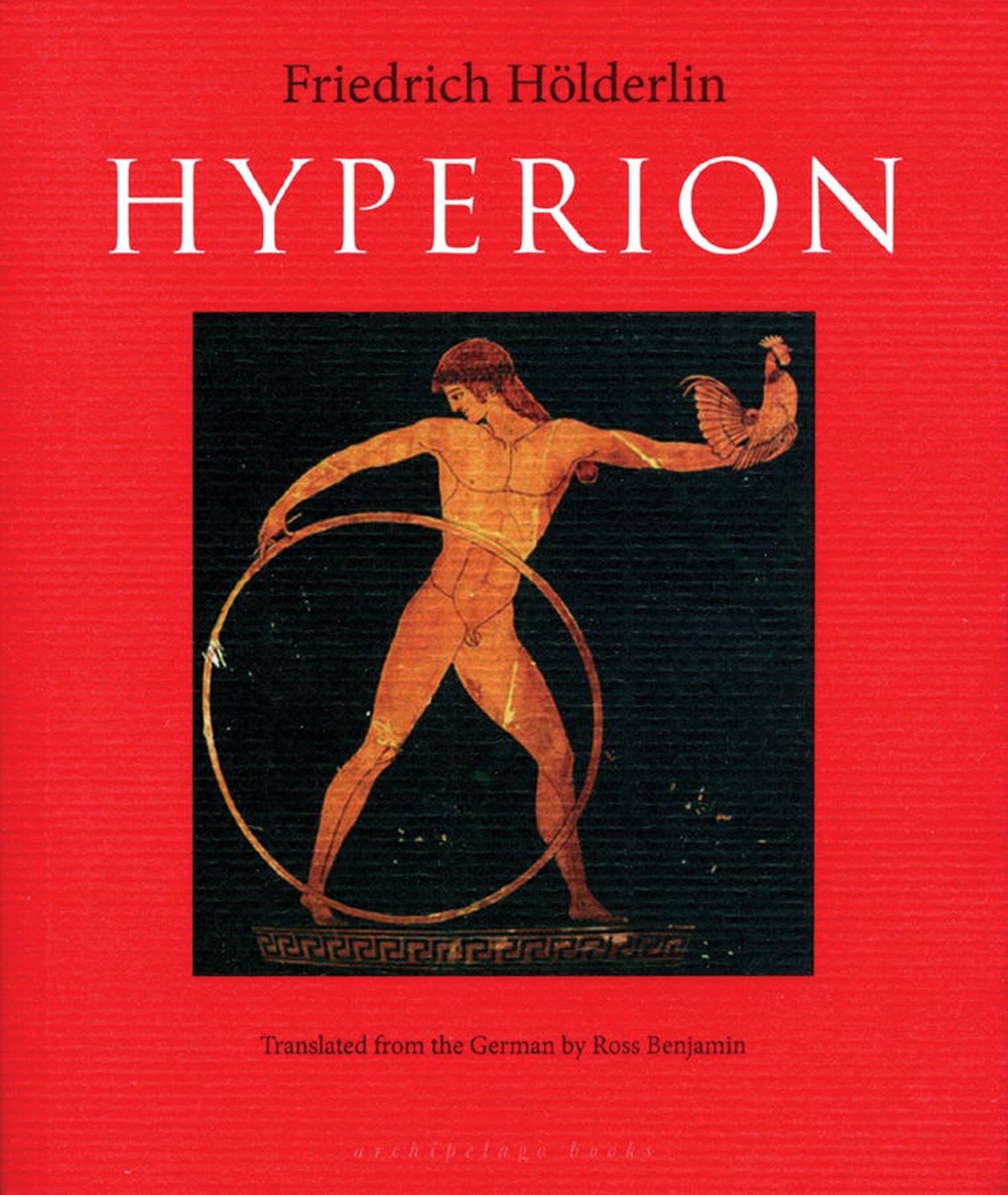
It was also his reading of Hölderlin that spurred Rilke forwards, both the poems and the novel Hyperion (1797/99). The New Poems are haunted by transience (as is the great ‘Requiem’ to Paula Modersohn-Becker (1909)), but Rilke comes to see poetry’s temporal nature not as something to be lamented and combated, but as its strength, what “allows it to enter into and elucidate the movement of life”. Years later, the unfolding of the Duino Elegies is just this: an initial lamentation at the transience of life, turning slowly towards celebration of that fact. Rilke learned from Hölderlin’s abrupt style, his winding, fractured or abbreviated syntax. The poem ‘To Hölderlin’ (1914) praises him and sets out a programme for Rilke himself. This is Louth’s translation:

To linger, even on what we know best,

is not for us; out of the fulfilled

pictures the spirit pitches to ones now to be filled; lakes

are only in eternity. Here falling is

the best we can do. Out of a feeling we’ve learnt,

falling onwards into one we divine, further.

Louth argues, “What Rilke apprehends in Hölderlin and works into the form of his poem to him, is movement itself, the poem as a passage ‘felt in departures’. It is ‘Herz-Werk’ in that it traces the flexion of time”.

Rilke’s last house, Muzot

The long-nurtured fruits of these lessons in poetic diction, syntax and a vision of life are what burst from Rilke years later at Muzot. Much has been written about the inspired “hurricane of the heart and mind” that resulted in the completion of both the Duino Elegies and the Sonnets to Orpheus in February 1922. Some may find Louth’s 100 pages on the Elegies – a systematic ‘going through’ each poem in detail – to be at risk of losing the uplift and often dizzying experience that readers can have with this text which Rilke called a “great white sail”. But Louth’s forensic approach is not a dismantling of the poems, rather “a way of inhabiting them”. The poems are not elegies in any formal or traditional sense but about the kind of loss that had always been Rilke’s subject: the necessary loss of our necessary preconceptions about the world so that we can (if only passingly) experience its ultimate nature as a wholeness of being. The angels who make brief appearances stand for all that we are not (but might briefly glimpse). The lack of self-consciousness Rilke perceives in animals – their capacity to see the Open (“das Offene”) without reflection – proves an alternative way of critiquing the way we live. The acrobats in the fifth poem (the last to be completed) serve to suggest that life itself is “a questionable kind of performance, a contrivance, endlessly failing and having to be begun again”. Once this is felt in the blood and we distance ourselves from a world view in which “theories, the conception of things, have come to dominate over the things themselves”, then (as the seventh Elegy proclaims) “Just being here is glorious” (‘Hiersein ist herrlich’).

The only chance of preserving such glory is (following Hölderlin) to ensure no particular interpretation of experience becomes “the fixed and solely valid one”. The language of poetry becomes a way of “hooking ourselves to things, tangling ourselves in them” while retaining a sense of inevitable provisionality. So poetry reflects the nature of a life “improvised into a makeshift whole which acknowledges the complexity of life while also showing how it can still be experienced as a rich, meaningful practice”. Louth’s methodical tracking through the poems is an effective approach because the work itself is “extensive, various, not linear in progression, and often hard to construe, to read it is also to live in it, and the kind of reading required—to be willing to take things on trust, to allow rhythms to inform arguments, to carry unresolved moments, to connect disparate images into promising patterns—is akin to the ways we have of getting through life itself”.

Likewise, the Orphic song of the Sonnets also “comes and goes” and the self-contained, episodic, yet intricately interconnected form Rilke chooses (over 55 sonnets) yields what is Rilke’s greatest work. Louth takes a thematic approach, looking at Poetry and Technology, Sense and the Senses as well as Vera Oukama Knoop (the putative addressee of the Sonnets) and the marvellously inventive use Rilke makes of the sonnet form. This works less well because these poems are far more light-footed, less “hard to construe” than the Elegies. They require less explication and dance away from the forensic. But Louth knows as much: “The language of the [Sonnets] has two particularly striking aspects. One is its allusiveness and elusiveness, a curious looseness and lightness of reference, as if the words have become detached from their normal task of signifying and approach pure form [. . .] The other is the way the language grows out of itself, unfolding genetically and responding to its own promptings, as if it were listening to itself”.

Interesting though it is to see Louth complete his grand project with a discussion of the many French poems that Rilke turned to after 1922, there is once more a sense of trying to pin down the ineffable. Many poems were responses to the Vallais countryside, a place where the restless poet at last felt more rooted. But the lightness and playfulness of the poetry makes it hard to evaluate. Brief poems often aspire to the condition of haiku, or in Louth’s words, “almost avoid being writing at all”. Philippe Jaccottet in 1970, found in them a delicacy, preciosity, even a kind of soppiness. Many poems do have the Sonnets’ light-footedness and grace, yet often without their intensity and reach. Louth’s final judgement is suitably delicate: “There is a definite sense of Rilke taking his foot off the pedal in his last phase, productive though it was, but not as mere relaxation: as a deliberate exploring of unburdened existence”. So there is a dwelling in simple things, through simple language which can hardly be begrudged a man approaching his death from leukaemia in December 1926. His last published poem listens to and ventures out with the hunters in the Vallais, envying them their energy and vitality, as the dying poet (still fascinated by paradox) describes them as “pressing up close to what’s living”. This last phrase is a fine formulation for precisely what Rilke tries and succeeds in doing in so many of his poems.