Review of ‘My Secret Life’ by Krisztina Tóth, tr. George Szirtes

This review first appeared in Acumen Poetry Magazine in the autumn of 2025. Many thanks to the reviews editor, Andrew Geary, for commissioning it.

As a female writer, talented in a variety of genres, living in a difficult political climate, Hungarian born Krisztina Tóth shares a good deal with Huch (my review of Tim Adès translation of Huch’s final book was posted here). Coming to the fore around the revolutionary year, 1989, Tóth has written poetry, children’s books, fiction, drama and musicals. My Secret Life (Bloodaxe Books, 2025) is her first sole author publication in English, ably translated and introduced by George Szirtes, presenting an overview of her poetry from 2001 to the present. Szirtes tells us that Tóth is no longer living in Hungary because of unbearable frictions with the Orbán regime. Like Huch she is drawn to poetry as personal expression, often to the formal elements of the art, both perhaps offering a redoubt against values she finds unacceptable. If there is little redemption to be found in her poems, there is some consolation to be had through the twin imperatives she expresses, to remain compassionate and to persist in trying to articulate human experience. Neither goal is easy.

Szirtes argues Tóth’s style is conversational, plain, precise, offering ‘a kind of kitchen-sink realism’. The personal also features and in these self-selected poems we get glimpses of a barely affectionate mother, a father who dies young, children, lovers, and a difficult grandmother. It’s not clear if these are genuinely autobiographical portraits and, anyway, they are most often absorbed into Tóth’s emblematic writing. An example would be ‘Barrier’ in which a couple are crossing a bridge, seemingly discussing ending their relationship. With the river below and trams thundering past, ‘the pavement was juddering’ and the poem is really about this instability in relationships as much as the (social/political) world, concluding there were ‘certain matters that couldn’t be finalised’. Such uncertainty drives roots even into the self: ‘I’m somebody else today or simply elsewhere’ (‘Send me a Smile’). Tóth uses the image of the ‘professional tourist’ in one of the major poems included here. With little background given, the narrator visits town after town, apparently hoping to be joined by a ‘you’ who never appears. Obviously a ‘stranger’, she wanders aimlessly, haplessly, buys a few things, the poem inconclusively ending with an image of a used toothbrush, ‘like an angry old punk, / its face turned to the tiles, / its white bristles stiff with paste’ (‘Tourist’).

Alienation, expressed through a profound sense of homelessness, is Tóth’s real subject. With the irony turned up to 11, the poem ‘Homeward’ ends quizzically, ‘But where’s home?’ In such a world view, the ability to remain compassionate is important to the poet, however hard it may be. The painfully brilliant ‘Dog’ presents a couple driving at night, seeing a badly injured dog at the roadside, and the woman wants the man to stop. I think they do, but the poem’s focus is on the powerful impetus to help versus the powerful sense that whatever can be done will prove futile. More weirdly, in ‘Duration’, the narrator finds a Mermaid Barbie doll stuck in the ground outside her flat. The childhood associations, the vulnerability of the frail figure, seem to compel action, but ‘what’?

Should I pull the thing out of the ground so it

sheds earth every night, because however often

we wash it, or wrap it in a tissue or leave it

on the radiator we’ll only have to bin it in the end?

Tóth’s wry, highly original lament, on deciding not to buy a universal plug adaptor, perhaps suggests what is being wished for in many of these poems. It is a way for a feeling human being to feel more at home in a world of suffering: ‘how to adapt the world / and its gizmos to the pounding of so many hearts’.

‘Song of the Secret Life’ pulls together many of these strands with the life as much the inner life of the self (the heart) as the life kept hidden in an unsympathetic personal or political environment. In the case of an artist, it is also the creative life, and as much ‘an utter mystery, a puzzle undone’, to the writer herself. But in order ‘to survive it needs telling’ and – like Huch’s creative figure in ‘The Poet’ – even if current conditions do not welcome such efforts, the individual must continue to write, to use language, to affirm the validity of the individual viewpoint. This is the burden of the magnificently hypnotic long concluding poem, ‘Rainy Summer’, in which the long-lined, rhymed couplets, express an unrelenting haunting of the speaker by ‘a sentence’. The latter phrase opens many of the lines, and it goes talking, throbbing, pulsing, dancing and rushing through the poem itself, though as much as the sentence might prove to be some sort of ‘home’ we are never told what it expresses. This is largely because it is a ‘rhythmic unit without words’, it is ‘the bodiless body of language’, it is the ‘speech that knows no speech’, it is ‘a sentence that contained you, gone yet here, some of each’.

Szirtes’ emphasis on the political backdrop to Tóth’s poems might lead us to expect more obvious political engagement and subject matter. That’s not what we get here, though no doubt her surroundings have determined many aspects of the work. Hers is a profound voice, finding in the menace, alienation, and instability around her emblems of more universally shared experiences of rootlessness, troubled self-questioning, of sensibilities that find the world as it is a painful and difficult place to navigate, of the pull of pity and compassion versus an overwhelming sense of the futility of individual action. ‘Sleeper’ addresses what might be a transmigrating soul or spirit, a ‘little pulse box’, asking question after question about where it has been, what it has seen, the mysterious passage from life to death, or vice versa: ‘what’s it like to step into such cold, unlit fiefdoms, / does anything remain’? Tóth’s poems ask such questions and like the best modern poems offer us equivocal answers only, consolatory but not redemptive.

Here is the whole of one poem included here:

Where – Kristina Toth, tr. George Szirtes

Not there, on the tight bend of the paved highway,

where cars are occasionally prone to skidding,

chiefly in winter, though no one dies there,

not there where streets are greener and leafier

where lawns are mowed and there’s a dog in the garden

and the head of the family gets home late at night,

nor there in front of the school where every morning

a man is waiting regular as clockwork,

nor inside the gates on the concrete playground,

nor in the neglected, dehydrated meadow

where a discarded dog-end hits the ground and glows

for a moment, it doesn’t begin there

but at the edge of the forest, in rotting humus

where somebody once was buried alive,

that’s where the poem begins.
‘From Palette to Pen’ – a bit more ekphrasis

My blog post a couple of weeks ago on ekphrastic poems (ie. poems stimulated by visual art) proved to be one of the most popular I’ve ever written. This was in part the ‘how to’ aspect of the blog. In preparing to run a workshop at the Holburne Museum in Bath in February, 2017, I’d been reading a wide variety of poems derived in some fashion from the poet’s encounter with visual art and I tried to categorise the various approaches. I came up with 14: 

  1. Describe – and do no more.
  2. Describe but imagine beyond the frame
  3. Describe but incorporate researched materials
  4. Make Main Figure Speak – the most common approach
  5. Make Minor Figure/s Speak
  6. Make Objects Speak
  7. Make the Artist Speak
  8. Interrogation of the Artist
  9. Interrogation of illustrated Figure/s
  10. Interrogation of Yourself
  11. An Account of Your Encounter with the Art
  12. An Account of Gallery Visitors’ Experience
  13. An Account of Others’ Experience
  14. Come at a Tangent – the ekphrastic experience as after-thought or illustration

From-Palette-to-Pen-185x300

While at the Holburne Museum I was given their recent anthology of ekphrastic poems, From Palette to Pen, edited by Frances-Anne King in 2016. It contains 20 poems stimulated by art objects in the Holburne and as well as recommending it as a great resource for ekphrastic writing, I thought I’d use it to test my earlier analysis of the form to see if it held water.

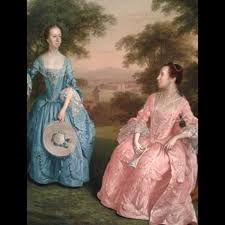
It did pretty well. It goes without saying that all the poems engaged to some degree in method 1 – description of the art object itself. But beyond that, by far the commonest approach was method 4 – making the main figure speak. This was adopted by Anna-May Laugher, Claire Dyer, Carrie Etter, Frances-Anne King, Pascale Petit, Linda Saunders and Lesley Saunders. Petit manages to make Adam speak, remembering his naming of the animals; Claire Dyer makes Rosamund Sargent speak from her own portrait by Allan Ramsay; Lesley Saunders makes one of the sisters, Alicia and Jane Clarke, speak and so betray their “little sisterly difficulties”.

imgres

Another common approach was my method 8, an interrogation of the artist (without getting the artist to actually speak for themselves (method 7)). Jenny Lewis’ poem on a 17th century Rosewater basin began in this way, inquiring “What’s on his mind as he hammers / the silver, makes light flower”. Her poem goes on to incorporate some obvious research into the object too (my method 3) which takes her poem away from a narrow view into the colonial world of “London, the world, New England” in which it was made. David Hale, writing about Jan Asselyn’s ‘Landscape with Drover’ also imagines and interogates the artist’s approach, gazing at his own picture in process:

Ah, the south. He feels the heat of it

on his face and hands, smells dust, dung

and crushed thyme as he sips his coffee,

wonders again what the bull is looking at –

where time and life have gone.

imgres

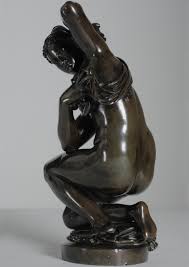
I’d be tempted to widen this category of approach – or even introduce a new one – because several poems in the anthology interrogate the artist specifically about the artistic methods used to create the art object. Sue Boyle does this in detail about the making of Antonio Susini’s bronze figure, ‘Crouching Venus’: “Coated in plaster, lowered into fire, / she must be negated, melted from her mould”. There are also elements of this approach in the poems by Dawn Gorman and Phillip Gross, the latter dwelling as much on the making of a Beadwork Basket as on its illustrations of Charles II and Catherine of Braganza. Gill Learner’s poem also looks over the artist’s shoulder as he glazes a 15th century earthenware dish.

My method 9 – interrogating or engaging with one of the figures in the art work – was used by Caroline Heaton, Wendy Klein and Tim Liardet. Klein and Liardet both directly address figures in the image (for example, “Someone chose the best for you, Mary Bourchier” and “You let the baby grip his fingers”). Heaton’s engagement with Plura’s marble statue of ‘Diana and Endymion’ is a bit less direct, using the third person (rather than a second person address) to think herself into Diana’s state of mind:

Confined to the island

of the self, she laments

the chill of her lunar circuit,

its lonely eminence.

imgres

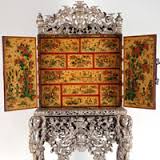
Rosie Jackson approached a piece of furniture, ‘The Witcombe Cabinet’, via a brief description of it but quickly developed thoughts about her own mother and indeed herself which I’d take to be my method 10 – using the art object to interrogate or enquire into one’s own life: “”My mother would have loved it here, / the roped off beauty […] But I ask questions of locked drawers”.

imgres

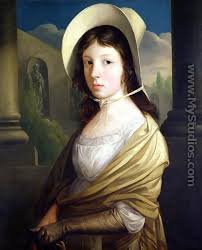
I think Claire Williamson mostly used method 3 – describe and make use of researched materials – in her poem on Thomas Barker’s painting of ‘Priscilla Jones’. The relationship between the sitter and the artist is the focus here, their romantic engagement and subsequent “passionless” marriage. In fact, I’ve not checked details of the painting/poem and I suppose it maybe that Williamson is making all this up – in which case she’s adopting method 2 – describe and imagine beyond the frame as George Szirtes does in anticipating the adult life of the boy in ‘Garton Orme at the Spinet’.

So the methods used in this anthology are fairly limited – seven of the fourteen I proposed. Those not adopted here are several varieties of ventriloquism (getting minor figures or objects to speak up; getting the artists to speak directly), the kinds of poem that more narratively describe encounters with art objects in a gallery or other location and a more tangential approach.

imgres

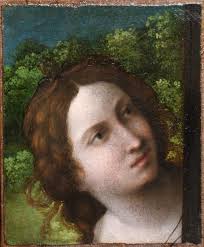
Finally, Lawrence Sail’s poem describes a Mantuan School ‘Female Head’ and is probably the ‘purest’ ekphrastic poem in the anthology in that it does little more than describe the image – method 1. However, Sail addresses the woman imaged as “Our lady of the liminal” and as such he breaches the borders (“offstage”) a fair bit, beginning to imagine beyond the frame to some degree (method 2). It’s a lovely poem and deserves quoting in full:

Female Head, about 1525

Our lady of the liminal –

witness at her back the margins of

the unruly forest,

and the focus of all her attention

being offstage.


But the heart of the story is locked

in the ghost of her gaze – its candour,

the early signs

of grief, a drift to the verge

where hope wavers.


And everywhere, time on the make –

in the darkening turquoise of the sky,

the slow swell

of the trees, the craquelure moving up

to infect her soft features.

Forward First Collections Reviewed – #1 Mona Arshi

This is the first in a series of reviews I will post over the next two months of the 5 collections chosen for the 2015 Forward Prizes Felix Dennis award for best First Collection. The £5000 prize will be decided on 28th September. The shortlist is:

Mona Arshi – Small Hands (Liverpool University Press, Pavilion Poetry) reviewed here;
Sarah Howe – Loop of Jade (Chatto & Windus); reviewed here;
Andrew McMillan – physical (Cape Poetry); reviewed here;
Matthew Siegel – Blood Work (CB Editions) reviewed here;
Karen McCarthy Woolf – An Aviary of Small Birds (Carcanet) reviewed here.

************

Mona Arshi – Small Hands (Liverpool University Press, Pavilion Poetry) Mona Arshi’s webpage

imgres

Despite the ironic lack of capaciousness implied by its title, Small Hands is a brimming miscellany of poems. Many of them suggest interesting growing points for the future, but Sathnam Sanghera’s claim that Arshi is “Britain’s most promising writer” and Moniza Alvi’s talk of “genius” is premature and liable to drag the reputation of blurb-writing even deeper into the mire. A trying-on of various recognisable styles or voices is expected of any first book, compiled as they usually are over years awaiting a publisher’s call, but Arshi’s arrival at a full collection has been swift. Publicity suggests she only turned from a profession in law to poetry around 2008. It’s for this reason that her influences (Alvi, Petit and Khalvati most obviously, perhaps Emily Berry) are so clear.

Two early poems in the book allude to the idea of catastrophe. ‘Practising Your Skills’ faces an accusation about a “tendency to catastrophise everything” and this also emerges in ‘Bad Day in the Office’ where the narrator is trying not to regard rainfall as “catastrophic”. These instances may be ‘character’ points but such a ramping or ratchetting up of the ordinary is often evident elsewhere in the book and tends to caricature, a dramatic arc-lighting, unexpected (literally cata-strophic) links between disparate ideas or images and hence a love of listing: in other words, forms of surrealism. This is something Arshi has spoken about, regarding and admiring poetry as a discourse utterly counter to the kind of language-use she once employed in the law. So ‘The Lion’ is out of Angela Carter’s The Bloody Chamber via Pascale Petit and evokes a strange relationship between a woman and an older man. It’s a powerfully disturbing poem because the male figure is accorded such power, language, sensuality, wisdom and a sort of droit de seigneur over the female narrator who seems disinclined to question the set up. As with several of the quasi-pornographic pieces by Sam Riviere, the critical question here is where lies the irony? Hard to tell, especially as this is the book’s opener.

imgres

Arshi’s somewhat whimsical surrealism is better seen in her portraits of female figures alone. ‘Cousin Migrant’ is a visitant “from the skies” as well as a paradox (“her arms are thin as margins yet she can lift my children / with ease”). The Cousin’s transgressive – or more accurately, indefinable qualities – are conveyed clearly, humourously, the narrator, in contrast, is nothing more than “a storm in a tea-cup”. The confines or otherwise of female lives are treated in more conventional poetic form in the object and memory piece, ‘The Gold Bangles’, evoked as a cultural inheritance of value though the narrator prefers to think of their owner’s wrists before the gift, “still unadorned and naked”. As here, there are several other poems that draw on Arshi’s background, born to Punjabi Sikh parents in West London. ‘Jesus Saves’ is also a more conventional poem of childhood memory, on this occasion hearing a racist speaker in 1979, on Hounslow High Street, “long after Enoch”. But elsewhere, Arshi prefers to construct enigmatic poems, hovering just beyond the edge of anything one might regard as a clear and present body of evidence. This is especially so in what seem to be ‘relationship’ poems like ‘Entomological Specimens’, ‘Practising Your Skills’ or ‘Insomniac’ which cryptically advises: “Never marry an insomniac. You will have / to mind yourself”.

At the centre of the book are several poems about the tragic loss of Arshi’s brother, Deepak, at the age of 41. These poems are moving and suggest contrasting aspects of her work: deep levels of tact and restraint. Moving through the experiences of learning of his death and the family’s adjustment to his loss in slant poems about a phone call, practical details of the mourning process, officialdom, the family garden, the urn, the loss still feels raw and unresolved and there will be more poems to come on this topic I’m sure.

Mona Arshi

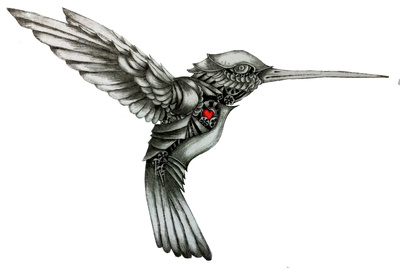
The other prominent and enjoyable aspect of Arshi’s work is its sensuality and awareness of the body; this is a collection full of hands, feet, mouths, lips, eyes, wrists, hair and, ubiquitously, skin. In ‘Lost Poem’ she talks of “taking in language / through my skin” and there is a clear project developing here in that, at their best, these poems unfold through a language of the senses rather than the intellect. Elsewhere, Arshi writes of wanting to “sequester” and “foreignate” words, de-familiarising them, wresting them away from conventional denotation. I first heard her read aloud when she won the Magma Poetry Competition in 2011 with the ghazal-like poem, ‘Hummingbird’, here tucked away at the back of the book. I now read that poem against ‘The Lion’ and this is the one I prefer for its originality. The narrative voice (undefined) addresses the ‘you’ which is mostly the hummingbird itself, though as with ‘The Lion’ the creature is also interchangeably / metaphorically human. The tender, persuasive imperatives almost immediately carry an erotic charge, though where the “fingers” probe and slip is mostly into “spaces”, lacunae. But the hummingbird figure has none of the over-bearing masculinity of the lion; we are told it is capable of “curing”, dissolving, even pronouncing the speaker. But the speaker here is not as passive and compliant as in the earlier poem. Though she will allow him/her to open the “bone-zip of my spine”, the insistence of her voice gives her an active role in the relationship. The hummingbird is invited to “anoint” the speaker, a significant contrast to the shallowness of the lion’s crude “undressing”. (Arshi discusses this poem on the Magma website here)

black-n-white-hummingbird-tattoo-design

George Szirtes’ rather more restrained blurb observations suggest that he reads in Arshi’s work an “erotics of the spirit”. Without doubt, ‘The Hummingbird’ is a sexy, enigmatic, yet precisely expressed poem that is going to repay our re-reading of it. And if that is not the case with many other poems in Small Hands we should not be surprised. Arshi combines a liking for obliqueness, sometimes even coolness, with a desire to push what language can do and a willingness to experiment with form. Her cultural background is relatively unexplored here, yet promises much if that is the way she wishes to go. Not a winner of the 2015 Forward First Book award for me, but an intriguing writer, potentially a unique voice if she can achieve the right distance between herself and her powerful formative influences.