Forward First Collections Reviewed #5 – Sarah Howe

Stop Press January 2016: Sarah Howe’s collection has just become the first ‘first collection’ winner of the TS Eliot prize. A fantastic achievement. What follows is the review I wrote of the book during the summer of 2015.

This is the fifth and last in the series of reviews I have been posting over the last two months of the 5 collections chosen for the 2015 Forward Prizes Felix Dennis award for best First Collection. The £5000 prize will be decided on 28th September. The shortlist is:

Mona Arshi – Small Hands (Liverpool University Press, Pavilion Poetry) reviewed here;
Sarah Howe – Loop of Jade (Chatto & Windus); reviewed here;
Andrew McMillan – physical (Cape Poetry); reviewed here;
Matthew Siegel – Blood Work (CB Editions) reviewed here;
Karen McCarthy Woolf – An Aviary of Small Birds (Carcanet) reviewed here.

Sarah Howe – Loop of Jade (Chatto & Windus); author’s website.

imgres

Howe reading at the Southbank Centre:

Sarah Howe’s first full collection is packed with journeys, stories, bits of language, calligraphy, mothers and daughters – but mostly it should be admired for its readiness to experiment. The concluding poem, ‘Yangtze’, might be read as an evocation of the Daoist belief in the primacy of fluidity and the watercourse way. A moon glimmers uncertainly on water’s surfaces, a river flows, a diving bird vanishes into it, fishermen’s nets catch on something submerged, a bridge remains only “half-built”, a travelling boat merely “points” to its destination. What remains hidden and inarticulate predominates; as the Daodejing argues, our life’s journey often runs against the current because we mostly lack the proper perspective to see the world is really one, not the parts we think we know. Those 81 wonderful ancient Chinese poems also argue that our way forward is really backwards, to recover an understanding of what has always been: that sense of unity of being which underlies all phenomena. Their wisdom is a sort of nostalgia and this is what drives much of Howe’s work.

dscf6175

Two nostalgic tributaries flow into Loop of Jade – one philosophical, the other autobiographical. As in Daoist thought, words are not to be relied on and this is why Howe’s epigraph is by Borges, out of Foucault. It is a mock absurd taxonomy of the animal kingdom, sub-divided into a) belonging to the emperor, b) embalmed, c) tame, and so on to n) that from a long way off look like flies. The butt of the joke is language’s categories, organised perhaps in such quasi-random ways. Several poems play with the pleasant thought that Chinese calligraphy can bring us closer to the truth. A scholar sits in his study and “lends his brush the ideal pressure – / leaves his mind there, on the paper”. Jesuit missionaries arriving at Canton likewise thought they’d discovered “Adam’s perfect tongue”, the language of Eden, an “anchoring of sign to thing”. The poems address the risk that we “might forget // words’ tenuous moorings” but as we are all signed-up postmodernists nowadays the joke ends at the scholar-poet’s expense in the poem ‘(k) Drawn with a very fine camelhair brush’ when his poorly tethered boat drifts away and leaves him helplessly marooned upstream.

Strigel_1506-detail

Yet Howe is poet enough (‘poet-scholar’ is more of a disjunction than a working synthesis) to allow a woman in a Bonnard painting to long for “someone who will teach her the names of trees” (‘Woman in the Garden’) and the technique of the banderole – those speech scrolls often included in paintings – makes an unusual subject for a poem because it is a way to “make / mute canvas speak” (‘Banderole’). Perhaps it even bears some resemblance to Chinese calligraphy. Certainly, we need names as a form of geography, “for knowing where we are and names / of fixed and distant things” (‘Islands’). Accordingly, Howe scatters brief lyric poems, mostly descriptive, through the book and these seem also to aspire towards the state of calligraphy – one way at least of negotiating with the recalcitrance, the difficulty of mooring words; but these are not among the most successful poems in the book.

wumen-huikai
Wumen Huikai

Instead, Howe’s experimentalism is more iconoclastic as shown in ‘(m) Having just broken the water pitcher’. This poem draws on a story from Wumen Huikai’s The Gateless Gate in which the sage Baizhang asks his pupil ‘If you cannot call it a water pitcher, what do you call it?’ The correct reply, we are told, is to kick the pitcher over and leave! There are some fascinating insights buried in this book about the rebelliousness of Chinese bloggers reinventing forms of language to avoid censorship and there’s no doubt they can be seen as partaking in the ancient traditions of their country. To paraphrase the opening chapter of the Daodejing: the words you are permitted to use are not the words that will remain. The kicked-over pitcher – to shift the metaphor as the Daodejing does – breaks the paradigm, returns us to the uncarved block of wood, the original state, before words, government, censorship.

SH photo

This original state is characterised in Laozi’s Dao poems as the ‘mother of all’ and the second nostalgic tributary flowing powerfully into Howe’s book is an autobiographical exploration of her Chinese mother’s life and culture. This is the more immediately accessible and marketable thread of the book that the Chatto blurb draws attention to and these poems are very vivid and moving. Most of them build in a documentary style, full of specific, often period, details to demonstrate yet another way of negotiating between words and things. ‘Crossing from Guangdong’ (a poem that might be usefully read beside Elizabeth Bishop’s ‘Arrival at Santos’) has the narrator arriving on a paradoxically “strange pilgrimage to home”, trying to imagine her mother’s earlier life:

Something sets us looking for a place.

Old stories tell that if we could only

get there, all distances would be erased [. . . ]

This search is as much philosophical/spiritual as autobiographical: “Soon we will reach / the fragrant city”, though arriving at the putative destination, there is still so much “you can no longer see”. The title sequence of the book itself is in this mode, becoming even more documentary in its largely prose passages, interspersed with lyrical folk tale material and ventriloquistic evocations of the mother’s speaking voice. It ends with a more conventional poem on the jade pendent itself , given by the mother, blessed by a grandmother. It is worn to protect: “if baby // falls, the loop of stone – a sacrifice – / will shatter / in her place”. Curiously, the final line suggests some sort of fall has already taken place though the jade remains intact and I guess this is the fall from cultural roots torn up in Howe’s childhood move to the West: “And if I break it now – will I be saved?’

slide-2

This is a fecund book, full of poetic ideas and a variety of forms. But it’s not exactly easy reading – Howe isn’t always inclined to swing her poems far across the chasm between writer and reader. But their richness derives from the twin sources of Howe’s thinking: on one side erudite and philosophical, on the other intimate and autobiographical and the use she makes of the myths, thinkers, stories and landscapes of her Chinese background means this is a book unlike any other.
Poems, Swerve and Alan Brownjohn’s Sky Blue Trousers

Life should be full of swerve is what I have been thinking recently. It’s how I prefer my days to unfold and certainly one of the main reasons why I value poetry. In dipping and swooping from this to that, swerve serves to exercise our capacities in terms of tension, torque, balance and force. I’m talking emotionally and psychological here, of course, though last Saturday evening did find me doing swerving obeisance to the sat nav woman as I drove up to the Dugdale Centre in Enfield, north London.

imgres

It had also been a pretty swervy week in the more serious sense too. My brother and I have been emailing trying to organise a Lasting Power of Attorney in regard to our nonagenarian parents, alongside my daughter’s final events in the Sixth Form, filled with promise and talented and beautiful friends. A liking for swerve also accounts for why I have always loved that moment in The Winter’s Tale when the Old Shepherd talks of meeting both things dying and things new-born.

As it’s also the end of my teaching year, the week had also been spent revising what I think of these days (thanks for nothing Sam Riviere) as my ‘81 Laozis’: my new versions of the 81 chapters of Laozi’s Daodejing which Enitharmon will be publishing next Spring. There’s a good deal of swerve in the poems’ urging towards openness, flexibility, sense of balance:

[to be] circumspect as a man

who crosses a stream in winter

watchful and alert to danger on all sides

respectful as on a first visit

yielding like ice when the thaw sets in

blank as a piece of uncarved wood

receptive as a valley cut through hills

I think of what the Daodejing proposes as the exact opposite of the (too much blood-stained) rigidities of fundamentalism. As I said, this is why I love poetry’s ability to swerve quickly, often without transition, from one thing to another, one emotion or image to another. And so, I was off to Enfield where Alan Murray runs the meetings of Enfield poets at the unprepossessing Dugdale Centre which – as its name might suggest – contains a Lidl store, an Argos store, a multistory car park and a theatre and arts complex. The readings on Saturday took place in a municipal box within a municipal box but even that didn’t spoil the event (poetry does make something happen when it’s read and shared like this).

imgres

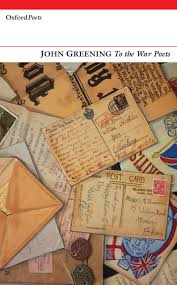
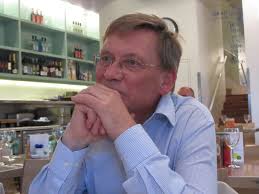
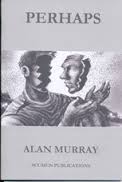
Alan (whose thoughtful book Perhaps was published by Acumen in 2013) introduced floor readers then handed over to Patricia Oxley as the three main poets were Acumen magazine related. John Greening first, whose quiet, measured delivery belies the time he has spent teaching literature to classes of schoolchildren. Dressed in chinos and pale shirt (yes, I’m doing the fashion notes too this time), I grudgingly admit (being a teacher myself) that he looked like a teacher, suggesting nothing of the real powerhouse of writing, editing, anthologising, reviewing and social-medi-ing that Greening is beneath that mild Clark Kent exterior. Born and raised in Hounslow he read ‘Heath Row’ from To the War Poets.

images

Topical, given the recent scandalous report suggesting a third runway to plague the poor citizens of west London, the poem reverses time’s arrow, unearthing what lies beneath tarmac and terminals, back to the original heath and bog, to sarsen stones and druidic rites, back further to a time when “the earth shudders, floods, howls, ignites”. His most recent book is threaded with addresses to the First World War poets and each short poem cunningly, often wittily, says something about the work of each. ‘To Edward Thomas’ notes: “You died at an observation post. / You looked and looked, and saw the detail / we do not”. Greening has also just published a major anthology, Accompanied Voices, with one of the world’s great music-publishing companies, Boydell Press. He read his own ‘Field’ from it, about poor John Field (inventor of the Nocturne) and the artistic irony that it was Chopin who superceded him, or as the poem puts it with all the brutality of the historical process, he “walked all over him”.

imgres

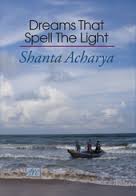
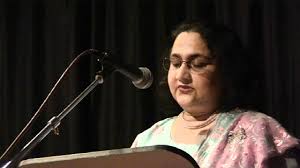
Shanta Acharya’s poems often record the phenomena of the natural world in part for themselves but also, as (her DPhil subject) Emerson suggests, because they can be read as the language of the “Universal Being”. Set in the artistic beauty of a Catholic church, the opening lines of ‘Italian Prayer’ ask: “How does one accustomed to the cold candour of stones / bend one’s knee in reverence”. Acharya’s work is, as Mimi Khalvati has said, “unafraid to take on the abstract, metaphysical, spiritual”. Dressed in an exquisite ivory-cream shalwar-kameez she also read the poem ‘Somewhere, Something’ from Dreams That Spell The Light (Arc Publications, 2010) that argues we do not travel “to explore another country / but to return home fresh, bearing gifts”. In fact, these gifts are for the self because all true experiences – thus discounting those of the ‘mere’ tourist – inevitably change us. The poem concludes, “Let’s fly free, not nailed to a mast; / see the universe with new eyes / not blinded by shadows that light casts”.

images

She also spoke of the Sanskrit phrase ‘neti neti’ (the title of an earlier collection) meaning ‘not this, not that’ as a definition of God or spiritual experience. This provoked a later discussion on the link between this idea and Laozi’s Daoist ideas, then The Cloud of Unknowing, followed by the writings of Julian of Norwich. Good swerves all. Lidl and Argos were well closed by this time of night.

imgres

My maternal grandmother would look sceptically up to a cloudy sky on occasions and make a meteorological call on the basis of whether or not there was enough blue sky to make a man’s pair of trousers. Well, those very trousers were being worn by Alan Brownjohn last Saturday evening, teamed with an unthreatening-cloud-coloured pale shirt. Brownjohn’s delivery is also very quiet, words seeming to emerge more from the side of his mouth, confirming that his tongue is often firmly in his cheek, doing deconstruction and the humour of post-modern irony before it was called such. Yet he manages to load poems with a weight of emotion too; he burns away sentiment, but still moves his readers.

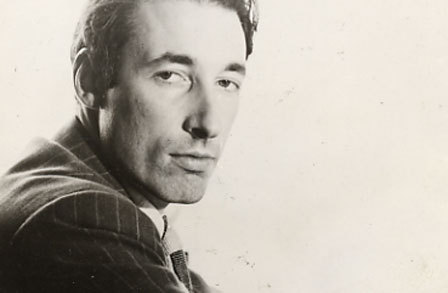
Alan Brownjohn more formally attired

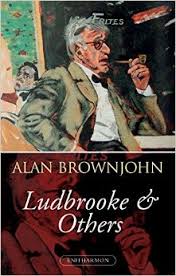
I was pleased he read several of the Ludbrooke & Others poems, 13 line sonnets for our austere age and an anti-hero-loser who nevertheless somehow gets our sympathy. Ludbrooke boasts of his “transformative” love-making in ‘His Classic Modesty’ (he persuades us it “is like the Acropolis”). In ‘His Jealousy’ he wants to persuade us (and himself, of course) that he has “deconstructed” and “junked” that emotion, only to feel the full force of it around line 12 to 13. We recognise a commonality at the same time as being allowed the space to imagine ourselves better than Ludbrooke. See the setting, re-setting, re-positioning of the powerful swerve going on there? That feeling you get after vigourous physical exercise of being stronger, more balanced, more capable? Poetry makes that happen to your heart – the figurative one.

imgres

The Abecedary Form / Carolyn Forche

The Form: I wanted to share here some thoughts on my experiments with the form of the abecedary. An abecedarium (or abecedary) is originally an inscription consisting of the letters of an alphabet, listed in order. Abecedaries were often practice exercises, teaching aids, but also developed as an ancient poetic form guided by strict alphabetical order. The earliest examples are Semitic, found in religious Hebrew poetry and the form has been used in various cultures for prayers, hymns, and psalms. Psalm 118 (or 119 by King James numbering) consists of twenty-two eight-line stanzas, one for each letter of the Hebrew alphabet. Chaucer’s An ABC is a medieval example of the form. Some abecedaries found in the Athenian Agora appear to have been left deliberately incomplete and the imperfection of these examples may have had a magical or ritual significance.

imgres

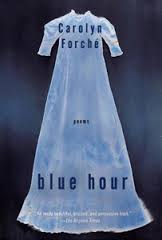
For those who have come across this form in contemporary poetry at all, it was probably (as in my case) through the poem called ‘On Earth’ in Carolyn Forche’s Blue Hour (Bloodaxe, 2003). I reviewed the book in some bewilderment at the time (see below) but have since come to see it more favourably. Forche herself says: “Gnostic abecedarian hymns date from the 3rd century AD. Along with Christian and Buddhist texts, they were recovered from small towns on the northern fringe of the Taklamakan Desert, early in the 20th century”. She also links the form with the idea of the pleroma, defined as the totality or fullness of God’s creation, the One. Over the 46 pages of ‘On Earth’, she adheres rigorously to the form in which alphabetical order guides not only the stanzas, but also the words opening every single line:

languid at the edge of the sea
lays itself open to immensity
leaf-cutter ants bearing yellow trumpet flowers along the road
left everything left all usual worlds behind
library, lilac, linens, litany

Poets.org says that abecedaries are now more commonly used as mnemonic devices and word games for children such as those written by Dr. Seuss and Edward Gorey. A derivative form is the much more familiar acrostic.

From my 2003 ReviewThe book contains 11 pieces in 65 pages, 46 of which are taken up with the long poem ‘On Earth’ and phrases do echo throughout the poems so there is a sense of unity to the whole. For the most part, Forche writes by assembling fragments and images, often without clear syntactical or narrative connections to surrounding lines. The reader experiences the verse as successive waves (lines stretch across the page and usually come in twos or threes), or as threads floating disconnectedly, but creating a striking impression of beauty. Forche’s obscurity comes more from an unshakeable confidence in her project, in her voice, in her idiosyncratic style and in her subject, largely concerned with the significance or recovery of the past in the present moment.

My difficulty with what Forche does is that all kinds of experience seem to be subjected to the same treatment, so that in the end the reader swims through an undeniably glittering, but rather gloopy, phenomenological soup in which “a city a thousand years” has the same weight as “a field of birds roasted by the heavens”, which has an equivalence to “a sudden reticence that seizes the heart”. All of the material – several deaths, the madness of a grandmother, a mother’s life, early years with a child, Chernobyl, some war-torn territories – is recorded with a swooning sensitivity, a recurring softness of diction and a penchant for grammatical inversion which seems to strain after the poetic: “In the blue silo of dawn, in earth-smoke and birch copse, / where the river of hands meets the Elbe.”

These doubts are brought to a head in the ambitious ‘On Earth’ which is (to quote the blurb) “a transcription of mind passing from life into death, in the form of an abecedary, modelled on ancient gnostic hymns”. The form is an alphabetical sequence and this additional random factor only increases this reader’s sense of a steamrollering of experience to ensure a smooth poetic passage. There is no doubt that Forche can produce some stunning images and when she strings them together in more conventional ways and the reader can hold on to her coat-tails, you can see why her reputation is so high in the U.S.

My interest in abecedaries: Has grown with my interest in looser forms of verse (I have given up on punctuation in most of my own poems these days) alongside a more-than-philosophical sense of the truth of the wholeness of being, reflecting Forche’s idea of the pleroma. This – see Rilke, see the Daodejing – is a condition impossible to be caught in the net of more conventional language and poetic form. Abecedaries encompass the whole alphabet (at least in theory – though I like the idea of the deliberate imperfection; perfection belonging only to God). An abecedary can therefore be seen as an appropriate poetic gesture (futile for sure) towards a unified field, an encompassing of everything, the only true state.

images

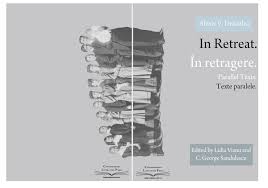
The Material: But the unified field, for an individual human being, must be regarded with some perspective; if this was not the case we would indeed be seeing with the eye of God, with his/her distance and utter impersonality. I wanted to write affective texts. I wanted my abecedary to be (paradoxically) limited. I wanted people in it; even a narrative of events. But all still subject to the demands of the form. I realised I did indeed have some suitable materials to hand. I had been asked by Professor Lidia Vianu, of University of Bucharest, to assist with the translation into English of several short stories by the relatively unknown Modernist Romanian author, Mihail C Vladescu. He published a collection of eight stories, In Retreat, almost 100 years ago. These are stories written in war-torn Eastern Europe but more significantly, Vladescu forensically portrays the sense of corruption in his society, with materialistic motives and adulterous behaviour most prominent. It seemed to me, and not merely because the centenary of the First World War is still in process around us, that this was material worth working on. I thought Vladescu’s relative obscurity to an English-speaking readership was also an advantage in such an experiment.

The Process: I selected phrases as far as possible randomly from the prose translation. These were then ordered alphabetically (via Excel spreadsheets) and subjected to as little editing as possible, though I have sectioned and created stanzas where it seemed best. Not surprisingly, my abecedaries are incomplete (x and z are more often than not the Persian flaws in the poetic carpet).

The results? Over the next 6 days I will post up the full 7 sections of my abecedary ‘Bathing in the Olt’ (from Vladescu’s original story called ‘Bathing’) and any observations would be welcomed. The text has already appeared in full in Shearsman magazine, 103/4, April 2015.

Click here to see each section posted: #1 / #2 and #3 / #4 / #5 / #6

imgres

How Do You Judge a Poem?

I am half way through the process of judging this year’s Torriano Poetry Competition (https://torrianomeetinghouse.wordpress.com/2014/10/27/torriano-poetry-competition-2015/). I’ve been lucky enough to judge a few such competitions in the last few years and what follows is a compilation of thoughts on the judging process. Though the initial sifting can be a slog, the latter stages are fascinating as poems that set little hooks in you at first reading, gradually become more clear, their internal coherence emerging alongside their skills with language and form. What follows is inevitably a personal take on the business – more so as the process unfolds – but I hope it may cast some light on it for those (of us) tempted to spend hard-earned cash on entering the numerous competitions now running (here are a few . . . http://www.poetrylibrary.org.uk/competitions/).

In the 2003 comedy film Bruce Almighty, Jim Carey plays God and, alongside with more obviously useful powers, he has to respond to the prayers of the world. But people are always praying; he rapidly approaches a kind of madness as voices swim around him, clamouring for attention.  He takes to reading the prayers in the form of e-mails. He tries to answer them individually but is receiving them faster than he can respond. He sets his e-mail account to automatically answer “yes” to all, assuming this will make everybody happy. Of course, it does not.

imgres

A poetry competition judge comparing himself to a character playing God lays himself open to criticism – but I have indeed found the initial phases of judging rather like Jim Carey’s experience. There are so many and such a variety of voices clamouring to be heard and every one of them is heart-felt, recording significant moments in people’s lives. There is a similar sense of responsibility too – the raw nature of much of the writing is impossible to deny. I’d like to set my response mechanism to say yes to everybody, but the judge’s task has to be how to distinguish submissions as poetry.

**

The numbers are always frightening. Many hundreds of poems will be submitted. Perhaps only 10% of these will demand a further reading after the brutal first sifting. Poems face an early red light from most judges because basic elements are not competently done:

  • Competitions are full of pieces where a particular verse form or rhyme pattern tyrannises the sentiment. The writer’s submission to this tyranny becomes clear quickly through the contortions imposed on the language to achieve a rhyme.
  • The writer’s choice of language can be devastating to the life of the poem. It just isn’t right to opt for forms of language or abbreviations that died out early in the nineteenth century.
  • Choice of diction also derails an entry if it is doggedly abstract. Sure, there remains much debate about whether it is the narrow English tradition that insists on things rather than ideas – but poems about Fear, Ignorance, Poverty, Eternity and Love which refuse to dip a toe into anything resembling a real life situation are going to find progress hard.

leaning-stack-of-papers-and-files

  • A fourth error is using language without being fully aware of its likely resonance with a possible reader. A poem called ‘Mother’s Pride’ which turns out not to be aware of the loaf of bread is going to have unanticipated clutter to climb over in the reader’s mind. Louis MacNeice wanted the poet not to be an ivory tower type, but rather “able-bodied, fond of talking, a reader of the newspapers, capable of pity and laughter, informed in economics . . . actively interested in politics”. All a bit Boys Own perhaps, but if this means the poet stays up to date with the way words live then he’s right.

 **

If you are thinking of submitting to a competition, it’s worth recalling Wordsworth’s formulation – familiar though it will feel – that poetry is built from “emotion recollected in tranquillity”. Poems made in the heat of the moment (and not revised and reviewed in the name of not tainting spontaneity) are seldom without their flaws. This is the kind of distinction Rilke also makes when he denies poetry is composed of feelings. Its constituents are rather “experiences” which he clarifies as “memories” though even with these, we “must be able to forget them when they are many and one must have the immense patience to wait until they come again . . . Only when they have turned to blood within us, to glance and gesture, nameless and no longer distinguished from ourselves – only then can it happen that in a most rare hour the first word of a poem arises in their midst and goes forth from them”. On the other hand, such recollection can sometimes create an intellectualised distance that may do harm to a good poem. Who said writing a poem was easy?

louis-macneice

Stephen Spender argues that a poet should try to acquire skill and virtuosity through the study and interpretation of other poetic works in the way Mozart and Beethoven did in playing the music of their predecessors.  Spender suggests translating poetry is the best possible exercise in interpretation. But the really important lessons (Spender says) are those of the eye, the ear, the athletic/poetic muscles. A poet can go a long way without a developed heart, but, he says, can get nowhere at all without these skills. The poet must ask continually of his lines: ‘Do they make the reader see, or hear, or feel, this experience which I am trying to re-create?’

 **

Reaching the final stages, the judge will be focusing more positively and more clearly on the sense, the story, the thought of a poem. Personally, I like poems that focus on small things and, in effect, make arguments for the ways in which they communicate the bigger issues that concern us all. I’m with Thomas Hardy in believing that “he used to notice such things” is one of the greatest of compliments. Edward Thomas’ poem about Spring, ‘But these things also’, likewise echoes this focus on what most people tend to overlook:

The shell of a little snail bleached

In the grass; chip of flint, and mite

Of chalk; and the small birds’ dung

In splashes of purest white . . .

Perhaps one explanation of why the question ‘what is poetry?’ is difficult to answer is because it is an art of the negative, of avoidance. The Daodejing says what is rigid and inflexible is a companion of death; what is flexible is a companion of life. I’d guess there would be general agreement that poetry is an art on the side of life. So poetry must eschew the inflexible; we must avoid the posture. And that’s very hard. In judging a competition one comes across the Wordsworth-posture, the Ginsberg-posture, alongside those of Betjeman, Hughes, Plath, Duffy . . . But we also posture like mad in ‘real life’. We may take up the pose of grief, melancholy, love, liberalism, environmentalism . . . The mark of the absence of posturing is an instability, an openness, an awareness of time (which posture tries to deny) and this is something I look for in a good poem. If a poem strikes an attitude my attention diminishes (even the attitude that wants to show a rejection of attitudinising through the hall of mirrors of ironic distancing). When the poem unearths a pulsing, shifting, live relationship between the self and the other, then I am captivated, recognising something that is both commonly human and uniquely personal.

But having said all this, I’d assure potential competition entrants that anything resembling a rule is there to be broken. Philip Pullman has said, “We don’t need a list of rights and wrongs, tables of dos and don’ts: we need books, time, and silence. Thou shalt not is soon forgotten, but Once upon a time lasts forever.”

114650911_345473c

So any poem in any form can work its magic. It will haunt its reader for days; it will make me change the way I think and feel; make me see the world differently. Ultimately, a poem contributes to who the reader is becoming. That is an exciting prospect for the writer. It is an even more exciting one for the judge who settles down to read.

Two mindfulness narratives for Tim Parks

A fascinating and honest account of taking up mindfulness or meditation exercises by novelist Tim Parks.

http://www.theguardian.com/lifeandstyle/2014/aug/30/meditation-mindfulness-tim-parks-more-than-medicine

He says: Being simultaneously immobile, wakeful and wordless is an experience that runs contrary to all our habits, and for which there is no model in our culture, nothing we can visualise, no narrative we can follow.. . 

I’m reminded of a couple of specific chapters from the Daodejing I have been working on for the last year or so . . .

Resistance

chapter 10

Can you stop your mind from straying?

Can you hold to the one? Never let it slip?

Can you make your breath soft as a child’s?

Can you listen to its long-drawn out and in?

Can you renew the glass through which you gaze

so the world is sharp and vivid?

Can you feel love of others? And persuade them?

Yet resist the desire to dictate?

Can you latch and unlatch the doors of perception—

yet be content to play the female part?

Can your insight range, penetrate far and near,

then back away—not interfere?

Then raise them, every one—nourish them all.

Raise them, but make no claim.

Influence them, but do not dictate.

Govern them, but do not legislate.

Only this, says Berenice, can be called power.

Focus

chapter 12

The spectrum of colours

dazzles the eye.

A plethora of sounds

dulls the ear.

The palate is coarsened

by explosions of taste.

Excess of pursuit,

too much of the hunt,

leads to nothing but

the mind’s disturbance.

The much-coveted rarity,

the limited issue,

serves only to cramp

its owner’s liberty.

The teacher’s focus

is steadily within—

not on what catches

the common eye.

The truth is: she shuns

that, prefers this.

Marxian glory days

The number of Marxian ideas and expressions I have forgotten since reading him at university is perhaps something not decently, publicly admissible. But one idea has stayed with me, become something of a talisman of a personal rather than political kind. In The German Ideology (1845) he declares that in the well-governed society, in a communist society, where nobody has one exclusive sphere of activity but each can become accomplished in any branch he wishes, society regulates the general production and thus makes it possible for me to do one thing today and another tomorrow, to hunt in the morning, fish in the afternoon, rear cattle in the evening, criticise after dinner, just as I have a mind, without ever becoming hunter, fisherman, herdsman or critic. 

Karl Marx - portrait

The well-governed life continues to prove as elusive as the well-governed society, of course, but a day of real/metaphorical hunting, fishing, rearing and criticising has remained an ideal of contentment. It was Henry de Montherlant (http://en.wikipedia.org/wiki/Henry_de_Montherlant) whose aphorism suggested that ‘happiness writes white (“Le bonheur écrit à l’encre blanche sur des pages blanches.” (Don Juan II, IV, 1048)) but in recording something like the perfect day I am running the greater risk of the plush, crushed raspberry colourings of complacency and self-satisfaction. But perhaps describing one’s own pleasure can be a political act.

My daughter has to be dropped off at 7am at school. Elevated to the dizzying heights of Year 7 prefect she is off to Wiltshire to accompany the ‘new kids’ on some bonding, outward-bound sessions. This leaves me near Hampstead Heath and time to jog/walk my way round it in the early morning with just dog-walkers and others getting the sluggish blood moving. Back at home with that serotonin high, paradoxically both both pumped-up and emptied-ready-to-be-filled, I work through some drafts of my current project, a version of  Daodejing. As a writer, I came to the Daodejing after translating the German poetry of Rainer Maria Rilke. Perhaps more importantly, it was as a long-standing teacher that I read Laozi’s 81 ‘chapters’. There are colourful myths about their origins, but they were probably a series of orally transmitted seed verses compiled as far back as the 7th century BCE by many Chinese hands, an aide memoire, certainly an aid to teaching.

imgres

The Dao or Way is not an individual entity, still less anything divine. It is a mode of being, all encompassing, a phenomenal, existential primacy, perhaps akin to the Western idea of original chaos. The text emphasises its feminine characteristics. It can be viewed from spiritual, epistemological, educational, political or environmental perspectives, though none of these exhausts its true nature. The poems enthusiastically accept that their profound and urgent messages are inevitably compromised by the need to express them in language, hence demanding a variety of technical manoeuvres – they stay light on their feet.

Into college for the afternoon, interviewing students, mostly about mistakes, choices, salvage operations possible for them after GCSE, AS or A2 exams. But also some preparation for the new course we have devised for A2 Coursework combining Fitzgerald’s The Great Gatsby, T S Eliot’s Prufrock and Other Observations, and Nathanael West’s The Day of the Locust. W H Auden’s brief discussion of West in The Dyer’s Hand is interesting, suggesting he portrays a Kingdom of Hell, ruled by the Father of Wishes. I read it, knowing I’m having a good day, some wishes coming true in contrast to West’s visions of West Coast apocalypse. Right here, right now, a brief, various-faceted jewel in the setting of others of more usual monotony. (More of West in another blog perhaps).

Driving home – the rolling dice of Henley’s Corner – I listen to the opening bars of tonight’s Prom: Brahm’s Third Symphony. By 9.30pm I’m walking into the Albert Hall myself for the late-night show: Beethoven’s Missa Solemnis. Didn’t I promise a good day? It’s John Eliot Gardiner and the Monteverdi Choir and Orchestre Révolutionnaire et Romantique  (http://www.bbc.co.uk/programmes/b04f8vlq). Gardiner says in a brief introductory interview that Beethoven’s unconventional Mass often skims more traditional moments of the text but is ‘marvellous’ on the ineffability of the Godhead, the humbleness of mankind and I’m in the mood to hear it…

Driving back up the Edgware Road, the sky is big as it seldom seems in London. The lights are bright in the Lebanese restaurants, my eyesight – usually close to blurry – seeming sharp tonight, hyperreal, resonant, woven still with the threads of earlier hours. Tomorrow, will be a thinner diet, more monotone, less good.