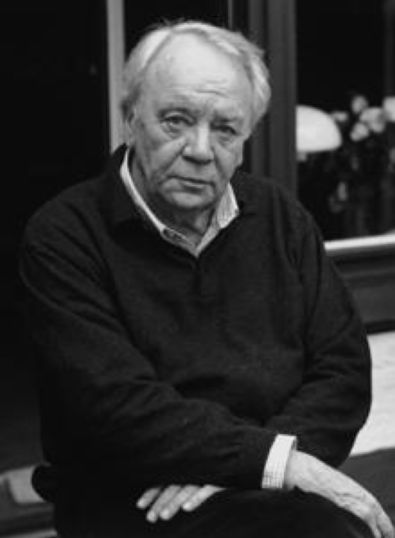
The sad news that Jürgen Becker (1932-2024) died recently at the age of 92 was particularly poignant as I have been translating his work for the past 3 years. I first read about his poetry in an essay I was translating by Lutz Seiler (published in In Case of Loss (And Other Stories, 2024)). There, Seiler characterises Becker’s work as ‘a process that integrate[s] both immediate and more distant modalities of language, his own voice as well as materials drawn from other sources such as events, photos, maps as well as interjections from neighbouring rooms, from the mail, the news, weather conditions and whatever else stray[s] within range’ (my translation). History, politics, the importance of recording ‘small things’, an extraordinarly porous kind of poetry – these were the aspects that drew me to his work (as a writer of my own poems as much as translator).
Becker’s ‘typical’ poem works at length, resembling a stream-of-consciousness, but better thought of as a kind of collage or montage. His effects are slow-burning, allusive, even elusive, and I don’t think his work is likely to top any UK chart of popular poetry any time soon. But his revered status in Germany is remarkable and I have actually had a couple of successes recently with my translations: a Highly Commended in the 2024 Stephen Spender Trust Translation Competition, judged by Taher Adel and Jennifer Wong (with the poem ‘Meanwhile in the Ore Mountains’), and one of Becker’s longer poems in translation being published (‘Travel film; re-runs’ – see below).
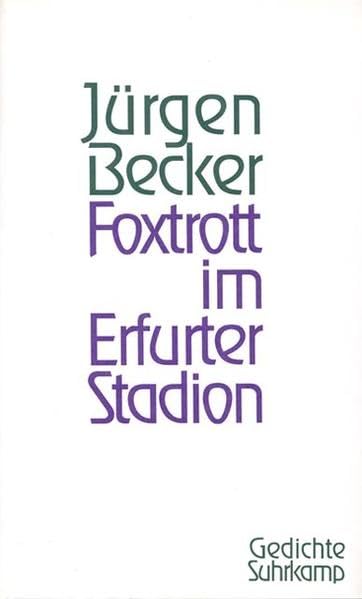
Becker grew up in the German region of Thuringia which, after World War II, was in the Soviet occupation zone, later the GDR. By then, his family had moved to West Germany and, after the fall of the Berlin Wall in 1990, the writer often returned to his childhood landscape. I have concentrated my translation efforts on Becker’s 1993 poems in Foxtrot in the Erfurt Stadium, published by Suhrkamp. The full translation is due to be published by Shearsman Books in 2025. The Spender Trust Competition poem is a short piece which I can quote in full. The Competition requires entrants to say a few words about the poem and the translation process. Here is a video of the Intro and Reading of the poem for the prize event, and (alongside) the text that I originally submitted:
Commentary – The Ore Mountains lie along the Czech-German border. Borders are important in this poem. Born in the East German region, brought up in West Germany, after the fall of the Wall in 1990, Becker often returned to his childhood landscape. Though relatively brief, this poem is just one sentence, woven together with the conjunction ‘wie’ (translated here both as ‘how’ and ‘the way’). The weave is dense and it’s not possible to tell whether what is observed – the children, the oil spill, the tree stump (resembling a body) – are contemporaneous or from different eras. My translation keeps these possibilities open: borders here are temporal, as well as geographical. The German word ‘Avantgarde’ has artistic as well as political implications, but my choice of ‘vanguard’ also brings out the militaristic connotations which are reinforced by the ‘spitzen, grünen Lanzen’ (‘sharp, green spears’) which are swiftly transformed into a bunch of sprouting snowdrops. These flowers of Spring are referred to as a ‘Konvention’ and I retained the English equivalent, intending to suggest both a performance (something conventional, perhaps not genuine), as well as a political gathering or agreement (like the Convention on Human Rights). The ambiguity felt relevant. The final vivid, visual images – a TV screen seen through a window, a script on the screen, a woman talking, but inaudible to the observer – sum up Becker’s concerns about the media, political and historical change, borders real and imagined, exclusion, and the need to ask questions of those in power. Issues as real today as when the poem was written.
Meanwhile in the Ore Mountains
Sitting still, watching how the afternoon below
waits for the dusk, the way snipers vanish
behind the remains of a wall and children run
after a white, armoured vehicle, the way a line
of hills, which marks a boundary, divides
the nothingness of snow from the nothingness of sky,
and along the frontier, one this side, another
along the other, fly the only two crows
to be found in this treeless landscape, the way
the iridescent pattern of an oil spill develops
with darkening edges, the way a tree stump
in the field becomes the shape of a body with
severed arms and legs, how, under the cherry,
the vanguard shows with sharp, green spears,
which later, over the next few days, assumes
the convention of snowdrops, how dark windows
are lit by screens, and on each screen appears,
at first, lettering, and then the face of
a woman who is soundlessly moving her lips.
The longer poem – ‘Travel film; re-runs’ – which does indeed run to over 100 lines in full – has just appeared in The Long Poem Magazine, Issue 32, eds. Linda Black and Claire Crowther. This brilliant magazine is one of the few outlets for poems stretching beyond the ‘competition’ mark of 40/50 lines only. Poets/translators again have the opportunity to comment on the work being published. This was my Introductory paragraph:
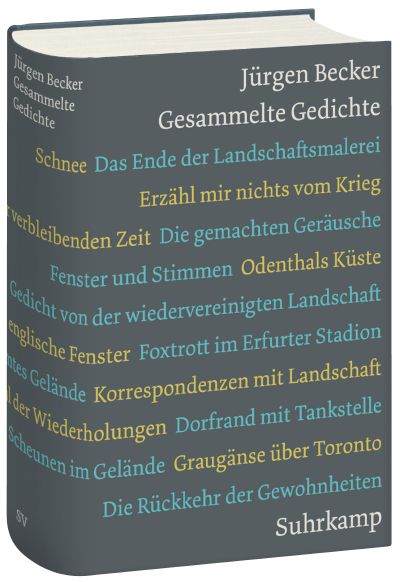
Given his 1000 page Collected Poems (Suhrkamp, 2022), it’s remarkable that Jürgen Becker’s work has been so little translated into English. This poem, published in his 1993 collection, Foxtrot in the Erfurt Stadium, is imbued with Becker’s sense of the changes in this particular part of Europe. The interleaving of the child’s and returning adult’s vision is what yields Becker’s characteristic poetic mode: a flickering between past and present, often without warning to the reader, a past frequently oppressed by the rise of fascism in the 1930s. The translator’s difficulties lie not in his word choices (Becker plainly describes, he states), but, to some degree, in his cultural references (here, the allusion to pimpf kids (cub, little rascal, little fart) is to members of the Hitler Youth), and, primarily, in dealing with his style of montage-composition, his commitment to ‘the apparently incidental’. Becker’s porous verse contains multitudes of perspectives, voices, inner and outer events, photos, maps, postcards, news, weather reports. In translation, it’s hard to flex, to permit these into English, and I have had to learn to trust Becker’s arrangements of them into long, semi-colon linked passages, utterly remote from conventional ‘lyric’. The opening 24 lines here elide landscape, weather, employment, domesticity, and history, then on to the natural world, compositional ideas, back to history. Becker is a great poet of the present moment and of the past. He grew up in Thuringia which, following World War II, lay in the Soviet occupation zone, later the GDR. By then, Becker’s family had moved to West Germany, and, after 1990, he often returned to these childhood landscapes. This poem was published in his 1993 collection, Foxtrot in the Erfurt Stadium. Becker worked for many years in German radio, and, in this poem, we might imagine a small production team visiting an un/familiar landscape in the East, perhaps where a childhood was spent, a place later abandoned.
Travel film; re-runs (extract)
the landscape: like corrugated cardboard, an enduring, fixed
motion, on a smoky grey day. The wind came
somewhere from below, from a region beneath
the weather chart; in the evening, we could no longer
reach our correspondents. We drove out
to the country house; we ate
Spanish green asparagus. It was a moment
from yesterday that rolled slowly past the shelf
with its yellow calendars and diaries and pictures;
something had begun,
and you’re aware of it,
the sound of that reiteration. You can … and
you allow it … push the off button; outside the window,
the blackbird flutters up, simply waiting
to be mentioned. Now you notice the way the paint
has peeled from the window frame, and where
the ants are coming from, in January the only
living creatures in the house. Perseverance pays off
at some point, even if you have little alternative
but to gather piece after piece together. Paint pots
in the shed, shades of green and white, but
we are waiting for a consistent light,
on either side of the house. Is it too late now,
to leave again
… lake shores, before they are all
accounted for, can still be appreciated, with sandy paths
reaching the purple horizon … subjunctive, without end;
a game of evasion that you can watch until you
whistle, or shout, and it’s nothing like awakening
from a dream. In the evening, we light a fire; it’s
a sudden, impromptu decision; then follows
the next draft of the letter: your sketches litter the table
… you no longer need a pass; highways,
the middle of the village … standing beside you
on the jetty; on the opposite side, the yellow ribbon
of the shoreline…
clips from the travel film just now
set going in the blink of an eye; then the meadow
is mown; there are a few old clumps of snowdrops
we leave standing. The fact is, we have missed out
on the moment of adulthood, even if, in the evening,
you say: never, not once, did the door open, from
which a little something left, and what you are now
entered in. The contrast, the changes … the fear has
been networked, so many of these shortcomings went
into production. Piano, from beyond French windows,
Shostakovich plays Shostakovich, and the life story
draws a curve out towards the northeast. Ice floes,
accumulating along the coast; in boots and furs,
walking over the frozen river, passing pimpf kids,
and old men, and a young woman who’s most likely
Polish, and you’re not going to stop staring at her
any time soon; freezing cold on the sledge back home,
your mother doesn’t live here anymore; the whole scene
darkens under the smoke of an engine pulling
the fast train to Lusatia . . .



 Martyn Crucefix