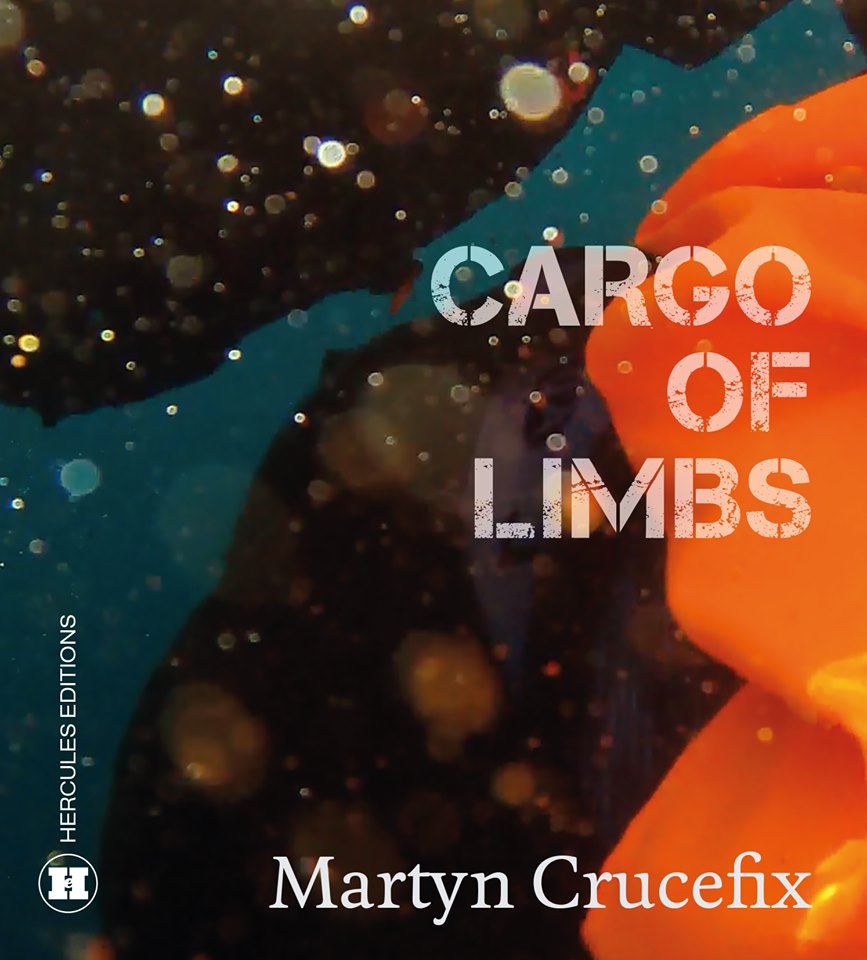
Continuing Relevance of ‘Cargo of Limbs’

I was recently tagged in a social media post by someone doing the Sealey Challenge – one poetry book a day for the month of August! I do admire people’s stamina. I was tagged because the book of the day for this person – and a mercifully short one at that – turned out to be my own chapbook, published by Hercules Editions back in 2019 under the title Cargo of Limbs. Originating in events almost 10 years ago now, it is utterly depressing that the longish poem that constitutes most of the book remains relevant. Now – as then – the news is full of people in small boats. Then, refugees and migrants were embarking in the Mediterranean. Now, most of the talk here is of people embarking from the coast of France to risk the real dangers of the English Channel. The book remains in print and can be bought from Hercules here or by contacting me directly.

I posted a short piece about the chapbook during the Covid lockdown in April 2020. I was preoccupied then with what writers can/cannot do in such dire circumstances as pandemics and wars: ‘Beyond feeling helpless, what do writers do in a crisis? I think of Shelley hearing news of the Manchester Massacre from his seclusion in Italy in 1822; Whitman’s close-up hospital journals and poems during the American Civil War; Edward Thomas hearing grass rustling on his helmet in the trenches near Ficheux; Ahkmatova’s painfully clear-sighted stoicism in Leningrad in the 1930s; MacNeice’s montage of “neither final nor balanced” thoughts in his Autumn Journal of 1938; Carolyn Forche witnessing events in 1970s El Salvador; Heaney’s re-location and reinvention of himself as “an inner émigré, grown long-haired / And thoughtful” in 1975; Brian Turner’s raw responses to his experience as a US soldier in Iraq in 2003′. You can read more of that piece – and hear me read the opening of the poem – here.

In the chapbook I wrote a ‘How I Wrote the Poem’ type of discussion and it’s that that I felt would be worth posting in full here because, though times have changed, nothing seems very different about the refugee crisis and the moral issues surrounding it . . .

It’s early in 2016 and I am on a train crossing southern England. On my headphones, Ian McKellen is reading Seamus Heaney’s just-published translation of Book 6 of Virgil’s Aeneid. This is the book in which Aeneas journeys into the Underworld. As he descends, he encounters terror, war and violence before the house of the dead. He finds a tree filled with “[f]alse dreams”, then grotesque beasts, centaurs, gorgons, harpies. At the river Acheron, he sees crowds of people thronging towards a boat. These people are desperate to cross, yet the ferryman, Charon, only allows some to embark, rejecting others. At this point, in Heaney’s translation, Aeneas cries out to his Sibyl guide: “What does it mean [. . . ] / This push to the riverbank? What do these souls desire? / What decides that one group is held back, another / Rowed across the muddy waters?”

The timing is crucial. I’m listening to these powerful words in March 2016 and, rather than the banks of the Acheron and the spirits of the dead, they conjure up the distant Mediterranean coastline I’m seeing every day on my TV screen: desperate people fleeing their war-torn countries. The timing is crucial. It’s just six months since the terrible images of Alan Kurdi’s body – drowned on the beach near Bodrum, Turkey – had filled the media. In the summer of 2015, this three-year-old Syrian boy of Kurdish origins and his family had fled the war engulfing Syria. They hoped to join relatives in the safety of Canada and were part of the historic movement of refugees from the Middle East to Europe at that time. In the early hours of September 2nd, the family crowded onto a small inflatable boat on a Turkish beach. After only a few minutes of their planned flight across the Aegean, the dinghy capsized. Alan, his older brother, Ghalib, and his mother, Rihanna, were all drowned. They joined more than 3,600 other refugees who died in the eastern Mediterranean that year.

Beyond my train window, the fields of England swept past; Virgil’s poem continued to evoke the journeys of refugees such as the Kurdi family. It struck me that some form of versioning of these ancient lines might be a way of addressing – as a poet – such difficult, contemporary events. I hoped they might offer a means of support as Tony Harrison has spoken of using rhyme and metre to negotiate, to pass through the “fire” of painful material. I also saw a further aspect to these dove-tailing elements that interested me: the power of the image. The death of Alan Kurdi made the headlines because photographs of his drowned body, washed up on the beach, had been taken. When Nilüfer Demir, a Turkish photographer for the Dogan News Agency, arrived on the beach that day, she said it was like a “children’s graveyard”. She took pictures of Alan’s lifeless body; a child’s body washed up along the shore, half in the sand and half in the water, his trainers still on his feet. Demir’s photographs, shared by Peter Bouckaert of Human Rights Watch on social media, became world news.

Demir’s images were indeed shocking, breaking established, unspoken conventions about showing the bodies of dead children. I remember passionate online debates about the rights and wrongs of disseminating such images. Yet the power of the images, without doubt, contributed to a shift in opinion, marked to some degree by a shift in language as those people moving towards Europe came to be termed “refugees” more often than the othering word, “migrants”. This tension between the desire to draw attention to suffering and the risks of exploitation has arisen more recently. In June 2019, the hull of a rusty fishing boat arrived in Venice to form part of an installation at the Biennale by the artist, Christoph Buchel. The vessel had foundered off the Italian island of Lampedusa in April 2015 with 700 people aboard. They too were refugees seeking a better life. Only 28 people survived. When the Italian authorities recovered the vessel in 2016 there were 300 bodies still trapped inside. Buchel called his exhibit Barca Nostra (Our Boat) and there is little doubting his (and the Biennale organisers’) good intentions to raise public awareness of the continuing plight of refugees travelling across the Mediterranean. Yet Lorenzo Tondo, for example, has argued that Buchel’s exhibit diminishes, even exploits, the suffering of those who died, “losing any sense of political denunciation, transforming it into a piece [of art] in which provocation prevails over the goal of sensitising the viewer’s mind” (The Observer, 12.05.19).

Interestingly, in Book 6, Virgil asks the Gods to strengthen his resolve to report back the horrifying truths he’s about to witness and I came to realise that the narrative voice in my new version ought to be the voice of a witnessing photojournalist. It is this narrator who accompanies my Aeneas (renamed Andras) through a more contemporary ‘underworld’. I imagine Andras also as a journalist, though he is a man of words rather than images. At some distance now from the writing of the poem, I see that the two western journalists have differing reactions to what they encounter. The photographer holds firm to recording events with a distanced objectivity. He considers it his role, his duty, to deliver such truths (perhaps as Nilüfer Demir felt on the beach at Bodrum; perhaps as Amel El Zakout felt on her own harrowing journey from Istanbul in 2015, the extraordinary images of which accompany this poem). My photographer’s partner, Andras, has a lot less poem-time, yet – following the outline of Virgil’s poem closely – he has a more emotional, empathetic response. By turns, he is fearful and compassionate. I think he has more moral scruple. As well as presenting the plight of contemporary refugees, between them I hope they are also debating, in part, the role of any artist impelled to bear witness to the suffering of others.

So Virgil’s original lines provided guidance but I have changed some things. As I have said, early on he apostrophises the Gods, asking for assistance in accurately reporting his journey to the Underworld. I saw no justification for my own narrator to be appealing to divine powers, though he understands those people fleeing might well put their trust in their own God. So it’s with tongue in cheek that he asks to be allowed to “file” his work in a way that is accurate (“what / happens is what’s true”) and these lines become his moment to make his faith in objectivity clear: “let me file // untroubled as I’m able”. The “brother” he alludes to is one-time journalist, Ernest Hemingway, who would often risk gunfire to file his despatches in Madrid, during the Spanish Civil War.

Later, Virgil describes the journey of Aeneas and the Sibyl through an ill-lit landscape, drained of colour, approaching the jaws of Hell. All around are personifications of Grief, Care, Disease, Old Age, Fear, Hunger, War and Death itself (Heaney’s translation buries these personifications to a large degree; in general, I prefer Allen Mandelbaum’s 1961 translation). I wanted to retain the device of personification but shifted the physical contexts of the actions to evoke the kind of experiences refugees are still fleeing from: bombing, persecution, the use of chemical weapons (“yellow dust of poison breeze running // into the trunks of trees” – an image I have borrowed from Choman Hardi’s fine poem ‘Gas Attack’). Aeneas then discovers “a giant shaded elm” (tr. Mandelbaum). Heaney’s translation associates this with “False dreams”; Mandelbaum has “empty Dreams”. All around the tree are grotesque beasts (centaurs, gorgons, harpies) which frighten Aeneas and he draws his sword against them. In my version, the tree of false dreams becomes an image of the often vain hopes that drive people to flee their homes, while Virgil’s menagerie of beasts suggest the kinds of distortions, the physical and mental lengths to which such people are driven and the dangers they face in such extremities: “bestialised women // girls groomed to new shape”. It’s here my Andras reveals his more volatile emotional nature in fearing what he sees, thinking these figures may be a threat to him. In the original, it is the Sibyl who calms Aeneas; in my version it is the less emotionally engaged narrator/photojournalist who lends Andras the defence of more emotional “distance”.

Virgil’s Aeneas begins to descend towards the River Acheron and the “squalid ferryman”, Charon. The landscape of my version is a portrait of routes overland to the sea’s edge and my figure of Charon, “the guardian of the crossing”, becomes an inscrutable and unscrupulous people smuggler. Virgil makes it clear he is aged, “but old age in a god is tough and green”. I took this hint of ambiguity further in terms of Charon’s eyes, his outstretched hand, even his physical appearance and presence: “young and attentive / yet from the choppy tide / he’s older gazing / a while then—ah— // gone—”. Virgil describes the “multitude” rushing eagerly to Charon’s boat and makes use of two epic similes comparing the human figures to falling autumn leaves and flocks of migrating birds. I’ve kept the ghosts of these images and extended the people’s approach to the ferryman as an opportunity to describe the kinds of perilous vessels that since 2015 have been launched into the Mediterranean: “they long to stagger // into the dinghy’s wet mouth / the oil-stinking holds / where shuttered waters / pool”. Virgil’s Charon permits some to board but bars others. As Book 6 proceeds, it is made clear those who are rejected are the dead who remain as yet unburied. In my version, the people smuggler also retains the power to choose who travels, but his reasons for doing so are not clear (probably money, possibly caprice). The irony is that in not permitting some to embark he may also be saving lives.

In Virgil’s poem, before he hears the full explanation of Charon’s selection process, Aeneas is baffled and deeply moved by it. He cries out – this time in Mandelbaum’s translation – for an explanation to the guiding Sibyl: “by what rule / must some keep off the bank while others sweep / the blue-black waters with their oars?” I wanted my Andras to be equally moved by their plight and the seeming injustice. But the question he tries to articulate is directed not merely at those who make a living from such dangerous journeys but also (I hope) to those in more official, political, public capacities – those who represent us – who also possess the power to accept or deny entry to people fleeing for their lives. There is no Virgilian equivalent to my final five lines but I wanted to accentuate the growing disparity between the ways the two western journalists are responding to what they witness. The narrator still wants to take good images. But Andras is moved enough to see the need for less distance, to dash the camera to the ground, to engage with those who are fleeing, to try to help.
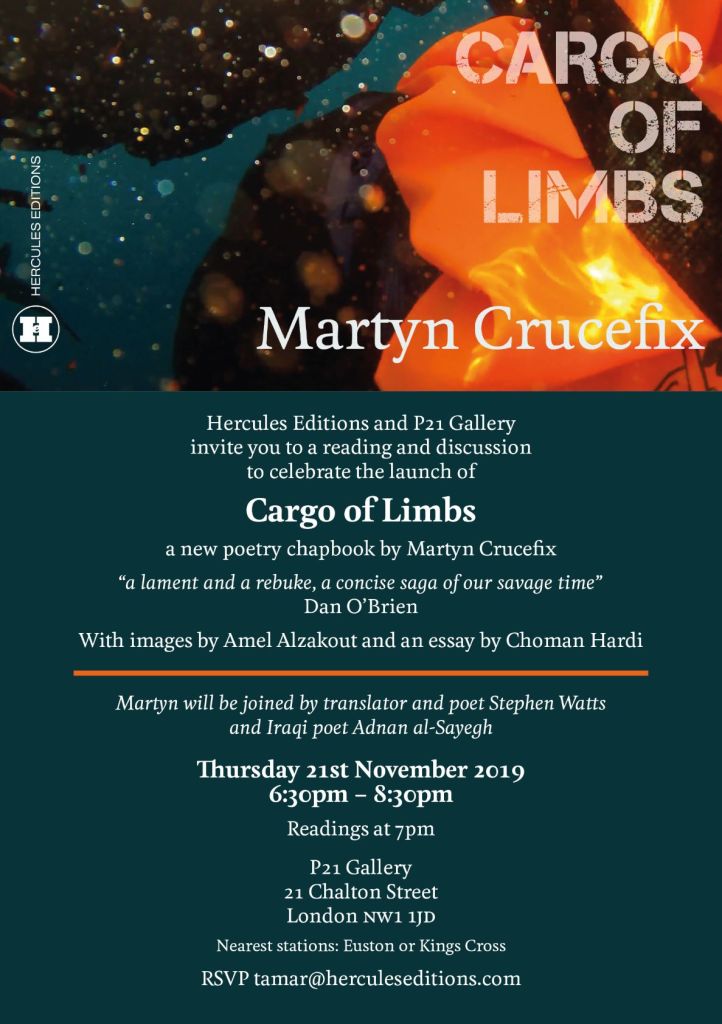
‘Cargo of Limbs’ launches Thurs 21st November

Apologies for the relative silence from my blog. I have been busy preparing and working to propel into the world two new books of poetry. The first out has been These Numbered Days, my new translations of the GDR poet, Peter Huchel, published by Shearsman Books.

The second book will be published by Hercules Editions, It’s called Cargo of Limbs more details of it can be found here. I’ll also post the launch event details below – it’s an open and free event and I would be delighted to see you there.

Tony Harrison’s ‘A Cold Coming’

I have been thinking about the role of metre in poetry in preparation for 3 evening sessions I have been asked to teach for the Poetry School in London. The sessions are part of a wide-ranging course on some of the basics of poetry (other parts of it will be taught by Tim Dooley, Judy Brown, Claire Crowther and Matthew Caley). Also, last Saturday I attended the Free Verse Poetry Book Fair in Red Lion Square, London. There – apart from spending too much money on poetry books and chatting with people who had come from all over the country – I listened to a discussion about the role of poetry in relation to politics. Fiona Moore chaired a discussion involving Choman Hardi, Bill Herbert, Sophie Mayer and R A Villanueva. Ideas put forward included the delicate issue of ‘using’ the experience of others in political poetry as well as the need to work polyvalently or collaboratively to combat the influence of unquestioned language and form. Herbert quoted W S Graham’s line: “What is the language using us for?” At the confluence of these two biographical moments I found myself thinking of Tony Harrison’s solutions to the poetry/politics issue – in part through his use of formal metre. The following discussion of Harrison’s Iraq War poem, ‘A Cold Coming’, originally appeared in book form in Tony Harrison: Loiner (Clarendon Press, 1997), edited by Sandie Byrne.

imgres

Harrison has declared his commitment to metrical verse because “it’s associated with the heart beat, with the sexual instinct, with all those physical rhythms which go on despite the moments when you feel suicidal”. In conversation with Richard Hoggart, he explains that without the rhythmical formality of poetry he would be less able to confront, without losing hope, his favoured themes of death, time and social injustice. “That rhythmical thing is like a life-support system. It means I feel I can go closer to the fire, deeper into the darkness . . . I know I have this rhythm to carry me to the other side”.

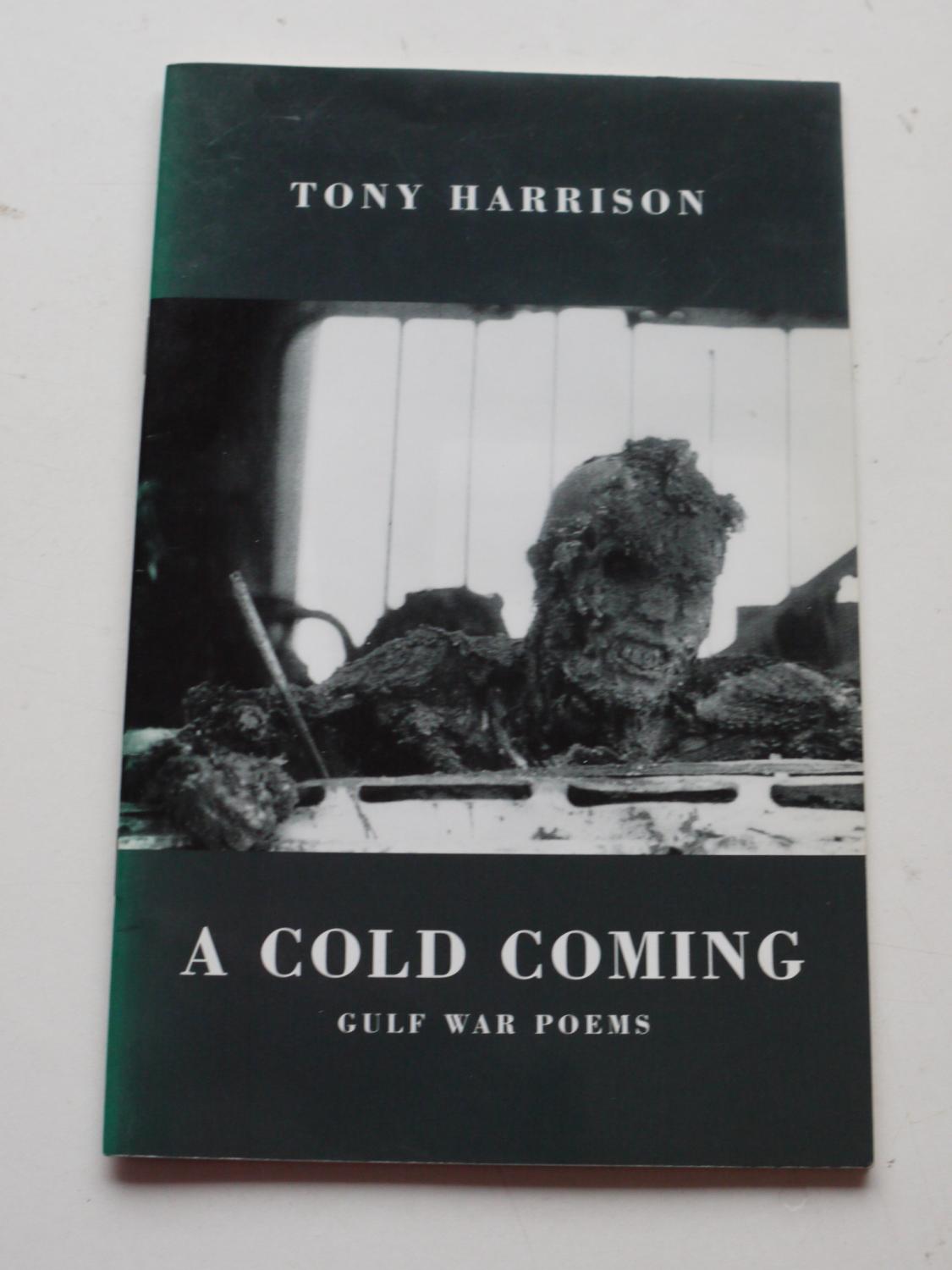
There are few of Harrison’s poems that go closer to the fire than the second of his Gulf War poems, ‘A Cold Coming’. Its initial stimulus, reproduced on the cover of the original Bloodaxe pamphlet, was a photograph by Kenneth Jarecke in The Observer. The picture graphically showed the charred head of an Iraqi soldier leaning through the windscreen of his burned-out truck which had been hit by Allied Forces in the infamous ‘turkey-shoot’ as Saddam’s forces retreated from Kuwait City. In the poem, Harrison makes the Iraqi himself speak both with a brutal self-recognition (“a skull half roast, half bone”) as well as a scornful envy of three American soldiers who were reported to have banked their sperm for posterity before the war began (hence, with a scatological nod to Eliot, the title of the poem). There are undoubtedly echoes in the Iraqi’s speech of the hooligan alter ego in the poemV’, yet Harrison worries little over any narrow authenticity of voice in this case, and he does triumphantly pull off the balancing act between the reader’s emotional engagement with this fierce personal voice and a more universalising portrayal of  a victim of modern warfare. Furthermore, it is Harrison’s establishment and then variation of the poem’s metrical “life-support system” that enables him to achieve this balance, to complete a poem which weighs in against Adorno’s view that lyric poetry has become an impossibility in the shadow of this century’s brutality.

imgres

The poem’s form – rhymed iambic tetrameter couplets – seems in itself chosen with restraint in mind, as if the photographic evidence of the horror lying in front of him led Harrison to opt for a particularly firm rhythmical base “to carry [him] to the other side”. Indeed, the opening five stanzas are remarkable in their regularity with only a brief reversed foot in the fourth line foreshadowing the more erratic energies soon to be released by the Iraqi soldier’s speech:


I saw the charred Iraqi lean

towards me from bomb-blasted screen,


his windscreen wiper like a pen

ready to write down thoughts for men.


The instant the Iraqi’s voice breaks in, the metre is under threat. Each of his first four stanzas opens with trochaic imperatives or questions and at one point he asks if the “gadget” Harrison has (apparently a tape-recorder but a transparent image of poetry itself) has the power to record “words from such scorched vocal chords”. Apart from the drumming of stresses in lines such as this, Harrison deploys sibilance, the alliteration of g’s and d’s, followed by an horrific mumbling of m’s to suggest the charred figure’s effortful speech in the first moments of the encounter. Regularity is re-established the moment the tape-recorder’s mike is held “closer to the crumbling bone” and there is a strong sense of release from the dead man’s initial aggressive button-holing as his voice (and the verse) now speeds away:


I read the news of three wise men

who left their sperm in nitrogen,


three foes of ours, three wise Marines,

with sample flasks and magazines . . .

10051408090


In the stanzas that follow the dead man’s angry, envious sarcasm is controlled within the bounds of the form and it is rather Harrison’s rhymes which provide much of the kick: God/wad, Kuwait/procreate, fate/ejaculate, high tech’s/sex. It is only when the man demands that Harrison/the reader imagines him in a sexual embrace with his wife back home in Baghdad that the metrical propulsion again begins to fail. It is in moments such as this that the difficult emotional work in the poem is to be done. This is our identification with these ghastly remains, with the enemy, and it is as if the difficulty of it brings the verse juddering and gasping to an incomplete line with “the image of me beside my wife / closely clasped creating life . . .”

The difficulty of this moment is further attested to by the way the whole poem turns its back upon it. Harrison inserts a parenthetical section, preoccupied not with the empathic effort the dead Iraqi has asked for but with chilly, ironic deliberations on “the sperm in one ejaculation”. Yet all is not well, since this section stumbles and hesitates metrically as if Harrison himself (or rather the persona he has adopted in the poem) is half-conscious of retreating into safe, calculative and ratiocinative processes. Eventually, a conclusion yields itself up, but it is once again the metrical change of gear into smooth regularity (my italics below) that suggests this is a false, defensive even cynical avoidance of the difficult issues raised by the charred body in the photograph:


Whichever way Death seems outflanked

by one tube of cold bloblings banked.


Poor bloblings, maybe you’ve been blessed

with, of all fates possible, the best


according to Sophocles i.e.

‘the best of fates is not to be’


a philosophy that’s maybe bleak

for any but an ancient Greek . . .

imgres

That this is the way to read this passage is confirmed by the renewed aggression of the Iraqi soldier who hears these thoughts and stops the recorder with a thundering of alliterative stresses: “I never thought life futile, fool! // Though all Hell began to drop / I never wanted life to stop”. What follows is the Iraqi soldier’s longest and most impassioned speech, by turns a plea for attention and a sarcastic commentary on the collusion of the media whose behaviour will not “help peace in future ages”. Particular mention is given to the “true to bold-type-setting Sun” and, as can be seen from such a phrase, Harrison once more allows particular moments of anger and high emotion to burst through the fluid metrical surface like jagged rocks. There is also a sudden increase in feminine rhyme endings in this section which serves to give a barely-caged impression, as if the voice is trembling on the verge of bursting its metrical limits and racing across the page. This impression is further reinforced in the series of imperatives – again in the form of snapping trochees at the opening of several stanzas – that form the climax to this section of the poem:


Lie that you saw me and I smiled

to see the soldier hug his child.


Lie and pretend that I excuse

my bombing by B52s.


The final ten stanzas culminate in a fine example of the way in which Harrison manipulates metrical form to good effect. In a kind of atheistic religious insight, the “cold spunk” so carefully preserved becomes a promise, or perhaps an eternal teasing reminder, of the moment when “the World renounces War”. However, emphasis falls far more heavily on the seemingly insatiable hunger of the present for destruction because of the way Harrison rhythmically clogs the penultimate stanza, bringing it almost to a complete halt. The frozen semen is “a bottled Bethlehem of this come- /curdling Cruise/Scud-cursed millennium”. Yet, as we have seen, Harrison understands the need to come through “to the other side” of such horrors and the final stanza does shakily re-establish the form (though the final line opens with two weak stresses and does not close). However, any naive understanding of the poet’s comments about coming through the fire can be firmly dismissed. This is not the place for any sentimental or rational synthetic solution. Simply, we are returned to the charred face whose painful, personal testament this poem has managed to encompass and movingly dramatise but without losing its form, thus ensuring a simultaneous sense of the universality of its art and message:


I went. I pressed REWIND and PLAY

and I heard the charred man say:


What Have I Been Reading: January – March 2016

Up-dated March 2016

imgres

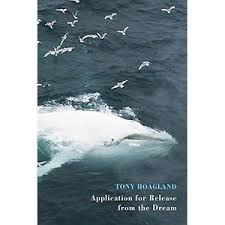
Tony Hoagland’s new collection from Bloodaxe introduces me to a poet I want to read more of (having missed him so far). Laugh-out-loud funny in the same breath as touching while being satirical and vividly descriptive of urban USA. Like Billy Collins, you relish the poem – then wonder how he managed to achieve it so apparently effortlessly.

imgres

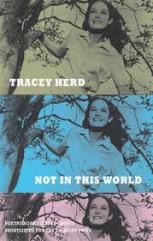
I read with Tracey Herd recently at the StAnza Festival (see this post) and was impressed with the emotional honesty of her writing. This is her first book in almost 15 years and was short-listed for the Forward as well as being a PBS Choice.

images
imgres

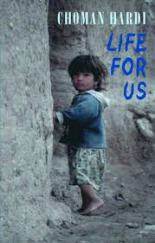
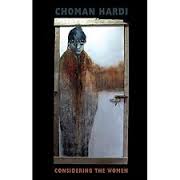
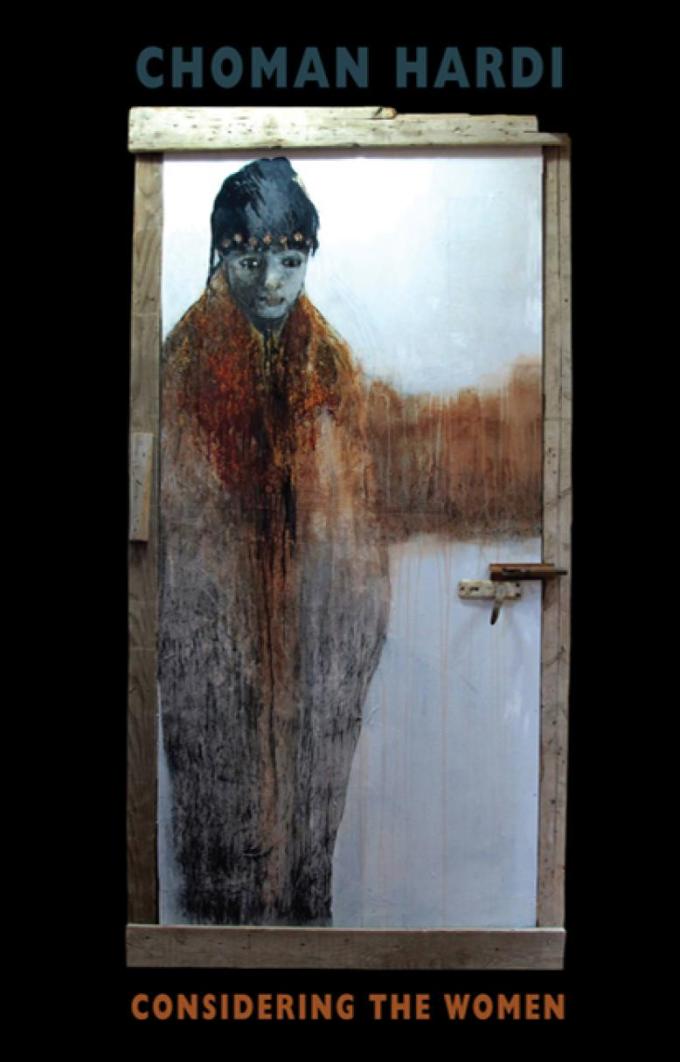
In reviewing Choman Hardi’s recent Considering the Women for Poetry London, I also went back to re-read her first book, Life for Us (both published by Bloodaxe). Her unsparing exploration of the plight and flight of the Iraqi-Kurdish people in the 1980s is poetry of witness of a high order. This is a body of work which is unique and deserves as much notice as we can give it.

Up-dated January/February 2016

imgres

Macfarlane’s take on the significance of the loss of rural vocabulary and the danger that we will narrow our human experience as a result makes for powerful reading. Actually I found the word lists a bit dull (which I’m sure I shouldn’t as a poet) but perhaps most important of all he directs readers to previously little known writers about landscape like Nan Shepherd, J A Baker and Peter Davidson.

imgres

Popa’s unpunctuated, economical, elusive poems, many of them drawing on Serbo-Croat myth and legends, can be hard going. There is little sentiment or surface detail to hold on to. But reading them you hear where Ted Hughes found the idioms of Crow. Poems like little hard pebbles giving lessons  to the more windy and verbose among us (I include myself of course).

imgres

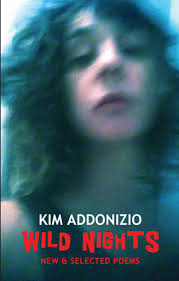
Addonizio can be verbose but what she evokes is a speaking voice, a chatting voice, driven on to revelation after revelation as if across a bar table littered with empties. She is a voice in your ear with all that implies about thrilling intimacy though on occasions I felt ‘give me a break’.

imgres

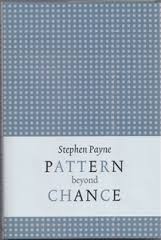
Stephen Payne’s poems emerge partly from his job as a Professor of Human-Centric Systems. He observes what people do and he wants to discuss it. He’s looking for the patterns which present themselves ‘beyond chance’. If that sounds a bit cool there is something of that here but the book overall is delicate, always thoughtful and often very moving.

Choman Hardi: Review of ‘Considering the Women’

In the Recent Reading section of my website I observed that Choman Hardi’s “unsparing exploration of the plight and flight of the Iraqi-Kurdish people in the 1980s is poetry of witness of a high order. This is a body of work which is unique and deserves as much notice as we can give it”. I also blogged about her second collection, Considering the Women, where I drew comparisons between her poem ‘Gas Attack’ and Wilfred Owen’s well-known anti-war poem ‘Dulce Et Decorum Est’. My thoughts were in part a spin-off from a review I was asked to do of the book (alongside collections by Tony Hoagland and Jan Wagner). That review has been published in Poetry London. But Hardi’s book has just appeared on the Forward Prize Best Collection Shortlist and the post that now follows is the discussion of the whole book from my original review. The “delicate deliberations” alluded to in the opening line refer to Jan Wagner’s work – in which I discussed his explorations of the self, definitions and re-definitions of it, through our honest encounter with the world.

557d81f5ddd39

The kind of horrific experiences and seismic changes to human lives that Choman Hardi writes about make some of these more delicate deliberations seem inappropriate luxuries. Hardi does not write much about herself yet the locus of her life is critical to the work. Born in Sulaimani, she lived in Iraqi-Kurdistan and Iran before seeking asylum in the UK in 1993.  She has since researched women survivors of Saddam’s chemical warfare against the Kurds in the late 1980s and has recently moved back to Sulaimani. Her first book (in English) Life for Us (Bloodaxe, 2004) was remarkable for its evocations of a childhood shattered by war, persecution and exile. Her new collection also contains timely poems about exile, warfare, ethnic cleansing, but goes on to reflect on the pull back to the homeland.

images

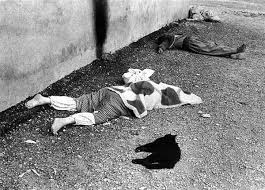
Hardi writes devastatingly about the Iraqi state’s genocidal attacks on the Kurds, drawing directly on her research in the central ‘Anfal’ sequence. ‘Gas Attack’ offers a mother’s account of “a chalky-yellow powder” settling on exposed skin, her own and her son’s. The boy dies, groaning “like a calf”, the mother still blinded, unable to see him or “say goodbye”. Hardi’s language is always sufficient to the task – plain, direct, rising to the occasional metaphor, natural enough to suggest a witnessing voice. In ‘Dibs Camp, the Women’s Prison’, another mother who has already lost husband and daughter, holds her son in her arms as he dies suckling on a green slipper because he has asked for a cucumber and “is beyond // knowing the difference”. ‘The Angry Survivor’ introduces a different perspective as yet another mother rails against the intrusion of journalists, officials, activists who want to probe her story, or as she puts it, “pick my wounds”.

The position of the researcher is a vexed one openly considered in this collection. The ‘Anfal’ sequence is begun by the researcher’s voice, earnest, naïve and well-meaning. It concludes with ‘Researcher’s Blues’ in which she is now haunted permanently by the women’s voices so that “all I can do is / pour with grief which has no beginning and no end”. Such hyperbolic language is carefully measured to the devastating subject but the impact of such traumatic events on a non-participant is perhaps better dealt with elsewhere in the collection in more autobiographical pieces. In ‘My English Years’ the narrator sketches the story of a mixed marriage in decline. One of the points of contention is her research which leaves her feeling “dispossessed”. The husband tires of what he sees as her obsession with “victimhood”, then he also grows “fed up with me” (‘Our Different Worlds’).

imgres

The irony of a poem like ‘Before You Leave’ – flinging out imperatives demanding that language, landscape, neighbours, parents must not be forgotten in exile – is that it is precisely these things that are never really abandoned. ‘Blackout’ records a more ordinary scene, a woman lying on a flat roof on a hot summer night. As the electricity is cut, her husband stumbles around in the dark below in yet another of those “ruptures” that seem to be the condition


[of] life going wrong –

a house disappearing after a bomb,

a loved one not waking up from sleep,

villages being erased from a map


That such occasionally generalized images stand for a universality validated by lived and carefully researched experience means Hardi’s readers may lower their critical defences. It’s brave and right of her to reflect her own life’s travails in these poems as it is always the individual’s experience that is trampled by state power and any re-statement of its importance is a political act.

Two Gas Attack Poems: Wilfred Owen and Choman Hardi

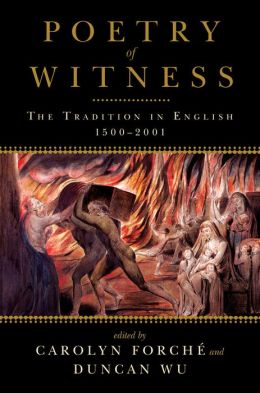
Ian Duhig has recently written for Poetry London about the genre of ‘poetry of witness’ (Poetry London). In 2014, Carolyn Forche and Duncan Wu edited The Poetry of Witness: The English Tradition, 1500–2001 (Norton) and the genre was there described as a tradition that runs through English-language poetry: “composed at an extreme of human endurance – while their authors awaited execution, endured imprisonment, fought on the battlefield, or labored on the brink of breakdown or death”. Though Duhig’s discussion raises doubts about both the genre itself, this definition, and its ethical stance, the two poems I discuss here are surely examples of it.

poetry-of-witness-cover

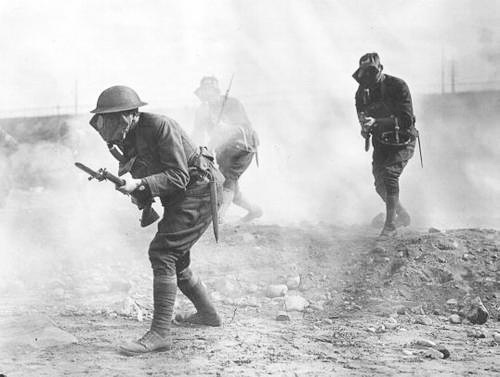
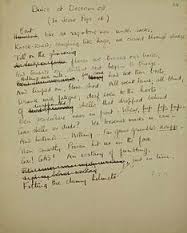
I’ve recently been reading Choman Hardi’s new collection and the link with Owen’s very well-known (well-studied) poem is obvious. Choman Hardi’s poem ‘Gas Attack’ comes from the ‘Anfal’ sequence in her recent book, Considering the Women (Bloodaxe, 2015). The narrator is a woman whose community is bombed by the Iraqi state in the notorious attacks on the Kurdish people in 1988. Wilfred Owen’s famous poem (‘Dulce et Decorum Est’) draws on his experiences of trench warfare on the Western Front in World War One. Owen’s title is a reference to Horace’s Odes (III, ii l. 13), the full phrase translating as “Sweet and fitting it is to die for one’s country”. It is this sort of ardent, patriotic jingoism that Owen looks to counter in the poem as it is the world’s blindness to real events in Kurdish-Iraq that Hardi wishes to correct.

Structurally both poems are similar in that they open by setting a scene of relative calm even suggesting the ordinariness of what, to most readers, must seem extraordinary. It is into these already difficult situations that the gas attacks fall and both poems (Owen’s at greater length) detail the nature of the attack and some of its immediate effects. Both poems have a third and final part in which they focus on specific victims. In Hardi’s poem this is the son of the mother narrator; in Owen’s case it is one of the gas-affected soldiers, flung onto a “wagon”, and suffering the agonizing effects of the gas. So both poems open, in effect, making use of a wide-angled lens but proceed to focus on individuals and this reflects the shared intention of both authors to elicit understanding and sympathy from their readers. It is Owen who makes this purpose more explicit in the final, bitter address to “My friend” (possibly the jingoistic writer, Jessie Pope, the original dedicatee of the poem).

imgres
Choman Hardi

The scene set in ‘Gas Attack’ is of the routine persecution of the Kurdish people under Saddam Hussein. The deliberate plainness of the opening line (“Bombs could fall anywhere, any time of the day”) with its repetition around the caesura suggests this – as does the unruffled sense given by the line’s end-stopping. The statement that such events are to be regarded as a mere “nuisance” that can be “got used to” wrenches the reader away from the more usual evaluation of such events into a world where these things are everyday incidents. There is however something proleptic about the awkwardly enjambed breaking of line 2, the reference to “shelters” and the unease implied by words like “haunting” and “muffled”. This is confirmed (after 2 more run-on lines) by the deliberate puzzle that the explosions “deceived us”. The faint personification here and the idea that explosions (surely pretty straightforward things) might have the capacity for deception alerts the reader, creating tension: in what way are these explosions unlike other explosions?

gas_attack_WW1

Owen’s opening 8 lines are immediately more harsh and noisy though even here there is some sense of routine in that the retreating men “marched asleep” (from fatigue and perhaps on ‘automatic pilot’). The fact they are heading for “distant rest” invites the reader to some mistaken sense of ease (no doubt reflecting the feelings of the men themselves as they march away from the Front Line). But through figurative language and physical positioning, Owen’s men are more distressed than Hardi’s Kurdish woman: “Bent double, like old beggars under sacks, / Knock-kneed, coughing like hags, we cursed through sludge”. Like Hardi, Owen also uses the word “haunting” but here for distant flares falling and the brief, stumbling phrases of lines 5-8 reflect the men’s difficult progress. Such devices elevate the reader’s anticipation of drama to come though again, on the surface, the men have “outstripped” shells (Five-Nines) that are dropping “behind” them. Their deafness to the sound of these shells on one side suggests their (safe) distance from them, on the other, “deaf even” (my italics) implies potential danger to come from this source.

WAR & CONFLICT BOOK ERA: WORLD WAR I/THE FRONT

Owen’s lines on the attack itself are a nightmare of panic initiated by the exclamatory, capitalized shouts of the men: “Gas! GAS! Quick, boys!” This is an “ecstasy” in that their consciousness is so agitated and extra-ordinary that they feel to be watching themselves as in an out of body experience (ex-stasis). Their flurry to don gas masks is suggested by 6 present participle verbs in as many lines though most of these are equally descriptive of the poor individual who fails to get his mask on fast enough. Figurative language conveys his agonising plight as he is “like a man in fire or lime” and he moves “As under a green sea [. . . ] drowning”. By contrast, the impact of the attack in Hardi’s poem is at first a strange calm, once again related to the deceiving nature of these Iraqi bombs (thought to be conventional; in reality chemical weapons). Owen’s men are familiar with these chemical weapons; Hardi’s Kurdish community is not – yet.

imgres

There is still no shift to the level tone of Hardi’s poem, even as the mother narrator observes how “a chalky-yellow powder settled // on our skin”. These lines seem to extend time agonisingly for the reader who, aware of the topic from the plainly informative poem title, waits for the narrator to comprehend events. In contrast to Owen’s figurative language of pain by fire and water, Hardi’s narrator’s ignorance (and therefore her innocence) is caught in her image of the powder “smelling of sweet apples at first” and it “seemed safe”. It’s the caesura of line 8 that marks the transition from ignorance to knowledge as the impact of the gas is evoked (again through a series of active present participles (going, laughing, buckling, twisting running, bumping)). The people’s erratic, tortured behavior has a black comedic, or surreal, quality which probably suggests the few shreds of the observer’s naivety (something Owen’s more experienced narrator never expresses).

In a notable contrast between the two poems, lines 15/16 of ‘Dulce et Decorum Est’ break from the retrospective narrative into the present tense (“I saw him [. . .] He plunges”). The lines provide another image of sight, perhaps launched partially by the heightened visual quality of the glimpse of the man “through the misty panes” of the narrator’s own mask. But in these lines the “helpless sight” is one derived instead from dream-vision and memory. The fact that, at an undefined moment after these events, they still haunt the narrator gives additional weight to the horrors unfolding in the past tense narrative.

daf16862692e4bb2a52873a4ec3c9bc5

This is not something Hardi’s poem does and to this extent Owen’s narration is more complex, implying an attitude towards the events which emerges most obviously in the long single sentence of lines 17-25. The third section of Hardi’s poem continues with the level-toned witnessing: “Villages from the region came to our aid”. At first it seems curious that they are the ones to draw attention to the narrator’s son who “looked strange”. At this point it is almost as if the mother does not want to refer to her son’s injuries, a kind of denial, though eventually it emerges that it is her own blindness (as a result of the chemical weapon) that has actually prevented her even seeing its effects on her son. The boy’s strangeness is conveyed in the plain statement that “his face was blistered, blackened” but also through the strange phrase (difficult to visualize) that it was “as if his eye-colour had spilt // out”. This probably refers to the “blackened” image but also suggests the physically horrific melting of eye-balls not unlike Owen’s “white eyes writhing” and the dissolving of “froth-corrupted lungs”.

Hardi continues to hold back the fact of the mother’s blindness which accounts for the recourse to the aural image of the boy’s groan “like a calf faced with the knife”. This in turn conjures up Owen’s opening to ‘Anthem for Doomed Youth’: “What passing-bells for these who die as cattle?” I don’t see influence here other than the fact that both writers are wanting to evoke sympathy by drawing attention to the dehumanising impact of warfare’s mass slaughter. Hardi’s narrator finally reveals her own injury (“I was still blind”) and after another run of destabilizing enjambment (ll. 11-14) the last line is more heavily punctuated, slowing and emphasizing and again keeping the tone level and factual: “he / died, [I] could not see him, did not say goodbye”. The mother’s passivity is very prominent; her hopelessness is what expresses her grief. It is as though the continual persecution and horror has left her drained even of the energy to mourn with passion.

Owen

This is obviously very different to the passionately angry conclusion of Owen’s poem. Owen’s focus on the dying soldier begins at line 17 but its vivid descriptions of the man’s death are already contained within a hypothetical syntax – a point is evidently being made with the surprising appearance for the first time of the second person pronoun (“you”). Far more assertively than Hardi’s poem, Owen demands his readers, those who knew too little of the realities of warfare in 1918, put themselves in a position of greater insight: “pace / Behind the wagon that we flung him in, / And watch”. Likewise Owen does not pull punches in terms of the gruesome description of the soldier’s suffering with his “writhing” eyes, his “hanging” face (upside down, hanging off the wagon?), his “gargling” lungs. The two similes he introduces achieve the same levels of hyper-intensity with the suffering “as cancer” (obscurely or – in another draft – obscenely) and the blood in his throat like a “cud”, yet another livestock allusion to match Hardi’s doomed “calf”. The cud on this occasion is itself developed metaphorically into “vile, incurable sores on innocent tongues”, further emphasizing the appalling injustice of this slaughter.

It’s at line 25 that the “you” is addressed more directly with the ironically amicable “My friend”. The “zest” and “arden[cy]” of those eager for patriotic glory is mocked (“glory” rhyming with “mori”) but the potentially ‘hedging’ effect of these ironies is vigorously and fiercely pushed aside by the plainly monosyllabic description of the Horatian tag as “The old Lie”. Owen’s poem takes the reader into the trenches, to the post-traumatic world of nightmares, but also manages to encompass this declarative, even propagandist, point. Likewise, Hardi’s poem plunges us into the gas attack and its aftermath but never ventures into the same argumentative, passionate point-making. Her decision to allow the details of this poem to speak for itself is a brave one (of tone and manner) given the horrors of which it speaks and the author’s evident commitment to bringing them to notice.

imgres