More than 10 years of blogging on poetry and translation – over 39,000 views in 2024 – now captured and preserved at the UK Web Archive: 'one of the top 10 poetry blogs' (Rogue Strands)
The Form: I wanted to share here some thoughts on my experiments with the form of the abecedary. An abecedarium (or abecedary) is originally an inscription consisting of the letters of an alphabet, listed in order. Abecedaries were often practice exercises, teaching aids, but also developed as an ancient poetic form guided by strict alphabetical order. The earliest examples are Semitic, found in religious Hebrew poetry and the form has been used in various cultures for prayers, hymns, and psalms. Psalm 118 (or 119 by King James numbering) consists of twenty-two eight-line stanzas, one for each letter of the Hebrew alphabet. Chaucer’s An ABC is a medieval example of the form. Some abecedaries found in the Athenian Agora appear to have been left deliberately incomplete and the imperfection of these examples may have had a magical or ritual significance.
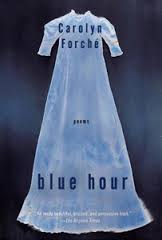
For those who have come across this form in contemporary poetry at all, it was probably (as in my case) through the poem called ‘On Earth’ in Carolyn Forche’s Blue Hour (Bloodaxe, 2003). I reviewed the book in some bewilderment at the time (see below) but have since come to see it more favourably. Forche herself says: “Gnostic abecedarian hymns date from the 3rd century AD. Along with Christian and Buddhist texts, they were recovered from small towns on the northern fringe of the Taklamakan Desert, early in the 20th century”. She also links the form with the idea of the pleroma, defined as the totality or fullness of God’s creation, the One. Over the 46 pages of ‘On Earth’, she adheres rigorously to the form in which alphabetical order guides not only the stanzas, but also the words opening every single line:
languid at the edge of the sea
lays itself open to immensity
leaf-cutter ants bearing yellow trumpet flowers along the road
left everything left all usual worlds behind library, lilac, linens, litany
Poets.org says that abecedaries are now more commonly used as mnemonic devices and word games for children such as those written by Dr. Seuss and Edward Gorey. A derivative form is the much more familiar acrostic.
From my 2003 Review: The book contains 11 pieces in 65 pages, 46 of which are taken up with the long poem ‘On Earth’ and phrases do echo throughout the poems so there is a sense of unity to the whole. For the most part, Forche writes by assembling fragments and images, often without clear syntactical or narrative connections to surrounding lines. The reader experiences the verse as successive waves (lines stretch across the page and usually come in twos or threes), or as threads floating disconnectedly, but creating a striking impression of beauty. Forche’s obscurity comes more from an unshakeable confidence in her project, in her voice, in her idiosyncratic style and in her subject, largely concerned with the significance or recovery of the past in the present moment.
My difficulty with what Forche does is that all kinds of experience seem to be subjected to the same treatment, so that in the end the reader swims through an undeniably glittering, but rather gloopy, phenomenological soup in which “a city a thousand years” has the same weight as “a field of birds roasted by the heavens”, which has an equivalence to “a sudden reticence that seizes the heart”. All of the material – several deaths, the madness of a grandmother, a mother’s life, early years with a child, Chernobyl, some war-torn territories – is recorded with a swooning sensitivity, a recurring softness of diction and a penchant for grammatical inversion which seems to strain after the poetic: “In the blue silo of dawn, in earth-smoke and birch copse, / where the river of hands meets the Elbe.”
These doubts are brought to a head in the ambitious ‘On Earth’ which is (to quote the blurb) “a transcription of mind passing from life into death, in the form of an abecedary, modelled on ancient gnostic hymns”. The form is an alphabetical sequence and this additional random factor only increases this reader’s sense of a steamrollering of experience to ensure a smooth poetic passage. There is no doubt that Forche can produce some stunning images and when she strings them together in more conventional ways and the reader can hold on to her coat-tails, you can see why her reputation is so high in the U.S.
My interest in abecedaries: Has grown with my interest in looser forms of verse (I have given up on punctuation in most of my own poems these days) alongside a more-than-philosophical sense of the truth of the wholeness of being, reflecting Forche’s idea of the pleroma. This – see Rilke, see the Daodejing – is a condition impossible to be caught in the net of more conventional language and poetic form. Abecedaries encompass the whole alphabet (at least in theory – though I like the idea of the deliberate imperfection; perfection belonging only to God). An abecedary can therefore be seen as an appropriate poetic gesture (futile for sure) towards a unified field, an encompassing of everything, the only true state.
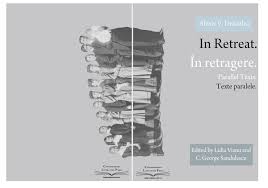
The Material: But the unified field, for an individual human being, must be regarded with some perspective; if this was not the case we would indeed be seeing with the eye of God, with his/her distance and utter impersonality. I wanted to write affective texts. I wanted my abecedary to be (paradoxically) limited. I wanted people in it; even a narrative of events. But all still subject to the demands of the form. I realised I did indeed have some suitable materials to hand. I had been asked by Professor Lidia Vianu, of University of Bucharest, to assist with the translation into English of several short stories by the relatively unknown Modernist Romanian author, Mihail C Vladescu. He published a collection of eight stories, In Retreat, almost 100 years ago. These are stories written in war-torn Eastern Europe but more significantly, Vladescu forensically portrays the sense of corruption in his society, with materialistic motives and adulterous behaviour most prominent. It seemed to me, and not merely because the centenary of the First World War is still in process around us, that this was material worth working on. I thought Vladescu’s relative obscurity to an English-speaking readership was also an advantage in such an experiment.
The Process: I selected phrases as far as possible randomly from the prose translation. These were then ordered alphabetically (via Excel spreadsheets) and subjected to as little editing as possible, though I have sectioned and created stanzas where it seemed best. Not surprisingly, my abecedaries are incomplete (x and z are more often than not the Persian flaws in the poetic carpet).
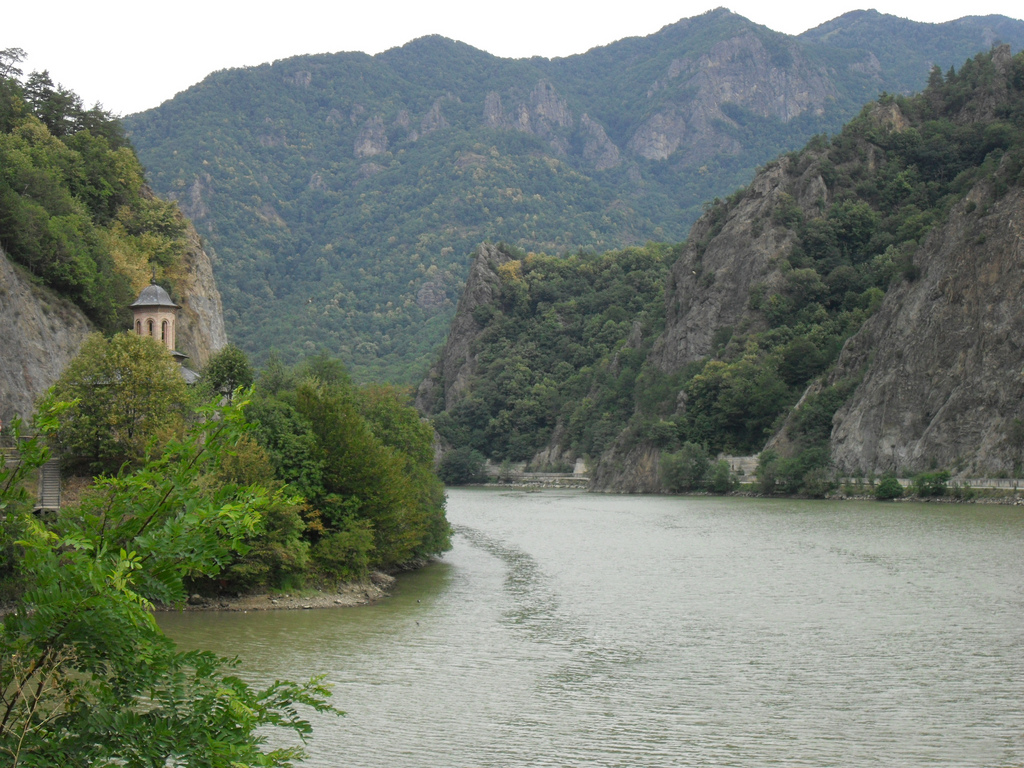
The results? Over the next 6 days I will post up the full 7 sections of my abecedary ‘Bathing in the Olt’ (from Vladescu’s original story called ‘Bathing’) and any observations would be welcomed. The text has already appeared in full in Shearsmanmagazine, 103/4, April 2015.
Click here to see each section posted: #1 / #2 and #3 / #4 / #5 / #6
With his death a few weeks ago, I have been re-reading Tomas Transtromer’s work and the first place to go (after the poet’s own website and video) is, of course, Robin Fulton’s comprehensive collection from Bloodaxe. But I have been comparing Fulton’s translations, which seem very faithful if a bit unexciting, to several done by Robin Robertson as published by Enitharmon in 2006.
Robertson bills his 14 pieces (presented usefully as a parallel text with the original Swedish) as ‘versions’ or, in the acknowledgements as “imitations”. There seems to me a good deal more vigour and poetic heft to Robertson’s versions, but it’s not immediately clear how many liberties he is taking with the originals and it’s interesting that Fiona Sampson suggests the Swedish writer has been an important influence on Robertson. In what follows I’m looking closely at just one poem from both translators (by the way, I don’t have any Swedish except what a dictionary can give me; nor have I ever made any academic study of Transtromer’s work).
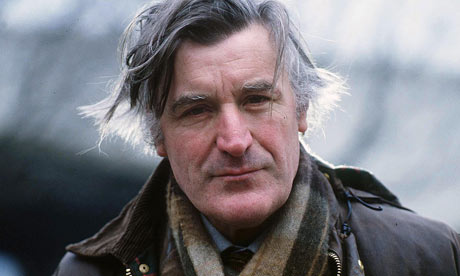
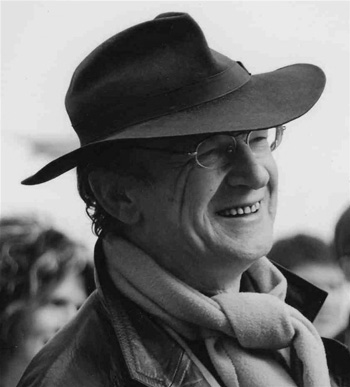
Tomas Transtromer, an early photograph
‘The Couple’ first appeared in Transtromer’s collection The Half-Finished Heaven (1962). It’s a distanced study of love (over three quatrains) as a couple turn out the light in a hotel room and, after making love, they sleep. In the third quatrain, darkness and unilluminated houses gather about them as if to watch or bear witness or threaten. Fulton’s opening is very plain and factual: ‘They switch off the light and its white shade / glimmers’. Robertson’s version feels more vivid though it does have a stagey-ness about it, the light becoming the slightly archaic ‘lamplight’ and the plain shade elevated to a ‘globe’. This theatricality is developed in Robertson’s version and is to some degree justified by the final image of the poem where the outer night transmutes to watchers, almost to an audience. But as far as I can tell, this trope is not made much of in the original until that last image.
Transtromer develops the fading of the extinguished light in a striking image of it as a dissolving pill or ‘tablet in a glass of darkness’ (Fulton). In the original, the simile is clearly marked and plainly given but Robertson adds a colon and allows the metaphor a good deal more space: ‘an aspirin rising and falling / then dissolving in a glass of darkness’. This is again vivid, visual, though perhaps the dissolving pill image takes over too much from the idea of the fading out of the electric lamp. The original has nothing of this energetic dissolving of the pill with its up and down movement (and does Transtromer’s tablet carry more weight of darkness than Robertson’s headache-curing ‘aspirin’?). The rising and falling image may have come from Transtromer’s next phrase: ‘Then up’ (Fulton). Turning the line ending, this becomes clearly linked with the rising up of the hotel walls (presumably in the couple’s perception, as the light fades and darkness asserts itself). This brief, even curt phrase is isolated between full stops and Fulton follows this and seems to be responding to the signals of the original in terms of the couple’s alienated, isolated experience, with language itself fragmenting to reflect that. Robertson differs again, lengthening and making more elegant the end to quatrain 1. He also introduces another theatrical reference not present in Transtromer’s original: ‘Around them, / the hotel walls slide like a back-drop up into the night sky’. Against Transtromer/Fulton’s jagged, uncomfortable process, Robertson’s walls rise more smoothly, the logic of his image suggesting they more fully establish a scene, rather than imprison. Again Robertson’s version is visually more pleasurable but on second or third thought, how many back-drops have you seen rise from the floor, going upwards?
Quatrain 2 opens apparently after the couple have made love. Fulton again seems to follow the plainness of the original with ‘The movements of love have settled’. ‘Subsided’ might have been a better word but it’s hard to judge whether the strangeness of this is in the translation or the original which does seem to want to describe the couple’s intimacy from a frightening distance. Robertson’s theatrical imagery recurs with ‘Love’s drama has died down’ which also distances the intimacy, though in a different way, gesturing towards the hollowness of romantic cliché rather than Fulton’s ‘movements’ which suggests a more completely meaningless activity. There’s not a lot to choose between the two versions in the remainder of quatrain 2 as the couple’s ‘dreams’ (Robertson) or ‘most secret thoughts’ (Fulton – this is pretty literal) are said to meet (Transtromer repeats the word ‘meets’ here) like colours blurring in a child’s painting. For Robertson, the colours ‘meet and bleed’ whereas for Fulton they ‘meet and flow’. ‘Bleed’ is a powerful word choice of Robertson’s here but again I wonder how right it is as the evocation of a wound in this middle quatrain where (if anywhere in this tough little poem) there seems to be some suggestion of communion, some sort of meeting of human lives.
The end of the poem is fascinating. Transtromer’s original has 5 brief, buttoned-down sentences, again reflecting the fragmentation I spoke of earlier. All is dark. The city draws close. Windows are unlit. The houses approach. They crowd in close, waiting, expressionless. Fulton – as we have come to expect, follows this faithfully but at the expense (for me) of some sensitivity to the ebb and flow of line endings, to the sonic dimensions of a poem (which in being brought over into English from Swedish have to be re-made, re-heard):
It is dark and silent. But the town has pulled closer
tonight. With quenched windows. The houses have approached.
‘Quenched’ windows? In contrast, Robertson, again smoothes and unroughens, but like a good jazz band, his words are listening to each other better than Fulton’s are:
All around is dark, and silent. The city has drawn in,
extinguishing its windows. The houses have approached.
Robertson’s vivid animation of the city-scape is more thorough and convincing at this point and, in the poem, that is important.
The final lines bring the houses even closer to the couple with faces expressionless (Transtromer’s word here is ‘uttryckslösa’ = expressionless or deadpan) and in an attitude of waiting (‘vantan’ = to wait or anticipate). Fulton again conveys the meaning well enough, though there is some sense of redundancy with both ‘throng’ and ‘crowd’. The problem for me is that it is hard to catch the significance of the ‘expressionless’ faces here:
They stand close up in a throng, waiting,
a crowd whose faces have no expressions.
To ‘have no expression’ is a profoundly neutral way of saying ‘expressionless’ and Fulton often goes for something like this, not quite daring to leap towards a more focused (I suppose I mean interpretative) word choice. This is not something Robertson ever seems reluctant to do – perhaps behind the defence of his poems as ‘versions’, gifting him greater freedom (a little less responsibility?) than if he’d declared the full ‘t’ word, translation. Robertson goes:
They crowd in close, attentive:
this audience of cancelled faces.
This is wonderfully economical, with a good play of vowel and consonant music, although ‘attentive’ is more neutral than waiting or anticipatory. Both ‘audience’ and ‘cancelled faces’ are dramatic choices. In one sense they complete the decision Robertson makes to bring the theatrical imagery far higher in the mix than in Transtromer’s original; the couple’s lives are performances though the only audience they have is the featureless and expressionless city about them. But ‘cancelled’ is also a surely over-dramatic in suggesting the faces have suffered (see ‘bleed earlier’) some mysterious trauma whereas in Fulton (and I think in Transtromer) the waiting a faces are merely empty, indeed, perhaps waiting to be filled.
Transtromer’s poem has a poignancy derived from the fact that the couple’s love-making, though distanced and close to meaningless in the great scheme of things, is perhaps the only possible source of meaning/expression in a largely unresponsive world. Robertson’s version manages to turn the dramatic volume several notches but in doing so pushes out to the extremes. His poem suggests an even bleaker diagnosis in which human activity is nothing but theatricality, stage sets, drama, while any potential audience or act of witness that might be possible involves only those whose faces and identities have already been wiped.
The Verdict: actually I set out preferring Robertson’s version because it garnered a more immediate response from me with its obvious sense of drama. On reflection – and looking more closely (as far as I’m able) at the original Swedish – I think Fulton is closer to the source (and therefore his poem reads more strangely, less easily, than Robertson’s). It’s this kind of frustratingly equivocal conclusion that makes those who fancy themselves as translators think it’s worth having yet another go at bringing a poem across into English. Just to throw a curved ball in right here at the end, here is Robert Bly’s translation of the same poem . . . declare your preference!!
They turn the light off, and its white globe glows
an instant and then dissolves, like a tablet
in a glass of darkness. Then arising.
The hotel walls shoot up into heaven’s darkness.
Their movements have grown softer, and they sleep,
but their most secret thoughts begin to meet
like two colors that meet and run together
on the wet paper in a schoolboy’s painting.
It is dark and silent. The city however has come nearer
tonight. With its windows turned off. Houses have come.
They stand packed and waiting very near,
a mob of people with blank faces.
Our swifts returned two days ago – the 10th of May – now they are now installed, screaming around the terrace row, occupying the air over this little patch of north London. No better tribute to their speed, power, heroic journeying and the pleasure given by their return than Ted Hughes’ poem from Season Songs (Faber, 1976):
Swifts
Fifteenth of May. Cherry blossom. The swifts
Materialize at the tip of a long scream
Of needle. ‘Look! They’re back! Look!’ And they’re gone
On a steep
Controlled scream of skid
Round the house-end and away under the cherries. Gone.
Suddenly flickering in sky summit, three or four together,
Gnat-whisp frail, and hover-searching, and listening
For air-chills – are they too early? With a bowing
Power-thrust to left, then to right, then a flicker they
Tilt into a slide, a tremble for balance,
Then a lashing down disappearance
Behind elms.
They’ve made it again,
Which means the globe’s still working, the Creation’s
Still waking refreshed, our summer’s
Still all to come —
And here they are, here they are again
Erupting across yard stones
Shrapnel-scatter terror. Frog-gapers,
Speedway goggles, international mobsters —
A bolas of three or four wire screams
Jockeying across each other
On their switchback wheel of death.
They swat past, hard-fletched
Veer on the hard air, toss up over the roof,
And are gone again. Their mole-dark labouring,
Their lunatic limber scramming frenzy
And their whirling blades
Sparkle out into blue —
Not ours any more.
Rats ransacked their nests so now they shun us.
Round luckier houses now
They crowd their evening dirt-track meetings,
Racing their discords, screaming as if speed-burned,
Head-height, clipping the doorway
With their leaden velocity and their butterfly lightness,
Their too much power, their arrow-thwack into the eaves.
Every year a first-fling, nearly flying
Misfit flopped in our yard,
Groggily somersaulting to get airborne.
He bat-crawled on his tiny useless feet, tangling his flails
Like a broken toy, and shrieking thinly
Till I tossed him up — then suddenly he flowed away under
His bowed shoulders of enormous swimming power,
Slid away along levels wobbling
On the fine wire they have reduced life to,
And crashed among the raspberries.
Then followed fiery hospital hours
In a kitchen. The moustached goblin savage
Nested in a scarf. The bright blank
Blind, like an angel, to my meat-crumbs and flies.
Then eyelids resting. Wasted clingers curled.
The inevitable balsa death.
Finally burial
For the husk
Of my little Apollo —
Last Saturday I travelled down to Chepstow to read at an event organized by William Ayot who, with his wife Juliet, runs the On the Border series of readings. They tend to bill a Welsh poet with A. N. Other; I was the latter and Richard Gwyn the former. Richard runs the Creative Writing MA at Cardiff University and is a brilliant poet and translator from the Spanish (especially South American poetry). He read some heart-stoppingly powerful new work from three Mexican poets recently published in Poetry Walesand some of his own prose poems from Sad Giraffe Café (Arc Publications). I read frommy translations of Rilke’sSonnets to Orpheusand also extracts from The Time We Turned.
Richard Gwyn
On the train down I was again reading Lee Harwood’s work (see my last blog post) and came across ‘Days and Night: Accidental Sightings – a bundle of 50 sticks for Joseph Cornell and others’. I’ve put together my own loose bundle of sticks as a modest thank you to William and Juliet for their hospitality in their extraordinary house, their passion for poetry in its widest sense, and that marvellous coronation chicken!
A bundle of 50 sticks for William and Juliet
At the track side willow belts always unkempt trunks leaning some broken
*
luminous blue sky in early May
*
On a diversionary loop the train slows as if to allow the doe standing knee deep in meadow grass to watch us as we pass we watch her
*
She wears muddy walking boots and has brought out a flask of something hot
*
clipping tickets he is careful to be polite though from those upgrading to First Class he has had money already
*
‘why do you do this’ the effect is never quite the same twice
*
In a faded green t-shirt a man walking with arms folded across his chest as if he had breasts he hoped to steady
*
mud-brown canal waters held eight of nine feet high behind a lock gate
*
An upturned wheelbarrow on a long houseboat its purple paint job a statement of optimistic intent
*
Words carve out sense as tractor tyres embrown the field’s new growth each year their lines down the hillside conclude at an iron gate
*
I feel with each mile nearer home I mean nearing the place I grew up in
*
Hills like the scarp edge of Salisbury Plain wait O this is not a likeness this is ‘the actual place’
*
a diversion to a chalk white horse full of memories
*
the Tory heartlands a tractor slowly turning over the ground
*
I ring home and wake my sleeping parents
*
‘Let’s make flying fun again’
*
a basket of split logs waits for the fire
*
On a wooden writing desk three animal skulls
*
‘quietude not inquietude’
*
Nine owl feathers in a china mug a sort of chalice
*
A glazed bowl with an assortment of matte pebbles from the beach
*
His son spoke out but the police were in bed with the FARC who saw to it he and his friends were tortured and killed can you believe it
*
I like to work I prefer to work with those who want to want to stop
*
a tall poplar tree like an exclamation mark he wrote as if to say this is it
*
One skull another skull then another skull beside another skull
*
rose gardens and orchards
*
If they haven’t killed enough by their early 20s they’re losers whose life expectancy is anyway no more than 24
*
Down to the underworld but returns if somewhat empty-handed he does return
*
mausoleums for themselves a cult of death
*
Bluebells in the hedgerows on either side of the road
*
left hand short by two digits his wife’s wrist broken by a fall
*
shut-eyed Blake above the flat-screen TV seems to offer the room a challenge
*
the watercourse way
*
Everything is a fiction the novel in your shoulder bag is the bank statement you use as a bookmark inside it that too
*
The narrative of the oh-eight crash there are other ways for it to be recounted that’s not a joke
*
Oppositional to a large degree I guess we are not pebbles from the same beach but it’s more than just rubbing along
*
A chimney balloon
*
On-line so many ‘friends’ devastated by the surprise results
*
It’s staying in places like this makes me feel a Londoner
*
He waves his paddle to let the train go then flips it up inside the back of his orange hi-viz jacket and pushing the handle into his back pocket it’s safely stowed
*
A speck of thistledown drifting up the aisle
*
attentiveness
*
banked blue rectangles squat in meadows to scoop the sunlight
*
Dirt is matter out of place but this is not dirt it is marvelously out of place
*
Red kite above the monkey puzzle
*
on an elevated hillside ahead yellow rape now level with me receding away behind
*
In tunnels my ears close as if valved
*
either that or everything is a metaphor I see myself turning socks inside out little involved packages
I’m ashamed to confess I’ve read little of Lee Harwood’s work before, though I’m sure my old friend and poet Keith Jebb has been telling me to do so for years. Since finding this book, I’ve rushed on to the Shearsman Selected Poems with great excitement. Lee Harwood was born in 1939 and grew up in Surrey. He has spent the majority of the past 35 years living in Brighton. In a writing career that began in the early 1960s, he has published over 20 volumes of poetry and prose, as well as translations of Tristan Tzara. His work has been widely anthologised and his Collected Poems (also Shearsman) appeared in 2004.
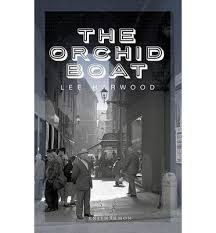
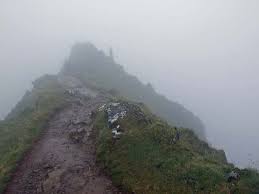
Exterior shots in The Orchid Boat (published by Enitharmon) are full of sketchy paths, remote horizons, fogs and mists; similarly, interiors sway, hide or semi-reveal with fabrics, curtains, drapes, dresses, veils. Come to think of it, these latter images are exactly right for much of Harwood’s work as the reader seems often to be moving through lucid, well-lit spaces that are partially obscured by hangings, veils impossible to identify with any clarity, suspended above, but from what and to what end is unclear. On the other hand, I don’t want to suggest that your reading of these fantastic poems will be a disembodied or disembodying experience: Harwood is a very sensual writer and I can feel the stones on his paths beneath my feet, the heft of his furniture, the texture of a dress. If veils do fall about me they are always specific, as tactile as they should be, silken, velvet, embroidered, studded with glass and jewels. There is so much to enjoy on the journey.
One of the more subtle, ironising veils Harwood deploys is his habit of enclosing lines in inverted commas. Here’s the opening of ‘Ornithology’: “A wall of dense fog ahead / – blocked, all knowledge denied. / ‘The flying bird brings the message.’” In some writers, such a device would read as an abstracted and overly-intellectual exercise in confronting one discourse with another, but Harwood’s use of it is always far more human. There is a dialogue implied, a companionship, or at least an internal conversation occurring. The intended effect is achieved but is something as much felt as understood: a destabilising of the objective view and, of course, this is what all the fog and mist is about. World is hard to know. But Harwood’s birds, to take one example, though they may be remote and elusive, are definitely there: “As the mist shifts you see swallows set on a wire, / a wagtail bobbing on a rock”.
Uncertainties in The Orchid Boat are temporal as well as spatial. In ‘New Zealand Playback’ voices are cross-cutting again: “‘I don’t want to be here’ // stumbling around in and out of history. // No answers to that one. // ‘You should get out more.’” The latter phrase also suggests one of the things I really like about Harwood’s work: it never wanders far from the spoken, colloquial voice, however complexly layered the over-arching arrangement of phrases may be. The poems explore what can be known and what cannot and the resulting movement is to “Zig-zag around, as usual” as ‘Sailing Westwards’ expresses it. The voyage, the far horizon, appears to be one way of putting it; the mountain path with its uncertain fog-shrouded cairns, is another. Either way, the one certainty is that “We just don’t know the full story”.
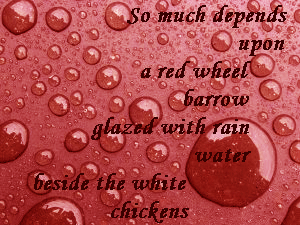
The orchid boat itself is brought into view in the beautiful poem ‘Departures’. A summer night, the sound of rain, swaying curtains, a female voice, an implied intimacy between a man and a woman, but perhaps all this was “years ago”. Yet even if a memory, it is vivid as in a mirror. But such reflections are already one step away from the thing itself and there rises the lure of fixing such experiences, our human need to do so. It’s in this context that the orchid boat appears to represent the workings of our desire to protect the provisional nature of what we know and feel. “How to imagine an orchid boat? / It gets harder. But days come and go”. The boat, always boarded without “thinking” over much, carries us “beyond all mirrors”. Though age seems to increase the allure of fixity (we grow more frightened as we grow old), Harwood believes both age and childishness are states of mind rather than temporally-defined cell blocks. So ‘Childish’ presents a free-running phantasmagoria of Wordsworth-worth cleansed perceptions, concluding: “the red handrail of the pagoda / glistens with raindrops”. There goes the ghost of Carlos Williams’ red wheelbarrow too.
Indeed, Williams is a better comparison than Wordsworth. Harwood is often associated with the New York School, with Frank O’Hara and John Ashbery. Personally, I’ve always found Ashbery’s work hard to like much because (actually more like Wordsworth) there is too much of the egotistical, of the centripetal force, too much pressure from within, too little from without, too much abstraction. I prefer the way Harwood’s poems float more centifugally. They travel outwards spatially, to and fro temporally: “I’ll stamp my foot / and, checking the rear-view mirror, / head for the frontier” (‘The Books’).
There is in Harwood always the desire (and it is partly erotic) to tune in to the fullness of experience, its full presence and contradictoriness: “To stand back from the bare times – alive and alert” (‘Palaeontology’). The adjective “bare” here probably means that slimmed-down, rationalised, processed version of human experience we glide absent-mindedly though every day (a processing done in large part through the magical powers of language). In the same vein, ‘A Steady Light’ evokes the dusty orderliness of a museum with its “robes and rituals and attempts at clarity [. . . ] all copied, copied again, amended, copied again”. In the face of such suffocating restriction, to be “alive and alert” is an aspiration for Harwood, a daily hope, an occasional thrill, an anticipation of the drawing of the veil:
A curtain stirs in the tired room
while the same breeze slowly shifts
the hangings in the nearby hospital.
Distant sounds from the streets below.
Get up from the couch or chair.
Walk across the room to stop by the window.
The air heavy with the heat of summer.
Much more of Harwood’s work is available through Shearman who publish his Selected as well as a Collected 1964-2004.
Another review of The Orchid Boat, by Robert Sheppard, is available here
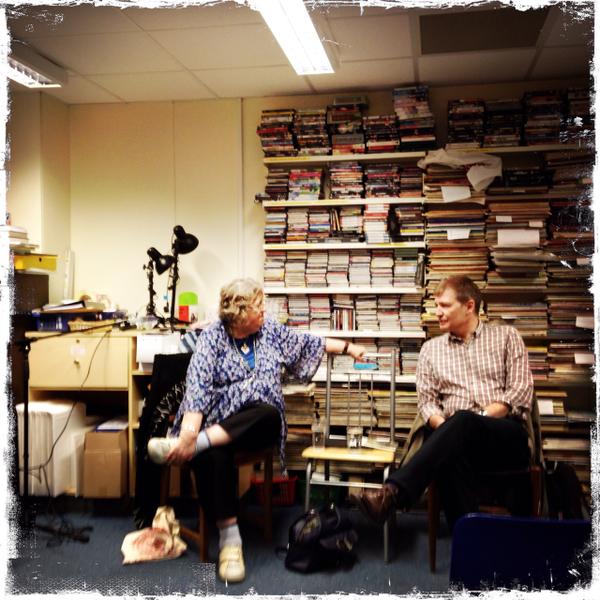
Piles and piles of books: literally covering the walls of the room. Shelves labelled children’s books, philosophy, modern novels, poetry, drama, politics – my eye catches a tottering stack of those old Ladybird books I used to love to read as a kid: evocative pictures of Stone Age man bringing down a mammoth, of happy passengers on modes of public transport, of prisoners from the American Civil War. Well OK – the back room of an Oxfam book store may not seem the most pre-possessing place to listen to poetry, but there are worse, such as scrubbed-sterile galleries, cramped cellar-spaces, overly reverent thee-ay-ters, noisy pub rooms. This place – it’s in Cheltenham town centre, at the Poetry Festival – has the live feel of untidy contingency, of work in progress, a vibrant culture that is literate, ideas and books readily swopped to and fro. That feels right. Piles and piles of books in transit from one hand to another.
Olivia Byard and MC at Cheltenham Poetry Festival
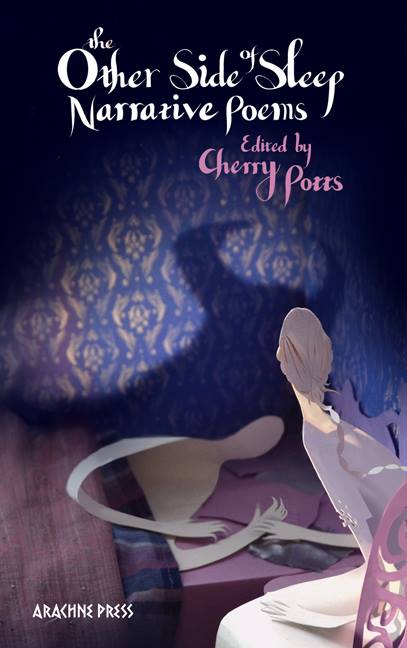
I was there on Saturday afternoon reading with Olivia Byard, both presenting work from the great Worple Press. Following our own performances there was the launch of The Other Side of Sleep, an anthology devoted to longer narrative poems. Published by Arachne Press, it’s intended as a welcome antidote to all those competitions that stipulate the standardised ‘no more than 40 lines’. Cherry Potts, the editor, introduced several voices. Jeremy Dixon read an entertaining piece about serving customers in Boots which was funny and (appropriately) repetitive – “Would you like a bag with that? Please enter your PIN”. Apart from writing his own work Jeremy produces intriguing, limited edition books at Hazard Press. Kate Foley was disappointingly unable to read her long poem (a double disappointment to me as she had also been unable to attend the recent Torriano Poetry Competition award evening I hosted in London (read my blog about the evening here).
Angela France read a fascinating poem about a story teller’s life that she cast in the form of a crown of sonnets, or corona. Wikipedia: a sequence of 14 sonnets concerned with a single theme, each linked to the preceding and succeeding sonnets by repeating the final line of the preceding sonnet as its first line. The first line of the first sonnet is repeated as the final line of the final sonnet, thereby bringing the sequence to a close. She read beautifully and with great pacing and conviction. Math Jones (a self-declared pagan) read from ‘Grithspell’, full of declarative lines and much spitting in which gods (rather belligerently to my ear) declared an end to war. In contrast, Bernie Howley (a relative new-comer to poetry) read ‘I Have No Feet’, a poem about leaping off a cliff into an Italian pool, while just behind her stood a banner with Emily Dickinson’s declaration about feeling the top of your head coming off.
After a coffee break mid-afternoon, an event called ‘The Minotaur is Not a Monster’ featured Myra Schneider (from whose recent Enitharmon book, The Door to Colour, the event title was taken) reading alongside Anna Saunders, poet, Executive Director and Founder of the Cheltenham Poetry Festival. Myra’s work (an earlier book reviewed here) is firmly based in the real world yet capable of addressing the yearnings and concerns of the spirit, as revealed in her reading of ‘Oranges’. In Crete, on one of those coach trips round the island, groups ushered in and out of suitable sites of interest – on this occasion a café and orange grove. As a leaving gift: “a giant orange with bumps, dents, niggles / and an off-beat attempt at rotundity, / a fruit unabashed by its rusticity”. Schneider’s work shares that same unabashed quality as the poem’s narrator later stuffs her mouth with huge orange segments, juice spurting all over the sheets. But this is no sensual liberation (or not that only). The taste is as much evocative of hard work, ritual, friendship, “those rare moments / when silence suspends the ordinary / and the unattainable seems within reach”.
One of Saunders’ poems, ‘Silks’, is rather more steamy in its sensuality and shape-shifting. A female eye; the male as snail, belly down, as “if the earth were using him / for an accordion”. A little stroking makes him “rise”, morph into butterfly, pupa, silk-worm, perhaps back to snail, its trail leaving behind his “pearlescent signature scribbled / from wall to door”. Saunder’s poems are fast-moving, flash-edited, pronouns and main verbs often jettisoned as scurf. She was a bit awkwardly introduced as a poet who had greatly improved – rightly Bernard O’Donaghue has admired her original and fresh technique – and no-one listening on Saturday would gainsay that.
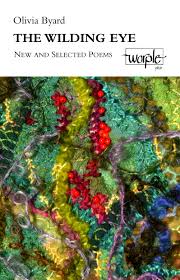
Earlier in the afternoon, Olivia Byard had read from her new and selected poems from Worple Press, The Wilding Eye: here. The title poem boldly trashes thousands of “years of husbandry” (the latter being the right word on several counts) in deciding to allow a manicured lawn to go wild. Within a couple of weeks it bears a “crown” of daisies, a “spurt of purple bloom”. One of the barriers being dismantled here is language as the very word “lawn” is forgotten, enthusiasm ramping up to addiction with each “new fix – of the rough / tough leggy fallow”. This is a ‘zoom’ poem, rapidly propelled without a backward glance towards a new world, ending breathlessly, jaggedly, venturing personal and ecological liberties, “gulping breaths, of sweet riot / and tangle”. Exciting stuff – and appropriate too as Saturday also saw the launch of Dear World, the Festival anthology with a preface by Andrew Motion. It’s sponsored by the Campaign for the Preservation of Rural England (Motion is their current President) and he argues, nodding to Wordsworth and Clare, that “big pictures are made of small details”, the ecological health of our world is reliant on the kind of observational attentiveness reflected in the writing of a poem: “use this book to inspire [. . .] to redouble our efforts to say why the countryside matters, and why it needs defending”.
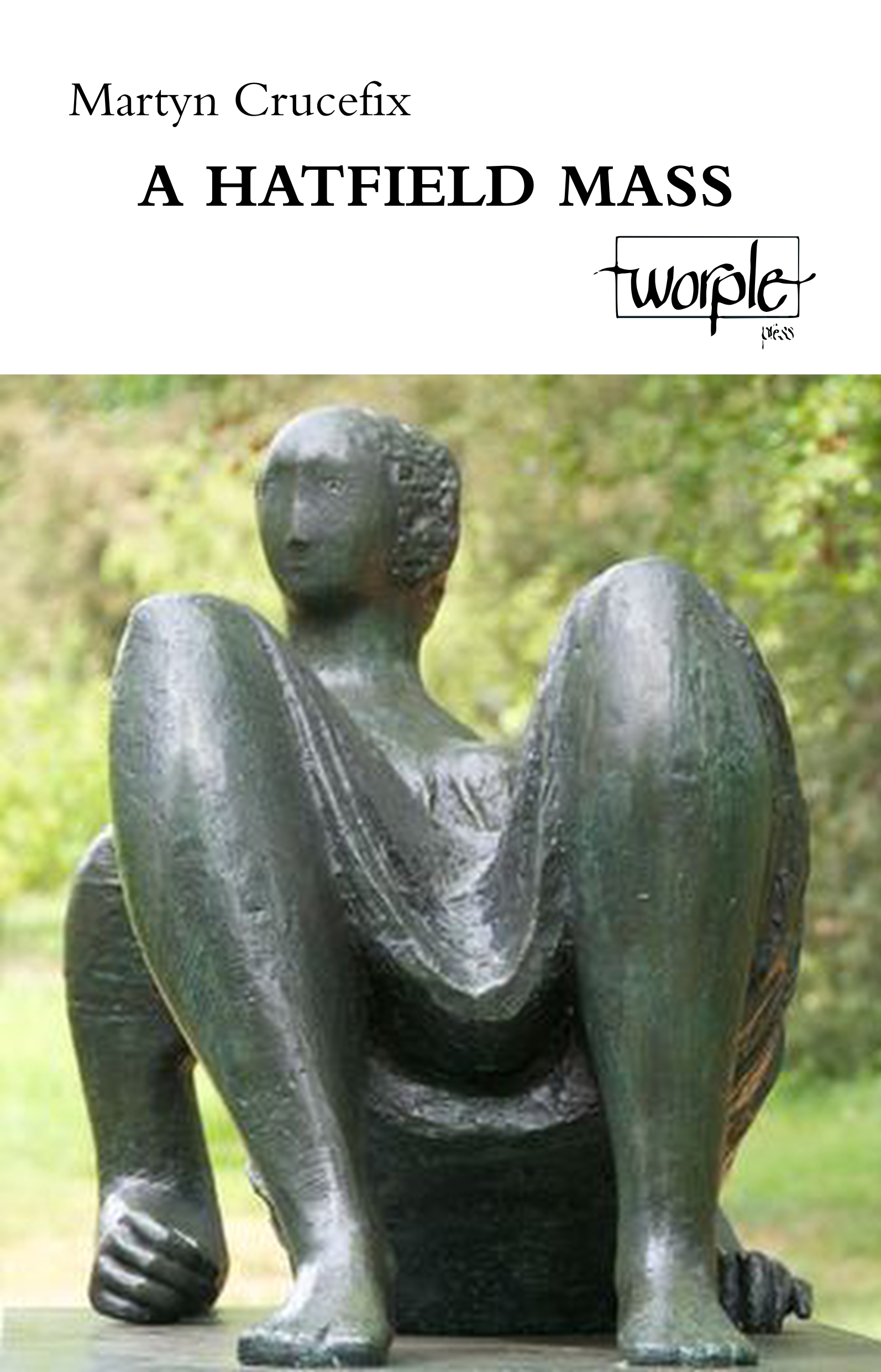
Earlier, I had the pleasure of reading from my own Worple sequence, A Hatfield Mass, subtitled ‘voice and shape in an English landscape’: here.
So here’s a poet well worth getting to know (if you don’t already). The new issue of Modern Poetry in Translation contains a new translation by Marilyn Hacker of the great contemporary French poet, Guy Goffette. Hacker has referred to Goffette as “one of the most unabashedly lyrical contemporary French poets, who claims Verlaine . . . as one of his literary godfathers”. He’s an admirer of Auden and his own work is not oppressively ‘literary’, not referential, not obscurely self-referential. He’s a poet somewhat to the ‘English’ taste (OK – you got me – to my taste), using quotidian words, everyday expressions, making them new, re-investing them with humour, connotation and emotion. Hacker has argued that “after a period in which much of French poetry eschewed the concrete, the narrative and the quotidian”, Goffette’s poems have recently found an enthusiastic readership. Yves Bonnefoy admires him as a writer who “has decided to remain faithful to his own personal life, in its humblest moments. He keeps things simple, he is marvellously able to capture the emotions and desires common to us all . . . without question one of the best poets of the present moment in France”.
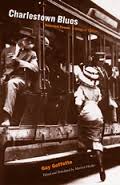
The new poems in MPT – a sequence of 6 sonnet-like pieces published in 2009 – make up an ‘Elegy for a Friend’, the poet Paul de Roux. The form used is a thirteen-liner, made up of three usually unrhymed quatrains and a last line which sometimes, though not always, reaches the classic 12 syllables. Since the early 1990s, this has become “Goffette’s ‘signature’ strophe” (Hacker again), whether used as part of a sequence or standing on its own. I reviewed Goffette’s last recent major appearance in English, Charlestown Blues, for Poetry London in 2007. I reproduce the review here and add comments on the new poems at the end.
The longer term coherence and success of a poet’s work is not – ought not – to be something willed. Like the oyster with its grain of sand, there is surely always something fortuitous about it. Marilyn Hacker’s fine translations from the French of Guy Goffette’s work suggest that, in this instance, Rimbaud’s declaration that “You never leave (“On ne part pas”) has proved a spectacularly productive starting point. Rimbaud’s comment suggests restlessness and desire for the other, yet also the tragic recognition of human limits as well as the idea that imaginative travel is more real than any form of mere physical tourism. These are indeed the topics and tensions that weave through Charlestown Blues.
Hacker’s introduction characterises Goffette in contrast to the Anglo-American preconception of contemporary French poets and not only due to his interest in form. She suggests we see modern French poetry as “abstract, more concerned with concepts than with human experience . . . resolutely “difficult””. Goffette’s work, in contrast, is diffused with “humour, longing, tenderness, nostalgia and occasional cruelty” and, though Hacker over-states his likeness to James Wright and Seamus Heaney, the general thrust of her argument is right. Born in 1947, of the same generation as our Motion and Raine, Goffette grew up on the shifting French/Belgian border (travelling without moving?). He now lives in Paris but still tends to look to the provinces while the metropolis is more often “a place from which his speaker is perpetually ready to depart” (Hacker’s introduction).
The title sequence, using a decasyllabic dixain and written during a residence in Rimbaud’s Charleville, seems scatter-shot and observational but with a strong thread of erotic longing: “your drying / stockings and scanties of a nun at bay – / poisonous flowers for a lonely man” (‘Letter to the Unknown Woman across the Street, 1’). Sex is one form of ‘leaving’ and Goffette catches such longing vividly: “oh beautiful stranger, / that creature who’s so often on the move” ((‘Letter to the Unknown Woman across the Street, 2’). Goffette’s work certainly revels in such demotic pleasures and Rimbaud himself puts in an appearance shouting “Fuck off! to puttering poetry” (‘February ‘98’). Earlier he wrings “the neck of the azure, which always puts / too much honey on the tails of verse-worms” (‘Farewell, Chateaux’). In the context of French poetry, it is this combative stance that leads Goffette towards the more grounded – even sordid – presentations of life that Hacker argues make him attractive to readers of English and American poetry.
Goffette’s natural reach approximates to the sonnet and these are frequently arranged in sequences, such as in ‘Waiting’. Largely from the point of view of a woman addressing her lover, these pieces suggest that it is the ultimate ‘leaving’ of death as well as desire that fuels his poetry. Here, eroticism is more explicitly a stay against death and time – “the judgment of this absence crushing me // like an insect on the pane” – though the final poem ventures a kind of romantic nostalgia, suggesting that even sex must fall short of human longing. The woman is made to envisage an island “where the surprise / of being lasts . . . the heart is still / in place, captain of the old ship”. This paradisal view is left to stand in stark contrast to the lovers’ reality, as they undress each other “amidst time’s peelings”.
So Goffette’s themes are the classical ones of love, time and death and though his diction is familiar enough with the contemporary, much of his imagery has a timelessness in its reference to journeys, rivers, trees, rooms, seashore, roads, stars. ‘Boarding the Streetcar: Variations’ responds to a photograph of New York in 1900 in which a woman climbs onto a streetcar watched intently by a male passenger and a (male) conductor. In a miracle of economy, the passenger’s viewpoint is sketched in and within six lines the moment of voyeuristic pleasure has come to represent “everything”:
the swift brightness of minnows
in a current, the taste of the first
fruit swiped from a market-stall, and how
the hazel switch whistled in the air
when it was about to strike a child’s
back
Yet when the passenger tries to articulate this moment he can manage “nothing” or the best he achieves are “words // like paper littering the grass after a fair / when shadows as they lengthen chill our hearts”. In contrast, the conductor’s view of the incident suggests its mix of beauty and danger, its very ordinariness, provides him with some memory which makes “the blood of things beat lengthily like a heart / in the shadow of dead rooms”.
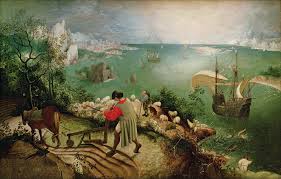
Hacker’s selection covers ten years from 1991 and concludes with a longer sequence published in 2001. ‘The Raising of Icarus’ is based on the same Breughel painting that inspired Auden’s ‘Musee des Beaux Arts’. Constructed from sonnet-like pieces once more, Goffette does not dwell long on the painting itself and instead seems to be observing people in the Paris metro, “running // against each other, same face same / night, and each one was night for every other” (‘In the Depths of the Labyrinth’). Rimbaud’s phrase is again apposite; these commuters travel without arriving anywhere and yet “To embark and not return is what they wanted” (‘In the Depths of the Labyrinth’). Later, they turn on the Shepherd in the painting who – they enviously feel – leads an idyllic pastoral life, while they must be “winning gold . . . cheers . . . bread” (‘The Shepherd Reproached’). It may be that the Shepherd is an artist figure but his response is that his life is no different to the crowd, though the one thing he does know is that death and the final dissolution of things is what serves to “raise every object up from darkness” (‘The Shepherd Answers’).
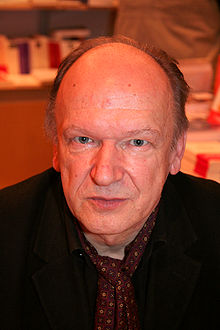
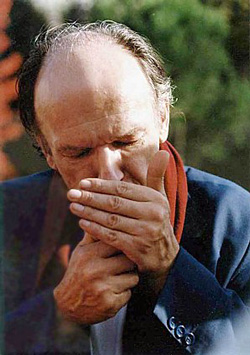
Guy Goffette
Death is, of course, the subject of the more recent sequence, ‘Elegy for a Friend’. It opens with memories of two friends in their youth, “When life was strong”, once again drawing on Rimbaud’s sense of restlessness, the youthful ease of travel, transformation, the passage of time unnoticed, yet (ominously) “it was already dancing there”, the shadow that “burns all shadows”. In the second section, temporal words become sand grains, become silence that eventually “takes up all the space and screams”. Yet, as the Shepherd figure in ‘The Raising of Icarus’ suggested, it is the presence of death that leads the poet to his creative “double question” about identity and time. If there is any regret, it is that this wisdom was not learned soon enough and, like stricken teenagers, the youthful poets sat too long in their “afflicted bedrooms”, or bickered unsympathetically, ignorant for too long of the real “desert of life”. Goffette’s elegy maintains a classical distance and relative impersonality with the sixth section using the first personal plural pronoun to sound more universal than intimate: “One day we must depart”. It’s a bleak ending full of thorns, scorched earth, what remains is “paltry”. There do remain the words on paper, “read and reread”, but their author is ambiguously described as a “blind man dancing in the fire”. Do we stress the blindness, our ultimate ignorance? Or the all-consuming fire? Or should it be the struggle to make art, the act of dancing?
This is challenging and wonderful contemporary poetry and – though the parallel text faces each page in Charlestown Blues – I seldom found myself checking the original which suggests that Hacker is doing a magnificent and valuable job of bringing Goffette’s work into English.










 Martyn Crucefix