More than 10 years of blogging on poetry and translation – over 39,000 views in 2024 – now captured and preserved at the UK Web Archive: 'one of the top 10 poetry blogs' (Rogue Strands)
I’ve had a major dose of the flu recently and have been too busy catching up with teaching and marking missed to devote much thought to blogging. So please forgive this brief and slightly self-absorbed effort. Talking about my own poetry is not really what I want to do too much of here. Nevertheless . . .
I gave a reading a couple of weeks ago in which the main focus was the idea of identity. It has been on my mind since and this week we have been looking at Sylvia Plath’s fictional self, Esther Greenwood. She is seen struggling in 1953 to appreciate she ought to be “the envy of thousands of other college girls . . . all over America”. She has won the opportunity of working for the summer as what we might now call an intern at a leading New York women’s magazine. In one of those flashes of figurative language that marks Plath the poet-novelist, Esther confesses she ought be “steering New York like her own private car”. Instead: “I wasn’t steering anything, not even myself”.
Esther’s ensuing breakdown – closely following Plath’s own – can be interpreted as her searching for a clearer sense of her own identity as she ponders and then rejects role models offered by Doreen (the wild girl), Betsy (the traditional), Joan (the lesbian), Cee Jay (the older career woman) and her own mother (hard-working single parent with no prospects). If we can manage to ignore the subsequently brilliant then tragic ten years of Plath’s own life after 1953, The Bell Jar, her only-completed novel, ends on an upward trajectory. Esther is re-born in the end: “patched, retreaded and approved for the road”. She finds a more sure sense of herself. As she waits for her release from the psychiatric ward she listens to her own heart beating: “I am, I am, I am”.
To borrow from Wikipedia, identity is defined as the distinctive characteristic belonging to any given individual or shared by all members of a particular social category or group. Identity, then, is a label. However, the formation of one’s identity occurs through one’s identifications with significant others (primarily with parents and other individuals during one’s life and also with identifiable groups). These others may be benign – such that one aspires to their characteristics, values and beliefs (a process of idealistic-identification), or malign – when one wishes to dissociate from their characteristics (a defensive contra-identification).
Plath’s Esther Greenwood seems initially to have lost or never really determined or had no faith in her identity though I suspect this is a common enough feeling among adolescents. In retrospect this seems to be the point of one of the poems I read (first published in Hurt (2010)). It features a bunch of adolescents walking in Cumbria, one of their number too pre-occupied with fretting about a fading relationship. ‘Riders on the Storm’, the song by The Doors which they choose to put on the pub juke box, operates as a sort of mock-heroic image which the main character signally fails to live up to. Heroes know who they are; he does not. The point seems to be that the pain caused by the dissolving of the fledgling relationship is an early opportunity, perhaps, to define himself a little more clearly.
Riders on the storm
With no schedule to drive us,
we wait for rain to stop beside Ullswater’s
southern lip, for the landlord of The White Lion
to determine when it’s time to open.
Ducking through the door, Helen, Clive, Steve,
each a few weeks shy of university,
and I’m there too, heart awash
with absence, her love letters at looked-for drops,
the girl I feel leaving gradually
as the tedious route past Thirlmere to Catstye.
But it’s OK for a while – passing midday snug
in a deserted pub
while outside the downpour gurgles, begins to blur
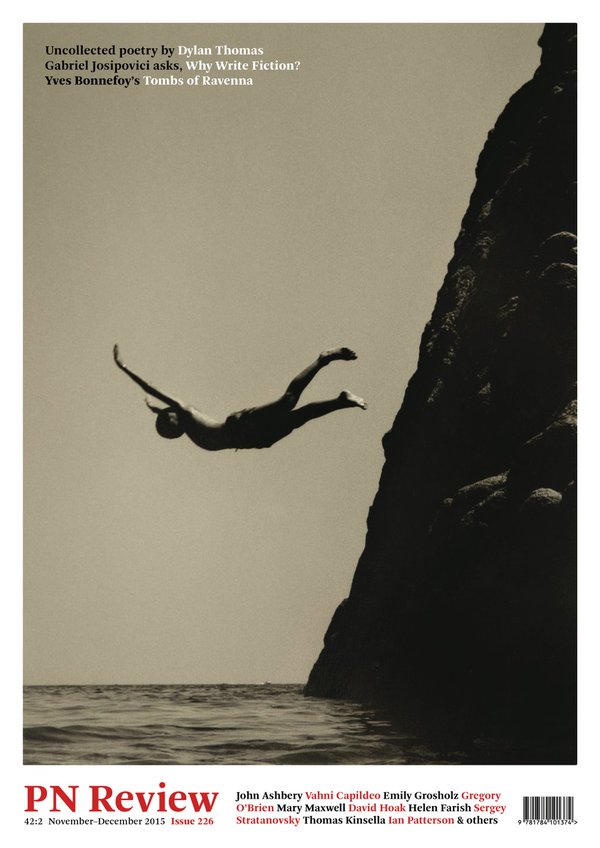
In my last blog I was discussing Keats’ ideas about Negative Capability, provoked by a visit to Keats House and a discussion there about Negative Capability and psychoanalysis. The speakers were Dr Margot Waddell, a child psychotherapist from the Tavistock Clinic, and Dr Toni Griffiths, Trustee of the Keats Foundation. Waddell focused on the acknowledged influence of Keats’ idea on the work of psychoanalyst Wilfred Bion. In the aftermath of such major stimulation, the new issue of PN Review fell through the front door, containing John Naughton’s excellent new translation of Yves Bonnefoy’s 1953 essay, The Tombs of Ravenna. Keats and Bonnefoy melded in my mind and I was reading the latter in terms of the former as follows.
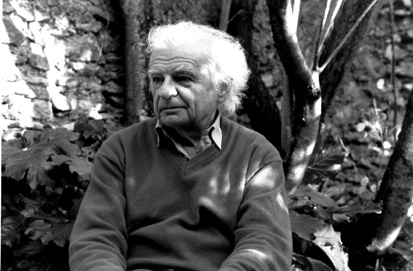
Bonnefoy observes that though many philosophers have discussed death, few have bothered to ponder the places where we traditionally lodge the dead: sepulchers and tombs. The explanation he offers introduces a key term for both his prose and poetry from 1953 to the present day: the concept. The concept, as in conceptual thinking, is a human creation, abstracted from the plentitude, the flood and flux of actual, particular human experience. It is “always a means of escape” into a more fixed abode. The concept denies time and is “a profound rejection of death”. It denies the fact of death as our inevitable fate and constructs an illusory “dwelling place of logic”, a more alluring place of “permanence and identity”. Also, and crucially, the concept is “made of words”. Language is a similar construct, also seeming to promise the same sort of escape into the timeless, the unchanging. All forms of conceptual thinking seem to promise an achievable resolution but, Bonnefoy argues, “what is pondered is no longer the real object”. Instead, we contemplate “a dubious knowledge” though it may soothe our “initial anguish and trivialises that most somber melody with words that mask the reality of death”.
So the concept promises a “strange immortality” but only if we can “forget brutal reality” – which, of course, we can and readily do. One reason is that there are general truths in conceptual thinking and a particular kind of power derived from it. It “allows thinking” of a certain kind; it is linked with “the vast power of words”. But any gain is predicated on a significant loss, the abandonment of the actually existing “world of things”. Conceptual thinking is “systematized”, generalizing, categorizing; it’s in this that its “flight” from the real is found. The only sort of thing that can be held up to counter the concept are specific particularities of human experience: Bonnefoy asks “Is there a concept for footsteps in the night, for a cry, for a stone rolling in the brushwood? For the feeling evoked by an empty house? No [. . . ]”
In his letters, Keats calls this sort of non-particular thinking “preresolved” and he encountered it especially in his friend Charles Dilke: “a man who [. . . ] has made his Mind up about every thing” (303; page numbers in brackets are to John Keats: Selected Letters (Oxford World Classics, newly revised 2002)). Dilke is one of the “stubborn arguers” who never begin on any subject “they have not preresolved upon” (303). In contrast, Keats argues the only means of strengthening one’s intellect and identity “is to make up one’s mind about nothing – to let the mind be a thoroughfare for all thoughts” (303). Keats’ best formulation of this idea arises when several things “dovetailed” in his mind after a frustrating debate with Dilke. The quality that marks out the artist – Shakespeare especially, he says – is Negative Capability. He defines this as consisting of a passive openness to the full range of particular human experience (“uncertainties, Mysteries, doubts”) without any imposition of preconceived notions, preresolved ideas or language: “without any irritable reaching after fact & reason” (41/2). Bonnefoy’s insight is that rather than being an occasional tendency, this reaching after fact and reason (conceptual thinking rather than direct, particular, various experience) is our default status. We pass our days in a delusion of resolution and systematization because if we did not we might fry our brains with the overload. In his last ever letter, Keats laments “the knowledge of contrast, feeling for light and shade, all that information (primitive sense)” as having become a great enemy to his “recovery” from his present state of illness. (369).
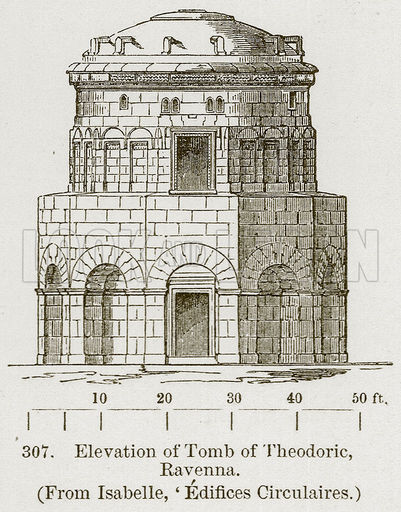
Yet the dully pragmatic ought not to be allowed to displace truth: Keats in better health argued this and Bonnefoy does the same in The Tombs of Ravenna. Bonnefoy’s essay for several paragraphs plays devil’s advocate, expecting to find “horror” in visiting the tombs of the dead, yet admitting that he felt “nothing but lightheartedness”. Initially, he locates this sense of up-lift in the ornamentation of the tombs, the “braids and interlacing [. . .] bows and foliage”. The essay playfully misleads its reader, suggesting that this effect of the ornamentation must be because it is comparable to the “concept” in denying the fact of death. Bonnefoy says he believed (note the past tense here) that ornamentation also abstracted towards the universal from the real, that the ornamentation presented “a closed world”, a world of “harmony”. Hence, just as the concept “seeks to establish truth without death [. . .] It seemed to me that ornamentation sought to build a dwelling place for us without death, and to have death no longer be here”. Visiting Ravenna, Bonnefoy felt lighthearted beside the tombs because its skilled and delicate ornamentation persuaded him of a world of permanence and consoling abstraction (beyond death, other than death).
But the essay now turns dramatically to deny the validity of such consoling sophistry. It’s invalid because Bonnefoy had failed to understand “the power of stone”. His insight is that it is not the ornamentation which is at the root of his lightheartedness but the very material out of which it has been carved. Stone is “unfathomable, and this abyss of plentitude, this night covered by an eternal light, is for [Bonnefoy] the exemplary form of the real”. What he means is that stone deflects the grasp of conceptual thought; conceptual thought distances itself from stone as it does from death. Stone is or represents “the difficult real” and it is or represents the “dawn of the sensory world”. Stone’s resistance, its very hardness, gestures towards the fullness and particularity of human experience (what Keats calls a “Life of Sensations”), towards “everything that has flesh, heartbeat, immanence”. The stone leads us towards the “truth tenaciously present beneath the truth of the concept”. And it is the latter ‘truth’ that Bonnefoy declares he must “tenaciously contest”.
The battle in Bonnefoy’s thought between the sensory world and the concept reflects Existentialism’s concern for existence rather than essence. His faith in a world resistant to and actually prior to the draining, withering forces of the intellect, his resistance to post-modernism, are reasons why he strikes many as such an inspiring figure. He says: “This world here exists, of that I am certain [. . .] It is simply with us. In what can be felt and sensed”. In The Tombs of Ravenna he names this underlying truth, not as existence, but “presence”. It is “what is perceived by the senses” and it was a dimly stirring awareness of this truth that constituted the “lightheartedness” he felt before the tombs of Ravenna. Through an encounter with the stone from which the tombs are constructed, the resistance of both life and death to the abstracting processes of conceptual thought was made clear and the pleasure induced arose from his closer approach to a fundamental truth.
Just as for Keats, such ideas have consequences for art and poetry. For Bonnefoy, poetry seeks to represent the real particular truths of human experience, to convey what it can of the “dawn of the sensory world”, as opposed to succumbing to the lure of conceptual thinking, even that conceptual thinking inherent in the very fabric of language itself. This specific paradox is not explored very far in The Tombs of Ravenna in which he confines himself to declaring that we require “another language than that of the concept” to articulate such truths. He concludes poetry’s only concern is “for that spot in the world I can sense” and because it must, as far as possible, resist the lure of conceptual truths (truth without death) it follows that “poetry and journey are of the same substance, the same blood”.
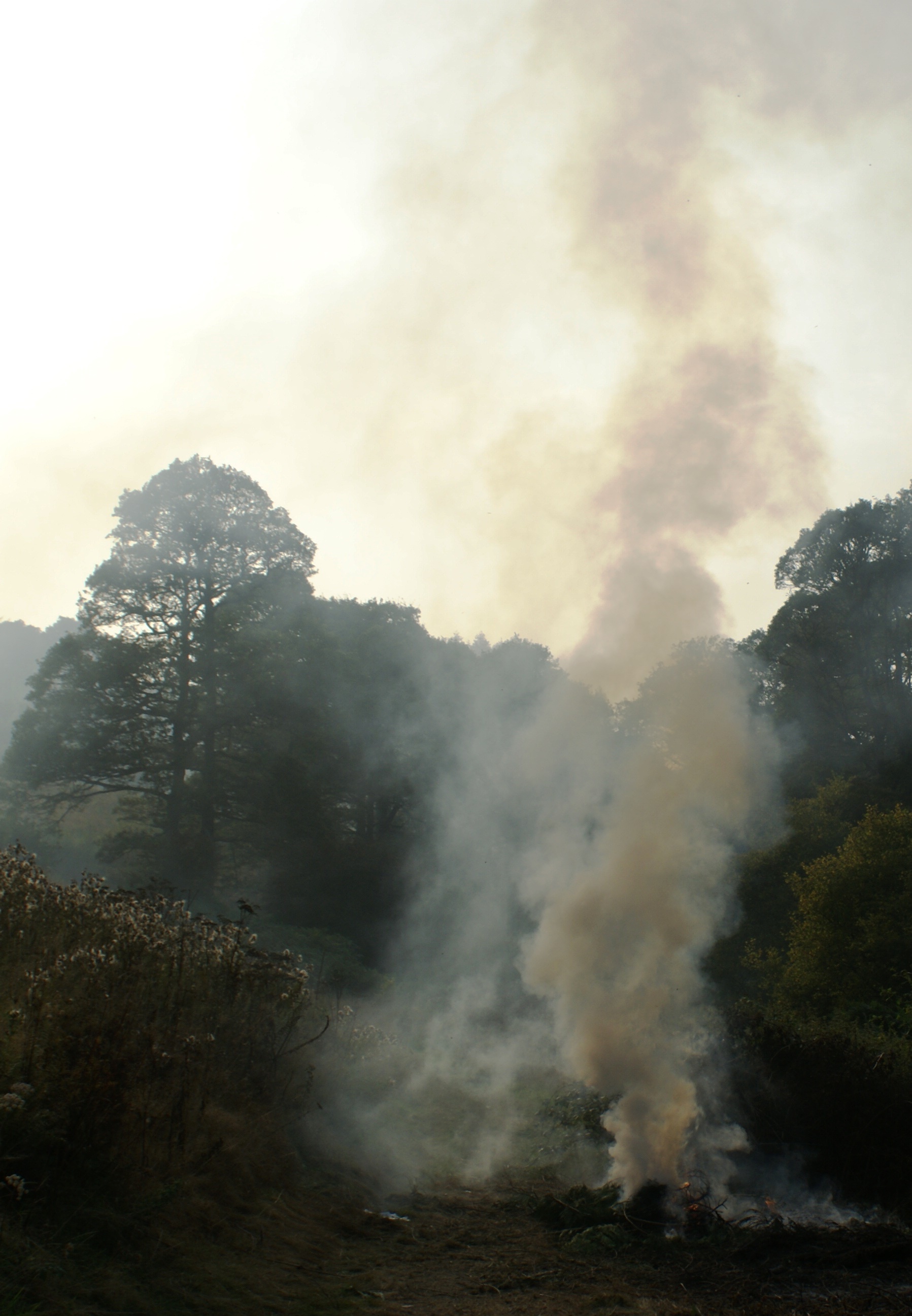
What such a poem might look like is suggested in those few moments when Bonnefoy himself resorts to “minute particulars”. On one such occasion, drawing from his own life, he tells us of “the cry of a bird I heard as a child, at the crest of a kind of cliff. I don’t know where that valley is anymore, or why or when I was there. The light is the light of dawn or of evening, it doesn’t matter. Through the brushwood runs the pungent smoke of a fire. The bird sang. Rather I should say, to be exact, it spoke, raucous on its misty height, for a moment of perfect solitude”.
Or as Keats put it in 1819, having listened to a nightingale singing on Hampstead Heath:
The 20th anniversary issue of Gerry Cambridge’s great poetry magazine, The Dark Horse, has arrived on subscribers doormats in the last week or so. In his editorial, Cambridge recalls the magazine’s beginnings in 1995: 500 copies of a slim, buff-card-covered, stapled pamphlet. It began, he tells us, “as a forum for the best writing about poetry and the best poetry (by my own lights)”. He also quotes Patrick Kavanagh on poetry as something you dabble in and then find it has become your life and how true must that be of editing a poetry magazine too. Cambridge reflects on the changes over the last 20 years, particularly in the technology of poetry submission and dissemination, in the “endless drip-feed” of social media, and the degree to which technology has shifted the power structures of contemporary poetry.
He is evidently uneasy about the influence of the turbo-charged prize culture we now live in which has “clotted and compromised” the world of poetry, alongside the “broadsheet, press-driven accolades and poetry politics that can foment discord among young writers”. It has always been a truism that the world of poetry is a cramped place and the level of attention it receives is vanishingly small. With the advent of a number of notable prizes, the urgency to be accorded such notice has upped the ante considerably so that success is ever more clearly marked, while failure is thrown into far greater contrast; though both ‘success’ and ‘failure’ are designations calculated nowadays too much in terms of immediacy.
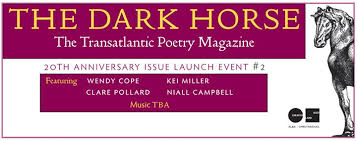
20th anniversary launch with Clare Pollard, Kei Miller, Wendy Cope and Niall Campbell
So in this context especially, 20 years is very a long time in poetry and The Dark Horse seems set for an impressive further run (equine jokes are hard to avoid and Cambridge himself does not try). This new issue is 190 pages long, with an interesting essay by Dana Gioia on poetry as enchantment, critical evaluations of James Lasdun and Mark Strand, new poems from Vicki Feaver and Oxford Poetry Professorship contender, A E Stallings, as well as Sweeney, Ryan, Cope, Mort, O’Donaghue, Carruth, Brackenbury and Stevenson and loads of others.
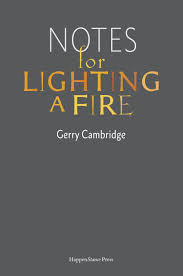
As well as an editor, of course, Cambridge is a very good poet and as my contribution to the magazine’s anniversary celebrations, I thought I’d post up my review of his last collection, Notes for Lighting a Fire (HappenStance, 2012). Wishing happy birthday to The Horse . . .
In Gerry Cambridge’s fine new collection, he seeks to peel away the inessentials of history, personal life, or the natural world in the confident belief that what remains possesses truth and value. His work attends to details, revels in tracing processes (laying a fire, peeling an orange, blowing an egg). He has a fine line in self-deprecation as in ‘Exposure’ where the narrator shaves his head, reflecting a desire to “go bare”, summed up as “an attempt at honesty, a minor / variety of courage”. Actually, this identifies a major thrust of Cambridge’s poetics, aspiring to the “plainness of nouns”, a reverence for things as they are. So conjuring a flame is an apt subject and ‘Notes for Lighting a Fire’ offers a practical guide, evokes a vast universe encompassing the act, touches on the contrasting evanescence of the merely topical, parallels the kindling of flames and poems and concludes with an expansive juxtaposition of science, history, earth and outer space as Orion swings into the sky “like a spaceship / of light from behind the black burial mound of that hill”. It is quite a performance.
Writing for a local council project to light its public buildings sounds less than inspiring but the sequence ‘Light Up Lanarkshire’ quickly escapes its unpromising beginnings. Light energy is derived from coal and coal “is a terse black language” ripe for this poet’s essentialist pen. Lanarkshire’s place-names and history are evoked with “millions of years” to create the “black subterranean seams” and their mine owners’ wealth. The best part of the sequence is Cambridge’s portrait of his miner grandfather, in “necktie and suit with his strong-jawed wife”. Recognising he may not have been an easy man to live with, he still finds admiration for him, “spruce as a gentleman, stepping out for his evening shift”. Likewise, Cambridge’s elegy for his father, only partially ironises inherited values of “the dignity of work etcetera” (‘Light Leaves (1/iv)’). The son/grandson memorialises the undeveloped spark of aspiration in both men’s “stab at a perfect world” (1/x) in his father’s lovingly curated toy trains and his grandfather’s extravagant purchase of “a fancy clock for the house”, devastatingly dropped when confronted by his wife’s critical “sherricking”.
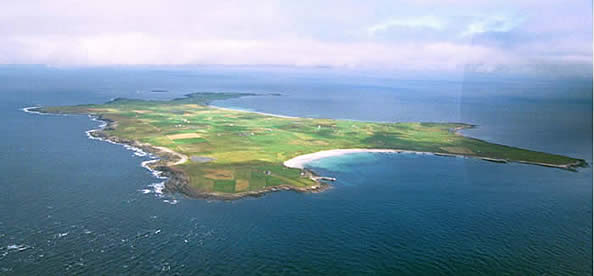
North Ronaldsey
In Cambridge’s other great love, the natural world, he finds further repositories of continuity. His queen wasp’s abdomen stores “Ten thousand summer wasps, wasp dynasties / Down the perpetual light of centuries” (‘The Queen’) and there is a delightful sequence of poems on a child collecting birds’ eggs. The more ecologically correct adult judges this a mere function of egotistical “possession” (‘Sacrifice’) but perhaps it more truly reflects a concern for paradoxically affirming fundamentals: the securing of the prize of a sparrowhawk egg would be “a bartered death that said I live! I live!” (‘A Sparrowhawk’s Nest’). Love of nature, stoicism and conservatism come together in ‘The Great Things’ in which details of North Ronaldsey are lovingly collected – its sense of space, inhospitable weather, a shrinking population, life clinging on, the beauty of a setting sun. The poem concludes, “Elsewhere the great things of the world will be taking place” but the irony is strong since it’s these stripped-back mundane details that form the true ground of human life and constitute the focus of this honest, profound and coherent collection.
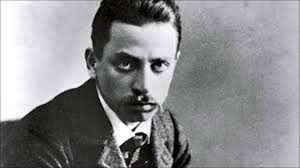
Idris Parry writes in the current PN Review (March/April 2015) comparing Rilke’s Duino Elegies with the Sonnets to Orpheus. The poet always spoke of the sonnets as subsidiary to the elegies, but Parry argues that while the elegies “talk about” the poet’s task, the sonnets perform it. I’d agree and, in translating both in the last 20 years or so, I have come to prefer the vivid enactments of the sonnets. Parry explores Rilke’s response to Rodin in Paris in 1902. What struck Rilke was Rodin’s “dark patience which makes him [as creative artist] almost anonymous”. What the young poet learned was to pursue an “unhurried and uncommitted exposure to experience” (Parry’s words). This is opposed to impatience which is (contra-Keats) an irritable reaching after clarity: “making up your mind before the event instead of letting the event shape your mind” (Parry again).
Rilke’s “praise” is just this acceptance and faithful utterance and is predicated on the truth of an underlying unity of existence. The poet is obliged to speak of this unity but can only use the language of division, a language deluded by the conviction of finality. Parry epigrammatically concludes: “We punctuate to retain our sanity, but we should not come to believe the punctuation”. The PN Review piece ends by looking at sonnet II, 18 and asks, if Rilke’s own German is a poor translation (using shabby tools) of an ultimate reality, how can translators hope to do it justice in bringing it over into English?
My own grappling with the issue of what can be lost and gained in translation began over 10 years ago when London’s Blue Nose Poetry group staged an evening to celebrate Rilke’s work. This was partly in response to a Poetry Review survey of the original 1994 New Generation Poets, several of whom declared his work to have been influential. Though a name I was familiar with, I have to confess I hadn’t gotten far through my Penguin Selected. Perhaps on account of my ignorance, I was to contribute only by reading aloud from the Elegies. The Ninth was chosen but as I practised, I found myself stumbling, losing the thread and, frankly, I hardly knew what it was I was reading:
Here is the time for the Tellable, here is its home.
Speak and proclaim. More than ever
Things we can live with are falling away, for that
Which is oustingly taking their place is an imageless act.
Act under crusts, that will readily split as soon
As the doing within outgrows them and takes a new outline.
This is Leishman’s translation of the Ninth Elegy and I supposed the obscurity was part of the point – that it must signal hitherto unplumbed depths of profundity. My view on this remains equivocal, but I believe a proportion of the difficulty is obfuscation and the impression of slippery ‘mysticism’ it generates has misleadingly become part of Rilke’s appeal for many readers. For me, the bottom line was I could not read this aloud with the kind of conviction that I demanded. I tried a couple of other easily available translations – Stephen Cohn’s and David Young’s – but still was not happy with the sound these poems made in my mouth.
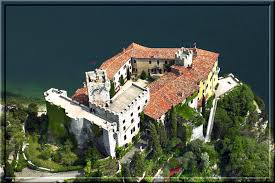
Castle Duino
Within a month I had produced a ‘version’ of my own. By version, I meant a close-ish translation, but I had taken considerable liberties with the more difficult passages and inserted what I thought Rilke might have meant or what I wanted him to mean. At the time this seemed to me a risky strategy compelled by necessity, though there is nowadays a good deal more debate about the role and value of versioning. My own position is that I prefer a genuine attempt to translate the original into a contemporary target language. I see the point of versions – but it is hardly ever what I am seeking as a reader. Nobody imagines translation is easy; but only a fool anticipates a perfect rendering. We expect translators to work in good faith and that their work will read sufficiently well in the target language not to distract us with the stale sweat of their strenuous wrestling with the original. Nor should they cover the difficulties of translation by delivering obscurities that defensively resist comprehension.
It was coming across my first attempt a couple of years later that set me systematically picking my way through the million pitfalls of the Elegies. Take for instance Rilke’s opening lines, the great cry at the start of the sequence. Rilke writes “Wer, wenn ich schriee, hörte mich denn aus der Engel / Ordnungen?” Not too much of a problem you might think, but William Gass, in his book, Reading Rilke: Reflections on the Problems of Translation (Basic Books, 1999), considers no fewer than 15 versions of these 11 words. Most – though by no means all – accept Rilke’s opening word – “Who” – and most, though not all, take over Rilke’s relative clause “if I cried”. But is he merely crying or crying out? And beyond this point of relative agreement lie terrible dragons of disagreement, especially over the word “Ordnungen”. How are the angels deployed? Are they in “angelic orders”, “amid the host of the angels”, “among the hierarchy of angels”, “the order of the angels”, “among the angels’ hierarchies”, “among the ranked Angels”, “through the Angel Orders” or even (Gass gives his own version) “among the Dominions of Angels”? In such company, my own version, “Who, if I cried out, would hear me among the ranks / of the angels?” runs the risk of a watery plainness but it has the advantages of clarity, echoes the rhythm, syntax and line break of the original closely, and (remembering my first concern was for oral performance) the line has a satisfying aural quality. I hear in the first phrases high, thin vowels that contrast the second half’s weightier, assonantal ‘a’ sounds: the cry of alienated humanity contrasts the solid, seemingly impregnable powers that lie beyond our reach.
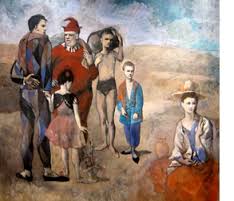
But the best-equipped translator faces especially difficult problems in Rilke. In the Fifth Elegy, for example, the poem describes some acrobats. This is a combined portrait of a troupe Rilke knew while living in Paris and a painting by Picasso (La Famille des Saltimbanques, 1905) with which Rilke lived in the summer of 1915 in the house of the dedicatee of this Elegy, Frau Hertha Koenig. This is, formally, one of the freer of the Elegies, its lines extending and contracting to reflect the energy of the tumblers.
Picasso’s ‘La Famille des Saltimbanques’ (1905)
But in the Picasso painting the figures are arranged in an almost imperceptible D-shape and Rilke writes: “Und kaum dort, / aufrecht, da und gezeigt: des Dastehns / großer Anfangsbuchstab . . .” In my version: “And barely discernible, / yet up-standing and unmistakeably on display, / the capital D of Destiny . . .” The original word “Dastehns” (something like “standing there”) reflects the visual pun and it would be a great loss not to bring this into the English. Stephen Mitchell uses the word “Duration”; Young’s looser version loses the pun with “existence . . . presence”. On this occasion, I found myself following Stephen Cohn and opting for “Destiny” (more usually the translation of “Schicksal”) which I felt conveyed Rilke’s sense of how these individuals are driven to perform by forces external to them, rather than by a more truthful inner compulsion.
Another critical decision arises in the Tenth Elegy with its tribe of people who enjoy a closer, more authentic relationship with death and grief than Rilke perceived in contemporary Western culture. He uses the word “Klage” and an English equivalent has to be found that works as the name of a young woman, her tribe, her ancestors and her country. Like the sound of the original, the word also has to reflect the harshness of the grief felt, while at the same time suggesting a dignity in such powerful emotions. For Rilke, the role of this personification and her whole tribe is certainly heroic. Most previous translators have opted for the word “Lament” but I felt this suggested a rather affected, almost poetic attitude – precisely the kind of posturing that Rilke asks us to avoid in our confrontation with these difficult aspects of life. I chose the word “Keening” to convey the genuine edginess of feeling (aurally again I liked the harsh initial K and the word’s trailing, wailing fall). This word seemed to me to work perfectly as personal and tribal name and geographical location: “gently she guides him through the vast / Keening landscape, shows him temple columns, / ruins of castles from which the Keening princes / once wisely governed”.
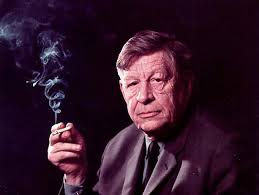
One thing I have learned is that translators take sustenance from their chosen originals. This is not just in the obvious way of extending their range, but also that they feed on a familiar. They find in their subject an answering voice, a confirmation of something already present within themselves. I experienced this in a surprising way. Rilke’s influence on Auden was particularly evident in the late 1930s. The sonnet sequence In Time of War refers directly to him and Mendelson’s Later Auden (Farrar, Straus and Giroux, 1999) argues that ‘In Memory of W. B. Yeats’ concludes with “an explicit echo” of Rilke’s Ninth Elegy and its famous injunction to “praise this world to the angel”.
Auden asks Yeats’ spirit to “Teach the free man how to praise”. Interestingly, Auden has never been a strong influence for me, yet the elegy to Yeats is a poem I have always loved. In fact, five or six years before I got to know Rilke, I remember modelling an elegy of my own on Auden’s – from the choice of title, the formal variety of its sections, to a finale in which I too celebrated one who “loved the world, craved its taste”, elevating him to a teacher of praise: “Listen, let me make this master speak: / Laughter, love, the senses are profound. / Drink deep, remember, Jeremy Round” (‘In Memory of Jeremy Round’). Reading Mendelson’s book has convinced me that I had been responding not merely to Auden but also – unknowingly – to Rilke. It turns out I have been finding a sympathetic familiar in him for longer than I had imagined.
I sometimes think poets are of two kinds: those drawn to dramatic subjects which explicitly dramatise the writer’s concerns and those drawn to more everyday topics which come to reflect the writer’s concerns in the course of the poem. I think of Hardy and Edward Thomas in the latter camp, alongside Heaney’s reference to Katherine Mansfield in North (1975): “I will tell / How the laundry basket squeaked”. In the former camp, for sure, stands the American writer, Dan O’Brien, who is everywhere at the moment.
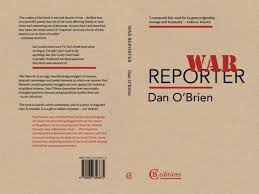
O’Brien sees himself as “a playwright who moonlights as a poet” and he has just won the Troubadour International Poetry prize and been shortlisted for the Evening Standard theatre awards (for his play The Body of an American). He also has poems included in the recent Magma issue discussed in my last blog (https://martyncrucefix.com/2014/12/01/the-launch-of-magma-60-at-lrb-bookshop/). O’Brien’s first book of poems, War Reporter, was published by Charles Boyle’s excellent CB Editions just a year ago and I reviewed it for Poetry London. The book went on to be shortlisted for the Forward First Collection Prize and to win the Fenton Aldeburgh First Collection prize (http://www.thepoetrytrust.org/news/fenton-aldeburgh-first-collection-prize-2013-winner-announced/)
In discussion at Aldeburgh, O’Brien said War Reporter had been described as “docu-poetry” and that “sounds fair.” The war reporter in the book’s title is Canadian journalist, Paul Watson, and for seven years O’Brien has been in communication with him, “obsessively” recording and working on email conversations, as well as Watson’s recordings from conflict zones around the world. The two poems in Magma are part of new work in progress. ‘The War Reporter Paul Watson Has the Time’ is a good example of the complex webs of guilt and complicity that O’Brien poems weave at their best. The narrator has helped an “interpreter” escape from Kandahar and vengeance is taken against the interpreter’s extended family through an IED: “A bump in the road and / the usual denouement”. The poems never flinch from explicitness about physical harm (“his father, leg like broken / bricks in a bag”) or psychological damage (“a pistol for protection, against all / sense and provocation, only to suck it in his mouth and – blackout”). ‘The War Reporter Paul Watson Knows’ returns in part to the moral quandaries surrounding Watson’s 1994 Pulitzer prize-winning photograph of Staff Sgt. William Cleveland’s body being dragged from the wreck of a Black Hawk and through the streets of Mogadishu. It also alludes to Watson’s more recent eyewitness accounts from the conflict in Syria: “The West engaged / in self-soothing debates while mercenaries / penetrate the borders, tilting the board / in Assad’s favour”.
The Troubadour winning poem likewise derives from the Syrian conflict. Co-judging with Seren’s Amy Wack, Neil Astley said O’Brien submitted three poems, any one of which could have won first prize: “All three were so compelling that I found myself measuring all the other poems I read against them . . . I had no hesitation in putting forward one of them for first prize.” The eventual winner was ‘The War Reporter Paul Watson and the Barrel Bombs’: “basically pieces-of-shit / IEDs of TNT, nitrogen / -rich fertilizer, diesel, anything / likely to kindle after exploding”. This is a more brutal, less multi-dimensional poem than some of O’Brien’s but it possesses an undeniable power to shock: “A foot in a sock / sticks out of the mountain. They tickle her / to see if they should dig”.
And here is my review of War Reporter from last year:
Dan O’Brien’s book is big, brave, important and challenging even in its imperfections. It is an act of ventriloquism, hitching a desperate and often horrifying ride on the work and experiences of Canadian war reporter, Paul Watson. Watson took the 1994 Pulitzer prize-winning photograph of Staff Sgt. William Cleveland’s body being dragged from the wreck of a Black Hawk through the streets of Mogadishu. Without doubt, his work tapped something important for America; as well as Watson’s original book, Where War Lives, and these poems, there is also a play and an opera in preparation.
The poems abound in speaking voices, dominated by Watson himself, but including the “Poet”. Each piece comes at the reader as a slab of blank, largely decasyllabic verse. Voices bleed into one another, partly under the pressure of war zone experiences but also because of an explicit similitude between author and reporter: “You’re like the writer / I’ve always wished I were [. . . ] your constant / returning to an underworld we can’t / look at” (‘The War Reporter Paul Watson Describes the Ghost’). Both men admit to the allure of war and death. Watson’s voice, telling of his Mogadishu photo, confesses “When / you take a picture the camera covers / your face, you shut the rest of the world out” (‘The War Reporter Paul Watson Hears the Voice’). The quieter, more reflective stretches of the sequence explore this idea and allude to Camus’ claim to have solved the mystery of where war lives; the answer is in each of us, in our loneliness and humiliation. Watson’s book pursues this and O’Brien does the same here, taking the idea to justify excursions into both men’s personal and family backgrounds. I’m not sure how effective this is (OK, both are drawn to war’s horror, but neither are warriors) and these episodes do sap the quite astonishing power of the more direct reportage.
The book has Watson recalling scenes from Somalia, Rwanda, the Balkans, Iraq, Afghanistan and Pakistan and it is art’s ability to contemplate such horrors that makes the book an important one. Tony Harrison (who always refers to himself as the man who reads the metre) insists that his formal artistry is vital to bring the poet through the fire he is intent on penetrating. O’Brien chooses to speak of man’s brutality by telling it slant, through another’s voice. Watson witnesses the stoning of a married rapist, but the initial possessive modifier ensures we cannot push the scene into the distance: “our audience cheers an elderly man / lifting a perfect cinder block above / his head, then smashing it down where a gash / jack knifes the rapist’s neck” (‘The War Reporter Paul Watson Attends a Stoning’). War lives in all of us and the collection is a hard read partly because of our reluctance to face this. The rigid consistency of form perhaps also adds some monotony, but I’d agree with Jay Parini, that O’Brien’s success is in finding words “sufficient” for our time, a form of speech adequate to the evil that persists.
Last Friday night I read briefly (partly from my Worple Press book: https://martyncrucefix.com/publications/a-hatfield-mass/) at the LRB bookshop, 14 Bury Place, London WC1A 2JL (in fact just doors along from Enitharmon Press’ new offices). It was the launch of Magma magazine’s new issue (http://magmapoetry.com/). Magma really has become one of the must-read magazines in UK poetry and the event was one of two national launches (the other is on Thursday 11 December at 7pm at the Lit & Phil, 23 Westgate Rd, Newcastle upon Tyne, NE1 1SE, with guest reader Sean O’Brien). The LRB is a spectacularly good bookshop but you feel acutely the vanishing of bookshops elsewhere – to be surrounded by shelves of ‘proper’ books is a real pleasure, distressingly beginning to take on the quality of a sepia-tinted memory. Yet, as one of the readers commented, this is a dangerous place to visit if you’re not prepared to part with hard cash: so many temptations. It’s also a good place for a reading: chairs from front to back on the ground floor, seating well over 50, and on Friday it was packed.
Magma 60 is edited by Rob A. Mackenzie and Tony Williams (one of the good and distinctive things about the magazine is its rolling editorship) and 19 poets were asked to read a couple of poems each, with Kei Miller putting in a longer shift at the end as guest poet. Among others, Peter Daniels’ poems evoked a quiet, desperate sense of things not holding, of wider societal failing (‘you might discover you’re painting the house / while the other side’s on fire’). Jacqueline Saphra remembered being seventeen and then dealing with her own seventeen-year olds, boys and girls, the latter crying from their rooms, ‘Come in, I won’t let you in, Come in’. Michael Henry recalled Finals exams and wanting to write about Brecht, which he does in his poem ‘Agent provocateur’: ‘The Brechtian grape is a dry white grape / and it tastes like the white corpuscles in blood’. Martha Sprackland and Jasmine Simms found common ground and a source of poetry in drifting off in science classes at school (I remember it well).
John Greening read about visiting the archaeological dig at Sutton Hoo and an intriguing poem about ‘The Battle of Maldon’ which knowingly fails to offer ‘an explanation // of what happens in the end [. . .] about how whatever it is was broken’. DA Prince also evoked an earlier age with ‘The bell-makers’ reminding me of sequences from Tarkovsky’s film Andrei Rublev (1966): ‘the brilliant blistering light, / that cataract of blazing air, the stream / of liquid pain’. Karen Leeder presented new translations of German poet, Volker Braun. Braun was writing in part through the upheavals of 1989, exploring the triumph of capitalism: ‘EVERYTHING AND NOTHING / Was it ever really yours? Fuck you, fantasist. / The encore: all that you could never need!’ (http://www.amazon.co.uk/Rubble-Flora-Selected-Seagull-German/dp/0857422189/ref=sr_1_1?s=books&ie=UTF8&qid=1417365225&sr=1-1&keywords=volker+braun).
At the end of the first half, Gwen Adshead, a forensic psychiatrist and psychotherapist who works in secure hospitals,talked about her work and love of Philip Larkin’s poetry and read ‘Talking in Bed’ (one of my own Larkin favourites; see below). Kei Miller’s live delivery illuminates and energises his own words on the page. I’ve written more about his prize-winning The Cartographer Tries to Map a Way to Zion (Carcanet) on this blog (https://martyncrucefix.com/2014/10/22/kei-millers-cartographer-and-friels-translations/). He read several of the Place Name pieces, the poem where the Cartographer asks for directions and gets indirections instead (‘all true’ Kei said), the ‘Hymn to the Birds’ and the 28,000 rubber ducks poem which moves (almost imperceptibly) from children’s bath toys to captives lost overboard on trans-Atlantic passages years ago. Miller finished with his short poem ‘Distance’ which seemed to be something of an answer to Larkin’s poem chosen by Gwen Adshead; here are the two of them. . .
Talking in bed
Talking in bed ought to be easiest,
Lying together there goes back so far,
An emblem of two people being honest.
Yet more and more time passes silently.
Outside, the wind’s incomplete unrest
Builds and disperses clouds in the sky,
And dark towns heap up on the horizon.
None of this cares for us. Nothing shows why
At this unique distance from isolation
It becomes still more difficult to find
Words at once true and kind,
Or not untrue and not unkind.
Distance
Distance is always reduced at night
The drive from Kingston to Montego Bay is not so far








 Martyn Crucefix