Helen Farish’s new collection, ‘The Penny Dropping’, reviewed

An edited (shorter) version of this review first appeared in Poetry Salzberg Review in June 2025. Many thanks to the editor, Wolfgang Görtschacher, for commissioning the writing of it. The collection, The Penny Dropping, was shortlisted for the TS Eliot Prize in 2024.
Tennessee Williams once wrote that ‘memory takes a lot of poetic licence’, but Helen Farish’s memory poems in The Penny Dropping (Bloodaxe Books, 2024) declare from the outset that their intention is to set things (here quoting TS Eliot) ‘in order’, by settling ‘life accounts bravely in the face of now and then, and [to] settle them honestly’ (here quoting Charlotte Bronte’s Villette). This is quite a task given the love affair the book recalls and reflects on occurred almost 40 years ago (the absence of mobile phones, internet and social media is particularly striking and hence evokes the ‘period’). But how ‘honest’ these poems are, of course, we cannot tell, though Farish’s commitment to autobiographical fidelity means any potential reviewer must be warily self-conscious – we do not want to criticise a (real) life, with all its choices good and bad, but to focus on the artistry of the poems. This commitment to honesty also has implications for the poet: a plain-speaking truth demands (as did Othello’s) a plain, unvarnished re-telling.

Indeed, Farish’s lyric poems are very plainly told (readers tiring of a lot of contemporary poetry’s tricksy obfuscation and language ‘breaking’ will be delighted to read poems here which are immediately direct and accessible) and formally they are unrhymed, irregularly lined verse paragraphs, attuned to the colloquial, the storytelling. But, with its age-old narrative (girl meets boy, they fall in love, fall out of love, difficult break up) and insistence on plain-speaking, Farish runs the risks of cliché. Often, she does not steer clear of very (over-) familiar phrases such as ‘pick up the pieces’, ‘a weight off his mind’ (‘Premonition’), ‘on the breadline’, ‘when push came to shove’ (‘Qui e Li’), ‘winning smiles’, doing ‘things by the book’ (‘The Butcher’s Boy’). Moreover, the male love interest is stereotypically a ‘hero’ in the poem of that name, is even designated ‘Tall, Dark, Handsome’ (‘Thanking the Universe’), and the rather feeble title of the collection – the penny dropping, the realisation of the end of the relationship – seems all rather too familiar for contemporary poetry (in fact, Farish is better than this and the penny that drops is not quite so obvious – more of this later).

So, the collection traces – in old-fashioned chronological order – the start, middle, end, and aftermath of a decades old love relationship. It’s a little bit Shirley Valentine, a little bit The End of the Affair, though the role model Farish herself suggests is Woody Allen’s Annie Hall. Despite the long distance recall, there is a vivid, sensuous immediacy to the writing. In lesser hands, a likely recourse would be to old photograph albums, but Farish is as liable to start a poem from an old map, still in her possession, on which the young lovers scribbled notes for their anticipated, future return (which never happened). And there must have been a lot of maps, as the book unfolds in an almost picaresque fashion with the lovers meeting in Morocco, travelling to Italy, and Sicily, onto Greece, and Crete, before a return to the UK in Oxford. One of the key methods Farish uses to convey the thrill, freedom and passion of early love is through these exotic locations, the colours and customs, the names, the booze, the food. ‘Things We Loved’ – the book’s first poem – does this via Morocco’s markets, rose sellers, taxis, tagines, its acrobats and a dilapidated cinema. In Palermo, we’re along the Via Maqueda, sampling gelato, or polishing off a bottle of Donnafugata in bed (‘Mozart’s 233rd Birthday’). Later in the book, the woman – now looking back over the decades – finds it’s still a bold Italian red, penne, gorgonzola, and oranges that conjure those long-lost days in true Proustian fashion (‘Pasta alla Gorgonzola’).

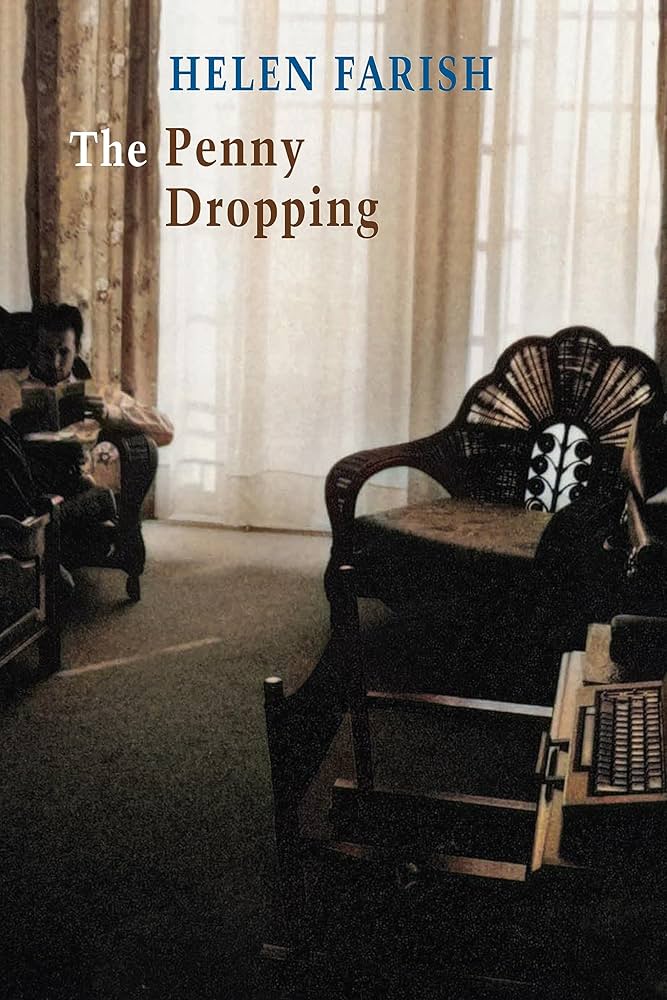
Bernard O’Donoghue praises The Penny Dropping not only as a book of poems but also as possessing the ‘coherence of a novel’. There is a clear narrative, but the characterisation of the male lover is very sketchy and, if the genders were reversed, surely we’d be railing against the male writer’s disservice to the female figure’s reality? Though a photograph (in ‘Exposure’), taken in Fez, is said to have caught him unawares, with his ‘own barriers down’, we never get much more about him than that he is sociable (more than the woman), is ‘too much the gentleman’ (‘May Day’), is good with children (and wants them; she doesn’t), has bouts of unexplained illness, and is eventually unfaithful to her. Bloodaxe’s unattributed cover image – in shadowy, ‘memoir’ sepia – has a self-absorbed, book-reading man almost out of frame and this seems about right. But, fair enough, the book is (a la Bronte) the author’s settling of her own accounts and Farish really does do this with tremendous honesty and an astonishing absence of blame (though plenty of self-criticism).

Even in the early days of the affair, she is conscious of the couple’s differences. At a Greek Orthodox Easter celebration, he is at ease and happy, ‘good with the little ones’ but she has ‘said no to the tripe and only joined in / for one glass of tsikoudia / before going back to [their] room to write’ (‘Christ Has Risen! He Has Risen Indeed!’). In ‘May Day’ he ‘would have joined in’ another local celebration and (in retrospect) she berates herself: ‘I should have said You go’. The self-blame here feels truthful, and is so commonly gendered, and the same perhaps for her (perceived) faults of passivity and sense that ‘I always had guilt inside’ (‘Scapegoat’). ‘In Seville That Spring’, at the moment of crisis (you ‘couldn’t go on, / you wanted space’) the woman again regrets and self-lacerates: ‘I should have made you talk to me, / I should have fought for you, stomping my feet [. . .] Instead, British-style, I drove north, / three hundred miles’.
These are painful poems in the end and the reader may well share in some of the criticism Farish levels at herself. But we are often wrong-footed. In the book’s title poem, there are two pennies dropping: one is the man’s sudden realisation that the relationship (in his view) is finished, but the other (in the poem, presented as an explicatory parallel to his realisation) is Farish’s sudden grasping that her mother is terminally ill. And it’s not until close to the end of the book, in ‘Beauty Spot’, that we are given to understand that her mother’s early death traumatised Farish, so much so that (speaking of herself), ‘she’ll lose you if she doesn’t absorb / how self-absorbed she is, / [. . .] you’ll look elsewhere’. Perhaps this is what happened. The story valorises truth, rather than being any sort of role model narrative for young women (or men for that matter). This is admirable and it’s in these final few poems that the emotional complexity of the relationship really emerges, the woman, now in her sixties, is left with a Goethean ‘blessed longing’, an emotional state, ‘not sorrow, and more sinuous than sadness’, not resolved, no longer rawly anguished, but with a desire to place, to settle, what has happened, to ‘have the memory / and be through the loss itself’ (‘That Selige Sehnsucht Feeling’).

That Selige Sehnsucht Feeling

I’d name it Selige Sehnsucht, that feeling

my home gave me yesterday, words

you used once in a note –

I must have forgotten something,

I have that Selige Sehnsucht feeling.

It’s an indefinable ache – not melancholy,

ot sorrow, and more sinuous than sadness –

a feeling on a journey, picking up

strands of other like-hearted feelings on its way.

Is it possible to be sick for home while still there?

I think you were saying you missed me

before you’d even left. And yesterday,

as the red sun lowered, picking up other reds

on its way – flame red, orange red, ember red –

I ached for what I was looking at:

the long tawny-brown grass which,

from across the field, the house seemed

to grow out of putting me in mind

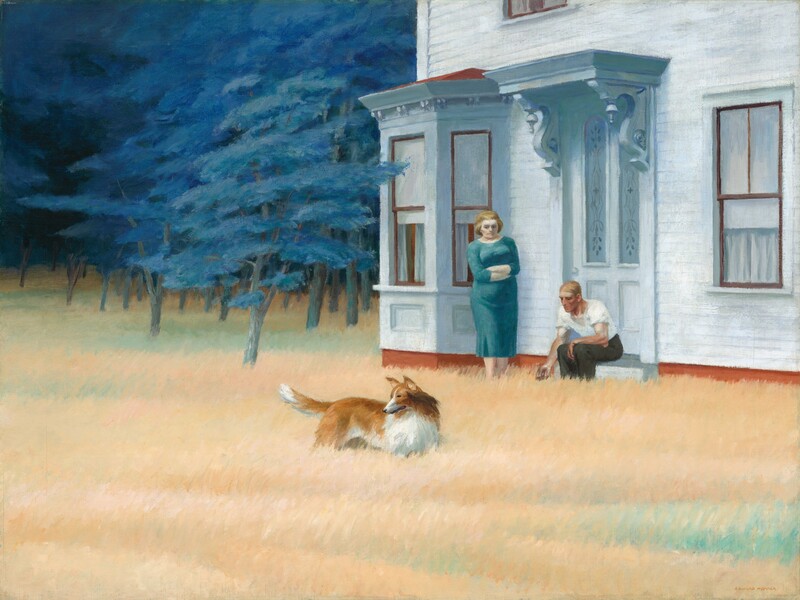
of an Edward Hopper house in a timeless

American field and the house retreating

into itself in the restful silence.

The bats came out. A barn owl flew close.

And the wind which often stirs at the end

of a summer’s day stirred. Take the place from me,

I almost thought, so I can have the memory

and be through the loss itself.

Was it something similar, a feeling in the same family

of feelings, that prompted your use of Selige Sehnsucht

in that long-ago note? I must have forgotten something,

you wrote, though whatever it was that was

taking you away for a few nights hadn’t even begun:

Or is it just that I love you so?
Goethe’s poetry – some new translations by John Greening

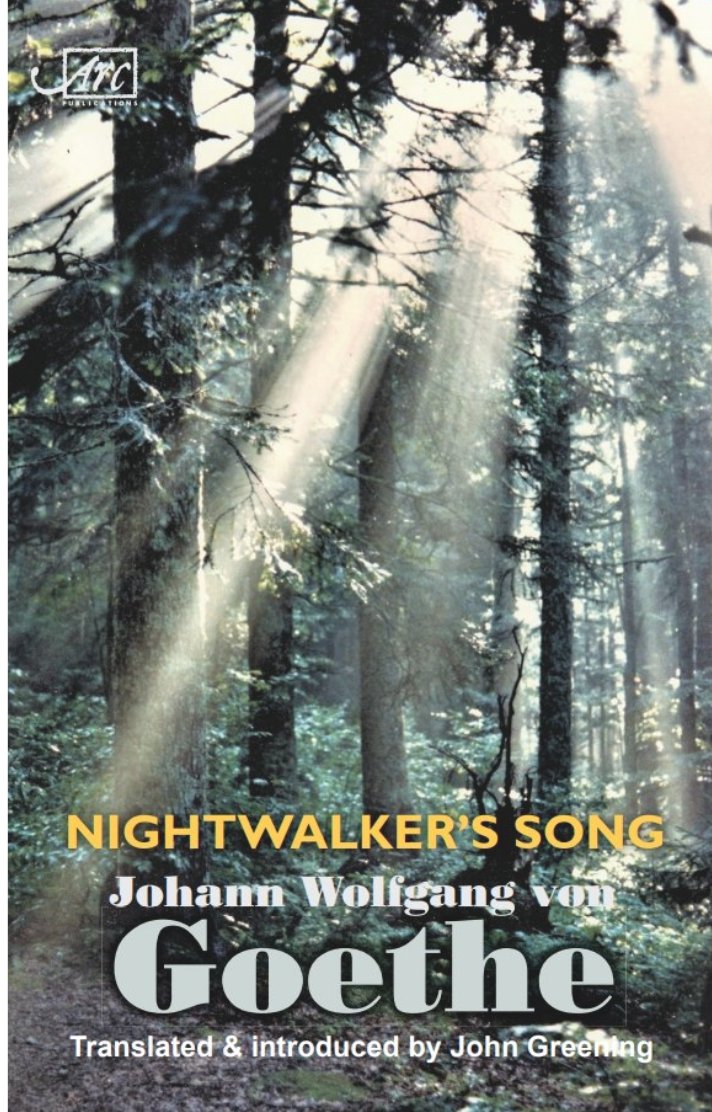
In this blog post, I am discussing John Greening’s new translations of a small selection (9 poems in all) from the works of Johann Wolfgang von Goethe. With the original German texts provided on facing pages, these translations are published as Nightwalker’s Song, by Arc Publications (2022). This review was originally commisioned and published by Acumen poetry magazine early in 2023. By the way, Acumen will be presenting a free to attend on-line celebration of its latest issue on Friday September 1st at 18.30 BST. It will include a brief reading of new work by yours truly, Gill McEvoy, Anthony Lawrence , Sarah Wimbush, Simon Richey, Dinah Livingstone, Michael Wilkinson, Jill Boucher, Jeremy Page, and others.

John Greening’s recent, self-confessedly ‘tightly-focused’ little selection from Goethe’s vast output is, in part, a campaigning publication. In his Introduction, Greening notes the difficulties surrounding the great German poet’s presence in English: the sheer volume of work, the range of that work, the man’s polymathic achievements (as poet, playwright, novelist, scientist, statesman, theatre director, critic), the long life untidily straddling all neat, period pigeon-holing. Christopher Reid has called him ‘the most forbidding of the great European poets’, but perhaps the English have come to see him as a mere jack-of-all-trades? And where do we turn to read and enjoy the poetry? Michael Hamburger’s and Christopher Middleton’s translations look more and more dated. David Luke’s Penguin Selected (1964; versified in 2005)is the most reliable source. But tellingly, as Greening says, one does not find young, contemporary poets offering individual translations of Goethe in their latest slim volume in the way we do with poems by Rilke or Hölderlin.

John Greening

So here Greening sets out a selection box of various Goethes to encourage other translators: we find nature poetry, romance, the artist as rebel, meditations on fate, erotic love poems, a rollicking ballad, dramatic monologue and a very fine sonnet. I like Greening’s determination not to lose the singing. Here, he has ‘shadowed’ the original metres and retained rhyme schemes, though he sensibly makes more use of pararhyme than Goethe’s full rhyming. While not approaching Lowellesque ‘imitations’, Greening has also sought a ‘contemporary texture’ by venturing to ‘modernise an image or an idea if it helped the poem adapt to a different age’. For example, in ‘Harz Mountains, Winter Journey’ (‘Harzreise im Winter’) Goethe’s buzzard has become the more familiar image, in southern England at least, of a red kite. The carriage or wagon (‘Wagen’) driven by Fortune becomes a car in a ‘motorcade’ and another vehicle is imagined ‘winking on to / the slip-road’. There’s also an enjoyable touch of Auden in Greening’s updating of ‘crumbling cliffs / and disused airfields’ (Middleton has ‘On impassable tracks / Through the void countryside’).

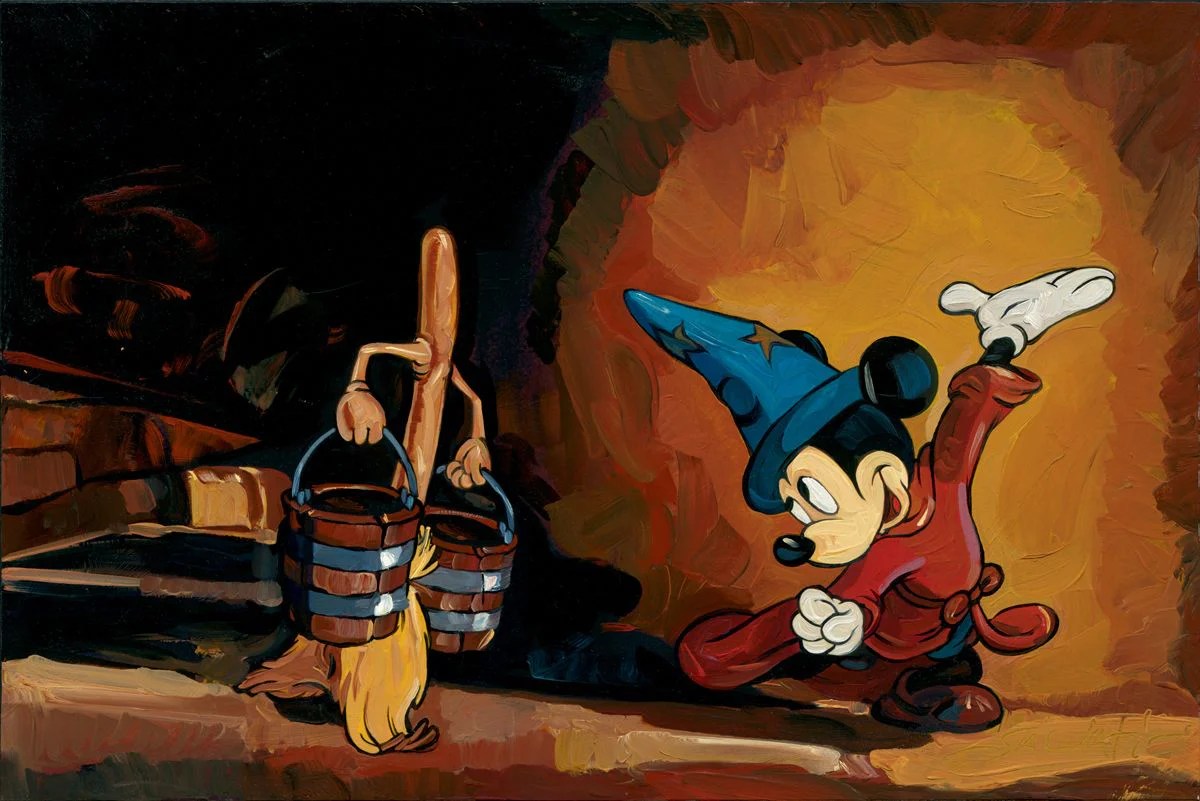
Walt Disney’s Sorcerer’s Apprentice

Greening’s skills in versification are well known and he deploys them all – and you can hear him enjoying himself – in ‘The Sorcerer’s Apprentice’: ‘Broomstick – up, it’s show time, haul your / glad rags on, so grey and grimy. / Seems you’ve seen long service, all you’re / fit for now is to obey me’. Though grace notes and fillers slow Goethe’s headlong verse (the opening line in German is simply ‘Und nun komm, du alter Besen!’ – ‘And now come on, you old broom!’), Greening’s rhyming is delightful and the modernising phrases (show time, glad rags) drive the poem along with a colloquial energy which is absolutely right.

Goethe’s ‘Prometheus’ – published in 1789, the year of revolution in France – is a growling dramatic monologue in which the rebel Titan (who stole fire from the gods to give to humankind) sneers and mocks the authority figure, Zeus. He belittles the top god in the opening lines by comparing him to a boy, thoughtlessly knocking the heads off thistles. Greening catches the mocking tone in the series of rhetorical questions later in the poem: ‘Honour you? For what? / Have you ever offered to lift / this agony?’ Prometheus ends – following one version of his story – by explaining he is creating the human race in his own image, ‘a new range’ translates Greening, neatly updating once more, ‘programmed / to suffer and to weep, or whoop and punch the air – / but who, like me, won’t care / about you’. In comparison, Luke’s version sounds rather fusty and less bolshie: ‘A race that shall suffer and weep / And know joy and delight too, / And heed you no more / Than I do!’

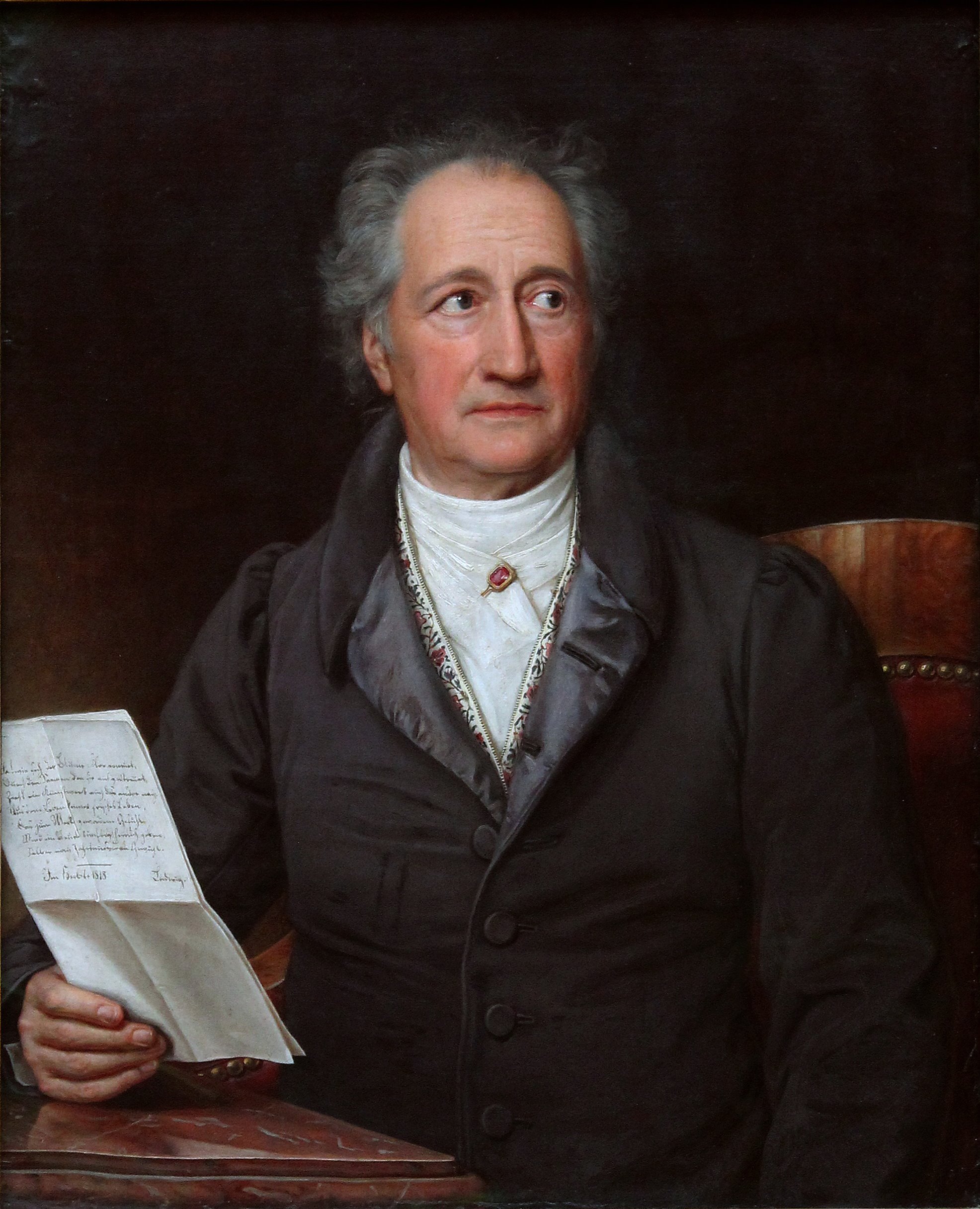
Johann Wolfgang von Goethe

Goethe is a great love poet. ‘Welcome and Farewell’ (‘Willkommen und Abschied‘) has a man approaching on horseback (Greening does not motorise on this occasion) through a moonlit landscape and the lover is spied at last: ‘how / I’d dreamt of (not deserved) all this’. The moment of union passes unspoken between stanzas three and four. As if instantaneously, now ‘the sun had risen’ and the parting must take place: ‘And yet, to have been loved – to love, / ye gods, such utter happiness’. It’s curious that Greening retains the rather archaic ‘ye gods’. One still hears the phrase, of course, but with more irony than I would have imagined here. The fifth of Goethe’s ‘Roman Elegies’ is a fabulous erotic piece. Written during the poet’s travels to Italy in the late 1780s, the narrator is studying classical culture by day and his female lover’s body by night. The latter nourishes the former: ‘I find I appreciate marble all the better for it, / and see with a feeling eye, feel with a seeing hand’. As he goes on, ‘compare and contrast’, I find Greening a little cool here. There is a selection of translations by D M Black (Love as Landscape Painter, from FRAS Publications in 2006) which generates more heat:

Yet how is it not learning, to scan that delectable bosom,

  Or when I slither my hands pleasantly over her hips?

Then I understand marble; then I discover connections,

  See with a feeling eye, feel with a seeing hand.

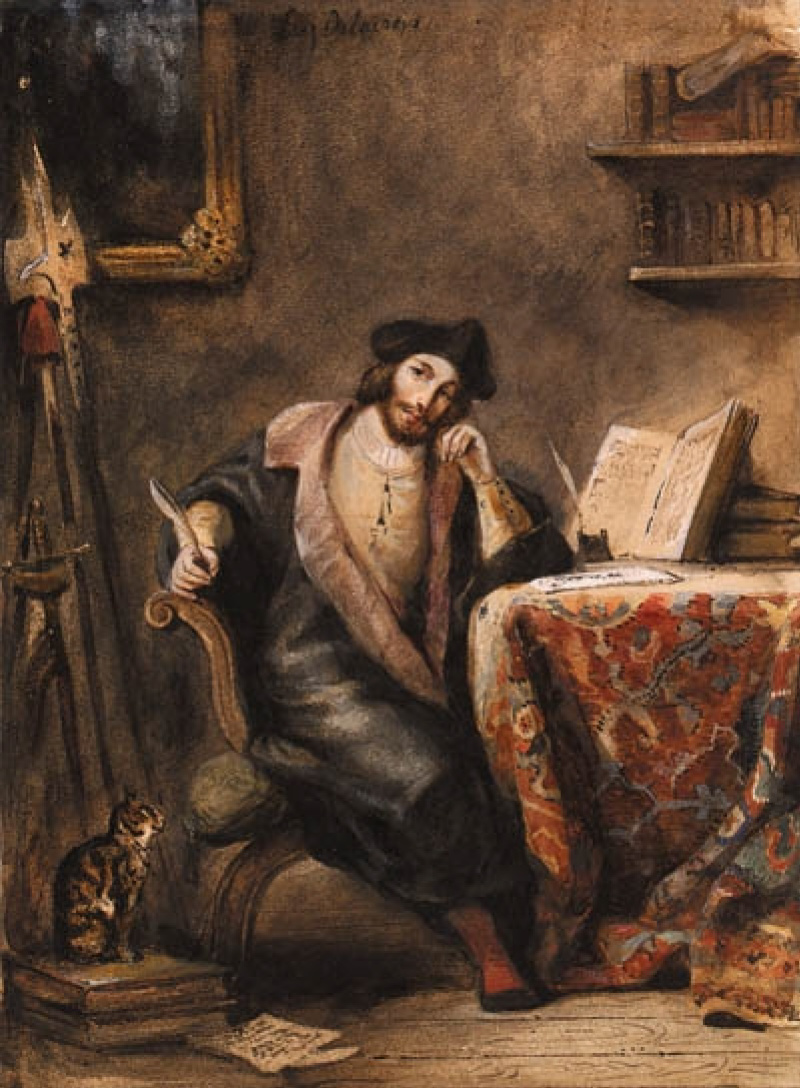
Faustus (by Eugene Delacroix)

Goethe’s Faust is represented here by the scholar’s opening speech to Part One (versioned, as it were, by Christopher Marlowe in the opening soliloquy of his Doctor Faustus). Greening excels in the handling of rhyme and line length, even compared to David Constantine’s 2005 Penguin translation. Perhaps most impressive of all is the sonnet ‘Nature and Art’ (‘Natur und Kunst’). Greening has the motor car in mind again in his updating of Goethe’s exploration of how the artist must labour incessantly to achieve the preparedness, the readiness to respond to Nature, to what is natural. Reading these lines, you feel Greening is translating as a skilled and experienced artist himself, triumphantly bringing a poem written in 1800 bang up to date:

It’s just a case of working long and late.

So once we’ve spent, let’s say, ten thousand hours

on steering, footwork, shifting through the gears,

it may be then some natural move feels right.

x

Creative though you be, you’ll strive in vain

to reach perfection if you’ve no technique,

however wired and woke your gifts may be.

x

You want a masterpiece? You’ll need to strain

those sinews, set your limits, drill and hack.

The rules are all we have to set us free.

For anyone yet to make the leap into Goethe-world, this little book is a terrific way into the great German writer’s work and such a reader will find Greening’s Introduction and his prefatory remarks to each of the chosen poems very helpful indeed. I recommend this collection.

‘I Hear the Unheard Heart’: the Poems of Rose Auslander

What follows is a review – originally published by Poetry London earlier last year – of Rose Auslander’s poetry. As I say below, her work has been surprisingly little noticed in the UK literary world. The situation is rather different in her own culture where she is well-known and much admired as this entry on the germanlit.org website makes clear. She is an unusual and original poet well worth seeking out and you can find this book on the Arc website.

While I Am Drawing Breath is a revised version of Mother Tongue, Anthony Vivis and Jean Boase-Beier’s 1995 volume of  Rose Auslander’s poems. That book strode across an effectively empty stage and the same is surprisingly true of this new version: there are really no rival translations into English currently available (she’s not even included in Michael Hoffman’s Twentieth-Century German Poems (Faber, 2005)). This sadly reflects Auslander’s reception through the first half of last century. Only at the age of 64 did her work begin to be noticed, though until her death, 23 years later, she received prizes and accolades, mostly in Germany. Her relative neglect is surprising given her extraordinary personal story, surviving the worst horrors of the twentieth century, and the vivid, gem-like minimalism of her work.

mc_While_I_am_Drawing_Breath_cvr_pbk_6_May_14

The life is important. Rose Scherzer was born into a German-speaking Jewish family in 1901, growing up in Czernowitz (then part of Austria-Hungary). The First World War forced the family to Vienna, then Budapest, but later Auslander returned to study at Czernowitz University. She made the acquaintance of philosopher, Constantin Brunner, but in 1921 emigrated to America with Ignaz Auslander (to whom she was briefly married). She returned to Czernowitz only to find it occupied by the Nazi’s in 1941. She lived in the Jewish ghetto, surviving against the odds, writing poetry and meeting Paul Antschel (later Paul Celan). The town was liberated by the Russians but while Auslander tried to arrange for the family to emigrate to America, her mother died, precipitating her daughter’s breakdown. She did not write in her native tongue again for another 10 years.

While I Am Drawing Breath contains work written in these later years (it’s a shame the arrangement of this book gives no sense of chronological development). By then the friendship with Celan had been revived and Auslander abandoned the rhyme schemes and metrical patterning of earlier work for a more free, highly compressed, yet colloquial style, rejecting all punctuation. It is this style that German readers recognise as her distinctive achievement and is the culmination of the tragic restlessness of her life as well as her fascination with language. It was hard to speak of what she had witnessed:


From the eyes

of sated man-eaters

smoke surges

and my words

have blackened

in it

(‘Smoke’)

Paul Celan

Eloquence, volubility, the pleasures of the text risked disrespect for the victims of war. Auslander’s words are never far from mourning:

I call out

my willow-word

to the sunken souls

the squall has

driven down

to the pebbles

(‘Willow Word’)

Czernowitz, probably 1941

Yet she seldom speaks directly of pogroms and persecution. ‘And Shut Out Their Love’ does record the advent of “guns and jagged banners”, but Auslander’s imagery is more mythic, more folk tale: hunger, blood, fire, snow, ashes, smoke. Faced with the “unbearable reality” of the Czernowitz ghetto, the options were to despair or dwell in “dreamwords” and there are strong escapist longings as in ‘In Those Years’ with its snow-bound world into which come seductive rumours of  a “country / where the lemons flower” (an allusion to Goethe’s 1795 lyric ‘Mignon’). ‘Immer Atlantis’ (translated here as ‘Atlantis Always Glittering’) re-creates that mythic city:

there are always celebrations in swaying gardens

well-proportioned people

always holy and delicate

tn_auslander

But her friendship with Brunner suggests Auslander was pursuing something more complex than the sort of consolatory fantasy this suggests. He warned against the dangers of superstition, or pseudo-contemplation: unfounded beliefs creating a distortion of true insight. Auslander regards language itself as a ‘third way’, a melding of self and world, without the risks of denying reality. In ‘Mother Tongue’, movement along the “word path” leads to transformation “from myself into myself / from moment to moment”. In ‘Words’, language is neither slave to reality nor liberated self-expression, but “my source”. In ‘The Net’ the goal is “one word / which says it all” as Brunner suggested, an ascent to a plane of spiritual (geistig) contemplation encompassing love, art, and philosophy.

That Auslander’s work pursues such goals without tumbling into arid abstraction and commentary is one of the pleasures of these tough, unselfpitying poems. She is open to “dull brown” as well as “radiant blue” (‘As If’) and her obsession “for binding words” is an attempt “to reach even further / into this known / unknowable / world” (‘Sentences’). What she hears through the cuckoo, rainbow, snow, camomile, mills, carnivals, islands and trees is a spiritual realm, given validity not by any organised religion but by the suffering she has endured:

I hear the unheard heart

in my breathing

like a clock made of air

then the melody of the music-box

is alive in my temples

its tones muted like the moving spheres

(‘The Unheard Heart’)