Forward First Collections Reviewed – #1 Mona Arshi

This is the first in a series of reviews I will post over the next two months of the 5 collections chosen for the 2015 Forward Prizes Felix Dennis award for best First Collection. The £5000 prize will be decided on 28th September. The shortlist is:

Mona Arshi – Small Hands (Liverpool University Press, Pavilion Poetry) reviewed here;
Sarah Howe – Loop of Jade (Chatto & Windus); reviewed here;
Andrew McMillan – physical (Cape Poetry); reviewed here;
Matthew Siegel – Blood Work (CB Editions) reviewed here;
Karen McCarthy Woolf – An Aviary of Small Birds (Carcanet) reviewed here.

************

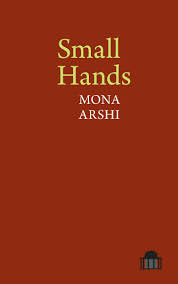
Mona Arshi – Small Hands (Liverpool University Press, Pavilion Poetry) Mona Arshi’s webpage
imgres

Despite the ironic lack of capaciousness implied by its title, Small Hands is a brimming miscellany of poems. Many of them suggest interesting growing points for the future, but Sathnam Sanghera’s claim that Arshi is “Britain’s most promising writer” and Moniza Alvi’s talk of “genius” is premature and liable to drag the reputation of blurb-writing even deeper into the mire. A trying-on of various recognisable styles or voices is expected of any first book, compiled as they usually are over years awaiting a publisher’s call, but Arshi’s arrival at a full collection has been swift. Publicity suggests she only turned from a profession in law to poetry around 2008. It’s for this reason that her influences (Alvi, Petit and Khalvati most obviously, perhaps Emily Berry) are so clear.

Two early poems in the book allude to the idea of catastrophe. ‘Practising Your Skills’ faces an accusation about a “tendency to catastrophise everything” and this also emerges in ‘Bad Day in the Office’ where the narrator is trying not to regard rainfall as “catastrophic”. These instances may be ‘character’ points but such a ramping or ratchetting up of the ordinary is often evident elsewhere in the book and tends to caricature, a dramatic arc-lighting, unexpected (literally cata-strophic) links between disparate ideas or images and hence a love of listing: in other words, forms of surrealism. This is something Arshi has spoken about, regarding and admiring poetry as a discourse utterly counter to the kind of language-use she once employed in the law. So ‘The Lion’ is out of Angela Carter’s The Bloody Chamber via Pascale Petit and evokes a strange relationship between a woman and an older man. It’s a powerfully disturbing poem because the male figure is accorded such power, language, sensuality, wisdom and a sort of droit de seigneur over the female narrator who seems disinclined to question the set up. As with several of the quasi-pornographic pieces by Sam Riviere, the critical question here is where lies the irony? Hard to tell, especially as this is the book’s opener.

imgres

Arshi’s somewhat whimsical surrealism is better seen in her portraits of female figures alone. ‘Cousin Migrant’ is a visitant “from the skies” as well as a paradox (“her arms are thin as margins yet she can lift my children / with ease”). The Cousin’s transgressive – or more accurately, indefinable qualities – are conveyed clearly, humourously, the narrator, in contrast, is nothing more than “a storm in a tea-cup”. The confines or otherwise of female lives are treated in more conventional poetic form in the object and memory piece, ‘The Gold Bangles’, evoked as a cultural inheritance of value though the narrator prefers to think of their owner’s wrists before the gift, “still unadorned and naked”. As here, there are several other poems that draw on Arshi’s background, born to Punjabi Sikh parents in West London. ‘Jesus Saves’ is also a more conventional poem of childhood memory, on this occasion hearing a racist speaker in 1979, on Hounslow High Street, “long after Enoch”. But elsewhere, Arshi prefers to construct enigmatic poems, hovering just beyond the edge of anything one might regard as a clear and present body of evidence. This is especially so in what seem to be ‘relationship’ poems like ‘Entomological Specimens’, ‘Practising Your Skills’ or ‘Insomniac’ which cryptically advises: “Never marry an insomniac. You will have / to mind yourself”.

At the centre of the book are several poems about the tragic loss of Arshi’s brother, Deepak, at the age of 41. These poems are moving and suggest contrasting aspects of her work: deep levels of tact and restraint. Moving through the experiences of learning of his death and the family’s adjustment to his loss in slant poems about a phone call, practical details of the mourning process, officialdom, the family garden, the urn, the loss still feels raw and unresolved and there will be more poems to come on this topic I’m sure.

Mona Arshi

The other prominent and enjoyable aspect of Arshi’s work is its sensuality and awareness of the body; this is a collection full of hands, feet, mouths, lips, eyes, wrists, hair and, ubiquitously, skin. In ‘Lost Poem’ she talks of “taking in language / through my skin” and there is a clear project developing here in that, at their best, these poems unfold through a language of the senses rather than the intellect. Elsewhere, Arshi writes of wanting to “sequester” and “foreignate” words, de-familiarising them, wresting them away from conventional denotation. I first heard her read aloud when she won the Magma Poetry Competition in 2011 with the ghazal-like poem, ‘Hummingbird’, here tucked away at the back of the book. I now read that poem against ‘The Lion’ and this is the one I prefer for its originality. The narrative voice (undefined) addresses the ‘you’ which is mostly the hummingbird itself, though as with ‘The Lion’ the creature is also interchangeably / metaphorically human. The tender, persuasive imperatives almost immediately carry an erotic charge, though where the “fingers” probe and slip is mostly into “spaces”, lacunae. But the hummingbird figure has none of the over-bearing masculinity of the lion; we are told it is capable of “curing”, dissolving, even pronouncing the speaker. But the speaker here is not as passive and compliant as in the earlier poem. Though she will allow him/her to open the “bone-zip of my spine”, the insistence of her voice gives her an active role in the relationship. The hummingbird is invited to “anoint” the speaker, a significant contrast to the shallowness of the lion’s crude “undressing”. (Arshi discusses this poem on the Magma website here)

black-n-white-hummingbird-tattoo-design

George Szirtes’ rather more restrained blurb observations suggest that he reads in Arshi’s work an “erotics of the spirit”. Without doubt, ‘The Hummingbird’ is a sexy, enigmatic, yet precisely expressed poem that is going to repay our re-reading of it. And if that is not the case with many other poems in Small Hands we should not be surprised. Arshi combines a liking for obliqueness, sometimes even coolness, with a desire to push what language can do and a willingness to experiment with form. Her cultural background is relatively unexplored here, yet promises much if that is the way she wishes to go. Not a winner of the 2015 Forward First Book award for me, but an intriguing writer, potentially a unique voice if she can achieve the right distance between herself and her powerful formative influences.


Gerry Cambridge’s ‘The Dark Horse’ – 20th anniversary

The 20th anniversary issue of Gerry Cambridge’s great poetry magazine, The Dark Horse, has arrived on subscribers doormats in the last week or so. In his editorial, Cambridge recalls the magazine’s beginnings in 1995: 500 copies of a slim, buff-card-covered, stapled pamphlet. It began, he tells us, “as a forum for the best writing about poetry and the best poetry (by my own lights)”. He also quotes Patrick Kavanagh on poetry as something you dabble in and then find it has become your life and how true must that be of editing a poetry magazine too. Cambridge reflects on the changes over the last 20 years, particularly in the technology of poetry submission and dissemination, in the “endless drip-feed” of social media, and the degree to which technology has shifted the power structures of contemporary poetry.

imgres

He is evidently uneasy about the influence of the turbo-charged prize culture we now live in which has “clotted and compromised” the world of poetry, alongside the “broadsheet, press-driven accolades and poetry politics that can foment discord among young writers”. It has always been a truism that the world of poetry is a cramped place and the level of attention it receives is vanishingly small. With the advent of a number of notable prizes, the urgency to be accorded such notice has upped the ante considerably so that success is ever more clearly marked, while failure is thrown into far greater contrast; though both ‘success’ and ‘failure’ are designations calculated nowadays too much in terms of immediacy.

images
20th anniversary launch with Clare Pollard, Kei Miller, Wendy Cope and Niall Campbell

So in this context especially, 20 years is very a long time in poetry and The Dark Horse seems set for an impressive further run (equine jokes are hard to avoid and Cambridge himself does not try). This new issue is 190 pages long, with an interesting essay by Dana Gioia on poetry as enchantment, critical evaluations of James Lasdun and Mark Strand, new poems from Vicki Feaver and Oxford Poetry Professorship contender, A E Stallings, as well as Sweeney, Ryan, Cope, Mort, O’Donaghue, Carruth, Brackenbury and Stevenson and loads of others.

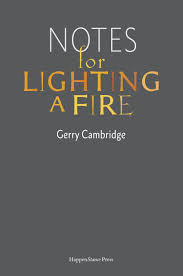
As well as an editor, of course, Cambridge is a very good poet and as my contribution to the magazine’s anniversary celebrations, I thought I’d post up my review of his last collection, Notes for Lighting a Fire (HappenStance, 2012). Wishing happy birthday to The Horse . . . 

images

In Gerry Cambridge’s fine new collection, he seeks to peel away the inessentials of history, personal life, or the natural world in the confident belief that what remains possesses truth and value. His work attends to details, revels in tracing processes (laying a fire, peeling an orange, blowing an egg). He has a fine line in self-deprecation as in ‘Exposure’ where the narrator shaves his head, reflecting a desire to “go bare”, summed up as “an attempt at honesty, a minor / variety of courage”. Actually, this identifies a major thrust of Cambridge’s poetics, aspiring to the “plainness of nouns”, a reverence for things as they are. So conjuring a flame is an apt subject and ‘Notes for Lighting a Fire’ offers a practical guide, evokes a vast universe encompassing the act, touches on the contrasting evanescence of the merely topical, parallels the kindling of flames and poems and concludes with an expansive juxtaposition of science, history, earth and outer space as Orion swings into the sky “like a spaceship / of light from behind the black burial mound of that hill”. It is quite a performance.

Writing for a local council project to light its public buildings sounds less than inspiring but the sequence ‘Light Up Lanarkshire’ quickly escapes its unpromising beginnings. Light energy is derived from coal and coal “is a terse black language” ripe for this poet’s essentialist pen. Lanarkshire’s place-names and history are evoked with “millions of years” to create the “black subterranean seams” and their mine owners’ wealth. The best part of the sequence is Cambridge’s portrait of his miner grandfather, in “necktie and suit with his strong-jawed wife”. Recognising he may not have been an easy man to live with, he still finds admiration for him, “spruce as a gentleman, stepping out for his evening shift”. Likewise, Cambridge’s elegy for his father, only partially ironises inherited values of “the dignity of work etcetera” (‘Light Leaves (1/iv)’). The son/grandson memorialises the undeveloped spark of aspiration in both men’s “stab at a perfect world” (1/x) in his father’s lovingly curated toy trains and his grandfather’s extravagant purchase of “a fancy clock for the house”, devastatingly dropped when confronted by his wife’s critical “sherricking”.

fullislandfinal_003
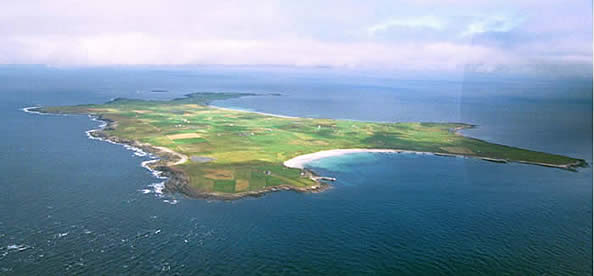
North Ronaldsey

In Cambridge’s other great love, the natural world, he finds further repositories of continuity. His queen wasp’s abdomen stores “Ten thousand summer wasps, wasp dynasties / Down the perpetual light of centuries” (‘The Queen’) and there is a delightful sequence of poems on a child collecting birds’ eggs. The more ecologically correct adult judges this a mere function of egotistical “possession” (‘Sacrifice’) but perhaps it more truly reflects a concern for paradoxically affirming fundamentals: the securing of the prize of a sparrowhawk egg would be “a bartered death that said I live! I live!” (‘A Sparrowhawk’s Nest’). Love of nature, stoicism and conservatism come together in ‘The Great Things’ in which details of North Ronaldsey are lovingly collected – its sense of space, inhospitable weather, a shrinking population, life clinging on, the beauty of a setting sun. The poem concludes, “Elsewhere the great things of the world will be taking place” but the irony is strong since it’s these stripped-back mundane details that form the true ground of human life and constitute the focus of this honest, profound and coherent collection.

Templar Poetry Launch: Weir and Onitskansky

On Tuesday evening last week I went to the Keats House Library in Hampstead for a reading which was both part of the on-going Keats House Festival and one of Templar Poetry’s regular slots there. Jeri Onitskansky (who I know a little via a workshop group) was launching her Iota Shot pamphlet, Call them Juneberries, alongside Tom Weir who, having had an Iota Shot last year, is already launching a full collection with Templar, All that Falling.

images
Cover image from ‘All that Falling’

Run by Alex McMillen, Templar http://www.templarpoetry.co.uk/about.html is an immensely busy and enterprising press, holding frequent competitions for full collections and Shots (small pamphlets) as well as the Iota magazine. The books all look very good and there was a good crowd at the reading. I was happy to find myself sitting between friends, Mimi Khalvati on one side and Lynne Hjelmgaard on the other. Later, I had a chat with Linda Black about both her writing (fascinating prose poems published by Shearsman) and her work in the visual arts.

All good and fine then? Well – I went away a bit disappointed actually and it was for the good reason that I wanted to hear more from the poets and their publisher, more than the bare poems themselves which I can (I am) reading at my leisure with the printed book. Perhaps there were time restrictions at Keats House but both poets read briefly (with no interval, we were out within the hour) and Weir in particular did not spend enough time introducing his poems. This art of introducing your own work is – I realised all over again – one of the key issues at a live reading (the other reason to go of course is to network and get noticed – quite different to meeting friends – but that’s just miserable). Alex MacMillan spoke economically to start with, just a basic biographical note to each poet. I thought more might be said since both these poets had ‘won’ competitions to get published. I bet there were people in the room who were keen to hear what he liked about these writers, what kind of work Templar published, even where he saw Templar in the twinkling firmament of poetry publishing.

imgres
Jeri Onitskansky

But . . . on with the show. Onitskansky started with several poems drawing on childhood memories of life in the US. ‘Minnows’ is a vivid recall of Summer Camp days though, for this graceless “fifth grader”, catching minnows from a creek was preferable to other more vigorous activities. Plus it provided imagery years later for a poem about wanting to be “filled with grace”. Rather more graceless (though still epiphanic) is ‘Friendship’ where two girls climb up a big rock and then pee down it, “watering a little pee forest” at the foot of it. Onitskansky is very good at innocence, though often a rather tilted, skewed version of it. ‘Girl with Dandelions’ has a child blowing a dandelion clock though she hasn’t yet “learned / they’re the same buttery stars that last / cheered the meadow”. Time passes in many of her poems and there are quite a few creatures too. Adulthood is a place of greater confidence mostly, though also there (in a thoroughly rat-bothered poem) “the long tail / of your mind scurries across the page”. These are interesting poems and Onitskansky is a name to watch.

If Onitskansky’s stage presence is quiet but assured, Tom Weir’s is gauche, jittery, rather apologetic, seeming younger than he really is. Acumen magazine published an interview with Christopher North a while back in which he listed annoying comments, cardinal sins committed by poets at readings. Here are 8 of them:

1) Have I got time to squeeze in a short one?
2) Now let’s see if I can find it…
3) Now if I can just get this thing to work…
4) This is one I wrote on the way here…
5) We were each asked to write a villanelle…
6) I know it’s here somewhere…yes. Oh no, erm, let me see…
7) How long have I got?
8) It’s a load of rubbish, but I’ll read it anyway…

imgres
Christopher North

Unfortunately, brief though the reading was, Weir managed most of these (OK – not 4 or 5). But his opening poem ‘Day Trippin’’ was charming, recounting dealings with a recalcitrant child: “with an ice-cream which you wore // like a glove as it melted over your hand”. That’s a great image but there were fewer of these than I’d expected. Maybe I just missed them. Weir’s delivery did not help his cause being gravelly and short of breath and losing the ends of phrases too often. I had bought the book so I could follow the poems but those listening will have missed phrases for sure. And some of these poems needed a bit more context (‘The Send Off’, for example). I don’t think I’m alone in liking to hear how poems arose, the poet’s thoughts about person, voice, form. A few moments of introduction also allow the auditors’ minds to pause, change gear ready for the next poem.

imgres
Tom Weir

Weir likes to be blunt, direct and there’s an Armitage-y feel to many of the poems, though without the catchy phrase-making and word play. A poem about a dog (apparently intent on suicide by drowning) was a curious choice, especially alongside the more powerful ‘Monsoon’ where men are caught “up to their waists in water, the children held high / above their heads like an offering to a god nobody believes in”. Weir has travelled plenty, particularly in South East Asia, and several of these poems are very interesting (a shame he do not read them on the night). Overall, the book seems a bit hit-and-miss especially as it includes two-line poems on both ‘Muscle Memory’ and seeing a woman dancing through a lit window. There are just 5 lines on ‘Closing Time’ and a 6-liner on a ghost. It’s hard not to see these as fillers and I worry the collection has been rushed out quickly and would have benefitted from editing the weaker pieces.

But it was all over quickly. And, returning to North’s complaints about poet’s reading aloud, I was certainly happy, on this occasion, not to have to suffer anything resembling sins 9 and 10:
9) So all you need to know is that a squawk-bogger is a Tasmanian newt and that ‘ramping in the dolditts’ is an expression used by Romany folk of Upper Silesia referring to their annual bean throwing festival and that Durnstadt-Terminium is a village in Bavaria where they make clay pipes – well, you’ll see what I mean when…
10) (Already 15 minutes over allotted time) …and here‘s one I simply have to read. It came about after my son’s first session in rehab – he’s out now and all seems OK Hooray! Hooray! And it’s an important poem for me because it was like a coming to terms emotionally with..blah, blah, blah.

Thanks Christopher.

Bathing in the Olt #7

Introduction to the abecedary form of this sequence: click here.

Previous installments:  #1 / #2 and #3 / #4 / #5 / #6

Bathing in the Olt

7.

The past behind its drawn curtains

the train to Slatina

their loved ones emerged from the glittering water

*

their property stood on a hill of red soil, a few hundred feet distant but facing the river Olt

they were making for the other bank

they had no thought for the tragedy that had already

*

this was Violetta now in love with Virgil

though she would have been happy to be rescued

to irresistible longing

to swim where the currents allowed

two nights of absence . . . to her that was evidence enough

urgent matters would force delay

*

Violetta seemed to have handled the short separation well enough

Violetta suddenly disappearing from sight

Violetta took her revenge

Violetta was a powerful swimmer

Virgil Trancu and his family lived close by in the neighbouring village

*

waiting for the scandal to break at any moment

waiting for what he felt sure would happen

warm sand under leafy osiers in the breath of a day drawing to a close

was meant simply to entice him

was out of danger

was wrong and she suddenly burst into tears

*

yawning, carefully, she un-

zipped her “maillot” and lay indifferently, beautiful and seductive

arcade-card-french-woman-in-head-scarf-and-wooly-bathing-suit-sitting-on-beach-leaning-on-one-arm-1920s

Bathing in the Olt #6

Introduction to the abecedary form of this sequence: click here.

Previous installments: #1 / #2 and #3 / #4 / #5

Bathing in the Olt

6.

Reasons for panic at Milcoveni as the heated imagination of his girlfriend

she bent briefly forward as if liable to fall

she had a simple plan

she had made it the night before and she would carry it out

she seemed to be begging for help and attention which she did not truly need

*

skirting the strongest currents of the river, he managed to reach the other bank

slave to her own impressionable nature

so hard to counter. Cautiously, he tried to spare her any pain

so it was that the two couples often met

*

soil erosion caused by the powerful and frequent flooding of the waters of the

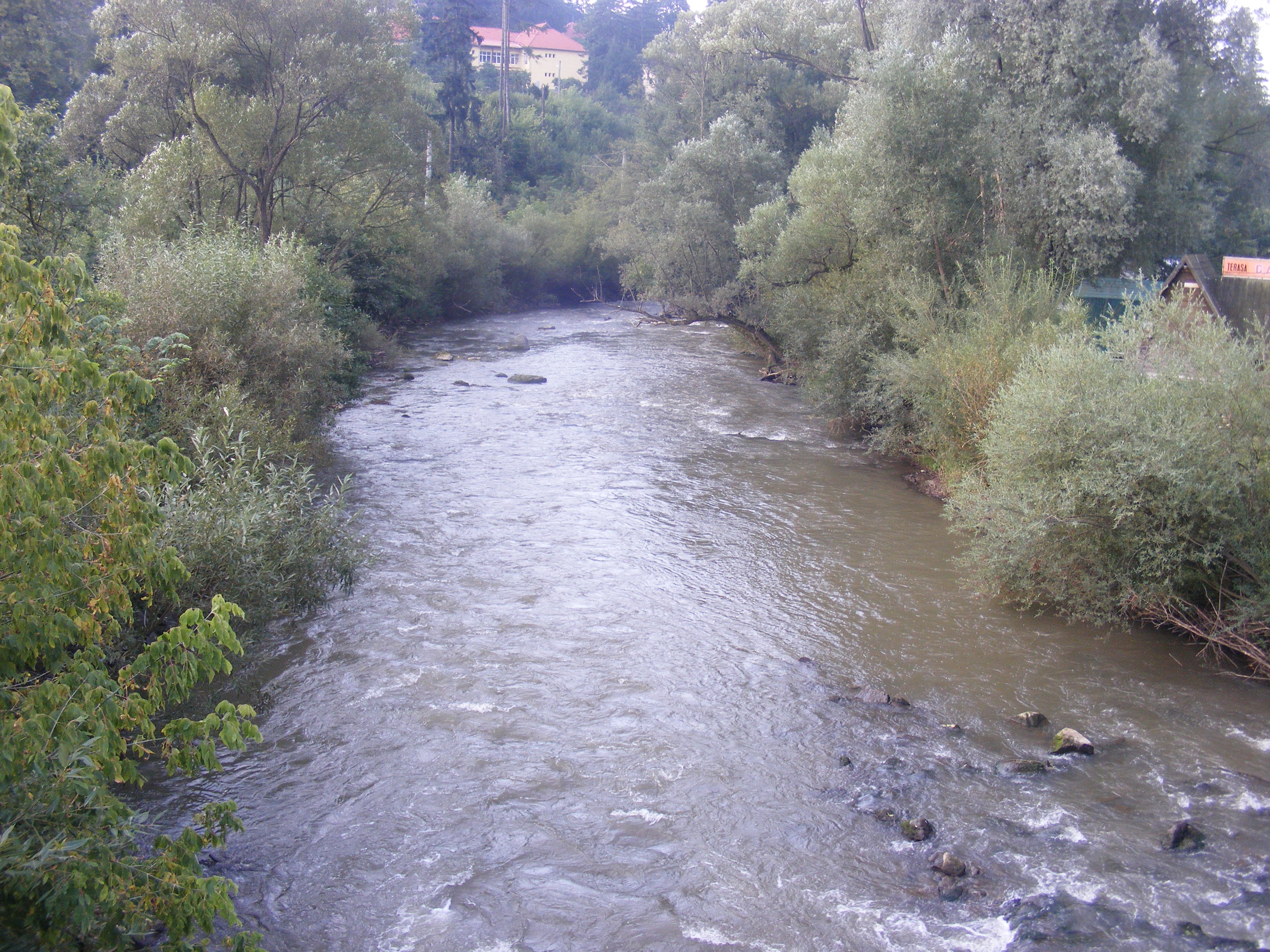
mighty Olt

some high society woman in Craiova

something of a coward and Benedict a mere beginner

struck out decisively for the side where the current seemed most powerful

*

taken aback and then enchanted by this new music

the “maillots” were brought out and Violetta’s was especially fine

*

the delay seemed to make sense no longer

the fear lovers experience when the one they love is not beside them

the grace and elegance of the two girls contrasted sharply with the ravines and the

river bed, hollowed out by the destructive fury

*

the material evidence . . . He found the two “maillots”

mvalea-oltului3

(Next installment posted tomorrow)

Bathing in the Olt #5

Introduction to the abecedary form of this sequence: click here.

Previous installments: #1 / #2 and #3 / #4

Bathing in the Olt

5.

Near the bank the river was quiet

neither love nor life in the old, white house in Milcoveni

*

no direct path so they had to make a detour to reach the water

no inkling that anything was amiss

no trace of Benedict

not at all hard to convince. And he surrendered

not taken in by his gesture; it merely fuelled her suspicions

*

nothing seemed to threaten their happiness

now they had lost almost everything

*

on the opposite bank something strange was happening

one solitary gesture: one of renunciation

perfectly covering her body it emphasized her beautiful figure

pretending fatigue and weakness

quickly went under without trace

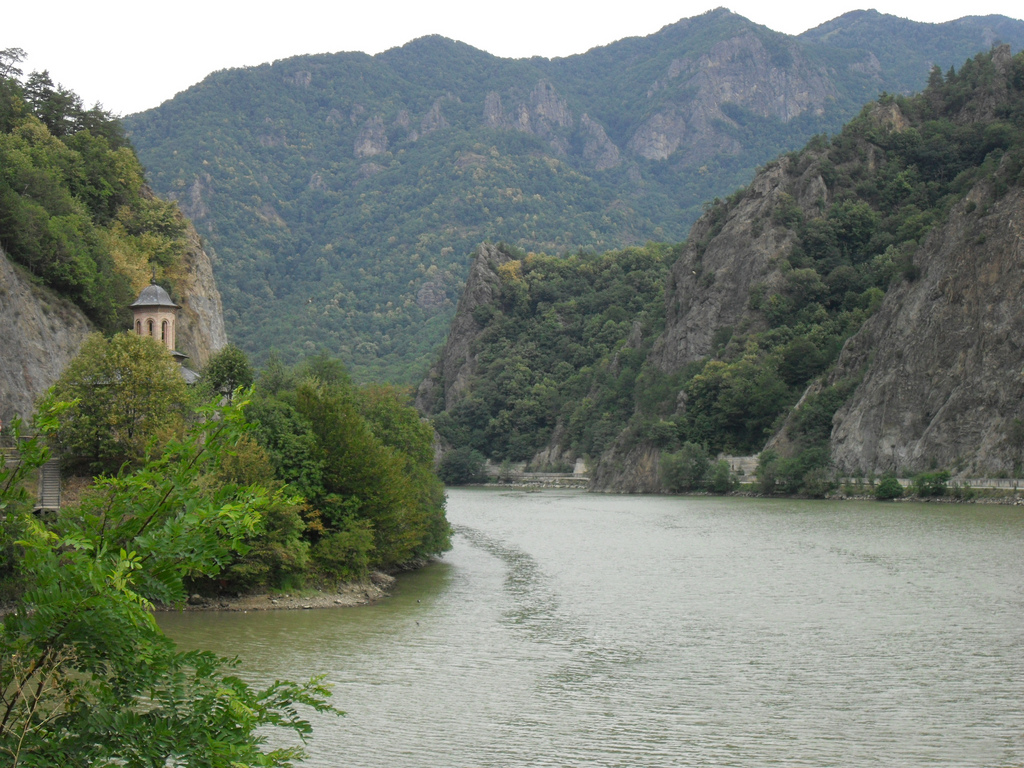
The_Olt_river

(Next installment posted tomorrow)

Bathing in the Olt #2 and #3

Introduction to the abecedary form of this sequence: click here.

Previous installment: #1

Bathing in the Olt

2.

Dawning on Benedict

*

deeply

delightful entertainment during the long, hot summer days, bathing in the Olt

*

did not shout

did not threaten, did not say a word

drowning in the whirlpool of the Olt

.

3.

Elegant, young, attractive

even Benedict seemed to have lost his confidence

forests of osiers, of dense, hollow willow trees and huge sand bars that gave the impression of tremendous disturbance in the landscape

for her these were dreadful moments

*

given the opportunity to sneak back she swiftly dressed herself

*

going to bed that night they abandoned themselves to passionate embraces

he would not be able to keep the promise he had made when he’d left his girlfriend, Violetta

her eternal threat never left his mind

her misfortune was not something Violetta thought greatly about

hidden under the shaggy willow trees on the fine, dry sand, beneath the melancholy rays of twilight

his athletic body and complete absence of hair

his body found where the current had brought it to the river bank

his was unexpected

5836008337_970273f706_b

(Next installment posted tomorrow)

Bathing in the Olt #1

Introduction to the abecedary form of this sequence: click here.

Bathing in the Olt

1.

A modest apartment

a swimsuit which on a famous beach last year in high season caused quite a stir

a well-lit house on a quiet street of the Capital

all part of the performance

*

an absence that had been longer than expected but through no fault of his own

as all miserable people

as they tried to hide

as you might after a funeral, having stood for hours, the welter of powerful emotion

at that very moment Violetta exacting her revenge

*

aware of his girlfriend’s fierce jealousy

Benedict had been adamant

both reproach and bitter disappointment

bringing the conversation skilfully round to bathing

cheat on me – on the very same day you cheat on me – I’ll cheat on you

*

children were taking cows to the pasture

*

close by he saw their naked bodies vanishing among the shade of the willow trees

crushed by the incident, imagining her happiness in ruins, her soul flared

arcade-card-french-woman-in-head-scarf-and-wooly-bathing-suit-sitting-on-beach-leaning-on-one-arm-1920s

(#2 posted tomorrow)

Bathing in the Olt #4

Introduction to the abecedary form of this sequence: click here.

Previous installments: #1 / #2 and #3

Bathing in the Olt

4.

I am miserable. I am very miserable . . .

I knew you would want to save me

if it was achieved without much effort on her part

*

important business would keep Benedict in Craiova for two more days

in contrast she appeared flawless

in his every action he could leave no room for any suspicion

in the horse-drawn carriage on the way they talked little

in vain she pleaded to accompany him

*

just some beautiful hotel waitress

*

keenly looking for the dining car waiting to catch sight of

left at home alone, spawned a host of suspicions

lovingly aroused by desire, the thought that she belonged to him

*

Milcoveni to take tea, served according to the rules of a fine house

more than once Mr. and Mrs. Virgil Trancu had been invited to join them bathing in the Olt

craiova-veche-gara

(Next installment posted tomorrow)

The Abecedary Form / Carolyn Forche

The Form: I wanted to share here some thoughts on my experiments with the form of the abecedary. An abecedarium (or abecedary) is originally an inscription consisting of the letters of an alphabet, listed in order. Abecedaries were often practice exercises, teaching aids, but also developed as an ancient poetic form guided by strict alphabetical order. The earliest examples are Semitic, found in religious Hebrew poetry and the form has been used in various cultures for prayers, hymns, and psalms. Psalm 118 (or 119 by King James numbering) consists of twenty-two eight-line stanzas, one for each letter of the Hebrew alphabet. Chaucer’s An ABC is a medieval example of the form. Some abecedaries found in the Athenian Agora appear to have been left deliberately incomplete and the imperfection of these examples may have had a magical or ritual significance.

imgres

For those who have come across this form in contemporary poetry at all, it was probably (as in my case) through the poem called ‘On Earth’ in Carolyn Forche’s Blue Hour (Bloodaxe, 2003). I reviewed the book in some bewilderment at the time (see below) but have since come to see it more favourably. Forche herself says: “Gnostic abecedarian hymns date from the 3rd century AD. Along with Christian and Buddhist texts, they were recovered from small towns on the northern fringe of the Taklamakan Desert, early in the 20th century”. She also links the form with the idea of the pleroma, defined as the totality or fullness of God’s creation, the One. Over the 46 pages of ‘On Earth’, she adheres rigorously to the form in which alphabetical order guides not only the stanzas, but also the words opening every single line:

languid at the edge of the sea
lays itself open to immensity
leaf-cutter ants bearing yellow trumpet flowers along the road
left everything left all usual worlds behind
library, lilac, linens, litany

Poets.org says that abecedaries are now more commonly used as mnemonic devices and word games for children such as those written by Dr. Seuss and Edward Gorey. A derivative form is the much more familiar acrostic.

From my 2003 ReviewThe book contains 11 pieces in 65 pages, 46 of which are taken up with the long poem ‘On Earth’ and phrases do echo throughout the poems so there is a sense of unity to the whole. For the most part, Forche writes by assembling fragments and images, often without clear syntactical or narrative connections to surrounding lines. The reader experiences the verse as successive waves (lines stretch across the page and usually come in twos or threes), or as threads floating disconnectedly, but creating a striking impression of beauty. Forche’s obscurity comes more from an unshakeable confidence in her project, in her voice, in her idiosyncratic style and in her subject, largely concerned with the significance or recovery of the past in the present moment.

My difficulty with what Forche does is that all kinds of experience seem to be subjected to the same treatment, so that in the end the reader swims through an undeniably glittering, but rather gloopy, phenomenological soup in which “a city a thousand years” has the same weight as “a field of birds roasted by the heavens”, which has an equivalence to “a sudden reticence that seizes the heart”. All of the material – several deaths, the madness of a grandmother, a mother’s life, early years with a child, Chernobyl, some war-torn territories – is recorded with a swooning sensitivity, a recurring softness of diction and a penchant for grammatical inversion which seems to strain after the poetic: “In the blue silo of dawn, in earth-smoke and birch copse, / where the river of hands meets the Elbe.”

These doubts are brought to a head in the ambitious ‘On Earth’ which is (to quote the blurb) “a transcription of mind passing from life into death, in the form of an abecedary, modelled on ancient gnostic hymns”. The form is an alphabetical sequence and this additional random factor only increases this reader’s sense of a steamrollering of experience to ensure a smooth poetic passage. There is no doubt that Forche can produce some stunning images and when she strings them together in more conventional ways and the reader can hold on to her coat-tails, you can see why her reputation is so high in the U.S.

My interest in abecedaries: Has grown with my interest in looser forms of verse (I have given up on punctuation in most of my own poems these days) alongside a more-than-philosophical sense of the truth of the wholeness of being, reflecting Forche’s idea of the pleroma. This – see Rilke, see the Daodejing – is a condition impossible to be caught in the net of more conventional language and poetic form. Abecedaries encompass the whole alphabet (at least in theory – though I like the idea of the deliberate imperfection; perfection belonging only to God). An abecedary can therefore be seen as an appropriate poetic gesture (futile for sure) towards a unified field, an encompassing of everything, the only true state.

images

The Material: But the unified field, for an individual human being, must be regarded with some perspective; if this was not the case we would indeed be seeing with the eye of God, with his/her distance and utter impersonality. I wanted to write affective texts. I wanted my abecedary to be (paradoxically) limited. I wanted people in it; even a narrative of events. But all still subject to the demands of the form. I realised I did indeed have some suitable materials to hand. I had been asked by Professor Lidia Vianu, of University of Bucharest, to assist with the translation into English of several short stories by the relatively unknown Modernist Romanian author, Mihail C Vladescu. He published a collection of eight stories, In Retreat, almost 100 years ago. These are stories written in war-torn Eastern Europe but more significantly, Vladescu forensically portrays the sense of corruption in his society, with materialistic motives and adulterous behaviour most prominent. It seemed to me, and not merely because the centenary of the First World War is still in process around us, that this was material worth working on. I thought Vladescu’s relative obscurity to an English-speaking readership was also an advantage in such an experiment.

The Process: I selected phrases as far as possible randomly from the prose translation. These were then ordered alphabetically (via Excel spreadsheets) and subjected to as little editing as possible, though I have sectioned and created stanzas where it seemed best. Not surprisingly, my abecedaries are incomplete (x and z are more often than not the Persian flaws in the poetic carpet).

The results? Over the next 6 days I will post up the full 7 sections of my abecedary ‘Bathing in the Olt’ (from Vladescu’s original story called ‘Bathing’) and any observations would be welcomed. The text has already appeared in full in Shearsman magazine, 103/4, April 2015.

Click here to see each section posted: #1 / #2 and #3 / #4 / #5 / #6

imgres