Laurel Prize Shortlist 2025 – My Favourite Is….!

The shortlist for the eco-poetry/nature poetry Laurel Prize 2025 has just been announced. The finalists – judged this year by the poets Kathleen Jamie (Chair)Daljit Nagra, and the former leader & co-leader, Green Party of England and Wales Caroline Lucas – are (in alphabetical order):

Judith Beveridge Tintinnabulum (Giramondo Publishing)
JR Carpenter Measures of Weather (Shearsman Books)Carol Watts
Eliza O’Toole A Cranic of Ordinaries (Shearsman Books)
Katrina Porteous Rhizodont (Bloodaxe Books)
Carol Watts Mimic Pond (Shearsman Books)

It turns out I have reviewed two of these collections – one of them I have been bending the ears of anyone who will listen about how very very good it is. I reviewed Katrina Porteous’s Rhizodont (Bloodaxe Books) for Poetry Salzberg Review fairly recently and posted an extended version of the review here. I concluded that ‘The people and landscapes of ‘Carboniferous’ are far more successful as poems to be read and enjoyed, while ‘Invisible Everywhere’ is a bold, well-intentioned experiment that fails’.

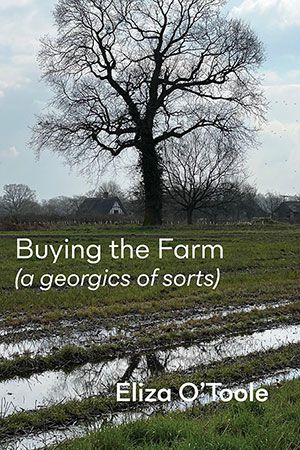
It is Eliza O’Toole’s A Cranic of Ordinaries (Shearsman Books) that I have been telling everybody about. Interestingly – and demonstrating the great enthusiasm the publisher shares for this poet – Shearsman have just published her NEXT collection: Buying the Farm (a georgics of sorts). The nominated collection was published in 2024.

I reviewed it in brief for The Times Literary Supplement recently, as follows:

The premise of Eliza O’Toole’s superb debut collection, A Cranic of Ordinaries, is unpromising: a year’s cycle of diaristic pieces in which the poet walks her dog through the Stour valley. But the result is a sublime form of ecopoetry which is visionary, yet creaturely and incarnate, and to achieve this O’Toole channels two great nineteenth century writers. Gerard Manley Hopkins’ ‘Hurrahing in Harvest’ joys in the things of Nature which are always ‘here and but the beholder / Wanting’. When self and natural world do communicate, Hopkins named that flash of true relationship ‘instress’.  O’Toole’s ‘Stour Owls’ records just such a moment, listening to the calls of a female tawny owl, the ‘slight pin-thin / hoot’ of the male, followed by a tense silence: ‘then the low slow of the barn owl as the / white slide of her glide brushes the air we / both hold & then breathe’ (12).

O’Toole also adopts Emerson’s idea of the ‘transparent eyeball’, seeing all, yet being itself ‘nothing’. The excision of the self’s perspective is systematically pursued. Seldom is the landscape ‘seen’ but is rather subject to plain statement: ‘It was a machine-gun of a morning’ (11), ‘a vixen-piss of a morning’ (13), ‘a muck spread of a morning’ (34). O’Toole has an extraordinarily observant eye, but this repeated trope counters any taint of the constructed picturesque, the human-centring of vanishing points and perspective. The observer grows ‘part or parcel’ of the world. Such a vision makes demands on language because in truth, ‘It is necessary / to write what cannot be written’ (94), and this yields one of the most exciting aspects of this collection as the poet deploys varieties of plain-speaking, scientific, ancient, and esoteric vocabularies as well as a Hopkinsesque ‘unruly syntax’. She describes ‘young buds. Just starting from / the line of life, phloem sap climbing, / a shoot apical meristem and post / zygotic. It was bud-set’ (26).

O’Toole’s choices about form are also bold, almost all the poems being both right and left justified, creating blocks (windows?) opening on each page. The realm the reader is invited into (not told about, not shown) is one where the manifold particularities of the natural world are also and at once a whole. O’Toole’s dog digs a hole: ‘In / the hole and out of it, the soil was / whole. There was a unity and no lack. / In the hole was soil. It was a / comprehensive various entirety; it / was a universe of relatings’. (38) In such ways O’Toole’s ordinaries are made ‘strange’ (33) and the toxic divide between modern humanity and the natural is momentarily, repeatedly, bridged.

Here’s one of the poems from A Cranic of Ordinaries. Apologies are due for formatting accuracy as – as we all know – WordPress is rubbish at dealing with poetry. But you’ll get the idea…..

Perpetual gravity – Box Tombs at Wiston

(the quality of appearing to recede, essential to the landscape tradition)

Now illegible, the children of John

Whitmore and Susanna his wife,

Sarah aged 11 Months,

Robert aged 2 Years,

Rebeckah aged 11 Months,

Elizabeth aged …. Weeks,

Lucy aged 1 Week,

Susanna aged 20 Years,

Thomas Aged 6 Years.

John Whitmore departed this life Jany

the ….6th 1746 Aged (6)6. He was a

good husband loving father faithful

friend and a Good Christian. Susanna

Whitmore died / Jany. 25 1789 Aged

(?8)6. To dwell until all the world

inscribed when it was still possible to

die. To lie slightly foxed, mortared in

a brick box irregularly repaired, alive

with stone-devouring lichen and

littered with dry lime, leaves and

frass. Fin* pees antimony and sees off

the squirrel, wards off unbelievers we

have no need for having no place

amongst toppling tombs. A litany

indescribable, a conjugation beyond

reach, an accent mark over a vowel,

an entire landscape made grave. It

was October, the same fields were

ditched, furrowed, carved, still dug

over and still the Stour was flowing. In

the picture’s distant plain, the sun

like other yellows, was still fading.

Generally, a history remains unsure.

*O’Toole’s dog

The Laurel Prize awards £5,000 for the winner of the prize and £1,000 for the other four finalists – so congratulations are due to all of them. The winner will be announced at the Laurel Prize Ceremony which is taking place on Friday 19 September at 5.30pm (BST), and will be aired via a free live-stream. This year’s ceremony is a part of BBC Contains Strong Language which takes place in Bradford from 18-21 September.

Ecology and Poetry: Review of Michael McKimm’s ‘Fossil Sunshine’

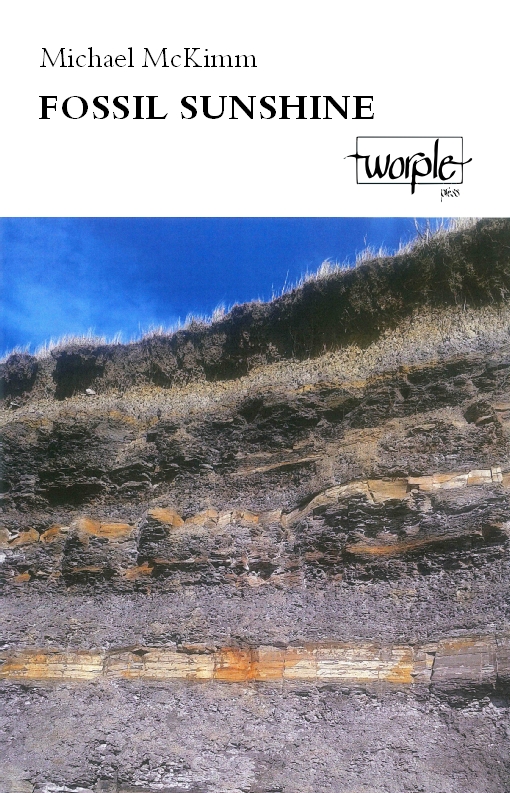
I met Michael McKimm earlier this year – at the Free Verse Poetry Book Fair in September 2014. His chapbook, Fossil Sunshine (Worple Press, 2013) interested me because much has been said in the last few years about how poetry has embraced science. This is one plank of the argument that also declares poetry has embraced popular culture, or the world and language of IT, the law, or maybe banking. Yes, poetry is keen to annex what it can. And I would happily sign up to the general principle that poetry’s health can feasibly be measured by the range of experience it can encompass. In times of feebleness poems are stuntedly concerned with poetic subjects, poetic diction; in periods of strength, there is a great sense of traction and encompassment, that anything will give itself to the poet.

Perhaps we are on the cusp of one of these latter moments; reading Nathan Hamilton’s 2013 Bloodaxe anthology (note the wide embrace of the title) Dear World & Everyone In It you might get that feeling. And guess what: Michael McKimm appears on page 90 and Fossil Sunshine really is differently-angled to most of the collections you’ll have read recently. These poems are the result of a year-long collaboration with earth scientists, in a project funded by Arts Council England. Drawing on fieldwork with geologists, the poems explore the relationships between geology, the oil industry and climate change, and (Worple’s blurb says) they ask what the evidence held in the geological record can teach us. The blurb goes on: “From ice ages to landslides, oil spills to geo-engineering, Fossil Sunshine captures the language of geology, as well as the energy and drive of exploration and discovery”.

Fossil_Sunshine96

Given its subject, the book inevitably has an admonitory tone. But one of the problems with poetry’s annexing more and still more was noted by Keats and his response was to loathe anything poetic that has a palpable, didactic design upon us. Indeed, the poetic and didactic are mutually exclusive for him. Poetry is a realm (perhaps unique) where life’s genuine truth and beauty (simply that it is full of shades and ambiguity) can be expressed and relished without any irritable reaching after clarity and fact. What I like so much about McKimm’s poems is that they would also have pleased Keats on this count. They are vigorous, ambiguous and even visionary. In them we see mankind’s power as much as our malign influence, the frailty of nature as much as its resilience. They want us to think about these issues, but will not do the thinking for us.

‘Tertiary Basalts’ describes its igneous subject as “Crow black, slick as onions, or walk-on-nails / tough”. It’s in part a child’s eye view (“A thick burnt red / running through like a layer of jam”) and the narrator admits that rock like this would give his earlier self “more pictures than the clouds”. But McKimm does not ironise the child’s vision but combines it with an adult understanding of the rock’s creation to make a more rounded celebration of the natural world. ‘Holderness Boulder Clay’ does something similar as it vigorously describes the sea’s biting away at the friable coastal reaches till “a fencepost hang[s] from a whip / of wire, and plastic drainage pipes / [are] like pillarbox guns”. Whatever warnings are here they are buried in the figurative language – the whip, the gun. The poem is a tour de force of minute particulars; I’ve never felt so close to the ebb and flow, the nibbling of erosion, the swirl of “gobstoppers of granite, sandstone, / Norwegian porphyry, carnelian”. Elsewhere (in prose this time), someone called Stuart takes a little hammer to a chunk of Yorkshire chalk and skilfully unearths a fossil sea sponge: “Laosciadia Planus. I weighed it in my hand.” And like a time machine, suddenly Bridlington with its Pitch and Putt course vanishes to be replaced by a vision of the past: “Sea conifers, angiosperms. The whole place electric with reptiles”.

media

Only someone much concerned with the environment could bring the natural world – both present and past – so vividly into poetry. Someone like that could not fail to express concern at our interventions in the world. A scattered sequence of poems, each called ‘Abstract from a Conference’, expresses this concern. The first explains that coal, oil, gas are anciently stored sunshine that we have since “sought with our intelligence / and drive”. Our brilliance has long been to our benefit but . . . “Is it possible, a soft // landing for civilisation? We were smart. / How smart do we now want to be?” The ‘Abstract’ in the title to these poems perhaps permits more didacticism than elsewhere: abstract as summary, abstract as form of language. Yet even here there is an awed sense of ourselves: “Survivalists, stewards of the biosphere, / from nothing we grew”. Where did we go wrong? We “thought of ourselves”. Perhaps little else. And for a while, “where was the harm in that? – / as the mighty river’s arteries flowed past.” ‘Pipeline’ is another sustained performance, a description of the route of a North American oil pipeline. Detail is put to use to suggest both the varieties of landscape it passes through as well as the ingenuity of its builders: “without even a pit stop it’s pierced Manitoba, / steady trajectory, knows where it’s going”.

So McKimm’s images are often carefully laid down, alive, at the borders of ambiguity. Yet the descriptive drive of the book pulls no punches when it comes to the mess we have made of things. Here are “the basics: deforestation, fallow lands, / tilling, terracing, irrigation systems, subsurface // water extraction, mining, transportation systems, / waterway re-plumbing, reservoir interception, // groynes, jetties, seawalls, breakwaters, harbours, / warfare”. Even a small scale ‘Oil Field’, apparently landscaped into a natural environment, is regarded, or rather listened to, with suspicion: “the beam pump’s / gentle purr, like an antique Singer threaded / through with jet, working with a rhythm / you would never think so peaceful or so clean”. At the living room table, my mother would propel an old Singer like this, an image perhaps of technology taken so far, only to be wrenched further still (the thread through this machine not homely cotton, but the more sinister thread of an oil jet).

imgres

Andrew McCulloch’s review in the TLS concluded: “Read these poems!” Penelope Shuttle has written: “The language employed by this poet is powerfully tactile.  These are strong and in every sense grounded poems”. ‘Grounded’ is a worthy pun, of course, as much about McKimm’s language and tone as about his rocky, muddy, sandy subject matter. I’d recommend these poems, for their grit and grain as much as their environmental concerns, for their humble belief in human ingenuity as much as their clear-eyed warning about where it seems to be taking us.