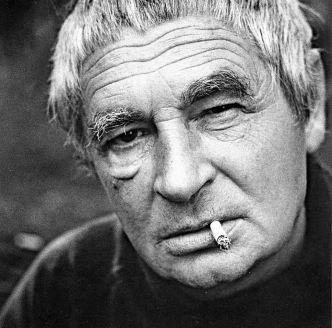
Three Poems by Jürgen Becker

Following on from the publication in January 2025 of my translation of ‘Dressel’s Garden’, one of Jürgen Becker’s longer poems (which recently appeared on the USA site Asymptote Journal), three more poems by this fascinating German poet have just appeared in Shearsman magazine and our hope is (permissions permitting etc) that Shearsman Books will be publishing a full collection of his work in the near future. All these poems are taken from Becker’s crucial 1993 collection, Foxtrot in the Erfurt Stadium. The newly published poems are relatively brief so I thought I’d post two them here with a little bit of literary and historical context. (I’ll comment in a later post on the longest of the three poems now published by Shearsman).
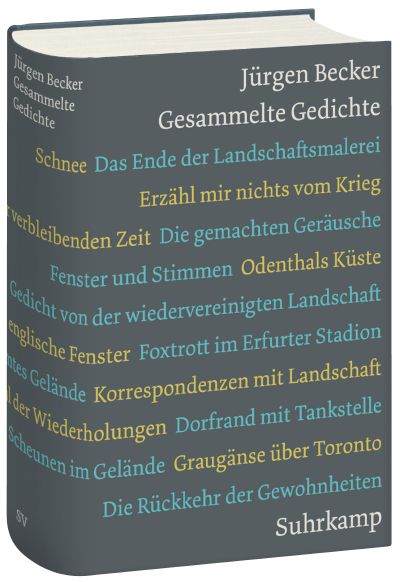
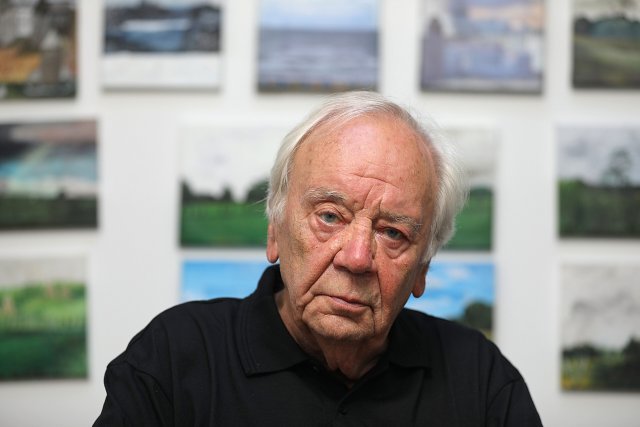
In her Afterword to Jürgen Becker’s monumental 1000-page Collected Poems (2022), Marion Poschmann praises the poet as being ‘the writer of his generation who has most consistently exposed himself to the work of remembrance, who approaches the repressed with admirable subtlety and is able to reconcile his personal biography with the great upheavals of history.’ Likewise, in their adjudication, the 2014 Büchner Prize jury highlighted the way ‘Becker’s writing is interwoven with the times, with what is observed and what is remembered, what is personal and what is historical.’ Jürgen Becker’s own personal journey began on July 10, 1932, on Strundener Strasse, in Cologne. In August 1939, shortly before the outbreak of the war, his father was transferred from his place of work in Cologne to Erfurt in Central Germany. This was the beginning of the seven-year-old Becker’s experience of war and a post-war childhood in Thuringia. In 1947, the family left Erfurt and returned to West Germany. Becker has said about this period that there was never any thought of wanting to travel to the Eastern zone, let alone to the GDR, to see the places and landscapes where he’d spent his childhood years: ‘For a long time, I oriented myself solely towards western horizons; I lived, so to speak, with my back to the GDR; my childhood was separated by a border, seemingly closed’. (More of borders in a moment).

Becker’s interest in ‘events’ – political and historical – can clearly be seen in the short poem ‘Reporter’. Its subject never seems to become outdated (as I write this, Turkey is enforcing a crackdown on reporting – see the arrest and deportation of BBC reporter, Mark Lowen, very recently). Becker’s poem is not set in any particular time period, though the allusion to a ‘vast thing, fading away’ suggests an epoch of great change, one political system fading, another on the rise. I love the journalist’s reported observation that he ‘can only leave / when nothing else happens’. In Becker’s writing, there is always something else arising (history does not stop happening – as we see in this particularly fast-moving historical moment). I take the implication of the final 4 words to suggest that the reporter may well be ‘removed’ by the authorities from whatever the situation currently is (against his wishes by the sound of it) and that we will all become the poorer for that, more poorly informed, less capable of distinguishing the truth of things: ‘He will be missed’.

He barely looks at the camera; it almost seems

as if he’s talking to himself, a correspondence

with something on the unseen table, perhaps

with the pencil, the cigarette.

A slight tremor in the hands … who knows; anyway,

very likeable, nothing specific, more a murmur,

what can you say … cold weather and glimpses

along a street which is illuminated a little

by the snowfall; a leftover flag being stirred

by a wind machine. A vast thing, fading away

slowly … it has already disappeared, even before

a decree. He repeats it: he can only leave

when nothing else happens. He will be missed.

The second poem, ‘Meanwhile in the Ore Mountains’, bears strong similarities in that the specific time period (though not the setting) is left deliberately vague, though so many of the details in the poem possess a terrific (terrifying?) resonance for our own times. As to place, the Ore Mountains lie along the Czech-German border and borders are important in this poem. As I mentioned above, Becker was born in the eastern region of Germany, but from age 7, he was brought up in West Germany, and after the fall of the Wall in 1990, he’d often return to his (eastern) childhood landscape. The resulting blending of a child’s and adult’s vision is what gives rise to Becker’s characteristic poetic mode: a flickering between past and present, often without clear signalling, the past frequently haunted by the disturbing changes that happened in Germany in the 1930s. I’ll post the original German of this poem as well, as in what follows I’ll make a few observations about translation.
Though relatively brief, this poem is just one sentence, woven together with the conjunction ‘wie’ (translated here both as ‘how’ and ‘the way’). The weave is dense and as I’ve suggested it’s not really possible to tell whether what is observed – the children, the oil spill, the tree stump (resembling a body) – are contemporaneous or from different eras. My translation keeps these possibilities open: borders here are felt to be temporal, as well as geographical. The German word ‘Avantgarde’ has artistic as well as political implications, but my choice of ‘vanguard’ also brings out the militaristic connotations which are reinforced by the ‘spitzen, grünen Lanzen’ (‘sharp, green spears’) which are then swiftly transformed into a bunch of sprouting snowdrops. These flowers of Spring are interestingly referred to as a ‘Konvention’ and I retained the English equivalent, intending to suggest both a performance (something conventional, perhaps not genuine), as well as a political gathering or agreement (like the Convention on Human Rights). The ambiguity felt very relevant (and once again topical).

The final vivid, visual images – a TV screen observed through a window, a script on the screen, a woman talking, but she is inaudible to the observer – sum up Becker’s concerns about the media, political and historical change, borders real and imagined, exclusion, and the need to ask questions of those in power. Issues as real today as when the poem was written in the early 1990s.

Sitting still, watching how the afternoon below

waits for the dusk, the way snipers vanish

behind the remains of a wall and children run

after a white, armoured vehicle, the way a line

of hills, which marks a boundary, divides

the nothingness of snow from the nothingness of sky,

and along the frontier, one this side, another

along the other, fly the only two crows

to be found in this treeless landscape, the way

the iridescent pattern of an oil spill develops

with darkening edges, the way a tree stump

in the field becomes the shape of a body with

severed arms and legs, how, under the cherry,

the vanguard shows with sharp, green spears,

which later, over the next few days, assumes

the convention of snowdrops, how dark windows

are lit by screens, and on each screen appears,

at first, lettering, and then the face of

a woman who is soundlessly moving her lips.

Zwischendurch im Erzgebirge

Still sitzen und sehen, wie unten der Nachmittag

die Dämmerung erwartet, wie Scharfschützen hinter

einem Mauerrest verschwinden und Kinder

einem weißen gepanzerten Fahrzeug nachlaufen, wie

eine Hügellinie, die eine Grenzlinie ist, das Nichts

des Schnees vom Nichts des Himmels trennt, und

entlang der Grenze, die eine diesseits, die andere

jenseits, fliegen die beiden einzigen Krähen, die

es in dieser baumlosen Landschaft gibt, wie

das changierende Muster eines Ölteppichs entsteht

mit dunkler werdenden Rändern, wie auf der Wiese

ein Baumstumpf die Form eines Körpers annimmt mit

abgeschlagenen Armen und Beinen, wie unterm Kirschbaum

sich die Avantgarde zeigt, mit spitzen, grünen Lanzen,

die später, in den nächsten Tagen, die Konvention

der Schneeglöckchen annimmt, wie in dunklen Fenstern

Bildschirme aufleuchten und auf jedem Bildschirm

zuerst eine Schrift und dann das Gesicht einer Frau

erscheint, die lautlos die Lippen bewegt.
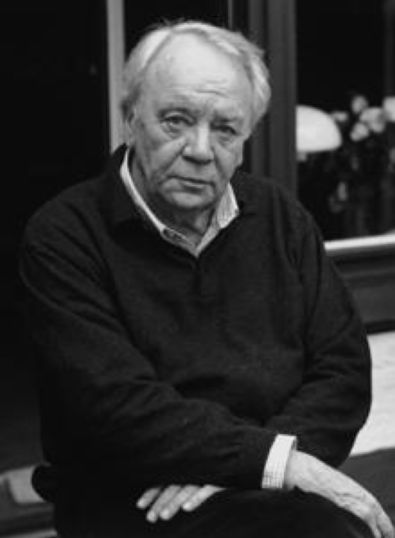
‘Dressel’s Garden’ – a new translation from the German

My new translation of a long(ish) Jürgen Becker poem (the first ever into English) has just been posted on the US site, Asymptote. Do click the link above and have a look at it. You can also hear an audio recording of the opening passages of the poem read in German (thank you, old friend, Tim Turner). Becker’s work is really very unusual – and hardly known at all in translation. I have been working on a particular collection of his poems, published originally in 1993 – Foxtrot at the Erfurt Stadium. Asymptote is a marvellous site with a whole range of creative work, so once you are there, stay and have a look around.

Two Poems by the late Jürgen Becker

The sad news that Jürgen Becker (1932-2024) died recently at the age of 92 was particularly poignant as I have been translating his work for the past 3 years. I first read about his poetry in an essay I was translating by Lutz Seiler (published in In Case of Loss (And Other Stories, 2024)). There, Seiler characterises Becker’s work as ‘a process that integrate[s] both immediate and more distant modalities of language, his own voice as well as materials drawn from other sources such as events, photos, maps as well as interjections from neighbouring rooms, from the mail, the news, weather conditions and whatever else stray[s] within range’ (my translation). History, politics, the importance of recording ‘small things’, an extraordinarly porous kind of poetry – these were the aspects that drew me to his work (as a writer of my own poems as much as translator).

Becker’s ‘typical’ poem works at length, resembling a stream-of-consciousness, but better thought of as a kind of collage or montage. His effects are slow-burning, allusive, even elusive, and I don’t think his work is likely to top any UK chart of popular poetry any time soon. But his revered status in Germany is remarkable and I have actually had a couple of successes recently with my translations: a Highly Commended in the 2024 Stephen Spender Trust Translation Competition, judged by Taher Adel and Jennifer Wong (with the poem ‘Meanwhile in the Ore Mountains’), and one of Becker’s longer poems in translation being published (‘Travel film; re-runs’ – see below).

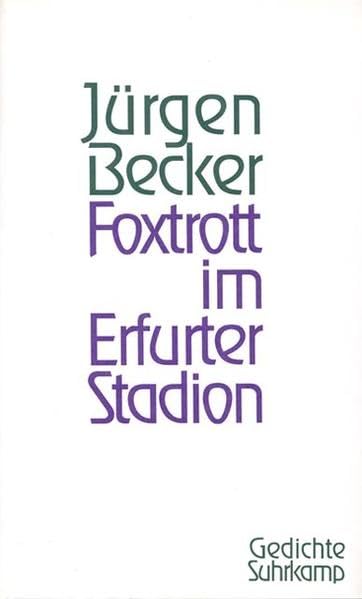
Becker grew up in the German region of Thuringia which, after World War II, was in the Soviet occupation zone, later the GDR. By then, his family had moved to West Germany and, after the fall of the Berlin Wall in 1990, the writer often returned to his childhood landscape. I have concentrated my translation efforts on Becker’s 1993 poems in Foxtrot in the Erfurt Stadium, published by Suhrkamp. The full translation is due to be published by Shearsman Books in 2025. The Spender Trust Competition poem is a short piece which I can quote in full. The Competition requires entrants to say a few words about the poem and the translation process. Here is a video of the Intro and Reading of the poem for the prize event, and (alongside) the text that I originally submitted:

Commentary – The Ore Mountains lie along the Czech-German border. Borders are important in this poem. Born in the East German region, brought up in West Germany, after the fall of the Wall in 1990, Becker often returned to his childhood landscape. Though relatively brief, this poem is just one sentence, woven together with the conjunction ‘wie’ (translated here both as ‘how’ and ‘the way’). The weave is dense and it’s not possible to tell whether what is observed – the children, the oil spill, the tree stump (resembling a body) – are contemporaneous or from different eras. My translation keeps these possibilities open: borders here are temporal, as well as geographical. The German word ‘Avantgarde’ has artistic as well as political implications, but my choice of ‘vanguard’ also brings out the militaristic connotations which are reinforced by the ‘spitzen, grünen Lanzen’ (‘sharp, green spears’) which are swiftly transformed into a bunch of sprouting snowdrops. These flowers of Spring are referred to as a ‘Konvention’ and I retained the English equivalent, intending to suggest both a performance (something conventional, perhaps not genuine), as well as a political gathering or agreement (like the Convention on Human Rights). The ambiguity felt relevant. The final vivid, visual images – a TV screen seen through a window, a script on the screen, a woman talking, but inaudible to the observer – sum up Becker’s concerns about the media, political and historical change, borders real and imagined, exclusion, and the need to ask questions of those in power. Issues as real today as when the poem was written.

Sitting still, watching how the afternoon below

waits for the dusk, the way snipers vanish

behind the remains of a wall and children run

after a white, armoured vehicle, the way a line

of hills, which marks a boundary, divides

the nothingness of snow from the nothingness of sky,

and along the frontier, one this side, another

along the other, fly the only two crows

to be found in this treeless landscape, the way

the iridescent pattern of an oil spill develops

with darkening edges, the way a tree stump

in the field becomes the shape of a body with

severed arms and legs, how, under the cherry,

the vanguard shows with sharp, green spears,

which later, over the next few days, assumes

the convention of snowdrops, how dark windows

are lit by screens, and on each screen appears,

at first, lettering, and then the face of

a woman who is soundlessly moving her lips.

The longer poem – ‘Travel film; re-runs’ – which does indeed run to over 100 lines in full – has just appeared in The Long Poem Magazine, Issue 32, eds. Linda Black and Claire Crowther. This brilliant magazine is one of the few outlets for poems stretching beyond the ‘competition’ mark of 40/50 lines only. Poets/translators again have the opportunity to comment on the work being published. This was my Introductory paragraph:

Given his 1000 page Collected Poems (Suhrkamp, 2022), it’s remarkable that Jürgen Becker’s work has been so little translated into English.  This poem, published in his 1993 collection, Foxtrot in the Erfurt Stadium, is imbued with Becker’s sense of the changes in this particular part of Europe. The interleaving of the child’s and returning adult’s vision is what yields Becker’s characteristic poetic mode: a flickering between past and present, often without warning to the reader, a past frequently oppressed by the rise of fascism in the 1930s. The translator’s difficulties lie not in his word choices (Becker plainly describes, he states), but, to some degree, in his cultural references (here, the allusion to pimpf kids (cub, little rascal, little fart) is to members of the Hitler Youth), and, primarily, in dealing with his style of montage-composition, his commitment to ‘the apparently incidental’. Becker’s porous verse contains multitudes of perspectives, voices, inner and outer events, photos, maps, postcards, news, weather reports. In translation, it’s hard to flex, to permit these into English, and I have had to learn to trust Becker’s arrangements of them into long, semi-colon linked passages, utterly remote from conventional ‘lyric’. The opening 24 lines here elide landscape, weather, employment, domesticity, and history, then on to the natural world, compositional ideas, back to history. Becker is a great poet of the present moment and of the past. He grew up in Thuringia which, following World War II, lay in the Soviet occupation zone, later the GDR. By then, Becker’s family had moved to West Germany, and, after 1990, he often returned to these childhood landscapes. This poem was published in his 1993 collection, Foxtrot in the Erfurt Stadium. Becker worked for many years in German radio, and, in this poem, we might imagine a small production team visiting an un/familiar landscape in the East, perhaps where a childhood was spent, a place later abandoned.

Travel film; re-runs (extract)

the landscape: like corrugated cardboard, an enduring, fixed

motion, on a smoky grey day. The wind came

somewhere from below, from a region beneath

the weather chart; in the evening, we could no longer

reach our correspondents. We drove out

to the country house; we ate

Spanish green asparagus. It was a moment

from yesterday that rolled slowly past the shelf        

with its yellow calendars and diaries and pictures;

something had begun,

the sound of that reiteration. You can … and

you allow it … push the off button; outside the window,

the blackbird flutters up, simply waiting

to be mentioned. Now you notice the way the paint

has peeled from the window frame, and where

the ants are coming from, in January the only

living creatures in the house. Perseverance pays off

at some point, even if you have little alternative

but to gather piece after piece together. Paint pots

in the shed, shades of green and white, but

we are waiting for a consistent light,

on either side of the house. Is it too late now,

to leave again

        … lake shores, before they are all

accounted for, can still be appreciated, with sandy paths

reaching the purple horizon … subjunctive, without end;

a game of evasion that you can watch until you

whistle, or shout, and it’s nothing like awakening

from a dream. In the evening, we light a fire; it’s

a sudden, impromptu decision; then follows

the next draft of the letter: your sketches litter the table

… you no longer need a pass; highways,

the middle of the village … standing beside you

on the jetty; on the opposite side, the yellow ribbon

of the shoreline

      clips from the travel film just now

set going in the blink of an eye; then the meadow

is mown; there are a few old clumps of snowdrops

we leave standing. The fact is, we have missed out

on the moment of adulthood, even if, in the evening,

you say: never, not once, did the door open, from

which a little something left, and what you are now

entered in. The contrast, the changes … the fear has

been networked, so many of these shortcomings went

into production. Piano, from beyond French windows,

Shostakovich plays Shostakovich, and the life story

draws a curve out towards the northeast. Ice floes,

accumulating along the coast; in boots and furs,

walking over the frozen river, passing pimpf kids,

and old men, and a young woman who’s most likely

Polish, and you’re not going to stop staring at her

any time soon; freezing cold on the sledge back home,

your mother doesn’t live here anymore; the whole scene

darkens under the smoke of an engine pulling

New review of my translation of Peter Huchel’s ‘These Numbered Days’

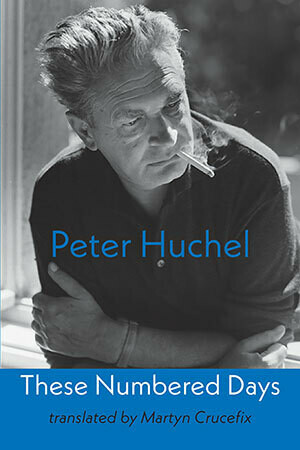
When Shearsman Books published my translations from the German of Peter Huchel’s 1972 collection These Numbered Days (Gezählte Tage), we were still in the early days of Covid restrictions and so launch events and so on were very difficult. I was pleased when the book was recognised in 2020 by winning the Schlegel-Tieck Prize for translation from German awarded by the Society of Authors. The judges were Steffan Davies and Dora Osbourne. Yet the wheels of reviewing such books turn very slowly. And I am pleased once more with the appearance of a lengthy review of the book by Frank Beck which has recently appeared in the excellent journal, The Manhattan Review, edited by Philip Fried. So, with due acknowledgements, I am reproducing Frank’s review here. Do check out his work and visit The Manhattan Review, an excellent US journal with a liking for pubishing reviews and work from the UK.

These Numbered Days (Gezählte Tage) by Peter Huchel, translated from the German by Martyn Crucefix and introduced by Karen Leeder. Emersons Green, Bristol, UK: Shearsman Books, 2019. 129 pp. $18.00 (paperback).

When poets look to the stars, often they are hoping to place their human worries in a wider context, in search of consolation. But what if they find, instead, that their concerns are reflected somehow in the sky overhead? Think of the famous fragment from Sappho: alone and unhappy, she watches the moon and the Pleiades descend together, like lovers lying down in bed. Readers may feel that something similar is happening in these lines from German poet Peter Huchel, as translated by British poet Martyn Crucefix:

                        Bent already by the night
                        into his icy harness,
                        Hercules drags
                        the star’s chain-harrow
                        up the northern sky. (p. 23)

            When have we felt so much heft in the distant stars? We might well wonder what weight Huchel himself was bearing when he wrote this last stanza of his poem, “Under the Constellation of Hercules” (Unterm Sternbild des Hercules).

            But first, let’s see how closely the English translation corresponds to the German stanza. Crucefix replicates Huchel’s pattern of three-beat lines, varied in line 3 with a two-beat phrase. He also makes use of the ready echoes some of Huchel’s words have in English: bent for gebeugt and icy for eisige. He creates a harsh music with chain-harrow, as does the clutter of consonants in Huchel’s Kettenegge. And Crucefix ties the stanza together with the r-sounds running through each of his five lines.

            Of course, acoustics aren’t everything: this closing stanza owes much of its power to the two, less portentous preceding stanzas, in which the speaker describes a small, rural settlement, “no larger/than the circle/a buzzard traces/in the evening sky.” All we are shown of the place is a rough stone wall, “glittering water,” and the smoke from a fire, “cut through with voices,/none of which you know.” This sense of elemental conflict prepares us for the star-hauling of the final lines: even in the heavens, it seems, the grinding struggles of the universe go on.

            In the German-speaking world, Peter Huchel is widely considered one of the finest 20th-century poets. He composed many of his poems out loud, rather than on paper, so their resonant language often seems, in the words of one critic, “as natural as air or breath.” Huchel is also admired for the way he endured years of harassment and confinement at the hands of the East German government. His reputation was consolidated in 1984, when Huchel’s poetry and prose were collected in two volumes, meticulously annotated by Axel Vieregg, a German scholar in New Zealand who had spent decades studying the poet’s work.

            English translations of Huchel’s poems have been difficult to find, although selections of them were compiled and translated by Michael Hamburger and Canadian poet Henry Beissel. (This despite Joseph Brodsky’s enthusiastic endorsement of Huchel’s poetry in The Wilson Quarterly in 1994, accompanied by translations by Joel Spector and a full-scale biography by British scholar Stephen Parker, in 1998.)

            These Numbered Days brings us graceful English versions of all 63 poems in Huchel’s 1972 collection, Gezählte Tage, the fourth of his five verse collections, published between 1948 and 1979. The translated poems appear side-by-side with the German originals. An introduction by Karen Leeder helps orient the English-speaking reader in Huchel’s world, while connecting his work with the most urgent issues of today. Crucefix’s fidelity to both the meaning and the manner of Huchel’s poems won his book the prestigious Schlegel-Tieck Prize for German Translation in 2020. 

            Huchel was born Hellmut Huchel in 1903 (the “u” is pronounced like the double vowel in moon), the son of a civil servant and his wife, from Lichterfelde, a Berlin suburb. Hellmut spent much of his youth on his grandfather’s farm in the nearby Brandenburg countryside, where he developed a feeling of deep kinship with the natural world. After studying literature and philosophy briefly, he lived in Paris for two years, then traveled extensively in Hungary, Romania, and Turkey.

            In 1931, at the age of 28, Huchel returned to Berlin, first earning his living as an editor and then by writing plays for radio. He changed his first name to Peter and began to publish his poems in Die literarische Welt and other leading German journals. Those early lyrics often draw on his memories of country life, as in “Havelnacht,” which describes a night on the Havel River in Brandenburg. Here are the poem’s last two stanzas (my translation):

                        Scents of so many past years
                        lean gently here, into the water.
                        As we go quietly along,
                        the night’s brew blows through us.

                        The greened stars are floating
                        as they drip from the oars.
                        And the wind cradles our lives,
                        as it cradles willow and crane.

            As beguiling as these images are, the poem’s effectiveness depends largely on its delicately deployed A/B/A/B rhyme scheme, which I have not tried to replicate. (The German poem might remind an English-speaker of Yeats.) Already, Huchel had acquired the technical mastery that the Swiss critic Paul Schorno would later describe as “certainty of what is being said through certainty of form.”

            In 1941 Huchel was drafted into the Luftwaffe, where he served until being taken prisoner by the Russians. This led to his working for Radio Berlin in the Russian-occupied sector after the war; eventually he became its cultural director. In 1949, when the Federal Republic of Germany was established in western Germany and the German Democratic Republic in the east, Huchel was named editor-in-chief of the GDR’s new literary magazine, Sinn und Form (Sense and Form). Under his direction, it came to play an important role in East German culture and even earned an international reputation.

Peter Huchel

            However, Huchel’s interest in the diverse contemporary poetry flourishing abroad in those years was fundamentally at odds with Communist Party ideology, and he repeatedly came into conflict with party officials. In 1962, as East Berlin was sealed off from the West by a wall, Huchel was dismissed as editor of Sinn und Form. He was forbidden to publish in East Germany or to travel, and, along with his wife, Monica, a translator of Russian, and their son Stefan, was placed under round-the-clock surveillance at their home in Wilhelmshorst, near Potsdam.

            The poems in These Numbered Days were written during the subsequent nine years, as Huchel remained under virtual house arrest. (Several of them were published in West Germany during the poet’s confinement; others appeared in English-language journals in Henry Beissel’s translations.)

            In these poems, the rich, rhyming music of Huchel’s early poems is replaced by a spare but flexible flow of language that can contract to a beat or two or relax into longer lines. One of the book’s finest poems considers how the work of “The Dipper” (Die Wasseramsel), a small bird that feeds along the banks of rushing streams, resembles the poetry Huchel now wants to create:

                       If I could plunge
                        brighter downwards
                        into the flowing darkness

                        about me to fish out a word

                        like this dipper
                        beside the alder boughs
                        picks its food

                        from the stony river bed.

                        Gold-panner, fisherman,
                        relinquish all your gear.
                        The shy bird

                        looks to work without a sound. (p. 45)

            Few poems in the collection deal with the Huchels’ troubles overtly. When they do, the tone is wry, refusing to reward oppression with anger. Even as the house around him deteriorates, presumably because repairs are not permitted, the poet declares, “I will not write/the names of my enemies/on the spongy wall” (“Weeds”). One has the sense of a man and his poetry being tested and determined not to fail. That includes trying to heed the advice offered to Huchel in a song by his friend, Wolf Biermann: “Do not become embittered/in this embittered time.”

            Huchel’s few visitors in Wilhelmshorst had to subject themselves to police surveillance, with all the attendant risk in such a police state, or to approach in secret, under cover of darkness, as Huchel describes in “Weeds”:

                        Guests are always welcome,
                        those who love weeds,
                        those who do not shy away from stony paths
                        over-grown with grass.
                        No one comes.

                        The coalmen come —
                        from their filthy baskets they pour
                        the lumpen black grief
                        of earth into my cellar. (p. 123)

            Huchel is still the keen observer of nature he was in his earlier books, but the natural world that once buoyed and nourished him now often mirrors his constricted situation, as in “Exile”:

                        Come evening, friends close in,
                        the shadows of hills.
                        Slowly they press across the threshold,
                        darkening the salt,
                        darkening the bread
                        and with my silence they strike up a conversation.

                        Outside in the maple
                        the wind stirs:
                        my sister, the rainwater
                        in the chalky trough,
                        imprisoned,
                        gazes up at the clouds. (p. 27)

            Yet such confessions —  even any use of personal pronouns — are scarce in these poems. Sometimes main verbs disappear, and the lines rely on gerunds and participles to move them forward. What is always present is Huchel’s patient watchfulness, often refracted through history and myth, as in his image of Hercules climbing the winter sky. With all roads around one blocked, the mind’s pathways become more important than ever, and allusions abound here. These poems reach out to the poet Alcaeus (a contemporary of Sappho), Tang dynasty writer Pe-Lo-Thien, Shakespeare, Kierkegaard, Virginia Woolf and other writers past and present.

             Another connection that sustains Huchel, though more fleetingly, is his memory of happier times, especially his travels in the Mediterranean, as in “Dolphins”:

                        Gazing out across the sea
                        in white sunlight
                        I saw them leap
                        above the salty
                        weight of the water —
                        dolphins,

                        my secret brothers,
                        carrying my messages to Byzantium. (p. 91)

            Such flashes of joy are tempered by the narrow confines of the Huchels’ lives. In “Hubertusweg” (the name of their street), the poet wonders about the policeman standing guard outside his house in the rain (“What’s in it for him . . .  ?”) and then considers the vulnerability of each person before a totalitarian state (“The state’s a blade;/the people thistles.”) Yet even totalitarian states have a life-span. Huchel sees his son reading a cuneiform text about “the peaceful campaign” of the Bronze Age ruler, King Keret, and his poem concludes:

                        On the seventh day,
                        as the God IL proclaimed,
                        a hot wind blew and drank the wells dry,
                        the dogs howled,
                        the donkeys cried out with thirst.
                        And without the use of a battering ram the city surrendered.                                              (p. 121)

            In 1971, in response to efforts by Heinrich Böll, Arthur Miller, Henry Beissel and others, the GDR allowed Peter Huchel and his family to emigrate to West Germany. He continued to write there until his death, in 1981. Eight years later, the Berlin Wall fell without a shot’s being fired, and Germany was soon reunited. The Huchels’ house in Wilhemshorst, where these poems were written, is now a writer’s center, sponsored by the state and local governments.

            Today the once-divided city of Berlin is one of the most vibrant places in the world. Huchel’s poetry is still in print and still read, and, at number 10, Hanseatenweg, near the Tiergarten, Sinn and Form keeps producing new bimonthly issues, very much along the editorial lines Huchel had in mind. Thus far this year, alongside work by and about German-language writers, the journal offered its readers articles about Jorge Luis Borges, Clarice Lispector, Marcel Proust, Marina Tsvetaeva, and Adam Zagajewski.

—Reviewer Frank Beck is a writer and translator and serves as a trustee for Elgar Works, which publishes the scores of Edward Elgar. His recent thoughts on poetry and music can be found at WWW.DIEHOREN.COM.