Between a Drowning Man (Salt, 2023)

Available from Salt Publishing (Autumn 2023).

‘An ‘Autumn Journal’ for our times.’ —Nancy Campbell
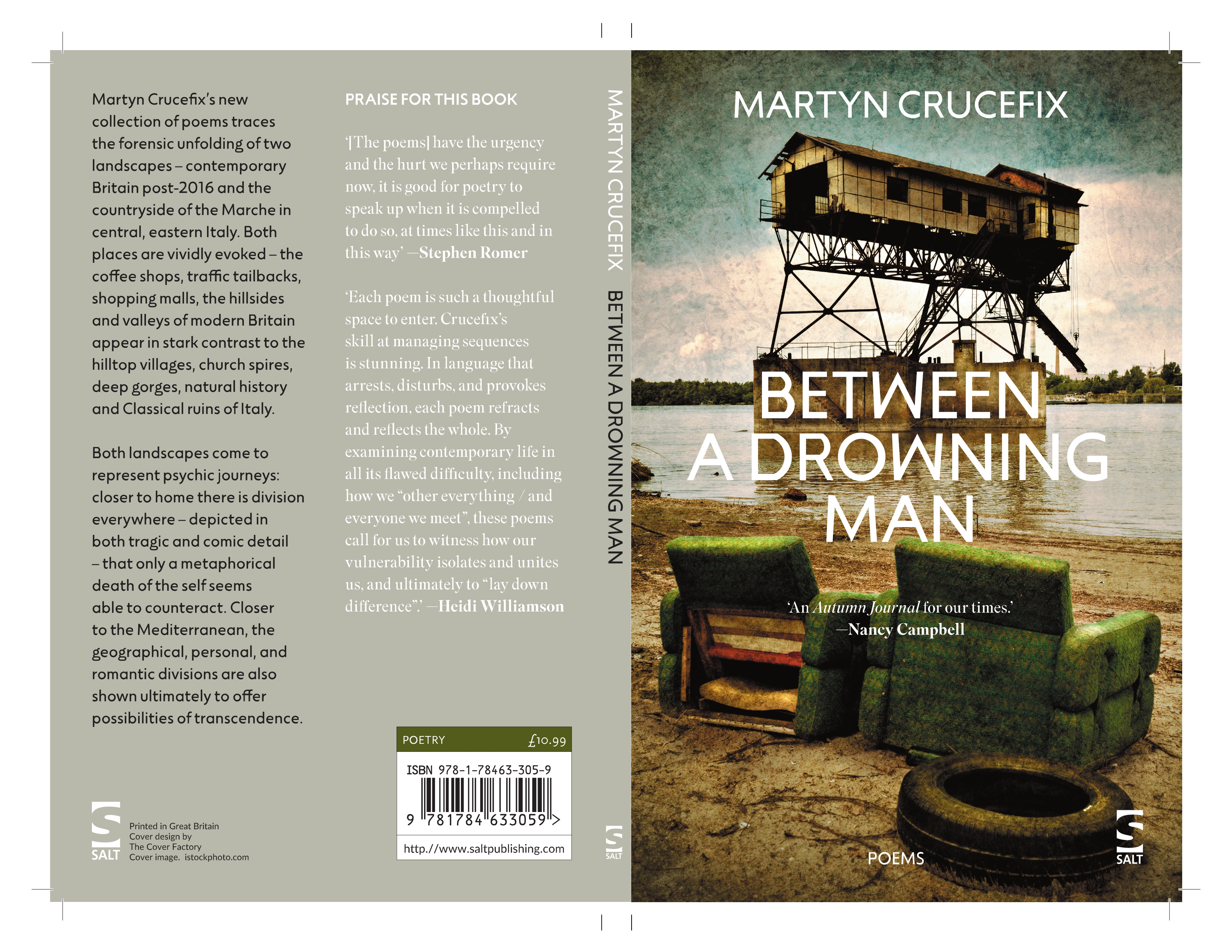
‘Each poem is such a thoughtful space to enter. Crucefix’s skill at managing sequences is stunning. In language that arrests, disturbs, and provokes reflection, each poem refracts and reflects the whole. By examining contemporary life in all its flawed difficulty, including ‘how we other everything/ and everyone we meet’, these poems call for us to witness how our vulnerability isolates and unites us, and ultimately to ‘lay down difference’. —Heidi Williamson

‘[The poems] have the urgency and the hurt we perhaps require now, it is good for poetry to speak up when it is compelled to do so, at times like this and in this way’ —Stephen Romer

Listen to Martyn discussing the background and the writing of the poems in this new collection in these two podcasts:

Planet Poetry – about the whole collection

A Mouthful of Air – focusing on the single poem, ‘you are not in search of’ (page 57)

SOME REVIEWS OF THIS BOOK

By Mat Riches – on The High Window

By Stuart Henson – on London Grip

By Shanta Acharya – on Everybody’s Reviewing

BLURB OF THIS BOOK: Martyn Crucefix’s new collection of poems traces the forensic unfolding of two landscapes – contemporary Britain post-2016 and the countryside of the Marche in central, eastern Italy. Both places are vividly evoked – the coffee shops, traffic tailbacks, shopping malls, tourist-dotted hillsides and valleys of modern Britain appear in stark contrast to the hilltop villages, church spires, deep gorges, natural history and Classical ruins of Italy. Both landscapes come to represent psychic journeys: closer to home there is division everywhere – depicted in both tragic and comic detail – that only a metaphorical death of the self seems likely to counteract. Closer to the Mediterranean, the geographical and personal, or romantic, divisions are also shown ultimately to offer possibilities of transcendence.

The poems of the longer sequence, ‘Works and Days’, are startlingly free-wheeling, allusive – brilliantly deploying source materials and inspiration from Hesiod’s original and the 10/12th century Indian vacana poems – all bound together by the repeated refrain of bridges breaking down. The Italian poems, as a crown of sonnets, are more formally controlled, but the repeating of first and last lines of the individual poems likewise serves to suggest the presence of an overarching unity.

In the end, both sequences travel towards death which – while not denying the reality of human mortality, the passage of time – is intended to represent a challenge to the powerful dividing walls between Thee and Me, the liberation of empathetic feeling, even the Daoist erasure of the assumed gulf between self and not-self: ‘these millions of us aspiring to the condition / of ubiquitous dust on the fiery water’.


Should I Send My Poems to Magazines or Competitions?

Issue 87 (January 2017) of Acumen has just appeared including Shanta Acharya’s interview with Indian poet and short story writer, Keki Deruwalla, plus reviews of books by Alice Oswald, Carol Rumens, Liz Lochhead, Tony Curtis and the first tranche of books from Little Island Press. There are also poems from Tony Curtis, Norbert Hirschhorn, Harry Guest, Duncan Forbes, Deruwalla and many others and translations of Verlaine, Tsiakos and Catullus. As well as this, Acumen editor, Patricia Oxley asked a number of poets (myself included) to comment on the relative importance of publication in magazines and winning (or placing) in poetry competitions. Which of the two is most important or advantageous?


keki-daruwalla_1
Keki Deruwalla


In his piece, Christopher North feels poems go to competitions first as the rewards of winning are greater than a mere appearance in a magazine. But for himself, he prefers to read poems in “gangs” or small portfolios (most likely to be found in magazines or chapbooks). North voices a common concern that the isolated poem (in a competition) is not always the best guide to a poet’s true worth. Hilary Davies’ piece suggests much the same thing, strongly praising the role of the magazine and its editor for having an eye not for the spectacular one-off, but for the longer term: “they have a stake in bringing on and nurturing new poets . . . there is a depth to the activities of the editor”, she argues, in stark contrast to the competition judge however thoroughly they do their job.

imgres

Davies also regrets the existence of the ‘competition’ poem that we are all so familiar with – the 40 lines, any subject, the successful mostly with a powerful narrative drive or end-of-poem punch. None of these elements are bad in themselves but Davies argues persuasively that “competitions unintentionally reinforce a formulaic and limited understanding of what constitutes a good poem”. Evidently, she sides with the magazines (see my recent review of Davies most recent collection). In contrast, Martin Malone confesses he’s not so sure where he stands though he acknowledges that competition wins “do provide a fast-track means of ‘getting-on’ in an age besotted with instant success”. The imagery he uses to express this – that we live on Planet Gadget and how we cannot but love our bells and whistles – makes clear his scepticism about the ultimate value of such winning poems. But Malone is clearer than most about the importance that winning competitions can often have on a poet’s career these days.

imgres

Caroline Carver’s piece is rather more celebratory in tone, suggesting the modern world of poetry presents writers with an “increasing choice” of outlets in terms of publication in print, or on-line or via competition entry. But the ease of the mouse click also means that the competitiveness and crowdedness of the market increases. Nevertheless, sounding admirably un-angsty about the topic, she says (assuming one has enough material available) a mix of both magazine submissions and competition entries is the safe way ahead. And for those who suffer repeated set-backs she refers us to the newly-launched website Salon of the Refused.

imgres

Michael Bartholomew-Biggs is both poet and editor of the on-line magazine London Grip. He puts forward what I think is the generally-expressed view here that “a publication record reveals more about a poet’s consistency and range than a prize – or even a few prizes”. Following the logic of this, he squares the circle by suggesting that the type of competition (which seems ever more common) that offers prizes and publication for a “portfolio” of poems seems to be “a distinct and valid route to recognition”. My contribution argued something like Bartholomew-Biggs’ view though rather more cynically suggested that winning prizes, in part through the likely resulting prominence through social media, might well weigh more heavily with a more commercially-driven publishing house. Overall, these six writers seem to feel a track record of publication in magazines is still the best guide to a poet’s quality and worth, though there is equally a clear anxiety expressed that competition-winning is becoming (or has already become) more used as a means of sifting through the submissions of collections for publication.

To read this discussion in full go to the Acumen website and subscribe!