How to Closely Analyse a Poem (and keep exam boards happy) #2 Edward Thomas’ ‘The Sun Used to Shine’

Having declared in my review of one year of blogging that I wanted to include more about teaching literature, I am posting some examples of the type of essay required by OCR exam board in module F661 (see also Essay 1). The essay following focuses on Edward Thomas’ poem ‘The Sun Used to Shine’ which can be read in full here. The poem has Thomas recalling happy days, walking with Robert Frost in the Gloucestershire countryside. Though the Great War  had begun, neither of them had yet become entangled with it. Students are supposed to present a close analysis of one selected poem (AO2) while also putting that poem into relation with some others by Thomas (AO4).

FDPhist
Little Iddens – where Robert Frost lived in 1914

Explore Thomas’ response to the English countryside of 1914 in the poem ‘The sun used to shine’. Your focus should be on close analysis of language, imagery, tone and form.

NB: Comparative sections here are in italics only to indicate the proportion of the essay devoted to that Objective (AO4). The main Objective remains AO2)

In this poem Thomas describes the English landscape as a place of pleasure and relaxed enjoyment as he walks with Robert Frost. These are remembered scenes and as the poem develops thoughts of the war of 1914-18 become more prominent. In the end perhaps the poem explores ideas about permanence and change, putting the war into a more historical perspective. The features which are typical of Thomas in the poem are the focus on the small details of the natural landscape (like ‘But These Things also’), the way the war lies in the background of the poem (like ‘Rain’ and ‘Tears’) and his interest in memory (‘Old Man’).

The opening stanza describes the two men walking at peace and the sun shining and here is an example of pathetic fallacy, the sun reflecting their happy mood. The easy rhythm of their walking is also reflected in the enjambement of lines 1-4 and the caesura in lines 2 and 4, giving a lilting, relaxed and flowing movement to the verse. At this early point in the poem, the regular ABAB rhyming adds to this impression and adverbs such as “slowly” and “cheerfully” obviously reinforce this sense of easy pleasure. The phrase “sometimes mused, sometimes talked” also suggests their free and easy life, with the caesura here again giving the steady walking rhythm of the opening as they contentedly (but thoughtfully – “mused”) explore the English landscape. This is similar to ‘As the Teams’ Head Brass’ where Thomas uses enjambement in many of the opening lines to reflect the flowing movement of the horse and plough up and down the fields. In that poem there is even less punctuation, reinforcing the idea that in ‘The Sun Used…’ the caesuras’ reflect the stopping and starting of the two men’s walking pace.
FDPsignpost

The narrator’s statement that the two men “never disagreed” about which gate to lean on is probably hyperbolic but again suggests their closeness and harmony and even the action of leaning on the gate with no urgency or hurry  reflects their relaxed state of mind. From line 6 the narrator conveys their mental focus as they walk through the landscape and suggests that they are wholly occupied in the enjoyment of the present moment. The phrases “to be” and “late past” suggest both past and future to which they give “small heed”. Other subjects are suggested by the phrase “men or poetry” and the “or” here suggests their easy freedom even in topics of conversation. However, it is at the end of stanza 2 that the war is first mentioned though at this point the word “rumours” is used, suggesting that the subject is only vaguely picked up and this is reinforced by the use of the adjective “remote” which is placed at the end of line 9 giving it an particular emphasis. At this point the war is not an important element as they walk through the landscape and this is also suggested by the word “Only” at the start of line 10 which rather dismisses the war topic of conversation in place of their focus on the landscape, this time in the form of the apples they find there.

The description of the apples is ambivalent because they are initially described with the adjectives “yellow” and “flavorous” suggesting their attractiveness and sweet taste so the reader may be a bit taken aback to hear in the next line that wasps have “undermined” the skin of the apples. The most important thing about this latter word is that it suggests the mines and mining associated with the battlefields of World War One and therefore suggests that thoughts of the war even penetrate the pleasant walks through the countryside of the two men. Something like this can also be seen in ‘Rain’ in which the narrator listens to rainfall in a depressed mood and hopes that no one who he “once loved” is doing the same. That poem uses a natural image of “Myriads of broken reeds all still and stiff” which also can be interpreted as referring to the many dead on the battlefields of France. ‘The Sun Used…’ was actually written in 1916 when Thomas was about to join up though the memory of the walks refers to 1914 when the war did seem further from him personally. These suggestions of war are continued in stanza 4 with the line of betonies described as both “dark” in colour (a contrast to the yellow apples?) and with the metaphor of “a sentry”. This makes very explicit the war reference and this is continued with the description of the crocuses (their “Pale purple” suggesting both weak vulnerability and shade) as having their birth in “sunless Hades fields”. Each of the words in this phrase might suggest the war with the darkness of “sunless”, the reference to death in “Hades” (the Classical land of the dead) and “fields” which surely refers to the battlefields in France.

robert_frost
Robert Frost

These suggestions that thoughts of war cannot be excluded from pleasant walks in the English countryside in 1914 are confirmed with the very next line: “The war / Comes back to mind”. Here it is the rising moon that reminds the two men of the war as they remember that the same moon would also be visible to soldiers on the battlefields of France “in the east”. The next word “afar” again suggests the distance of the war, though actually the poem has suggested that thoughts of it are not at all remote. The narrator’s thoughts now go beyond thoughts of the 1914 war. Typical of Thomas, he develops a more historical perspective, referring to earlier wars, “the Crusades / Or Caesar’s battles”. This has an ambiguous effect as it might suggest some consolation that war has always occurred and perhaps always will. On the other hand, perhaps it suggests the more depressing thought that humankind cannot avoid warfare. This sense of long stretches of time is quite common in Thomas’ work such as in ‘Aspens’ where he describes the trees at the crossroads and there implies that they are permanent, even indifferent to the human world: “it would be the same were no house near. / Over all sorts of weather, men, and times”.
FDPmayhill2
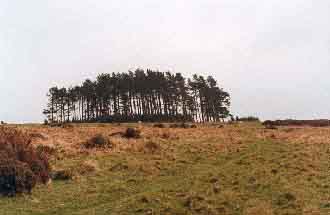
May Hill – where Thomas and Frost often walked together

Perhaps it is this longer historical perspective that creates the thoughts of the final 11 lines of this poem. They open with a hyperbolic statement that “Everything” fades away and Thomas then uses a series of similes of things which he regards as transient, starting with the “rumours” of war, running water vividly described as “glittering // Under the moonlight” and the two men’s “walks” through the English countryside, even the men themselves (in line 26) and the apples from stanza 3 (now more pessimistically described with the adjective “fallen”) and the men’s “talks and silences”. This is a very inclusive list which gives the impression of time sweeping away many of the pleasures of life. The climax of the list is the last simile that seems to wipe away memories too (an important element in many of Thomas’ poems). He seems to suggest that memories are like marks on sand and the tide washes them away (is the tide an image of Time?). The poem ends with images of “other men” enjoying the same “easy hours” that the poem began with though now Thomas and Frost have vanished. In these last lines some things have changed (“other flowers”) but the moon alone remains “the same” suggesting that much of the landscape even will have changed (this reminds me of the felled elm tree in ‘As the Team’s Head Brass’ in which the English landscape is shown to be changing).

In this poem, Thomas records pleasures gained from walking in the English countryside in 1914 though he also suggests that thoughts of the war cannot be excluded. As the poem goes on, it seems to become detached from the countryside but does return to it at the end in suggesting that though people may vanish and die and even aspects of the countryside itself may change in the long perspectives of Time, there are a few things – like the moon – can be seen to remain constant.
How to Closely Analyse a Poem (and keep exam boards happy) #1 Edward Thomas: ‘Old Man’

Having declared in my review of one year of blogging, that I wanted to include more about teaching literature and having spent the last 3 weeks or so congratulating, consoling, interviewing and advising students post-results, I thought this would be a chance to post something of that sort. Part of my job during August is to talk to students who have fallen short at schools and colleges (largely at A level) and it never ceases to astonish me that so many of them – clearly capable of better grades than they have achieved – seem muddled and even ignorant of the Assessment Objectives required by exam boards. Now I’m the first to loathe this kind of acronymic reductiveness but if AOs are what the examiners want, it’s either a brave or stupid teacher who screws them up.

Of course, English A level courses are changing significantly this academic year but I’ll talk here about the OCR English Literature specification I have been teaching for a few years (both AS and A2 levels are available for the last time this year). Module F661 involves study of prose and poetry. The latter involves a study of 15/16 poems by an author and essays are close analyses of one selected poem (AO2) with the student putting that poem into relation with some of the other poems (OCR call this AO4 in this module – though elsewhere AO4 is historical and cultural context) . . .

See what I mean – it’s not really complicated but it’s easy to find this sort of stuff very boring indeed.

My advice is that it’s always better to show than tell. I show essays performing this relatively complex task written by students as homework or in past years’ exams (photocopied to the class, read and discussed). Alternatively, I’ll occasionally write something myself. The latter has the advantage that I can make specific points about style and strategy (and teachers doing what they ask their students to do is another piece of good advice). What follows is an example of the latter on OCR’s selection of Edward Thomas’ poems, focusing on ‘Old Man’. I’ve also included in this one a kind of meta-commentary on what the essay is doing. The poem can be read here.

imgres

“I have mislaid the key” (‘Old Man’). Explore how Thomas tries to get to grips with his feelings about the real nature of the Old Man plant.

  • In your answer, explore the effects of language, tone, imagery and verse form, and consider how the poem ‘Old Man’ relates to other poems by Thomas that you have studied.

 NB.  Bolded phrases signal close analysis to the examiner

Introduction

‘Old Man’, on the face of it, is a poem that tries to describe and explore the narrator’s feelings about a particular plant. Ironically, the descriptions tend to be rather vague and the point of the poem seems to be that the narrator cannot precisely pin the plant down, nor can he pin down the memories which smelling the plant’s odour brings to his mind.

Brief comparative suggestions here …

This sort of uncertainty is very common in Thomas’ poetry (for example in ‘The Glory’) as is his interest in states of memory. This is also a poem where we see evidence of Thomas’ love of Nature and his close attention to its many details which also appears in a poem like ‘Aspens’.

*

Para 1: Get well into your close analysis of stanza 1 . . .

Line 1 opens with the alternate names of this plant. Old Man and Lad’s Love are contrasting terms – suggesting both youth and old age – and this immediately announces the ways in which the narrator finds it difficult to define this plant. In the opening stanza, the narrator is preoccupied with the plant’s names, probably because this might be one way to get to grips with the thing itself. But the narrator, after the caesura in line 1, immediately declares that “there’s nothing” in the name. This feels rather hyperbolic but the second line’s repetition of the two names perhaps gives the reader the sense that nothing is really conveyed by them. He then tries some simple descriptions of the plant itself but line three calls the plant both a “herb” and a “tree” which seems contradictory again and the hyphenated phrase “hoar-green” has the same effect because the first word is associated with grey (grey hair – old age?) whereas the second word is more associated with youth and freshness. The phrase is therefore oxymoronic and confirms the difficulty of defining this plant. The metaphorical “feathery” also suggests something soft, something whose shape is hard to define. Reinforcing this idea, the narrator goes on to say that (even for someone who actually does know “well” what the plant looks like) its names “Half decorate, half perplex”. The repetition of “half” here suggests that nothing about the plant is straightforward or clearly defined. Also if the name decorates the plant perhaps it also obscures it from sight, while the word “perplex” suggests that the name actually confuses things rather than clarifies.

A brief comparison . . .

This is surprising given Thomas’ evident love of language as seen in a poem like ‘Words’ where he praises words in a series of images such as “Tough as oak, / Precious as gold”.

220px-Artemisia_abrotanum0
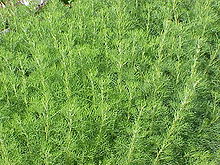
Old Man or Lad’s Love

Para 2 is till focused on stanza 1 – it’s detailed but I’m taking a long time…

Line 6 of ‘Old Man’ uses a phrase which does make clear what the narrator is after: “the thing it is”. But the language used here is vague and does not convey an image of the plant at all. This stanza ends with the narrator suggesting that the “thing” is not something that “clings” to the names of the plant. Despite the names not seeming much use in getting to grips with the plant, the stanza ends with a half line in which the narrator, rather contradictorily, says he does “like” them (the names). This short sentence is begun with the conjunction (“And”) though I would expect it to begin with a more contrasting word (like “but”) and this reinforces the way the opening stanza of the poem has been wrestling with trying to define things and names but failing to do so.

A brief comparison . . .

This sort of failure to get to the heart of experiences occurs in ‘The Glory’ too. There, having praised the beauty of the English countryside, the narrator suggests there is something further that he cannot access: “I cannot bite the day to the core”.

*

Para 3 covers lines 9-16…

Line 9 of ‘Old Man’ uses the word “herb” for the second time to characterise the plant itself (rather than its names) and begins by sounding more definite with the monosyllabic “I like not”. This seems reinforced with the line’s final word “certain” but the enjambement to line 10 plays a trick on the reader: “for certain / I love it”. I think this surprises the reader but again the narrator seems to be struggling to define his own feelings about the plant. This second stanza goes on to focus on the narrator’s child’s interaction with the same plant. He wonders if the child will also have a strong attachment to it. This seems to be one of the ways in which he is trying to work out his own feelings about it, though I don’t think it helps him to be any more definite. Lines 10 – 17 focus on the child’s actions in relation to the plant. These lines are full of active verbs as she “plucks” a “feather” from the plant. The “feather” metaphor again suggests something about the type of leaves the plant has and “plucks” has a plosive opening, a harsh ‘k’ sound and sibilance at the end which is perhaps suggestive of the plucking motion, even the sound it might make. Sound is also important in lines 13-15 as the child is “snipping  . .  tips and shrivelling / The shreds”. Sibilance hisses through these lines, to me suggesting the quite aggressive action of tearing the leaves off. The short hard vowel sounds (mostly ‘i’) also suggest this to me. The noun “shreds” again suggests the destructive way the girl behaves. The girl seems unaware of what she is doing and this is suggested by how she just drops the leaves “on to the path”. This is reinforced with the casual-seeming repetition of the word “perhaps” (another example of vague lack of definition in this poem) but especially because the girl is perhaps “thinking, perhaps of nothing”. She then “runs off” though we are not told where to and the reader gets the impression she has not taken much notice of the plant. Her casual attitudes are perhaps reflected in the poem’s form (mostly iambic lines of about 10 syllables, but no rhyme) which gives a loose, colloquial, even casual tone. This suits the poem’s meandering, thoughtful qualities – though perhaps is a contrast to the way the narrator seems to want to be more precise and definite.

A brief comparison…

Thomas uses the same sort of lines in the opening of ‘As the Team’s Head-brass’, where the long lines running on reflect the movements of the horse and plough as they move up and down the field beside the fallen elm.

*

Para 4 covers 16-23

Despite the child’s casual attitude to the plant in the present moment, the narrator wonders if she will remember it in the future, or as he puts it in line 19, the “hereafter”. Later in the poem we realise that this is part of his fascination with the plant: its smell reminds him of something in his own past. Lines 16-18 suggest some sort of comparison between the girl and the plant as the narrator compares their heights and ages. But his main sense seems to be that the girl is oblivious to the plant and this is emphasised when we are told that she says “Not a word”. The narrator now wonders what she might remember later in life of the “bitter scent”. This is an oxymoronic phrase which again suggests the puzzling nature of the plant with its acrid “bitter” smell, which is here described using the more attractive sounding word “scent”. This stanza ends with a listing technique. The narrator lists the elements of the landscape which he thinks the girl may later associated with the smell of the plant. The items in the list are not very remarkable but conclude with “me / Forbidding her to pick”. The father/narrator here takes on an authoritative character (the garden imagery might remind the reader of the original garden of Eden and God’s forbidding to pick from the Tree of Knowledge) though it seems from the poem that his warnings are ignored by the girl.

*

Para 5 to the end of the poem…

It’s at this point that the narrator’s puzzling obsession with the plant becomes more clear as he admits that he too shrivels and sniffs the leaves but where he first “met” the scent is unclear to him. ‘Tears’ is similar in that it describes a fox-hunting scene and then soldiers parading, and the narrator tells us that they revealed to him “truths” that he has now “forgotten since their beauty passed”.

A brief comparison…

Thomas is fascinated by these areas of uncertainty and this is also reflected in his interest in those moments when seasons change as in the way ‘But These Things Also’ ends with an asyndeton: “Spring’s here, Winter’s not gone”.

In line 25 of ‘Old Man’ the narrator personifies the plant’s scent into a character he might encounter and in the following lines the repeated verbs (shrivel, sniff, think, sniff and try) suggest his fascination with the plant once again. But here too he fails to get to grips with its real significance as he declares that his efforts are “Always in vain”. The paradoxical thread that has run throughout the poem is again clear as he says that he “cannot like” the smell of the plant and yet he’d give up “sweet” smells rather than this contrastingly “bitter” one. The mystery remains unsolved as the final stanza begins and this is conveyed very simply with the metaphor that he has “mislaid the key” to the experience and to his understanding of the plant. This sentence fills only half a line in line 32 and so is short, dramatic and striking because longer sentences are far more typical of Thomas’ poems. The final lines use the repetition of negatives like “nothing” and “no” to suggest the absence of any clear understanding of the plant or the memory associated with it. These final lines are also heavily punctuated, slowing the pace of the poem, perhaps suggesting hopelessness. The absences of child, mother, father and play-mate, create a sense of loneliness in the final lines though the mystery remains unsolved. The last line of the poem conveys this very powerfully with the memory being imaged in the metaphor of an “avenue, dark, nameless, without end”. Again the caesura here slows the pace so that the reader emphasises each element of the scene, the final phrase especially suggesting eternity while the darkness might well suggest death itself, in an image

A final comparison…

that reminds me of the bleak ending of ‘Rain’ where everything seems to have dissolved for the narrator except the “love of death”, a suicidal thought that we know was something Thomas himself felt at times.

*

Conclusion

So the narrator may try to get to grips with what the plant represents or suggests to him but he fails. He tries to consider the plant through its names, its physical appearance and smell, through the child’s experiences of it and lastly through his own memories. It is clear that the plant provokes powerful feelings but the “key” remains lost. The colloquial tone of the poem and its simple language make the reader feel as if we are hearing the narrator talk aloud but what he ends up saying is that he cannot tell us what is really behind this plant nor what memory it suggests.

6946098312_ccae29204e_b

Dannie Abse’s Memorial Celebration – 25.03.15

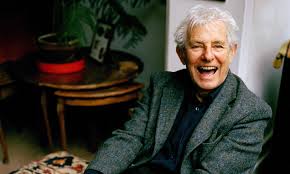
He remains a man who it feels impossible to confine to the past tense. So said Jeremy Robson, one of the speakers at Dannie Abse’s celebratory memorial event held in Kings College Great Hall on Wednesday evening this week. Indeed more than a few of those who had come to remember him, confessed they half expected Abse to be there himself, still large as life. Carol Ann Duffy imagined he’d want to “get outta here” – too much poker-faced reverence – and, yes, it was easy to imagine him somewhere still working away at his set goals – 5 or 6 publishable poems a year and every 5 years a collection of his marvellously accessible, witty and moving poems. How often did he achieve his own expectations of a good poem: that the reader should enter it sober, but leave it drunk.

imgres

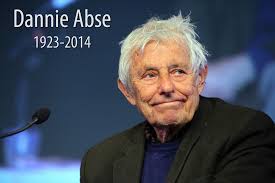
Beneath a projection of this marvellous photo of Abse, Paul Gogarty oversaw the readings and recollections, immediately plotting the four compass points of the poet’s life: poetry, family, chess and Cardiff City FC. Lynne Hjelmgaard (Abse’s partner for the last 6 years) read the mysterious, life-changing visitation recorded in ‘The Uninvited’ (the only poem he would re-publish from his first book, After Every Green Thing) as well as her own moving poem in tribute to him. Alan Brownjohn, recalled his friendship with Abse and his direct acquaintance with the source materials of the two powerfully dark poems he chose to read: ‘Three Street Musicians’ and ‘A Night Out’ (the latter discussed in my earlier blog).

Tony Curtis alluded to another of Abse’s much quoted poetic observations: “I start with the visible and am startled by the visible”. He argued that, though not conventionally religious, the poet was a deeply spiritual man who could perceive the invisible through the visible. This was demonstrated in Owen Sheers’ reading of the extraordinary ‘In the Theatre’ in which a surgeon incompetently meddles with a patient’s brain (this was around 1938, only a local anaesthetic) only for the dying man to cry out hauntingly, ‘Leave my soul alone’. Sheers said this was the first Abse poem he ever heard – on a tape playing in his parents’ car apparently. Imagine the quiet drone of the engine after lines like these: “that voice so arctic and that cry so odd . . . to cease at last when something other died./ And silence matched the silence under snow”. A memorable moment, leading Sheers to dispute the reading of this particular poem with Andrew Motion, who gracefully withdrew (the English rightly ceding to the Welsh on this occasion, Motion observed) and chose instead to read ‘Apology’. Motion also recalled meeting Abse at an early Eric Gregory do and asking him (as a judge of competitions) how he approached the task of whittling down the thousands of entries. Easy, Abse apparently replied, throw out every poem containing the word ‘myriad’.

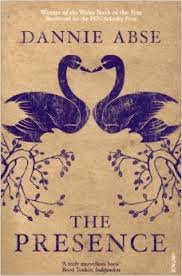
Abse’s daughter Susanna painted a more domestic picture of husband and father, a lover of all sorts of games including quizzes, board games, sing-songs on long car journeys, casting spells on recalcitrant traffic lights and pretending to talk to John Lennon on the family phone. She also recalled his “visceral” sense of loss when Joan was killed in the car accident in 2005. Only through the act of writing his memoir, The Presence (2008), and the poems later published in Two For Joy (2010) did he slowly return to something like a normal life. Elaine Feinstein read ‘White Balloon’ (“Auschwitz made me / more of a Jew than ever Moses did”) and ‘St Valentine’s Night’, the latter reminding us of Abse’s achievement as a poet of both erotic and uxorious love. Carol Ann Duffy had earlier read ‘A New Diary’ and Gillian Clarke chose the much-anthologised, neo-Romantic ‘Epithalamium’ (“Singing, today I married my white girl / beautiful in a barley field”) which she followed with her own response to it, ‘Barley’.

imgres

Perhaps most movingly there were several clips of Abse reading his own work (mostly from Ian Michael Jones BBC film series Great Welsh Writers). So the poet himself completed the evening with his reading of ‘The Presence’, the heart-rending lament for his wife, Joan, which surely everybody assembled in Kings Great Hall, beneath its classical white pillars trimmed with gold leaf, felt should now be addressed to the author himself:

It’s when I’m most myself, most alone

with all the clamour of my senses dumb,

then, in the confusion of Time’s deletion

by Eternity, I welcome you and you return

improbably close, though of course you cannot come.

images

The Poetry of Tom Rawling

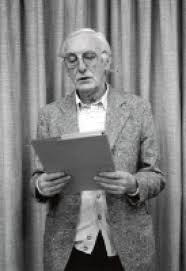
In the early 1980s I arrived in Oxford as a self-absorbed post-graduate and promptly sought out student poets wherever I could find them. The group I joined was then (I think) meeting in rooms in Hertford College, opposite the Bodleian Library (and happily very close to the Kings Arms). Bill (W N) Herbert was there, as was Keith Jebb and Paul Mountain. The group, with changing personnel – I remember Elise Paschen was a member for a while – continued to meet throughout my 4 year stint among the dribbling spires, but we would supplement it by decamping to the Old Fire Station on George Street where Tom Rawling was running a public workshop. Tom had taken over when Anne Stevenson moved north. As a retired headmaster, Tom ran us all as a well organised and disciplined class. Elizabeth Garret joined later and I think Peter Forbes was already a member, as was Helen Kidd. Jeremy Round, who was soon to achieve short-lived fame for his cookery writing, was also a regular. My poem ‘In Memory of Jeremy Round’ (eventually published in Beneath Tremendous Rain (Enitharmon, 1990) https://martyncrucefix.com/publications/beneath-tremendous-rain-1990/) is a lament for his tragic early death, but also tries to paint a vivid picture of the workshop and its members:

We’d wrangle inconclusively

between the beers and crossfire from Tom,

elder statesman who’d slip quietly glittering

poems from his tackle bag like fish; from Helen,

whose pages always seemed typed under earthquake

conditions, whose baggy poems had more passion

than most of us could muster; from Peter’s

exactitude, schooled on a diet of science, he held

each piece like a prism till it shed eloquent

rainbows; from Bill and Keith, the ferocious

tyros, the university wits, who minced nothing

but their language into strange sweet things;

from Paul whose poems were amazed not to find

themselves loosed into a more graceful age

than the one we live in.

There were others writers, of course, to whom I apologise for not recalling them clearly. Bill has also written about these few years with great eloquence and insight: http://tracearchive.ntu.ac.uk/poets/herbert/dec_2.htm.

imgres

But rather than his aspiring students, it’s Tom Rawling’s own poetry that I want to highlight. A pamphlet called A Sort of Killing appeared in 1978 (an historical event now as this was one of the first publications by a young Neil Astley). OUP published Ghosts at My Back (1982). Two other books followed: The Old Showfield (Taxus, 1984) and The Names of the Sea-Trout (Littlewood Arc, 1993).

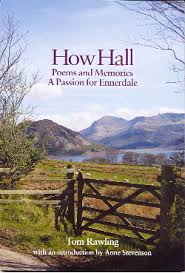
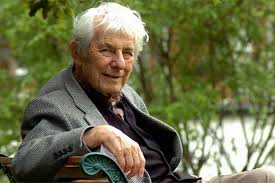
Grevel Lindop has long been a fan of Tom’s work (http://grevel.co.uk/poetry/tom-rawling-rediscovering-ennerdales-poet/). There is an audio recording of Tom reading many of his best poems (you can listen to one of them here: http://listenupnorth.typepad.com/listenupnorth/tom-rawling-poet.html). Listening to him again, what what comes over is his modesty, his sharp intelligence, his confidence in his own work and the vivid recall he had of his formative years, growing up in Ennerdale, Cumbria. Tom’s poems, in their accessibility, boldness with language, natural and ecological themes are (as my review concludes) ideal for the classroom and it is still a cherished hope of mine that they might be taken up by a mainstream publisher and presented to a new generation (a Rosemary Tonks of the western valleys of Cumbria, wielding his fly-fishing rod). Perhaps the best way to sing my praise of Tom’s work is to post up a review I wrote of his posthumous collection How Hall (2009).

imgres

I recommend you search out more of his work (http://en.wikipedia.org/wiki/Tom_Rawling). Here is my review:

Tom Rawling, How Hall: Poems and Memories, a passion for Ennerdale (Lamplugh and District Heritage Society, 2009), £7.50, ISBN 978-0-9547482-1-0

Tom Rawling, How Hall: selected poems of Ennerdale poet Tom Rawling, read by the author (Lamplugh and District Heritage Society, 2009), £5, CD audio recording

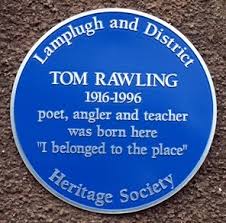
As a child in the 1920s, Tom Rawling grew up in the Ennerdale valley in what was then called Cumberland. It was not until his retirement in the shallow decades of the 1970s and ‘80s that he began to write poetry as a man “haunted . . . even bullied by his memories” as Anne Stevenson’s insightful introduction to this new selection explains. A marvellous collection was published by OUP in 1982 and two further publications from smaller presses resulted, but at his death in 1996 Rawling had not attracted the kind of attention he had hoped for and certainly deserved.

How Hall is a new edition of more than 70 poems, three pieces of autobiographical prose and some wonderfully evocative photographs. The accompanying CD is an audio recording of an extended reading given in 1983 and the passion and precision of his voice and his humble and insightful comments add further invaluable dimensions to any appreciation of his work. Rawling shares with Heaney the kind of vivid recall of childhood that yielded the title of his first book, Ghosts at My Back. An early poem has the young Rawling playing “squire” to the village blacksmith who also introduced him to his life-long passion, fishing – both are described as “tying knots / That didn’t slip” (‘Johnny’). Yet home life was not always so easy and there are poems that bitterly lament the repressed and repressive life of his mother (‘Hands’), his father’s drinking (‘Honour thy Father and thy Mother’) and the son’s rebellious, divisive “radical words” (‘Clipping Day’).

His rebellion took him away from home, but ironically it is for the authenticity of Rawling’s responses to the farm life and countryside of the Ennerdale of his youth that we should continue to read him. Perhaps it has taken us 25 years to understand what he felt intuitively, the importance of our relationships with the natural world and the kind of folklore that once bound man and nature together. Even in the 1920s, it was only Rawling’s grandmother who “glimpsed beyond the byre” to the atavistic fertility beliefs that lay behind “ritual no longer understood” (‘Grandmother’); it was she who knew the spell to complete a whistle carved from hedgerow sycamore (‘Sap-Whistle’). ‘The Barn’ vividly evokes the thrill of the hay harvest: “Bright prongs pierced and unpicked, ash handles / bent, they launched the bundles we embraced” and as the barn filled it was only when “heads bumped the slates / we came down the ladder in triumph”.

images

Anne Stevenson – who met Rawling in Oxford in the late 1970s – rightly directs us not to dismiss his work as “romantic retrospection” because he really “wrote poems to tell the truth and in them rehearsed the daily rituals of life and death”. ‘Rumbutter’ characteristically revels in that recipe’s “sweet beginning” as well as, “not quite hidden, the cinnamon / of the coming funeral feast”.  There is certainly no room for sentimentality in Rawling’s view of nature: a pig is to be cared for only till the “pole-axe fell” (‘Hooks in the Ceiling’) and chickens are nurtured carefully, but in their “due season, each neck pulled / . . . the admired knack of killing” (‘Feathers’). Rawling also shares with Heaney a fascination with the insights embedded in idiom and dialect. ‘Hearthwords’ addresses the younger Irish poet with their shared belief that “the naming spell / gives the thing itself / into our hands” And then, as his own poetry began to flow, he swiftly developed a precise, lean, direct form of free verse, capable of moving from the joyous observations of “cloud and sun pursu[ing] / Their steeplechase across the land (‘I Am What I Was’) to the shockingly frank recording of the realities of the cow shed: “ a column of piss / cascades to the cobbles . . . a face gurning, whistling and whispering soft farts” (‘Privy’).

But Rawling’s reach is not confined to the material. Perhaps his most distinctive poems are those that deal with angling, especially fly-fishing for salmon and sea-trout which his poems transform into an almost religious questing and testing of the individual’s devotion, skill and subterfuge. His own first encounter with the power of the sea-trout he recalled as a moment when he had “waded / into mystery, tampered with Leviathan” (‘Leviathan’). One function of any poem is to offer us profound if vicarious experiences and these poems succeed so well in this evocation, taking us to the riverside at night, “to the dub / where sea-trout rest” where we might “hear an old ewe’s husky cough, / the water slopping, slapping” (‘Night Fisherman’).

imgres

Poem after poem makes it clear that to fish in this way is to engage differently, intimately with the world and to embark on the difficult process of laying aside our humanity’s hobbling self-consciousness, to cast off the accretions of civilisation until we allow “the body [to] flow into the rod” (‘Torridge Salmon’), achieving a different form of consciousness as we “wade in deeper, / Share with the fish / Its lateral line / The current’s push” (‘Only the Body’). It’s easy to understand why Ted Hughes came to admire these poems as Rawling triumphantly celebrates the efforts and occasions when we encounter the Other in what becomes a frankly spiritual communion. So in ‘A Shared Rod’, a kingfisher perches on the “bamboo rod-tip” as the angler waits in the reed bed:

His great eye turns, a moment’s stare,

then, blue-green whirr,

the arrow skims downstream,

leaving an emptied space,

a shared rod quivering.

It is really this kind of encounter – with all that is not bounded by ourselves – that Rawling is conjuring in ‘The Names of the Sea-Trout’, a spell for fishermen that revises and revivifies his grandmother’s superstitious connections with the natural world:

Bender of steel, the breaker, the smasher,

The strong wench, the cartwheeler,

The curve of the world,

She who doesn’t want to surrender,

The desired, the sweet one.

Profound, vivid, honest, accessible – these are poems that at once connect us to a lost past and prepare us for a world in which the environment must again become our close companion. Rawling’s work would be wonderful to teach in schools if it were more easily available and a mainstream publisher would do well to bring him nearer centre stage. For the time being we must thank Michael Baron, Stan Buck and the Lamplugh and District Heritage Society for the very many pleasures of this marvellous book.

imgres

Teaching Dannie Abse’s ‘Two For Joy’ (2010)

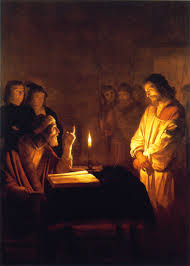
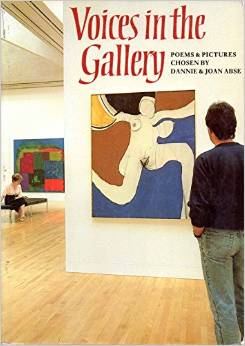
I first became aware of Dannie Abse’s work in 1986 when he and his wife, Joan, were editing Voices in the Gallery,  a sumptuous anthology of poems about paintings for the Tate Gallery. To my astonished delight, they accepted ‘At The National Gallery’, an early poem of mine about Gerrit van Honthorst’s ‘Christ Before the High Priest’ which later appeared in Beneath Tremendous Rain (1990). Our paths continued to cross around the London poetry scene, especially at (usually fraught) Poetry Society Council meetings in the 1990s. A couple of years ago he visited the College where I work and happily discussed his poems with students. His death in September 2014 was such a sad loss.

With the New Year we are again teaching Dannie Abse’s collection Two for Joy (http://www.amazon.co.uk/exec/obidos/ASIN/0091931177/karelsoftw-21). But with the changes to A Levels being hurried in from September 2015, this will be the last time we work on this book (for AS Level Coursework) though it has proved a joy to teach. This is perhaps a surprise given its subject matter.

The book is a compilation of work from several years focused on Abse’s relationship with Joan, his wife (herself a writer, editor and acclaimed art historian). It was published a couple of years after The Presence (http://www.amazon.co.uk/exec/obidos/ASIN/0099531860/karelsoftw-21), a memoir completed in response to Joan’s tragic death in a car accident in 2005. ‘Two for Joy’, of course, alludes to the old country saying, cited on seeing magpies: one for sorrow, two for joy. The poems in the collection evoke both sides of this cryptic saw, from the early joys of young love to the sorrowing widower more than 50 years later.

imgres

In terms of teaching and coursework the book’s focus is so intense, powerful and yet varied that the material always goes down very well with students and enables them to write confidently about ‘the collection’ (one of the Assessment Objectives). We might start with the simplicity of ‘Condensation on a Windowpane’ where the aging narrator inscribes his and his lover’s names on the wet windowpane because he wants to write “something simple as pure water”. Yet even water, further considered, is complicated, “like steam, like ice, like clouds”. This plainness of address and nakedness of emotion is immediately engaging but Abse is really flagging up the collection’s main themes of love and time as, eventually, the words fade, dribbling down the glass: “They weep as they vanish”.

Or what better way (I mean appalling way) to gain students’ attention than this opening quatrain of ‘Lachrymae’:

I crawled from the noise of the upturned car

And the silence in the dark began to grow.

I called out her name again and again

To where neither words nor love could go.

This little sequence of poems like tear drops is set after Joan’s death and delicately re-visits a few scenes from married life, only to end with the narrator walking in solitude beside the Hampstead ponds, “where a lone swan sings / without a sound”.

An earlier poem ‘A Night Out’ records a visit the couple made to the Academy cinema in Oxford Street in the 1950s. As a Welsh Jew in London, courting and marrying a gentile, there are plenty of moments in these poems where the unconventional couple have to confront the narrow-mindedness and bigotry of the 1950s and early 1960s: anti-Semitism in ‘A Marriage’; general moral strictures in ‘Two for Joy’. On the occasion of the cinema visit, Abse’s cultural background is significant as they watch a fictionalised account of the Holocaust: “images of Auschwitz, almost authentic, the human obscenity in close-up” so much that “we forgot the barbed wire / was but a prop [. . . ] those striped victims merely actors”. Afterwards, the couple are stunned by what they have seen, sitting in a “bored espresso bar”. Gathering themselves at last, they return home to a German au pair girl, their own children safely asleep upstairs:

Reassured, together we climbed the stairs,

undressed together, and naked together,

in the dark, in the marital bed, made love.

images

Abse’s technical skill with plain language is on full show in such lines and the class might have debates about how far individual love is shown to counter, compensate, or merely distract from world horrors. In a 1980 essay called ‘Rhyme’ (collected in Dannie Abse: a Sourcebook, ed. Cary Archard: http://www.amazon.co.uk/exec/obidos/ASIN/1854115073/karelsoftw-21) Abse has commented on this poem and presenting students with his observations has often proved to be a moment when sceptics about the deliberateness of a writer’s choices can be converted. He compares ‘A Night Out’ with ‘In Llandough Hospital’ arguing that the charge of emotion from the film was so powerful that he “did not want to make any pretty artifice out of it. I did not want to be lyrical about such a theme. I wanted to be as truthful as possible, to avoid all kinds of artificiality, to say what I felt and to say it plainly. I wanted the verisimilitude of prose”.

The period of the Cold War is briefly evoked at the end of ‘A Scene from Married Life’ in contrast to the “few and brief” cold wars of the couple’s marital rows. Set in Abse’s beloved Ogmore-by-the-Sea in South Glamorgan, after a petty squabble, the narrator metamorphoses into a monster of self-pity and suicidal thoughts. The poem cleverly balances the two perspectives of the over-dramatising, younger self with a more ironic, mature judgment. It’s only at the end with the appearance of Joan on the cliff top (surely an echo Thomas Hardy’s ‘The Voice, with Emma in her ‘sky blue gown’) that the faux-suicide relents:

On the high cliff my wife dressed in blue and all

The best of the world true and desirable.

With surrendering waves I crawled back to the shore.

6110017_ee8699d49a_m

Such humour, often in self-mockery is never far from Abse’s work. The darker side of grief is evoked in the image of blood-stained petals falling in ‘Magnolia’ (“bridal branches slowly violated”) but most powerfully in ‘The Revisit’ which again works the rich seam of two periods of life knotted together. A beautiful lake scene enjoyed together is re-vised by the lonely widower into an apocalyptic vision, with the sun-set now evocative of “Angel wars. Such April bloodshed!” Though there are more consolatory poems in the book, where time the healer is seen to begin its work, ‘The Revisit’ shocks in its blunt confrontation with grief and on this occasion Abse’s use of poetical devices, the abundant skill of the artist, only serves to emphasise the helplessness of the man:

The gradual distance between two stars is night.

Ago, love, we made love till dark was bright.

Now without you dark is darker still and infinite

It would be a shame indeed if, in the mean-spirited, ever-narrowing criteria of the new A Level specifications, a collection such as this one could not continue to find a place. Dannie Abse’s website is at: http://www.dannieabse.com/.

imgresjpeg

W. H. Auden, West and Wannabes

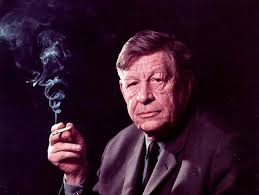
In The Dyer’s Hand (1962), W H Auden throws off one of his critical Interludes on the subject of Nathanael West’s fiction from the 1930s. With the passage of time and the continuing prominence of Simon Cowell, his observations only become more relevant. I currently have classes in process of preparing OCR A2 Coursework on West’s The Day of the Locust (1939), Fitzgerald’s The Great Gatsby (1925) and T S Eliot’s Prufrock and Other Observations (1917) and I’m finding that Auden’s piece, while difficult, provides a framework of terms and ideas which relate all three texts.

images

Auden denies West’s status as a novelist first, then as a satirist. The first point is because of West’s lack of interest in the accurate representation of either the “social scene” or “subjective life”. Auden’s definition, I guess, demands forms of realism, while West delivers forms of caricature. As for satire, Auden also holds a conventional position on it, demanding not merely a critique of American society and its behaviours but also positive elements, a way out, a solution however faintly sketched. West does not provide the latter (though I disagree that this disbars him as a satirical writer) and I wonder if later work might have developed a more positive message. West’s death, at the age of 37 in a car accident in Southern California in 1940, was one of the greatest losses suffered by US literature in the 20th century.

Auden argues West fictions are “Cautionary Tales” from an infernal land ruled by the “King of Wishes”. All his main characters suffer from what Auden christens “West’s Disease” in which the sufferer is incapable of converting wishes into desires. A wish here is a fantasy, a refusal of reality, particularly self-directed so that it proclaims “I refuse to be what I am”. Momentary, innocent, frivolous wishing is a form of play; if allowed to predominate in one’s psychic life, a wish becomes a form of self-hatred, leading to guilt and despair. In contrast, a desire (Auden is less clear on this) is an ambition, an intention which acknowledges the conditional nature of reality and the self, accepts the present state of both but seeks a pragmatic course to pursue the desire. Wishes begin as whimsy and grow poisonous; desire is the fuel that drives us out into the world.

imgres

West’s characters know only wishes. They are doomed because they cannot truly desire anything since wishers deny themselves; they can believe nothing because wishers are always drawn to the next novelty. Faye Greener (from Locust) amuses herself by running through fantasies, stories she plays in her head, like “a pack of cards”. She loves to slip into a dream, she says, because “any dream was better than none”. But Faye is young and her wishes have some vitality. She may be convincing herself that they may sometime become desires. The strange case of Homer Simpson (yes, West got there long before Matt Groening) is of an older man who has ceased to entertain wishes at all. His is a passive sort of despair: “It took him a long time to get all his clothing on. He stopped to rest after each garment with a desperation far out of proportion to the effort involved”.

Both characters demonstrate the utter self-centred nature of wishers. Auden argues that, for such people, others exist only as images of what s/he is or is not, all feelings are mere projections of what is felt about the self. As perceived from the outside, all behavior therefore appears fraudulent, erratic, incoherent. Born of frustration and anger, the final stages of West’s Disease is a craving for violence, symbolically reflected in Locust in the stomach-churningly sanguinary cock fight of Chapter 21 and then literally in the film premiere riot of the final pages.

imgres

In 1962, Auden speculated that the promises of democracy and modern living only served to exacerbate this Disease, encouraging hopes of personal achievement beyond the bounds of reality and supplying apparent means of satisfying wishes through technological advances: “In societies with fewer opportunities for amusement, it was easier to tell a mere wish from a real desire”. We have probably only progressed in precisely the wrong direction on these issues. The instantaneous satisfaction of our wants blurs the wish/desire distinction Auden wants to make and we now have a slangy, slurred word for Faye Greener. Wannabe is a noun formed from a complex verb combination and is defined as someone who wishes for something but fails to have the drive, ambition or talent to make the journey in reality; a poser, a follower, a charlatan of sorts whose grip on reality is tenuous even when Simon Cowell tells them they are talentless.

More troublingly, it strikes me West’s Disease is an essential component of extremist, fundamentalist views – both political and religious – which achieve their existence and persistence only through the wisher’s denial of the indubitably various nature of reality. Faye Greener’s innocent deck of Hollywood dreams disturbingly travels, via West’s scenes of riot and sexual abuse, into the mouths of fanatics, to the deserts of Syria where real crimes are being committed because other human beings have become no more than mere projections of what is felt about the self.

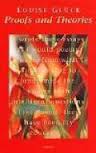
Louise Gluck’s ‘Education of the Poet’

As Keats once said, several things dove-tailed together. One of these was being asked by Poetry London to review Louise Gluck’s new collection, the PBS Recommendation, Faithful and Virtuous Night (Carcanet, 2014). The other – yesterday – was discussing with students the opening quatrain of Edward Thomas’ ‘The Sun Used to Shine’ with its marvelous evocation of the happy days he spent with Robert Frost in the Gloucestershire countryside in 1914. The opening lines employ an ABAB rhyme scheme, enjambement, judiciously placed caesuras and simple colloquial choices of verb and adverb to create its effects. As often, students asked whether what we were discussing was ‘thought about’ by the poet. My usual answer is that a writer is far more conscious of his craft that they might expect, but also that he considers options and exercises a veto. Like evolution, what fails goes to the wall; what remains becomes more and more coherent and effective. This is an idea I first saw expressed in Gluck’s essay, ‘Education of the Poet’ (originally a lecture delivered in 1989, reprinted in Proofs and Theories: Essays on Poetry (Carcanet, 1999).

imgres

Gluck’s over-riding point is that her characteristic mode of thought defines itself “in opposition”. This gives rise to her image of the poet as fundamentally in a state of helplessness much of the time, absorbing whatever is regarded as ‘oppositional’ and looking for opportunities to speak back. She makes it clear that such an idea “does not mean to distinguish writing from being alive”. What it means in practice is that the life of the poet is a life of “yearning, not [one] made serene by sensations of achievement”. The image of the writer effectively, confidently, repeatedly decanting her self, her being onto a sheet of paper is a false one. There are periods of silence, preoccupied with the desire to make art, a restlessness that may be agony. When at last “some sound, some tone” precipitates, what follows is a period of concentrated work: “so called because as long as one is working the thing itself is wrong or unfinished: a failure”. Yet when the poem, the utterance, is finished – Gluck argues – the poet is no more, reverting “simply [to] someone who wishes to be one”.

This pattern of a powerful force, a cacophony being replied to by the artistic voice  can also manifest in the way a poet engages with language. Gluck rejects the idea that poets are people who can’t get enough of individual words like ‘incarnadine’, in favour of language deployed in larger swathes to create contexts in which the “simplest vocabulary” is liberated from custom. It is custom that is thus replied to through using the gestural aspects of language – setting, timing, pacing – releasing words into novel relationships with truth. The poet generates material, improvises, plays with language and replies to what is produced through the process of veto. Like evolution, what fails goes to the wall; what remains becomes more and more coherent and effective.

imgres

So it’s no surprise that Gluck’s taste in poets favours those whose mode of poetic speech is more like a spoken confidence, a reply, a conversation: “I read to feel addressed”. Accordingly, her personal preference is not for poets – like Wallace Stevens – whose work is a more solitary musing, like “intercepted meditation”, not concerned to be listened to. I find myself in agreement with much of what Gluck says and – re-reading the essay now – I remember that she also uncovers this pattern in the teaching process. She warmly recalls being taught by Stanley Kunitz, his application to the novice writer of a steady “scrutiny”, the oppositional force “from outside, from the world, from another human being”. It’s a scrutiny and compulsion she herself continues to provide for her own students; the teacher’s presence is to stir, to provoke the reply, to kick start the process of definition.

It seems even one’s own work can be seen in this light. Considering her early collections, Gluck regards each new book as a fresh reply to what went before. This is a good answer to my students’ inquiries about how conscious an artist can be. Gluck tells us – and we should more than half believe it – that here she sought latinate suspended sentences, there how to end a poem without sealing it shut; elsewhere she looked to learn a longer breath, to make better use of the present tense; later still to write something less heroic, devoid of mythic reference. The artist is conscious, manipulative, alert. The artist waits, responds, manoeuvres. The both.

Sir John Franklin and Mary Shelley’s ‘Frankenstein’

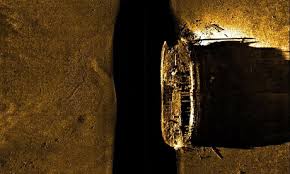
The Guardian tells us today: The grisly and mysterious tale of two British ships that disappeared in the Arctic in 1845 has baffled generations and sparked one of history’s longest rescue searches. But now, more than 160 years later, Canadian divers have finally found the remains of one of the doomed Navy vessels.

imgres

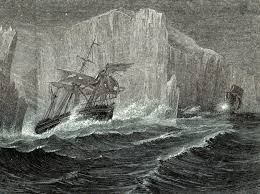
Legend has it that sailors on board the HMS Erebus and HMS Terror, who were chosen by the explorer Sir John Franklin, resorted to cannibalism after the ships became ice-bound in the Victoria Strait in the Arctic territory of Nunavut. Search parties hunted for the crew until 1859, but no sign of either ship was discovered until now. However, tantalising clues have emerged over the years, including the bodies of three crewmen, discovered in the 1980s.

The Franklin expedition’s mission to the fabled Northwest Passage had frustrated explorers for centuries and the sea crossing was only successfully made 58 years later, far further north. The original search expeditions in the 19th century helped open up parts of the Canadian Arctic for discovery. (http://www.theguardian.com/world/2014/sep/09/british-ship-1845-franklin-expedition-found-canada)

And by coincidence an AS class is today beginning to study Mary Shelley’s Frankenstein in which Robert Walton writes home to his sister, Margaret Saville, from St Petersburgh, on December 11th, 17—. One of the three aspirers in Shelley’s book, Walton also hopes to discover the Northwest Passage. He too becomes trapped in the ice but then picks up the bedraggled and wasted figure of Victor Frankenstein. Victor’s tale begins as a moral warning about the dangers of over-ambition, how the pursuit of knowledge risks destroying the “tranquillity”of life and our “domestic affections”.

This may have been Mary’s primary message, living as she did through the loss of a daughter the year before and Percy Bysshe’s roving eye and Byron’s restless wanderings. Despite her mother’s political radicalism and feminism and her father’s philosophical anarchism, I find it hard not to read the novel on one level as a rather conservative plea for a quieter life. Unlike Franklin and his crew, the ice eventually breaks up around Walton. This gives him the possibility of choice – and he chooses not to follow in Victor’s self-destructive footsteps but to turn for home, to Margaret, delivering his journal as the novel we now read.

imgres

On the other hand, deriving from a dream she had in the year with no summer, 1816, there’s plenty in the novel that may have been brimming beyond the author’s conscious control. Victor is a tragic hero of sorts. Even when he is dragged on board, close to death, Walton senses “He must have been a noble creature in his better days, being even now in wreck so attractive and amiable”. Franklin, 50 years later, was another Victor, risking all; it cost him (and his crew) all they had. A failure, but a tragic sort of failure and one long remembered. But Walton’s journal is a story of two sorts of heroism: the one that never gave up as well as the one that chose life, the life of relationships. We remember Walton because of Victor. But I think Walton knew what he was choosing and maybe thought of it with equanimity in the anonymity of his twilight years.

Mary Shelley saw her husband drowned in 1821. She died of cancer in Bournemouth in February 1851. I wonder what she thought, 6 years earlier, reading of Franklin’s abortive voyage. I imagine her re-reading the end of her great novel, the created Creature’s life ended because his creator, his only human tie to life itself, has perished: “He sprang from the cabin window [. . . ] upon the ice raft which lay close to the vessel. He was soon borne away by the waves and lost in darkness and distance”

Teaching Edward Thomas’ ‘Adlestrop’

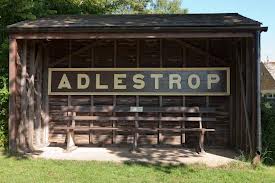
We teach the OCR exam board’s AS module F661, opting for Edward Thomas as the poet for close analysis. Oddly, the board do not include ‘Adlestrop’ in their selection of poems. So in the opening sessions, here’s a way of gentling students in to the processes of closely analysing a poem while also showing them Thomas’ most well-know piece.

imgres

Discuss with the class the idea of syllable counting in a verse line. Get them to try it by asking students to write an 8 or 10 syllable line beginning “Yes. I remember . . .”. Perhaps one of each.

For the exercise that follows (for those who want more restrictions) suggest keeping to an 8 or 10 syllable per line. Others (possibly the less able) may prefer more freedom . . .

Now . . . tell them to imagine they are travelling – some form of transport, walking, bike, train, bus. Ask around to reveal what they are imagining. Try pushing it a bit further, for more details, the car, the time of day, the scenery . . .

Now write 4 lines – a quatrain – in which you describe travelling and arrival at a particular location, at a particular time of year. They stop there. Maybe suggest they might open with “Yes. I remember . . .”. again – but not compulsory  . . .

Yes. I remember Adlestrop —
The name, because one afternoon
Of heat the express-train drew up there
Unwontedly. It was late June.

Next, write 4 lines in which you have stopped at this place – you hear a variety of noises – describe them . . .

The steam hissed. Someone cleared his throat.
No one left and no one came
On the bare platform. What I saw
Was Adlestrop — only the name

imgres

Next write 4 lines in which you give a description of what you see – first 2 lines things close by – second 2 lines things further off . . .

And willows, willow-herb, and grass,
And meadowsweet, and haycocks dry,
No whit less still and lonely fair
Than the high cloudlets in the sky.

Finally write 4 lines in which your attention continues to drift away into the distance, ever more remote from where you stopped; suggest it is wholly up to them where they stop with this one – attention may be drifting for miles, even for years . . .

And for that minute a blackbird sang
Close by, and round him, mistier,
Farther and farther, all the birds
Of Oxfordshire and Gloucestershire.

Very optional 4 lines depending on how well they are going – in which they may conclude the piece in any way they wish. Interestingly, Thomas does not make use of this option, does not conclude in any neat fashion; a point for discussion later perhaps. . .

Finally, show Thomas’ own poem. Give out copies. By this stage, students will be likely to have opinions and/or questions about the way the original piece deals with the same material they have just written about.

Homework: to type out the lines created during the lesson – taking any opportunity to alter or just tidy them up to be presented next lesson.

Next lesson – Take the poems they have typed up. Copy them and re-distribute them, one to each student (not their own poem though). Ask them to identify and annotate SIX items from the poem in front of them where they perceive the writer has made use of technical devices.

Ask each student to present and illustrate orally TWO of these devices to the rest of the class. These will range from the simple (a moment of alliteration perhaps) to the more complex (the way the writer develops over quatrain 2 and 3 a lexical field associated with illness)

The teacher might ‘mark’ the original creative piece; certainly a ‘mark’ might be derived from a student’s annotation of another student’s poem.

Re-packaging ‘percussive’ Ted Hughes

Anthologies are the reluctant poetry readers’ hedging bet. There’s a good chance that something good will turn up and prove a winner. They sell well – they are the infrequent poetry buyer’s punt for a gift that will please at least in parts. So Alice Oswald’s compilation of Ted Hughes’ animal poems into a Bestiary will certainly put more cash into the Faber vault. But few complaints – anything to get more people reading any poetry cannot be bad.

Ted-Hughes-001

Oswald discusses her approach to the selection in The Guardian: 

http://www.theguardian.com/books/2014/aug/29/ted-hughes-alice-oswald-animal-poetry-bestiary

She picks up Hughes’ own early image of his poems as creatures with a “vivid life” of their own. He condemns poems which fail to possess this coherent vitality as likely to walk with a pronounced limp – a wonderful way, I’ve found, of imaging that elusive ‘rightness’ of a poem for students and workshoppers. Interestingly though, there is a shimmering, vacillatory quality to others things Oswald writes and this comes directly from Hughes himself. His animals are very much themselves yet they are expressive of human qualities too. Oswald quotes from Moortown Diary; Hughes on the poet “getting close to what is going on, and staying close, and of excluding everything else that might be pressing to interfere with the watching eye”. Held in tension with this are other Hughes’ statements such as this, in a letter, warning of the dangers of mere observation: “When a man becomes a mirror, he just ceases to be interesting to men.”

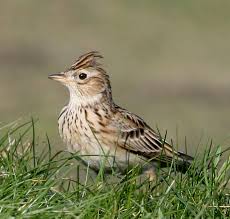
Oswald goes on to suggest that it is the “percussion” of Hughes’ language that instills such vivid life into his poems, quoting from ‘Skylarks’:

The lark begins to go up
Like a warning
As if the globe were uneasy –

Barrel-chested for heights,
Like an Indian of the high Andes,

A whippet head, barbed like

a hunting arrow,

But leaden
With muscle
For the struggle
Against
Earth’s centre.

And leaden
For ballast
In the rocketing storms of the breath.

Leaden
Like a bullet
To supplant
Life from its centre.

imgres

If it is a percussive effect that is critical here it is more Mozart than Stomp. Oswald has precious little space to develop her argument, but what I find in such a passage is Hughes’ distinctive manipulation of scale and perspective, not unrelated to his paradoxical comments above. Microcosm and macrocosm are continually leant against each other here, or – it being a more metamorphic, high-pressured process – they are spun about each other till it’s hard to pick one from the other. The tiny body of the lark is a warning to the globe; its braced, needle-thin ribs conjure images of Andean mountains; its crested, whippet head seems to speed lethally through remote forests. The three stanzas focusing on the “leaden” nature of the bird – less weight it seems to me, more loaded with quiddity, self-ness – provoke the reader to focus closely on its body, only again for our attention to be spun outwards to “Earth’s centre . . . rocketing storms”, vulnerable life beating at its “centre”.

In part, what Hughes achieves is a sense of interconnectedness – which he would have intended in both spiritual and environmental terms. What the reader experiences is a sudden inflation or deflation of scale and perspective, a magical effect, an effect created through language, an effect achieved so skillfully and instantaneously that one might well have some sense of a percussive, explosive or implosive quality. I don’t hear or feel a noise as such – my sense of the world pulses, is stretched or compressed in the most exciting fashion. An effect with a moral dimension to it as well – a serious, ludic experience, in which we see and re-see our own place in the world.