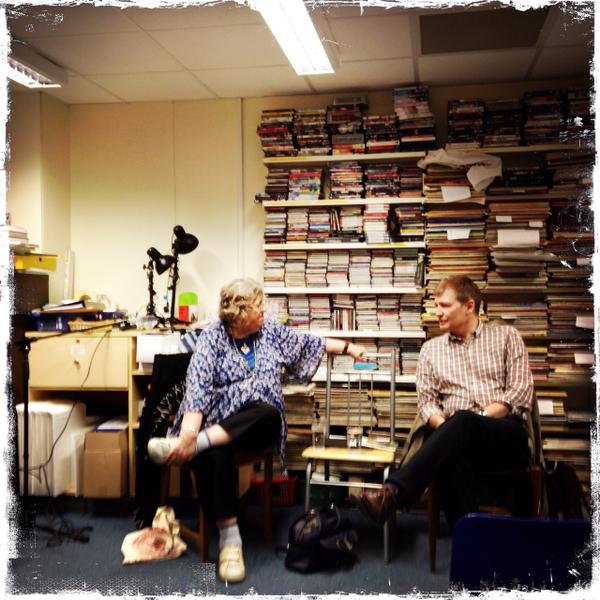
Piles and piles of books: literally covering the walls of the room. Shelves labelled children’s books, philosophy, modern novels, poetry, drama, politics – my eye catches a tottering stack of those old Ladybird books I used to love to read as a kid: evocative pictures of Stone Age man bringing down a mammoth, of happy passengers on modes of public transport, of prisoners from the American Civil War. Well OK – the back room of an Oxfam book store may not seem the most pre-possessing place to listen to poetry, but there are worse, such as scrubbed-sterile galleries, cramped cellar-spaces, overly reverent thee-ay-ters, noisy pub rooms. This place – it’s in Cheltenham town centre, at the Poetry Festival – has the live feel of untidy contingency, of work in progress, a vibrant culture that is literate, ideas and books readily swopped to and fro. That feels right. Piles and piles of books in transit from one hand to another.
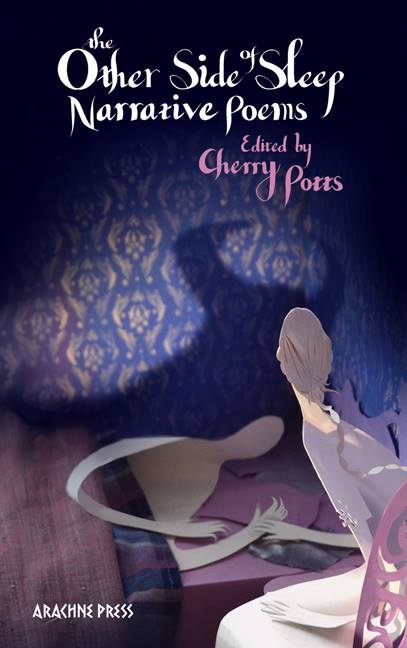
I was there on Saturday afternoon reading with Olivia Byard, both presenting work from the great Worple Press. Following our own performances there was the launch of The Other Side of Sleep, an anthology devoted to longer narrative poems. Published by Arachne Press, it’s intended as a welcome antidote to all those competitions that stipulate the standardised ‘no more than 40 lines’. Cherry Potts, the editor, introduced several voices. Jeremy Dixon read an entertaining piece about serving customers in Boots which was funny and (appropriately) repetitive – “Would you like a bag with that? Please enter your PIN”. Apart from writing his own work Jeremy produces intriguing, limited edition books at Hazard Press. Kate Foley was disappointingly unable to read her long poem (a double disappointment to me as she had also been unable to attend the recent Torriano Poetry Competition award evening I hosted in London (read my blog about the evening here).
Angela France read a fascinating poem about a story teller’s life that she cast in the form of a crown of sonnets, or corona. Wikipedia: a sequence of 14 sonnets concerned with a single theme, each linked to the preceding and succeeding sonnets by repeating the final line of the preceding sonnet as its first line. The first line of the first sonnet is repeated as the final line of the final sonnet, thereby bringing the sequence to a close. She read beautifully and with great pacing and conviction. Math Jones (a self-declared pagan) read from ‘Grithspell’, full of declarative lines and much spitting in which gods (rather belligerently to my ear) declared an end to war. In contrast, Bernie Howley (a relative new-comer to poetry) read ‘I Have No Feet’, a poem about leaping off a cliff into an Italian pool, while just behind her stood a banner with Emily Dickinson’s declaration about feeling the top of your head coming off.
After a coffee break mid-afternoon, an event called ‘The Minotaur is Not a Monster’ featured Myra Schneider (from whose recent Enitharmon book, The Door to Colour, the event title was taken) reading alongside Anna Saunders, poet, Executive Director and Founder of the Cheltenham Poetry Festival. Myra’s work (an earlier book reviewed here) is firmly based in the real world yet capable of addressing the yearnings and concerns of the spirit, as revealed in her reading of ‘Oranges’. In Crete, on one of those coach trips round the island, groups ushered in and out of suitable sites of interest – on this occasion a café and orange grove. As a leaving gift: “a giant orange with bumps, dents, niggles / and an off-beat attempt at rotundity, / a fruit unabashed by its rusticity”. Schneider’s work shares that same unabashed quality as the poem’s narrator later stuffs her mouth with huge orange segments, juice spurting all over the sheets. But this is no sensual liberation (or not that only). The taste is as much evocative of hard work, ritual, friendship, “those rare moments / when silence suspends the ordinary / and the unattainable seems within reach”.
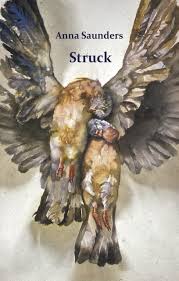
One of Saunders’ poems, ‘Silks’, is rather more steamy in its sensuality and shape-shifting. A female eye; the male as snail, belly down, as “if the earth were using him / for an accordion”. A little stroking makes him “rise”, morph into butterfly, pupa, silk-worm, perhaps back to snail, its trail leaving behind his “pearlescent signature scribbled / from wall to door”. Saunder’s poems are fast-moving, flash-edited, pronouns and main verbs often jettisoned as scurf. She was a bit awkwardly introduced as a poet who had greatly improved – rightly Bernard O’Donaghue has admired her original and fresh technique – and no-one listening on Saturday would gainsay that.
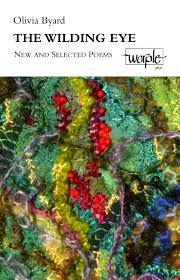
Earlier in the afternoon, Olivia Byard had read from her new and selected poems from Worple Press, The Wilding Eye: here. The title poem boldly trashes thousands of “years of husbandry” (the latter being the right word on several counts) in deciding to allow a manicured lawn to go wild. Within a couple of weeks it bears a “crown” of daisies, a “spurt of purple bloom”. One of the barriers being dismantled here is language as the very word “lawn” is forgotten, enthusiasm ramping up to addiction with each “new fix – of the rough / tough leggy fallow”. This is a ‘zoom’ poem, rapidly propelled without a backward glance towards a new world, ending breathlessly, jaggedly, venturing personal and ecological liberties, “gulping breaths, of sweet riot / and tangle”. Exciting stuff – and appropriate too as Saturday also saw the launch of Dear World, the Festival anthology with a preface by Andrew Motion. It’s sponsored by the Campaign for the Preservation of Rural England (Motion is their current President) and he argues, nodding to Wordsworth and Clare, that “big pictures are made of small details”, the ecological health of our world is reliant on the kind of observational attentiveness reflected in the writing of a poem: “use this book to inspire [. . .] to redouble our efforts to say why the countryside matters, and why it needs defending”.
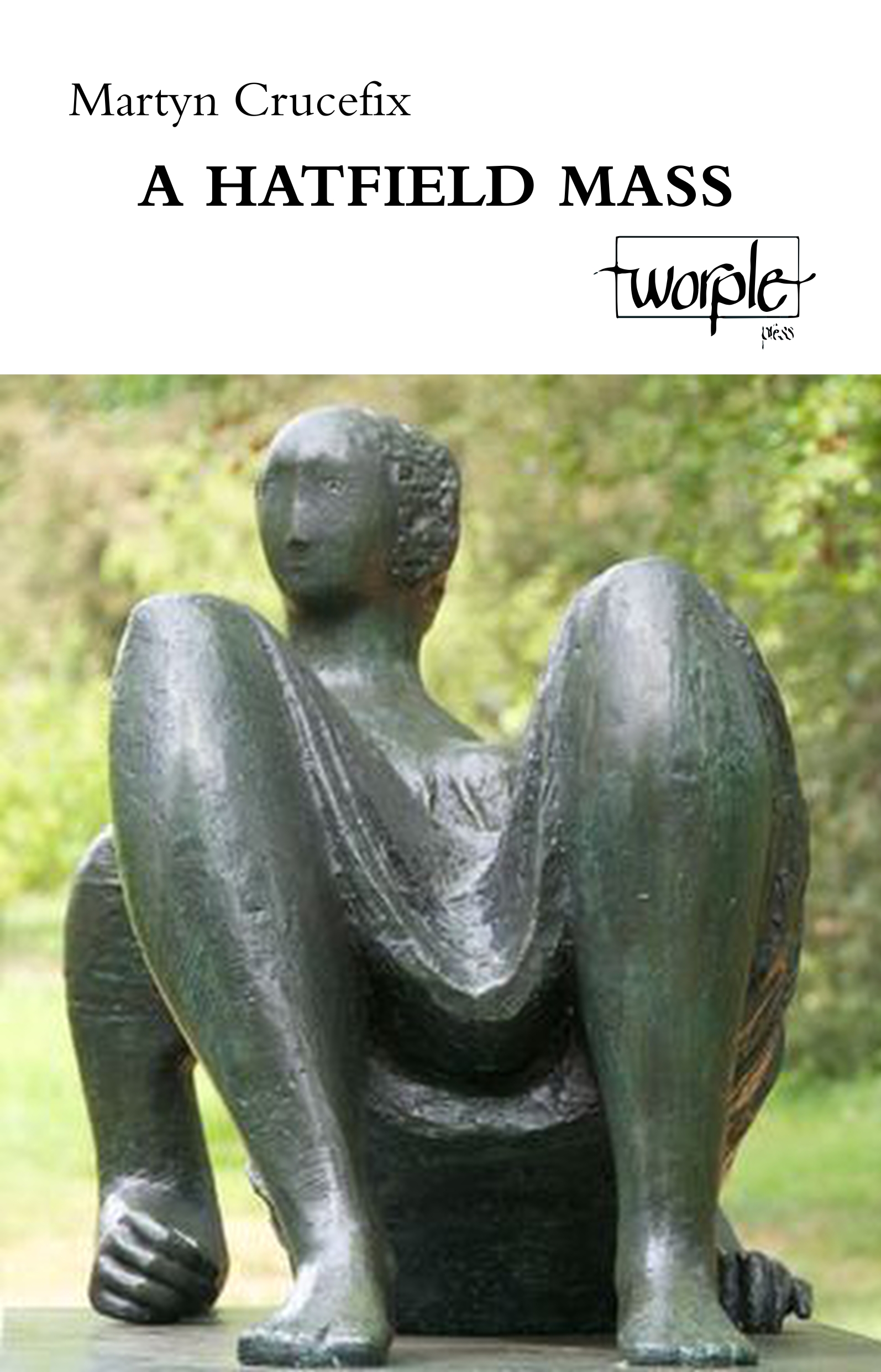
Earlier, I had the pleasure of reading from my own Worple sequence, A Hatfield Mass, subtitled ‘voice and shape in an English landscape’: here.
Back to London later, exhausted . . .