Katrina Porteous’ most recent Bloodaxe collection, ‘Rhizodont’, reviewed.

An edited (shorter) version of this review first appeared in Poetry Salzberg Review in June 2025. Many thanks to the editor, Wolfgang Görtschacher, for commissioning the writing of it. The collection, Rhizodont, was shortlisted for the TS Eliot Prize in 2024.
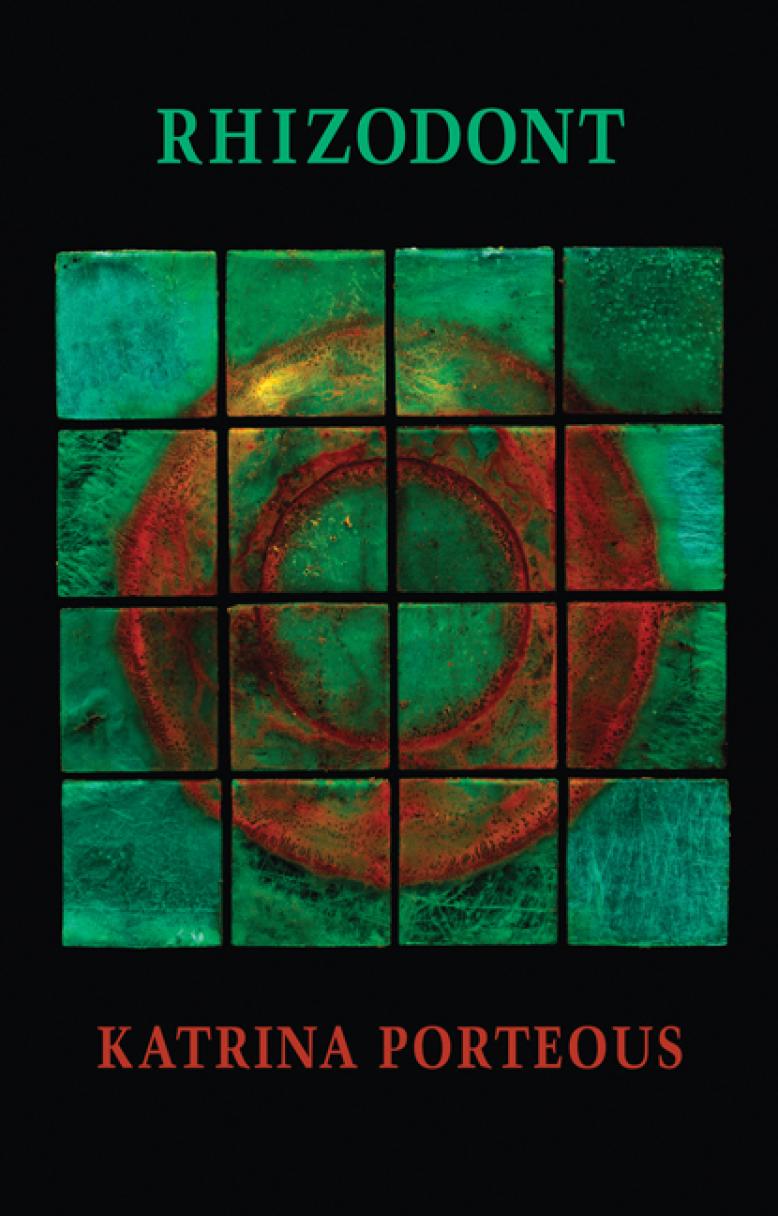
The ‘rhizodont’ which provides the title for Katrina Porteous’ fourth collection (Bloodaxe Books, 2024) is not some niche root-canal dental work, but a large predatory species of fish, which became extinct 310 million years ago. It’s thought to be the first creature to transition from water to land and hence the ancestor of all four-limbed vertebrates (including humans). The poems here are divided into two superficially very separate books (titled ‘Carboniferous’ and ‘Invisible Everywhere’) but what Porteous insists holds them together is her exploration of this notion of transition. As ‘#rhizodont’ puts it, ‘We’re all on a journey’, and the ambition of this book touches upon transformations various: geological, natural, industrial, cultural (and linguistic) and technological. There can be no faulting the ambition of this and there are many fine poems, though Porteous insists on Notes explaining a great deal of what she is doing/writing about which gives the whole a rather teacherly quality that will divide her readership. Here’s the title poem in full, plus a video of the author reading it:

#rhizodont

Then, in a flash,

It claps shut – an ambush –

Teeth, fangs, tusks – crunch, rip,

Snap. The rhizodont,

Dragging itself out of water.

The old world sinks and slips

Beneath its tilted strata.

We’re all on a journey.

This one’s about us

Unearthing ourselves from a place –

Somatic, interlaced –

To be conjured from light, and sent

Invisible, everywhere,

For everyone to possess.

The children stare at their phones,

A fervent, lit up,

Incorporeal congregation,

Some deep, residual

Root in a life everlasting

Outlasting them, like a fossil

Sarcopterygian fish.

The longer ‘Carboniferous’ section is loosely glued together by a geographical journey from the former coalmining communities of East Durham, moving up the Northumberland coast to Holy Island. This is familiar territory, important to Porteous’ earlier collections, and she again writes well (with great local knowledge) of the geological conditions that have eventually given rise to the important fishing and mining industries (and cultural communities) in the area. Both industries are now in decline and in ‘A Short Walk from the Sea’s Edge’, while the older folk still use ‘old words’ (like stobbie, skyemmie, and gowdspink), the younger generation ‘checks in with Insta before school’. This also illustrates Porteous’ belief that the post-war generations’ transition ‘from analogue to digital technologies’ is a particularly dividing and challenging shift such that ‘the analogue island we lived on’, will seem as incomprehensible as ‘Latin and Greek’ to future generations (‘Hermeneutics’).
The poems also portray the natural wildlife of the region – dragonflies, sandhoppers, crabs and a wide variety of birds and plants. Despite coastal erosion and industrial pollution, Porteous focuses on such ‘small and local’ species as have been around for (often) millions of years. The glowworms in ‘Tiny Lights’ are ‘alien, ancient’ and for most residents of the area, completely ignored, though their continuing existence offers some sense of a continuity amidst vast change. The sounds and sights of the birds in ‘Goldcrests’ are marvellously observed, and they serve both to mark the season and, ‘bringing // Wildness’, they remind us of the natural world’s wider perspectives. The ‘Grey Heron’ is likewise superbly captured in the course of 18 shortish lines, but does the poem really need its 25 line prose Note, detailing the setting’s geographical history, the life cycle of Atlantic salmon, conservation measures being taken and the poet’s intention to place ‘the timeless drama of the ‘prehistoric’ grey heron against [the town of] Amble’s history, first as a coal port then as a salmon fishing harbour, and depict the bird as an explorer, venturing into Amble’s still-to-be-decided future’? I’m not convinced, though you don’t have to read them, and it’s true Porteous’ stated intent is merely to inform, and stimulate further reading.

But can a poet’s commitment and enthusiasm spill over too much? Rhizodont contains 111 pages of poetry and 30 pages of Notes and explicatory Introduction, containing lots of interesting facts and figures, but also a good deal of over-explanation as in the Note to the poem ‘Wishbone’: ‘The poem juxtaposes recent cultural evolution with this enormous timescale, and asks what we, with our plastic waste, will leave behind us’. Most poets would leave such interpretation up to the reader and Porteous’ (admirable) compulsion to write about things she believes are important, is also conducive to poems being written under less than compelling conditions, perhaps to fill a gap in a sequence, or to make a point not yet covered elsewhere. It’s almost certainly deliberately excluded, but this reader misses a bit more of the poet’s involvement, either personally, as in ‘Begin Again’ in which, confronted with the vastness of geological time and Nature’s endurance, the speaker’s suddenly ‘ glad / Of tea-cups, hands, companionable laughter’, or of the poet’s love of words and music as in the several balladlike pieces included here ( like ‘The Tide Clock’ and ‘Low Light’).
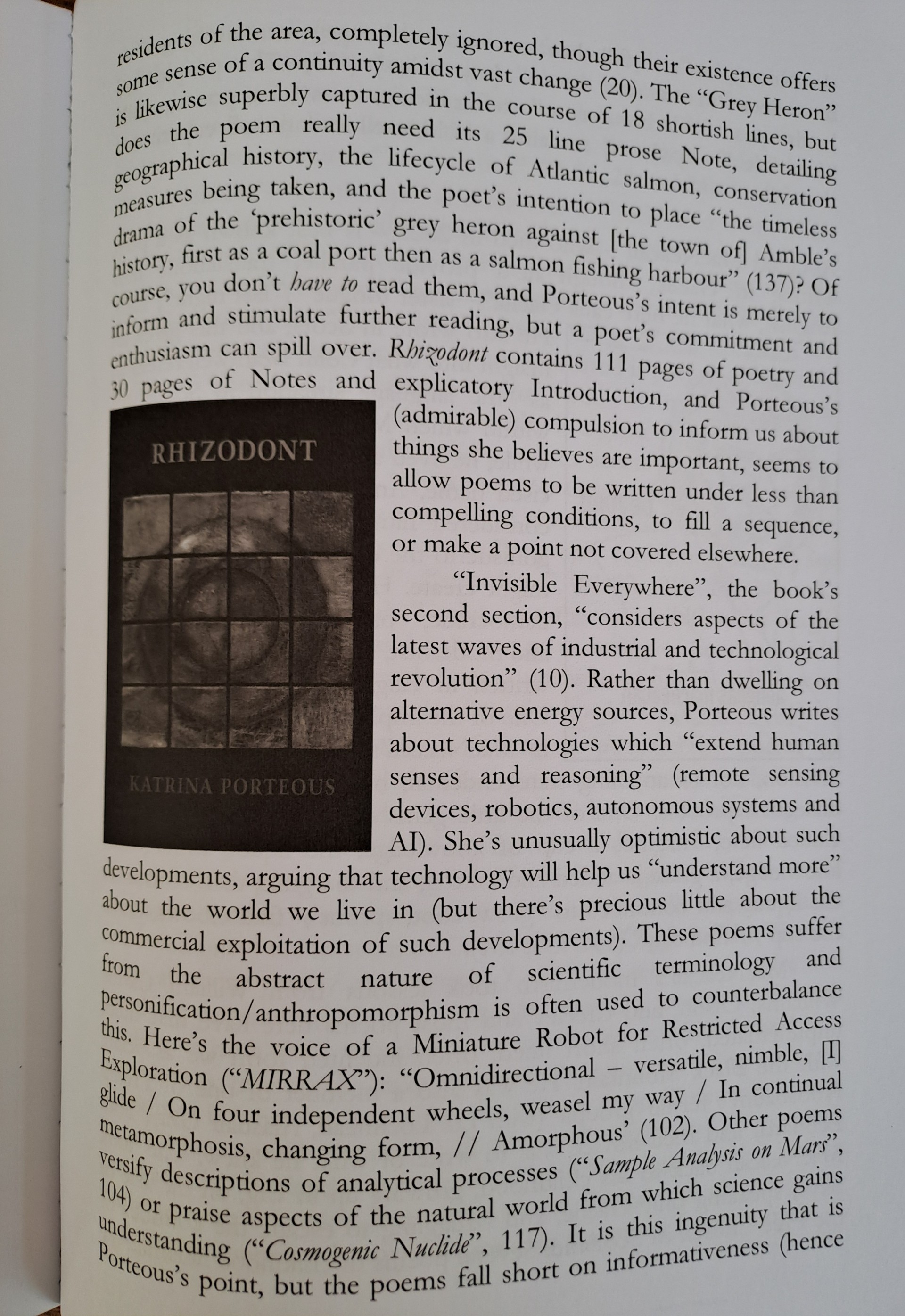
The collection’s second section ‘considers aspects of the latest waves of industrial and technological revolution’ and, rather than dwelling on alternative energy sources, Porteous writes about technologies which ‘extend human senses and reasoning’, by which she means remote sensing devices, robotics, autonomous systems and AI. She is unusually optimistic about such developments, arguing (in poems and Notes) that such technology will be used to ‘understand more’ about the world we live in (but there’s precious little here about the commercial exploitation of such developments). And the poems themselves? They often suffer from the abstract nature of scientific terminology and don’t convincingly convey much emotion about the tech. It’s interesting how often personification / anthropomorphism is used in these poems; the Antarctic ice speaks, or is spoken to, and here is the voice of a Miniature Robot for Restricted Access Exploration (‘MIRRAX’): ‘Omnidirectional – versatile, nimble, [I] glide / On four independent wheels, weasel my way / In continual metamorphosis, changing form, // Amorphous’. Other poems versify descriptions of analytical processes (‘Sample Analysis on Mars’) or praise certain aspects of the natural world from which science gains understanding (‘Cosmogenic Nuclide’, ‘Basal Shear’). It is this ingenuity that is the point, but the poems fall short on informativeness (hence the need for Notes), but also fall short on emotional engagement (poetry?), failing in the end to convey Porteous’ stated intention: to reflect ‘in awe and wonder that human consciousness is able to gather and interpret [all this] information’ [my italics]. The people and landscapes of ‘Carboniferous’ are far more successful as poems to be read and enjoyed, while ‘Invisible Everywhere’ is a bold, well-intentioned experiment that fails.

Impressions of the TS Eliot Prize Readings 2025

I’ve always enjoyed Ladybird spotting the ways poets present themselves in a reading situation. Last night’s TS Eliot prize readings at the Festival Hall was a grand opportunity for such a pursuit. Ten readers in a row. Here are a few jotted down impressions, gleaned from the on-line version of the show. Before you crucify me for such poor, ill-informed critical judgements, I do hereby declare I have only thoroughly read two of the contenders, so these are very much impressions of ‘what happened on the night’. I’ll leave mentioning my favourite and my predicted winner (not the same poet) to the end. The award will be announced this evening (Monday 13th January 2025).

The housekeeping…. This year, the shortlist was chosen by judges Mimi Khalvati (Chair), Hannah Sullivan and Anthony Joseph. The TS Eliot Prize (it says on their website) is among the world’s most celebrated awards. Inaugurated in 1993 to celebrate the Poetry Book Society’s 40th birthday and to honour its founding poet, the prize is now awarded by the TS Eliot Foundation. The evening was introduced by Ian McMillan.

In the order the shortlist for this year’s prize was presented last night:

Katrina Porteous Rhizodont (Bloodaxe Books) – KP was described as a northern lighthouse by Ian McMillan – finding the universal in the local – the north east of England – Holy Island – this is poetry full of its concrete ‘subject’ – details and actuality, a powerful wish to communicate (the book is full of explanatory Notes) – here, the coal beginning (to be formed) again – Our Billie – a local girl, forms the backbone of one poem  – some unfortunate ‘down with the kids’ moments, referencing Insta and emojis – KP reads in a bobbing, fidgeting sort of way – does stillness evoke more power? – ‘The children STARE at their phones’ – particular words picked out for heavy emphasis – a bit over insistent on their significance – a robot explores the moon surface now – an interest in new technology – but then, the Antarctic without ice – the book title, rhizodont, is a fish transitioning onto land a very long time ago – the delivery here surely too mimetic – snarly, is that how a fish sounds? But passionately held views without a doubt.

Rachel Mann Eleanor Among the Saints (Carcanet Press) – McMillan suggested that Mann takes up liturgical language and re-invents it (for a modern audience?) – Eleanor the central figure is a trans woman of the 14th century – at one point she’s in conversation with Julian of Norwich and Margery Kemp, so lots of hazelnut references – but thank goodness I didn’t hear ‘all shall be well’ – the delivery a slow emphatic one, I actually wrote ‘from the pulpit’ before I noticed (I think) the dog collar – am I right? – lots of first person voice going on here – often in an ecstatic (religious) mode, a few grand arm gestures – the language often moving towards Hopkins (why not?) – masculinity? –embroidering a priest, sanctus, sanctus, then love – the murdering of a trans girl, drawing a bead on contemporary relevance – in 1394 Eleanor was arrested – the dark shades worn by RM curiously out of keeping with the verse lines.

Carl Phillips Scattered Snows, to the North (Carcanet Press) – from the US –‘quiet’ being the word here – rather sweetly alluded to his sponsors for the evening – Lemsip – welcome to England – the lines being read in the cadence of a breath, a dying fall – suggestive here of an interior communion, very delicate, exploration of an emotional life – McMillan suggested this is where time and intimacy meet – what do they say to each other I wonder? – a taking off of  clothes – then he also takes his clothes off – colours and a bell – a concern (as technique and subject matter) for precision, for what is true? (how unfashionable in the US) – snows in the title poem, Phillips manages to take us to Roman history and love without us getting lost along the way – quietly persuasive and good company – a forest journey – things almost said – a vulnerability to this writer (someone else posted this idea) I’ll borrow it.

Gustav Parker Hibbett High Jump as Icarus Story (Banshee Press) – opening with allusions to Ovid for the Icarus link – reaching for the sunlight (not the best of phrases) – but athletics as a metaphor it seems at first – sliding into athletics for real – practising high jumps with a friend – in a world where they are regarded as ‘interchangeable’ because of ethnicity – the dark body hanging – the poems delivered head down, reading from the page, a whispering voice, not coming from the throat or diaphragm, so intimate as to be rather too in-turned – these are plain narratives, lots of ‘stuff’ – one later poem is longer, more sustained and the insistence on these real details begins to transform the poem into something a bit more visionary – jumping 6’ 8” – Noah, all he wanted was the stars – black boys doing anything – the USA and Mexico – to customise paradigms if they don’t fit.

Karen McCarthy Woolf Top Doll (Dialogue Books) – this turns out to be a verse novel so rather hard to convey a clear impression of it – Hugette a female recluse who lived with lots of dolls – KMW read several dramatic monologues this evening – Maman being spoken by a French doll – a rag doll speaking as if a military general, denying that he is a ‘gollywog’ – big pause on that – these are probably funny in many ways – but with their points to be made – but Woolf is acting them out with neck, eyes and eyebrows – male dolls, deep-voiced, female, light, a dancer doll flighty voiced – Ballerina Barbie is all en pointe and pirouette (arms being waved on stage) – yes, fictional and imaginative recreation, but this begins to feel like a sort of ventriloquism in the delivery – the mask is evident – being acted out – I can’t hear the verse of this verse novel – a Japanese doll to finish off with – cherry blossom, bento, the moon. My review of KMW’s earlier collection An Aviary of Small Birds.

Interval

Helen Farish The Penny Dropping (Bloodaxe Books) – a book-long retrospective on an old ended relationship – trying to say what is perhaps inarticulate – joy and ache – biographical narrative as universal – McMillan suggests the relationship is merely a ‘hook’ rather than the ‘focus’ that it surely is? – the delivery is slow and fluting, very deliberate and clear almost as if Farish is finding the words (for the first time) as she goes – effective I think – again poetry with a lot of subject stuff – lists of local colour, places, events, food and drink – things we loved, a list – though spoken of as ‘a’ relationship this feels really quite narrowly autobiographical – driving the M40 discussing having (not having) children – a bit toe-curling, some allusions to film Pretty Woman with Gere and Roberts – who is it says ‘we were made for each other’ these days – a valentine card? – nice recipe at the end, pasta and red wine – but surely a candle was on the table too?

Peter Gizzi Fierce Elegy (Penguin Poetry) – also from the US – the delivery here a steady pulsing (these are short lines, I think, and Gizzi seems to be breathing and voicing that – a rich, resonant voice (the kind you’re born with) – a terrific flow and a shifting from concrete to abstract – the moon and then ‘kinda real, kinda not’ – the ingenious light – a letting out of inner weather – a rather self-conscious making of fine phrases and with the ‘self’ as the primary subject (not the outer) there are passages of pure lyricism – risks even allusions to the Muse, a lyre, but bedded in American colloquial – neatly done – forests, shapes, landscapes all becoming the inner life, representing it – shapes become the beloved – without reading more I’m none the wiser as to what is elegiac here or fierce – but interesting poems.

Hannah Copley Lapwing (Pavilion Poetry) – McMillan suggesting Copley’s book pushes language to the state of music – do we expect Mallarme? – not at all – the lapwing gives the chance for some birdsong – but lapwing does not speak but is rather spoken about – another bird, a daughter… Peet? – all the folksy names for a lapwing, of course – the bird is found to be missing – a mosaic, otherwise know as – the bird becoming person – a poem about addiction – our creaturely behaviours – the difficulty of caring for someone (some bird) – raggedy, slugs, let him disintegrate, love – Copley also reads in cadences that fall every time, not quite clear whether these are the lines of verse or her grammatical units – the lapwing figure is anthropomorphised or a human being is birdified – a nice balancing act mostly – though some less so – a family tree and (very human) grief – something to feather – ready to give – think I’d have liked more musicality.

Gboyega Odubanjo Adam (Faber & Faber) – Odubanjoof course not present after his tragic, untimely death – this his first and only collection – Adam the name given to the torso of a boy pulled from the Thames some years back – a couple of recordings of the author were played – poems read by Joe Carrick-Varty and Gabriel Akamo – the latter the much better reader – a memorial set of poems to the disappeared, the dispossessed – the dead boy’s imagined journey through Germany to the UK – thank you to the woman, the people, the police – this language is more like music – a montage-like, even Whitmanesque feel to the rolling cadences, a riffing and use of repetition, the material rising towards the mythic – blow trumpet as if apocalyptic – chorus, musical bridge transition, outro – a burned CD, its track-listing – a weird fairy tale about water – frog and scorpion, two sisters, ocean and sun in a dialogue – gosh – yes this is good work.

Raymond Antrobus: Signs, Music (Picador Poetry) – this was introduced as a book about fatherhood and masculinity – wasn’t that the 1990s? – a subject for all time – the pleasures (and anxiety) about bathing with your own child – coded with scripture – the son doesn’t pee, but it would have been OK if he did – this is poetry with a lot of ‘I’ – but surreal little flights and often incantatory, an enjoyable allowance of the musical nature of language – I broke up with, I broke up with – anaphora-driven here – the buying of a second hand noise – but I said nothing is where it ends – the intrigue of what remains silent – poems are being performed but not acted out – though there’s a bit of surf-board business, arms keeping balance, as the poem is read – teaching his son BSL – for music – another swaying, conducting sort of motion – yes – very engaging – ‘poetry is music from the place we were born’ (though that’s a very constricting definition). I reviewed two of RA’s earlier collections – The Perseverance and All the Names Given.

On the night, my favourite was Carl Phillips (despite his sore throat). But Gboyega Odubanjo’s work was also powerful in ways that I cannot articulate and for that reason – but also for reasons external to the poetry – I think he will be posthumously awarded the TS Eliot Prize 2025.

Late Addendum (11pm Monday 13th January) – and the winner was Peter Gizzi Fierce Elegy (Penguin Poetry)

Visiting Torbay Poetry Festival 2017

p045rwch[1]

The 11am train out of Paddington is so packed that I expect to see Jeremy Corbyn sitting on the floor between carriages – disgruntled at the discomfort of his position, if more gruntled at the clear evidence of the underfunding of public transport. I usually choose the Quiet Carriage to varying degrees of success and on this occasion, from Reading to Swindon, I have the pleasure of eavesdropping on a phone conversation in a language I do not know. A contemporary version of Frost’s the sound of sense – though I’m not sure I make much sense of the sounds themselves, half of it murmuring like love-talk, the other staccato as a list of shopping. Maybe that’s just what it is!

Anyway, I have work to do – correcting replies I’m giving to an email interview to be published by South Bank Poetry in the next couple of weeks. I’ve already prepared the reading I’m giving on the Saturday night, so I don’t bother thinking about that. Getting off the train 3½ hours later, I meet up with Maggie Butt who is still recovering from running the recent Poem-a-Thon in support of the Enfield Refugee Fund. Possibly, I think, she’s reeling less from the sheer effort involved as from the whole event’s astonishing success, raising something like £14000 in one day. We walk along the breezy promenade at Torquay to the Livermead Cliff Hotel which is the focus of the Torbay Poetry Festival. It turns out they are not expecting me until the following day but with some juggling of rooms I’m soon ensconced and ready for some poetry.

train[1]

I had arrived in time to hear Myra Schneider and Alasdair Paterson reading. But Myra was unwell and absent, so her poems and little emailed introductions were beautifully read by Mimi Khalvati and Danielle Hope. I know Myra’s work well and it is often very location specific, so it was a strange feeling having north London brought so vividly before me when, just outside the expansive windows, the English Channel was rolling in towards the beach. Alasdair (amongst many other things) runs the Uncut Poetry series in Exeter, so he is both in-comer and relative local to the south west. With the kind of Scottish burr that in itself draws attention to the sound of any poem it is applied to, he read in a quiet, level voice. Especially memorable was a poem with a surrealist and Chinese slant, presenting a kind of bureaucratic Confucianism, managing to convey both a satirical edge and a rather joyful sense of freedom.

Early evening on the Friday, Kathy Miles read her poems layered with myth, history and personal experience. And Matthew Barnard, who is published by Eyewear, read several poems about visits – or maybe residence – on the Isle of Skye. One of the great recommendations of this little poetry festival (run by Patricia Oxley, who also edits Acumen, and her committee) is indeed its small scale. It means guests and readers are always in touching and chatting distance of each other. Someone who is a regular attendee described it to me as more like a house party and it certainly has that sense of a bunch of people meeting up in an endless, delightful carousel of combinations and re-combinations. Maybe all I mean is that it is very friendly!


DuncanForbes-200x245[1]
Duncan Forbes
 

The first half of Friday evening’s reading was given by the urbane, witty and clever Duncan Forbes. One of his poems expressed the concern, shared by so many of us who work with language, about the number of words that seem to be dropping out of common usage. So many of these are associated with the natural world, the weather, earth and landscape. Duncan was smart and engaging on the subject but interestingly a number of his more recent poems seem to tone down the wit and word-play in order to focus on landscape – in one instance a gloriously evoked Portuguese setting. Mimi Khalvati’s work is well known and tends to provoke praise such as ‘lush’ and ‘graceful’ which is true enough though she also has a quiet almost metaphysical wit of her own. She read a poem from the just published Hippocrates Society anthology of the heart:


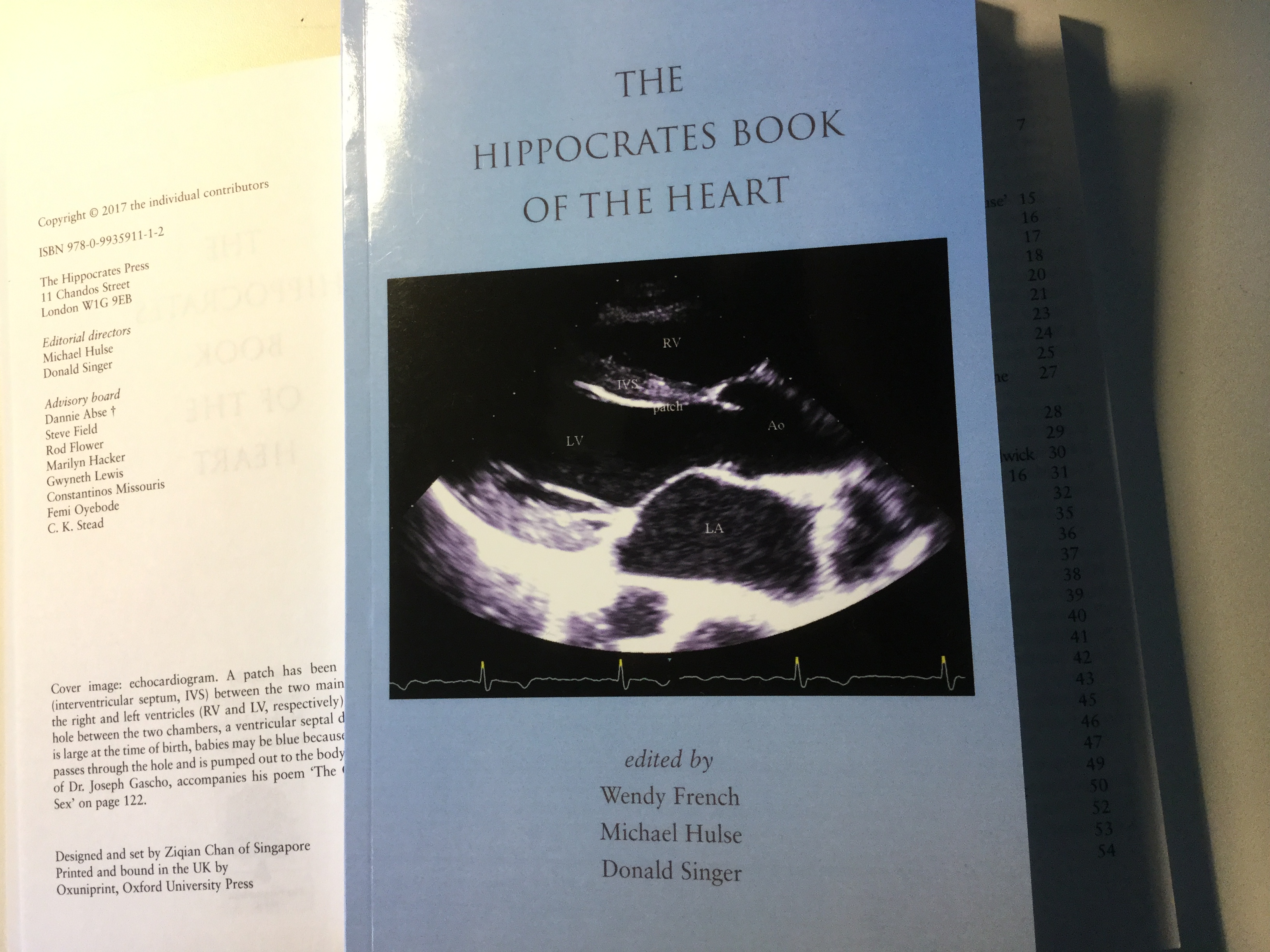
Old tramping grounds are bruises to the heart.

Go visit them at dusk when belisha beacons,

reflected in dark windows, flash and dart

like fireflies [. . .]

IMG_0287

We were expecting Storm Brian on the Saturday and being just metres from the water’s edge it was awaited with some trepidation. But living up to its rather un-tempestlike name, Brian blew only in brief gusts, ruffling Torbay into rather poetic white horses rather than anything more dangerous. It seemed appropriate that the main event of the morning was a celebration of Cornish poet Charles Causley. This was coordinated by John Miles and included members of The Causely Trust and the poet’s biographer, Laurence Green. We heard about Causley’s childhood, the early death of his father, his war experiences in the navy, then his years teaching at the same school he attended. A curious life of great rootedness and sense of locale, combined with his sense of the ocean always at his doorstep and the possibility of travel. Perhaps the highlight of the session was an unaccompanied singing of Causley’s ‘Timothy Winters’ by Roy Cameron. I’ve known some of the poems for ages, but the event made me want to go back and reread them. I always remember something Causley wrote, echoing Frost’s ideas about ulteriority, that poems are always about something else and that’s why they are so hard to write.


blogcharlescausley2[1]
Charles Causely
 

If Patrica Oxley sets the organisational tone for the Festival, it is her husband William who sets the sociability quotient. This is also reflected in his most recent publication, On and Off Parnassus (Rockingham Press), a collection of anecdotes, or Oxley-dotes, which has been described as giving readers “a finely judged mixture of anecdote and nuanced memoir”. William’s encounter with a much larger-than-expected tiger cub proved entertaining. Alongside him Maggie Butt read from her recent collection, Degrees of Twilight, taking us from a trip to Cuba to her very moving response to Dylan Thomas:


Why not go gentle into that good night

like drifting into sleep from sun-soaked day,

remembering the brightness of the light?


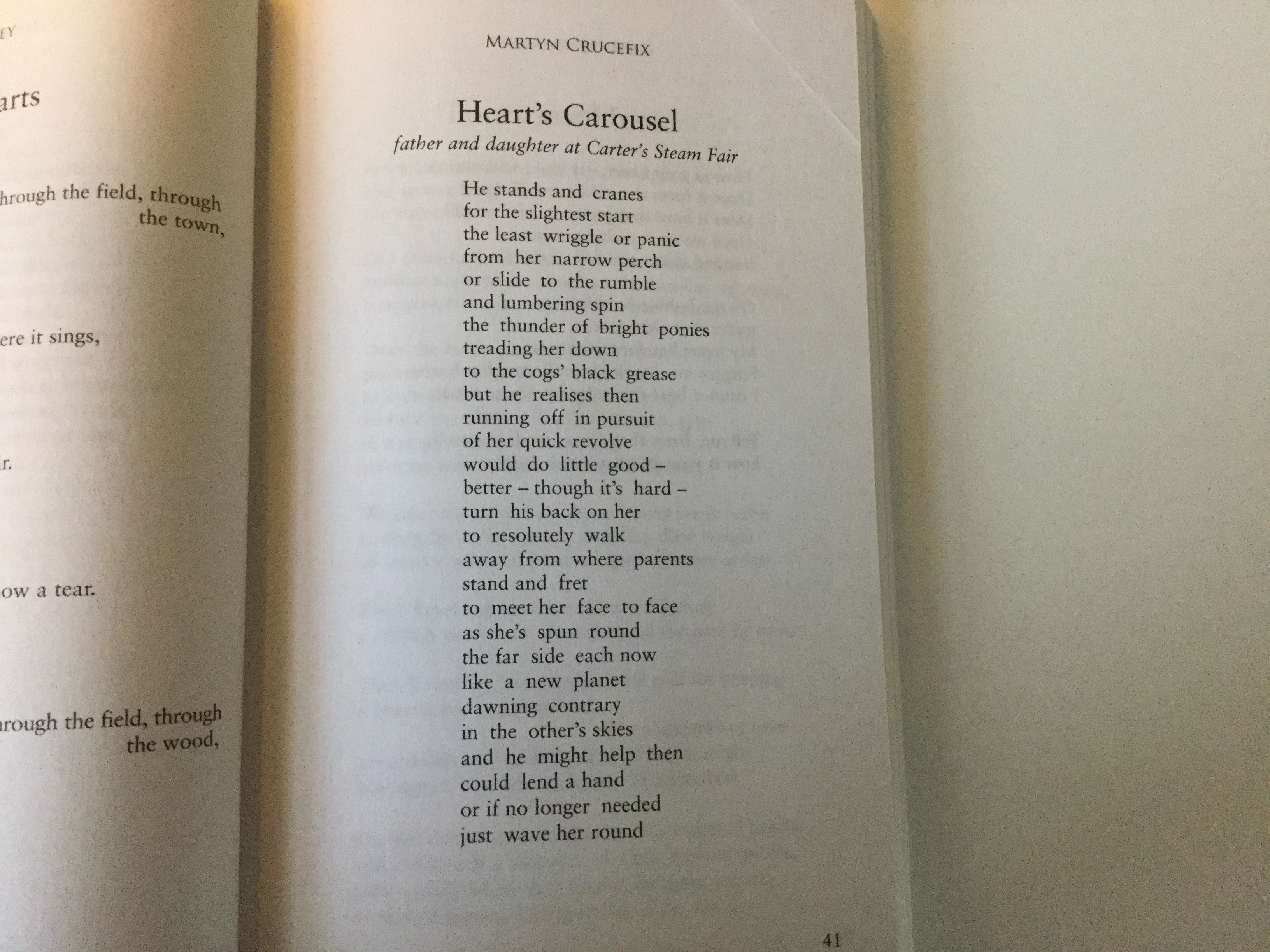
Penelope Shuttle had judged the Festival poetry competition this year and she announced the winners at an event later on Saturday afternoon. The winner was Cheryl Pearson with the poem, ‘The Fishwife’. My reading was before the dinner and the wine began to flow. I read almost wholly from my new book. I veered off plan by including a poem included in the new Hippocrates anthology. It seemed appropriate to place it after another poem about my daughter a few years ago – the first was about visiting a church and extinguishing somebody else’s candle and the heart poem about watching her, for the first time, riding a fairground carousel alone: anxious moments that yielded up thoughts for this father at least about the paradoxes of closeness and distance as children become more and more themselves:

IMG_0286

Regretfully I could not hang around long on the Sunday morning as I had to get back into London for a reading with Tim Ades and Caroline Maldonado (dear reader, my life is not usually so literarily busy, far from it). Sadly then, I had to miss Penny Shuttle’s main reading as well as work from Alwyn Marriage, Shanta Acharya and Isabel Bermudez. On the return train, I read and loved Penny’s most recent book, Will You Walk a Little Faster? (Bloodaxe Books). And – in the light of the TS Eliot shortlist which had been released over the weekend – I was left wondering why she was not on it. Her work is always so sharp, surprising, endlessly experimenting, touching, visionary, down to earth, above all immensely human. These are not things I could say about all the shortlisted books. Ah, literary prizes, the delight of the few chosen publishers everywhere. And while I’m busy complaining, why is Nick Makoha’s powerful book not on the list? But enough bitching – the Torbay Poetry Festival is remarkable for a number of things, but especially its inclusive and friendly tone. Stay with that.

wp2f72b580_06[1]