Aonghas MacNeacail’s English Language Poems Reviewed

An edited (shorter) version of this review first appeared in Poetry Salzberg Review in June 2025. Many thanks to the editor, Wolfgang Görtschacher, for commissioning the writing of it.
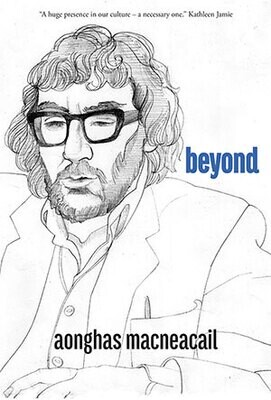
It is as a poet writing in Gaelic that MacNeacail – who died in 2022 – is most well-known, though he would himself provide translations of his work into English, what, in the poem ‘last night’, he refers to as Gaelic’s ‘sister tongue’. There were also poems written in Scots and these variants give an insight into what Colin Bramwell here calls ‘the language situation in Scotland’ within which MacNeacail worked all his life. For a number of years, MacNeacail lived and wrote under the anglicised name Angus Nicolson, but always considered himself a tri-lingualist and antagonistic to the kind of divisiveness such a ‘situation’ might give rise to. His natural inclination was democratic, pacifist, anti-authoritarian, and modernist. Now, the collection, beyond (eds. Colin Bramwell with Gerda Stevenson (Shearsman Books, 2024)) gives readers a selection of poems written in English by Aonghas MacNeacail over the past 30 years. One of the implications of the book’s title is his deeply held wish to look ‘beyond’ division, not to anything transcendental (MacNeacail’s focus was always this world, not some other), but to the next term in an on-going dialectical process. One of the little gems from ‘the notebook’, included here, imagines a cup of knowledge, the liquor within, also knowledge, a grain is added and stirred, and the grain then consumes the liquor and continues to ‘grow, root, sprout / find elbows, crack the cup // find clay’.

MacNeacail’s modernism took its key lessons from the likes of William Carlos Williams, Olson, and Creeley and most of the poems here have that fluid, unpunctuated (hence pointed by the breath), often short lined, often indented formal shape we associate with the Black Mountain. He was a member of one of Phillip Hobsbaum’s fertile ‘groups’ (along with Liz Lochhead, Alasdair Gray and Tom Leonard) and the advice given was to go back to his roots, to ‘write about what you know’. In part, this took MacNeacail back to his childhood, growing up in Uig, on the Isle of Skye, speaking only Gaelic. It also made it clear what he wanted to escape from: Gerda Stevenson describes this as ‘the confines of the proscriptive Free Church of Scotland’. Several childhood poems, illustrate the stifling force of religion, on his mother, for example, ‘strapped down tightly / by a darkly warding book thick with orders that drove / and hedged her way’ (‘missing’). The church governed education too, the teacher little more than a ‘stern presence’, who demanded ‘psalms / from memory’ (‘crofter, not’).
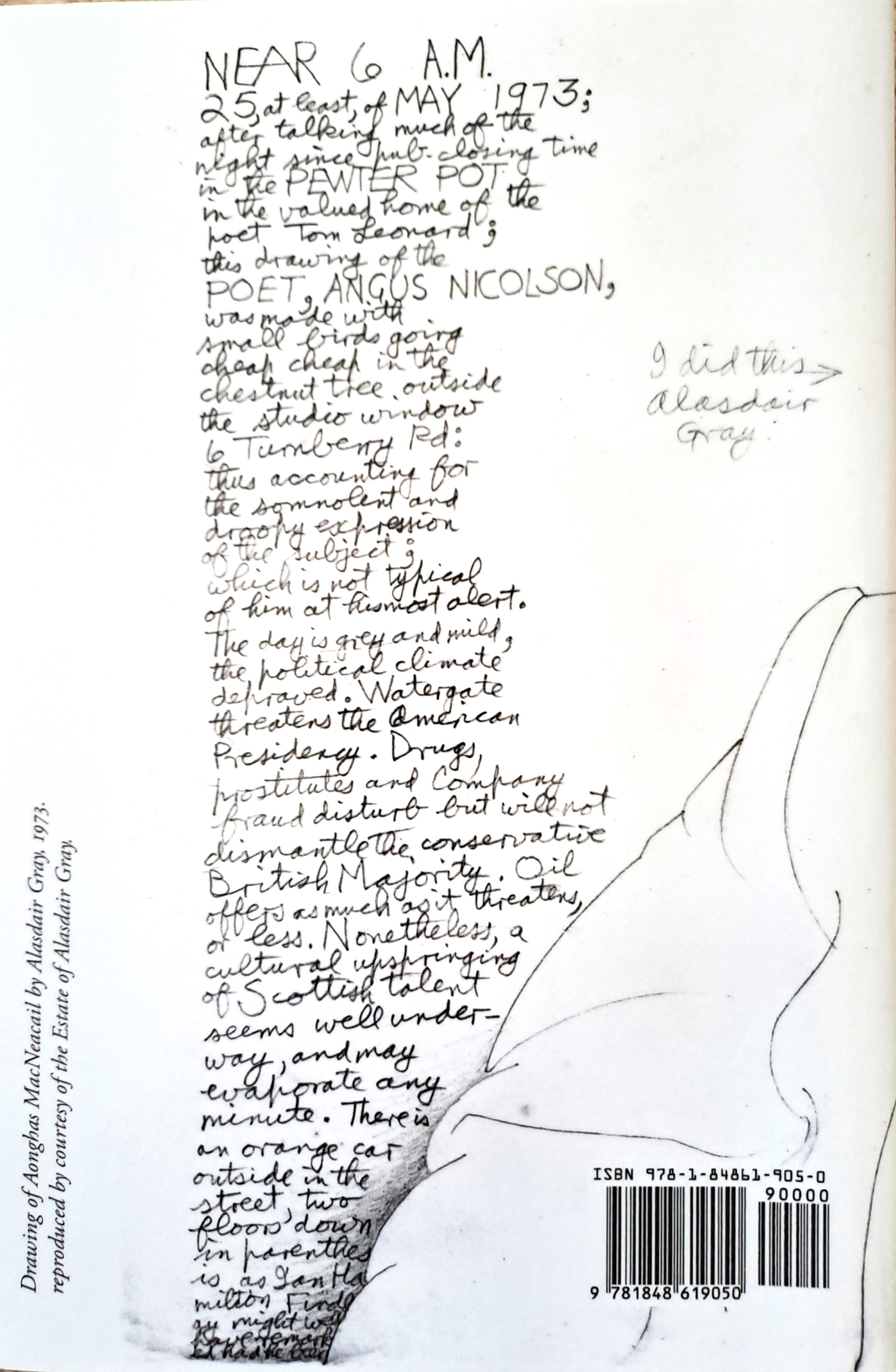
The teacher’s ‘granite eye’ also features in ‘forbidden fruit’ where the contrast is between education’s confining ‘barbed-wire’ and the invitations of the natural world (of Skye), specifically the allure of ‘the biggest [. . .] sweetest’ nut hanging on a branch over a waterfall. The poem ‘had adam not eaten the apple’ feels like a later piece, with a more self-confident, liberated MacNeacail declaring ‘the thing is / not to always / spell the word correctly’ and imagining god’s demands for eternal perfection leading him to waken every morning, complaining ‘another fucking immaculate day’. A longer poem like ‘gaudy jane’ gives a sense of MacNeacail’s unshackling from restrictions. The figure addressed is part woman, part a realm of liberation, a window onto ‘wild excursions’, towards ‘dancing voices, laughing feet’, she is a glass of whisky, a doorway into nature, to sensuality, and a way to access the ‘little gods of mischief and delight’. Celebrations of the natural landscapes of Skye (and elsewhere) in fact become one of the characteristics of MacNeacail’s writing. Snowfall over hills is as if ‘god’s apron / settles on our field and makes / a tranquil bowl’ (‘snowhere’). In ‘a rainbow’, the natural phenomenon is enjoyed and admired, ‘so real // high up on that pentland slope’, its natural beauty preferred to any fanciful talk of pots of gold, its fleetingness an image of imagination and memory. MacNeacail’s ‘primula scottica at yesnaby’ celebrates the rare wildflower’s fragile beauty, its hardy nature, till it also becomes an image of Scotland itself: ‘the air it breathes is stiff with brine / this whit of life      still flowers / every tiny purple radiance is lambent / in the blood of time’. 
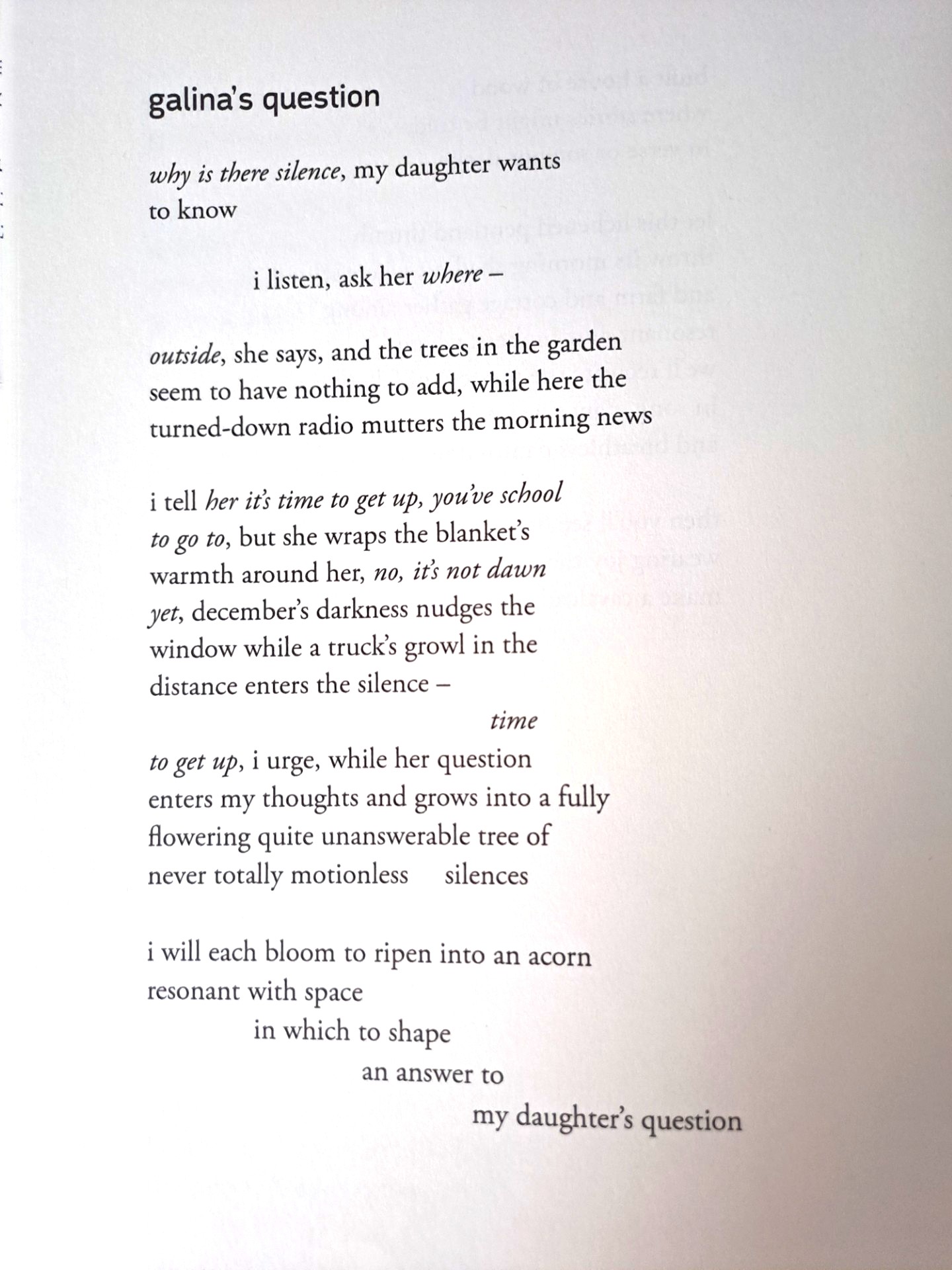
MacNeacail’s love of Nature is matched only by his writing on the varieties of human love, erotic, romantic, filial, parental, between friends. I can’t think of any other poet who’d compose 80 lines (both touching and hilarious) in praise of ‘some of my best friends’. A poem like ‘love in the moonlight’ is unashamedly romantic in its contrasting of the moon’s ‘pallor’ with the loved one’s ‘sun- / wrapped noons, bright mornings / and the way your evenings / dance into a fiery dusk’. There are several delicate poems featuring MacNeacail’s daughter, Galina, and – reminiscent of Courbet’s ‘The Origin of the World’ painting – ‘the curious eternal’ is a marvellous erotically-charged paean to a loved one, ‘after all those years / the mystery / of flesh, secretions, pulse and breathing patterns’. MacNeacail’s English poems exude a human warmth that, to judge from comments from friends and colleagues, was true to the man himself. They are driven by his wish to communicate – in whatever language, in truth – and his slipping free from Christianity’s ‘one book’, that would ‘consign all art and ingenuity / to black irrelevance’ (‘this land is your land’), allowed him to celebrate the flawed, the not perfectly straight, the interrupted conversations, that constitute being human with a passion and modesty. These lines from ‘the notebook’, are a characteristic, and invaluable, vade mecum: ‘no matter / how little / you say / it may / be worth / the saying, if it / touches the edge / of a shadow / that can / (possibly) / be thinned / by the breath / of words’.

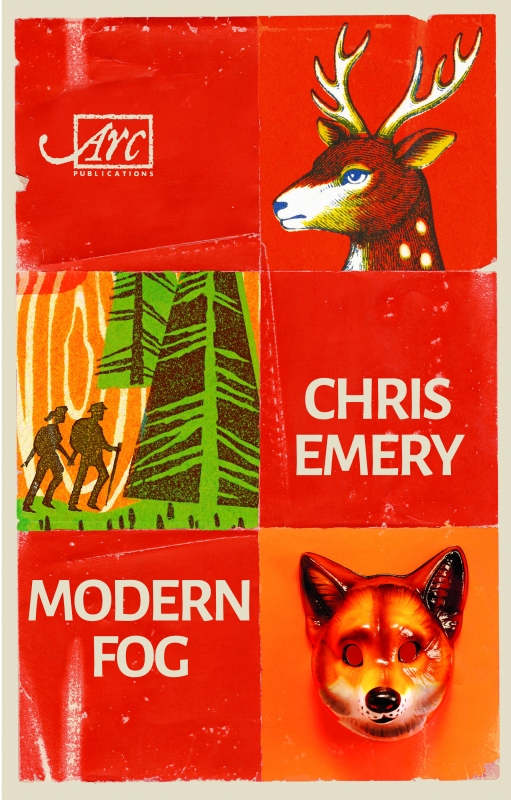
Review of ‘Modern Fog’ by Chris Emery (Arc Publications, 2024)

Chris Emery’s most recent collection both presents, and intends to see beyond, the Modern Fog of its title. The poems revel in describing aspects of this world and – in keeping with the images on the book’s cover – the occasions for such descriptions arise from journeys (often walking – the cover shows a hand-holding rambling couple) and the highlights of such journeys are frequently encounters with creatures (the cover has a deer and a fox). So ‘The Path’ leads us past ‘chalk beds’ and ‘clay beds’ and ‘dirt paths’ to excited sightings of a jay and a buzzard. Presenting more of a pause in such a walk, ‘The Day Storm’ is composed largely of the poet’s characteristic ‘noticing’ of blackthorn, blackberry and nettle. But once the eponymous storm has passed, the trees are now found to be ‘gashed . . . / splintered’ and this gives rise to one of Emery’s most interesting observations that, in their damaged state, the trees are in some mysterious way ‘clarified’. More of this later.

There is more than a little of Philip Larkin in Emery’s work – particularly the detail-listing-Larkin of ‘Here’ and ‘To the Sea’. Emery’s ‘All the Routes Home’ offers us an inclusive list of a Roman road, a Viking lane, an unclear path, a Puritan track. The poem ‘The Bay’ might be read as a more condensed version of Larkin’s ‘Here’ as, ‘after hours of hill torture’, the trail walker arrives at a bay, dotted with ruined buildings: ‘the afterthought of winter crofting’. This image of transience, of ultimate human failure, in effect a memento mori, is softened a little with Emery’s insistence that the homesteads ‘still hold their ounce of love’. In contrast to Larkin, and reminiscent of those earlier ‘gashed’ trees (somehow being advantaged by their damage), Emery is reluctant to accept death as an absolute ending and it is in this that the reader will find indications of his religious belief.

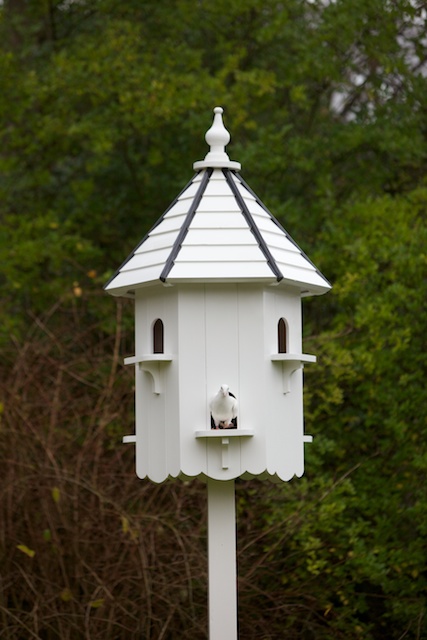
Similar spiritual themes emerge in the many encounters these poems have with creatures. ‘The Buzzard’ is another hill walk on a ‘churchless’ afternoon, but the flight of the bird on its thermal suggests an upward aspiration, a craving that the human observers also ‘hope to crave’. There is a beautiful little poem ostensibly about a dove returning to its dovecot:  

Small snatch of air, sole white arc,

crisp handclap, then ritual landing.

All followed by cossetting and fuss

at the stoop. The laughable dance

with lots of nodding and wittering

before the tricky hop up

to the dovecote . . .

The poem is transformed to something unconventionally angelic by being given the title ‘Pentecost’. The more lengthy ‘Day Fox’ vividly captures the ‘living amber’ of the creature against the green of grass, but its death at the roadside is equally clear: ‘his pelt was tar black and slicked back / on the tiny lump of him’. Here again, Emery goes a step or two beyond the plain facts of death as, in the corpse’s decomposition, ‘the world / relaxed into him with all its fiery prayers’. To suggest this is an image of an afterlife is to lack the poem’s own subtlety, but Emery is surely probing Eliot’s idea (not original to TSE) that ‘In order to arrive at what you are not / You must go through the way in which you are not’ (‘East Coker’). The remarkable poem ‘Stags’ does this more explicitly in that the momentary sighting of the creatures is (in the poem itself) now no more than a shaky memory, an ‘absence’ that stands ‘at the edge of what’s never / fully grasped’. But the recall of their passing still has a potency as a ‘store of grace and loss’ and is here declared ‘the last religion of these woods’.

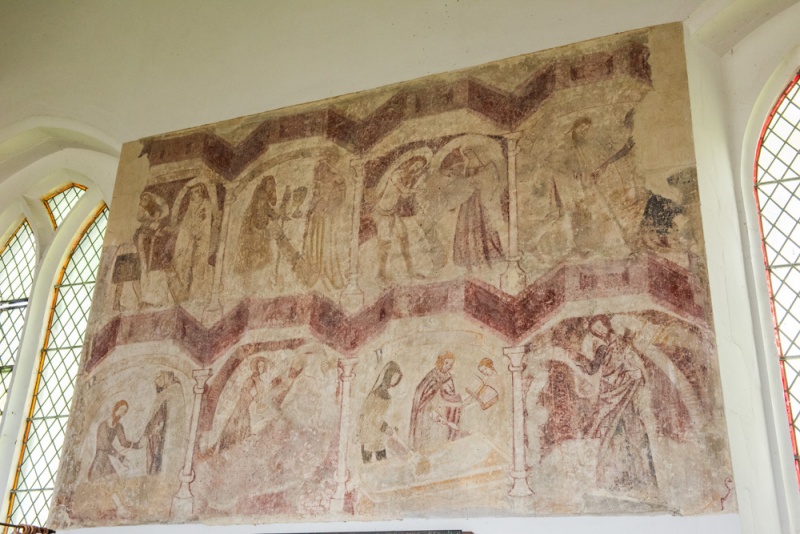
St. Andrew’s, Wickhampton in Norfolk

But Emery is equally at home describing the ‘dreck’ of our modern world. It’s surely more this sort of thing that constitutes the ‘modern fog’ of the book’s title. There is an NCP car park, the final destination perhaps of the couple in ‘Newbies’ who are driving along ‘old roads, lobbed estates seeping / by the rim of each roundabout’. The tacky nature of modern life is also found in ‘Edgeworlds’ which encompasses 4x4s parked up beside a ‘ratty beach’ and coach tours, detergent-smelling corridors and TV reruns. But such scenes function in this book partly as a foil to the (again) Larkinesque ‘churchgoing’ side of Emery’s character. ‘The Wall Paintings’ – a visit to St. Andrew’s, Wickhampton in Norfolk – opens, not with cycle clips, but with the equally evocative ‘thunk of a latch and then your eyes adjust’. And far more monumentally, ‘At St Helen’s, Ranworth’ is a 12-part sequence (each shaped like the church’s tower) more explicitly contemplating the building’s impact on the poet’s religious experience.

I guess I’m more attuned to Emery’s art when he is working up from the roots of the secular and material world, as in ‘One Drive in Winter’, in which the travelling couple go beyond satnav reach, the petrol tank close to empty, beyond any very obviously attractive destination, yet they still discover something worthy of a return, something about themselves, an opportunity to ‘solemnise the marginal and lost’. It may be that the great churches of the Norfolk Broads are themselves part of the category of the ‘marginal and lost’ these days and I do admire Emery’s attempts to bring them back into contemporary poetry, but I find his more slantwise and paradoxically inclined images (evocative of ‘East Coker’s ‘In my end is my beginning’) more accessible emotionally. To give one more example, in ‘The Elders’ – a poem written in memory of Adam Zagajewski – Emery again deploys an image of trees damaged after a storm (this time perhaps more metaphorically damaged by ‘revolution’) and these oak limbs also ‘lie / broken with new life’.

This intriguing collection’s two concluding poems are perhaps variations on this same theme. ‘The Start of It’ is – here’s the paradox again – the beginning of the end prior to the beginning: in this poem we read of frank intimations of mortality, of moments when ‘something abstract stiffens in the grace’ of a life, when we may come to glimpse ‘the formal shape [we] make in time’. In a completely different mode, ‘The Legacy’ eventually reveals itself to be a poem about the gentle removal of an empty wasps’ nest, its ‘featherweight’ and ‘strange paper weather’. In the transformative effect of real poetry, the nest comes to be seen as a human life lived, ‘sad and gorgeously dented’, but from which the creatures that made it have departed to another place: ‘to drone in apple acres / elsewhere darkening / with sweet ruin now.’ Whether we believe in such a place – and the oxymoronic ‘sweet ruin’ casts a shadowy doubt – is, with writing as good as this, hardly the point, appealing as it does, through vivid imagery, confidently written, to a fundamental human longing for continuation in the face of what we think we know of the end of life.

On the Side of Hope: Heidi Williamson’s ‘Return By Minor Road’

(Thanks to Bloodaxe Books for a review copy of this collection)

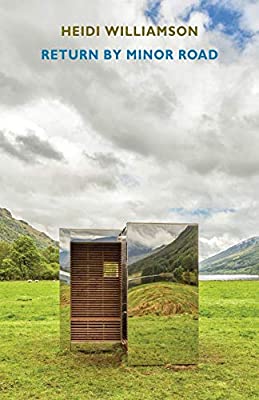
The return alluded to in Heidi Williamson’s Return by Minor Road (Bloodaxe Books, 2020) is partly physical, but predominantly one of memory and yet, the book argues, it is an almost redundant journey in that we carry important events with us anyway. In confronting a particular tragic event from the past, these poems strike me as offering routes through our current experiences – of pandemic, grief, lockdown – in particular an appreciation of the ‘minor roads’ along which we might recover a sense and shapeliness in what now strikes us as chaotic and closer to a deletion of meaning.

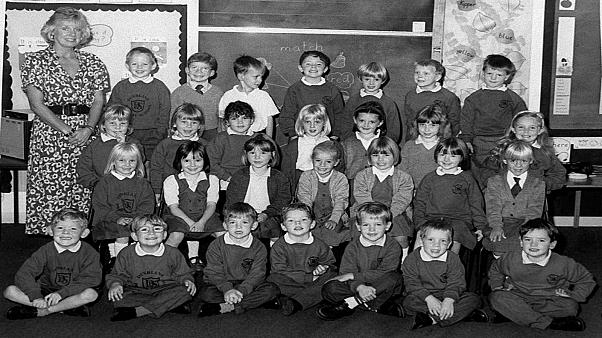
The event at the centre of this collection occurred at Dunblane Primary School, north of Stirling, Scotland, on 13 March 1996, when Thomas Hamilton shot 16 children and one teacher dead, injuring 15 others, before killing himself. It remains the deadliest mass shooting in British history. What Williamson is not doing here is exploring the nature of evil, the damaged personality of the perpetrator, or the wider political/social fallout of such terrible events. She was living in the area at the time (I think as a student) and this retrospective collection is divided into three parts: the haunting of memories (but Williamson has more powerful ways of articulating this than the ‘ghostly’ metaphor), the re-examining of the actual event, and a physical re-visiting of the location.

Teacher, Gwen Mayor, with her class of children.

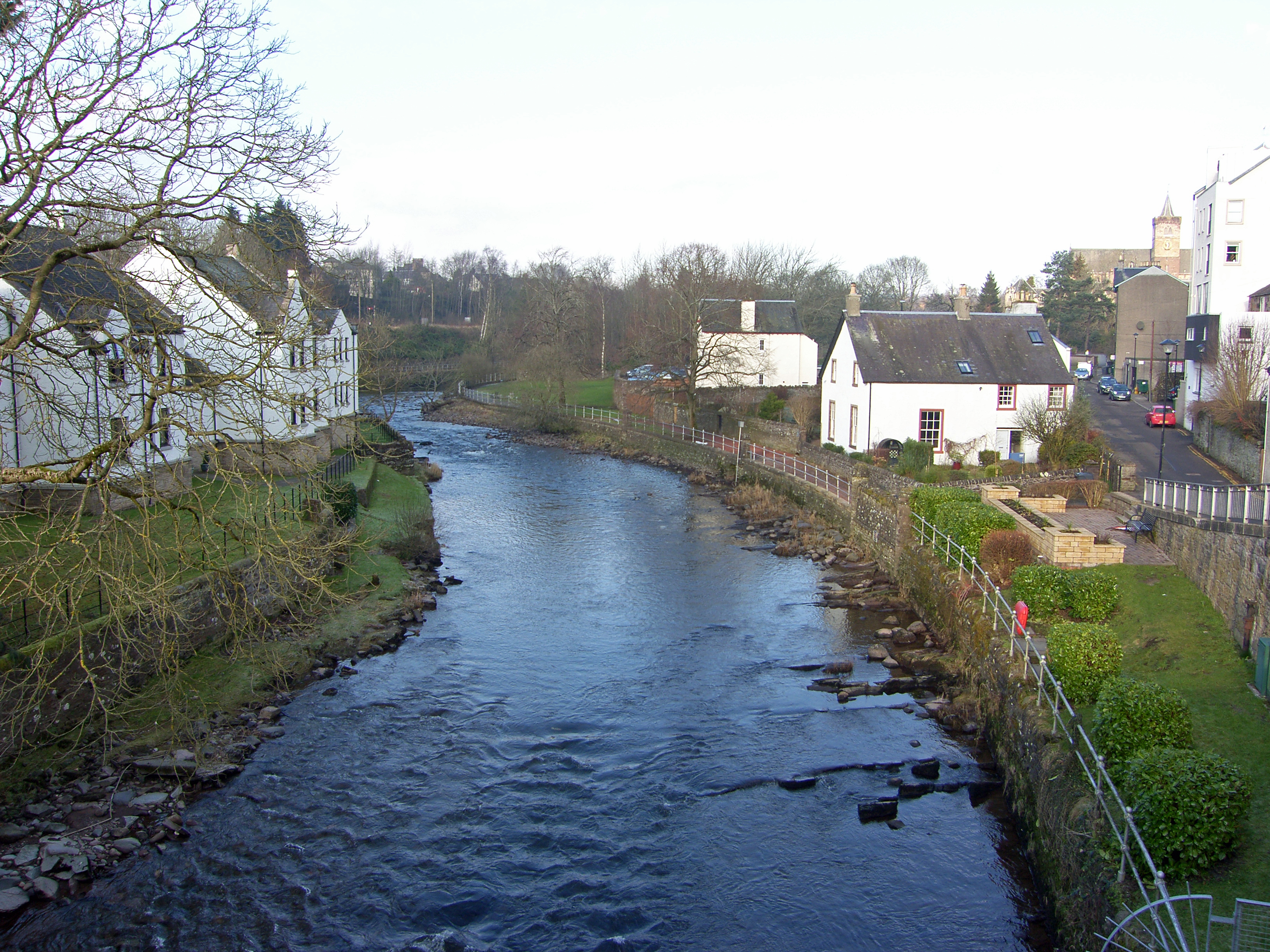
The personal nature of the response offered by these poems is flagged in an epigraph from Jane Hirshfield: “our fleeting lives do not simply ‘happen’ and vanish – they take place. She means that events do not slip away into the past, but take or carve out a place in our historical and present selves and it is this geographical/topographical idea  that Williamson pursues so effectively in many of the poems. The particular, the creaturely and the personal predominate. A mother settles her child back to sleep at night – the troubled sleep patterns of the innocent in this context have immediate resonance – and returning to her own bed she finds how awkwardly the bedspread rucks up, “how hard it is to settle”. Uneasiness at night recurs in ‘Thrawn’, images of Allan Water (the river running through Dunblane) surfacing years after the event. ‘Loch Occasional’ again uses a local geographical reference to suggest the sudden flooding of memories, when “the silt of what happened rises” and – echoing Hirshfield’s comment – the “occasional”, which one might expect to have its moment and vanish, is said to “endure”. The rise and fall of Allan Water is the primary image for the persistence of memory in so many of these poems. Rain falling, “insistently / with its own unnameable scent”, is an image chosen elsewhere and (rather more conventionally, à la Henry James) ‘Fugitive dust’ is literally haunted by the figure of a child.

Allan Water, near Dunblane

What such resurfacings mean in personal, day-to-day terms is clear in the prose poem, ‘It’s twenty-two years ago and it’s today’. Besides the form, this is a different style of writing: shorthand, a journalese of plain statement, brief jottings of a day spent with husband and child. The ordinary is tilted out of true by unwanted remembrance, manifesting as unusual quietude, the papers left unread, the phone disconnected: “Neither of us says why”. Halfway through this poem, the narrator manages to write, she says, “[s]mall hard coughs on the page”. Perhaps this alludes to the (again) quite different style of verse in ‘Cold Spring #1’ which is the key section recounting the events of the 13 March 1996, though the massacre itself is reduced to a single word, “incident”. Covering 4 pages in total, we are given dislocated fragments only – speech, visual images – as an ordinary day turns into an historical event. This works really well and, without pause, the poems move off again to explore the aftermath: phone calls from worried relatives and friends, hesitant visits to the local pub, encounters with news journalists, memorial flowers already beginning to fade.

What the book offers as healing counterweight to the massacre – and there’s no doubt that Williamson wants to offer something despite the troubled days and nights, despite quoting from Hopkins’ ‘terrible sonnet’, ‘No worst there is none, pitched past pitch of grief’, despite allusions to the “uncontrollable heart” – what the poems offer is the natural world’s existence and persistence and the innocence of the child. Williamson’s response to nature is always powerful and detailed, carrying a lode of emotional implications. As has become a commonplace idea in these ‘lockdown’ times, the loss or expansion of our narrow selves in the world of nature is redemptive. ‘Dumyat’ opens:

Some days we cried ourselves out,

packed our coats and climbed

the soggy rock to its small summit.


There was something about stepping

one by one, beside each other

without speaking, without the need.

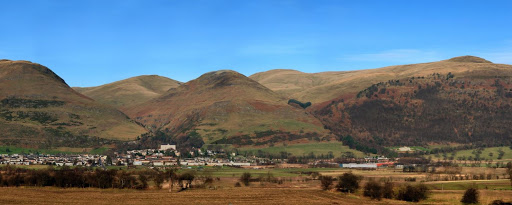
Elsewhere, striding up into the nearby Ochil Hills was a way to “clear us of ourselves”. Another poem celebrates the “Reliability of rain. / Durability of rain” and in another the (relative) unchanging nature of the nearby Trossachs offers a consolation of sorts; I guess a longer perspective in which even such human-scale horrors must be found to shrink.

View of the Ochil Hills

It is also the presence of – and the need to provide for and protect – her own child that offers a path beyond tragedy. The title poem offers a straightforward account of Williamson’s return to the landscape of Dunblane, but she and her husband visit with their child who carries nothing of what the place means to his parents, hence he is innocent, complaining, distracted, playful … The poem ends with the child playing a horse racing game, taken down from the hotel bookshelf, in a wonderful image of the onward propulsion of youthfulness, its greed for the future, the as-yet unburdened nature of its vitality: “He gallops his horses forwards, forwards”.

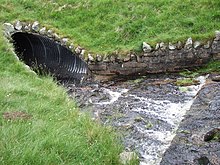
I don’t mean to give the impression that Williamson’s book offers anything like an ‘easy’ response to the horrors of Dunblane. The ‘minor roads’ by which people mostly manage to pick up their old lives – here nature and family – remain shadowed and troubled in two late poems. ‘Self’ offers a liturgical series of questions to which the poet can only ever answer “I don’t know” and the concluding poem also makes use of repetition, recording the landscapes around Dunblane once again with the repeats playing variations on the idea that all this was left behind when the poet moved away and yet all this was also carried away too. It’s the paradox of the book as expressed to perfection in the poem ‘Culvert’. More typically in this poem, Williamson observes her “unassuming heart” and the water images recur with the heart becoming a valley collecting waters and debris after a downfall (the traumatising event). But the event does not merely pass through the heart:

it was the heart,


rent in the same way

a clearing is made

by great and incremental


incidents.

Experiences make the heart what it is, carving our selves, finding a permanent place within them, shaping them for the future, always flowing through them, even if unseen for the most part:

its pulse ebbs in culverts


below neat estates,

a furtive love trickling

deeper and deeper.

Love of the natural world and love of family – especially youth – resonates through this quietly convincing collection which manages to take on its daunting subject matter and emerge, not victorious of course, but having argued on behalf of resilience, on the side of hope.