John Greening reviews my new chapbook ‘Walking Away’

John Greening has recently reviewed my new chapbook of poems, Walking Away (Dare-Gale Press, 2025), a review which first appeared on The High Window website. Many thanks to David Cooke at THW and to the reviewer for his kind and perceptive comments about a set of poems for which I feel (an obvious) affection. Mum and Dad would be bemused by it all I think, but pleased to be so remembered.

Martyn Crucefix has come a long way since his remarkable Enitharmon debut, Beneath Tremendous Rain (1990). Learning, no doubt, from poetry he has since translated or adapted – notably Rilke, but also Peter Huchel, Rosalía de Castro and the Daodejing (more familiar as the Tao te Ching) – he has become more and more experimental, more complicatedly troubled. This was especially evident in his 2017 sequence A Convoy and in the beautifully illustrated Cargo of Limbs from Hercules Editions (2019), itself a version of Book Six of the Aeneid. 

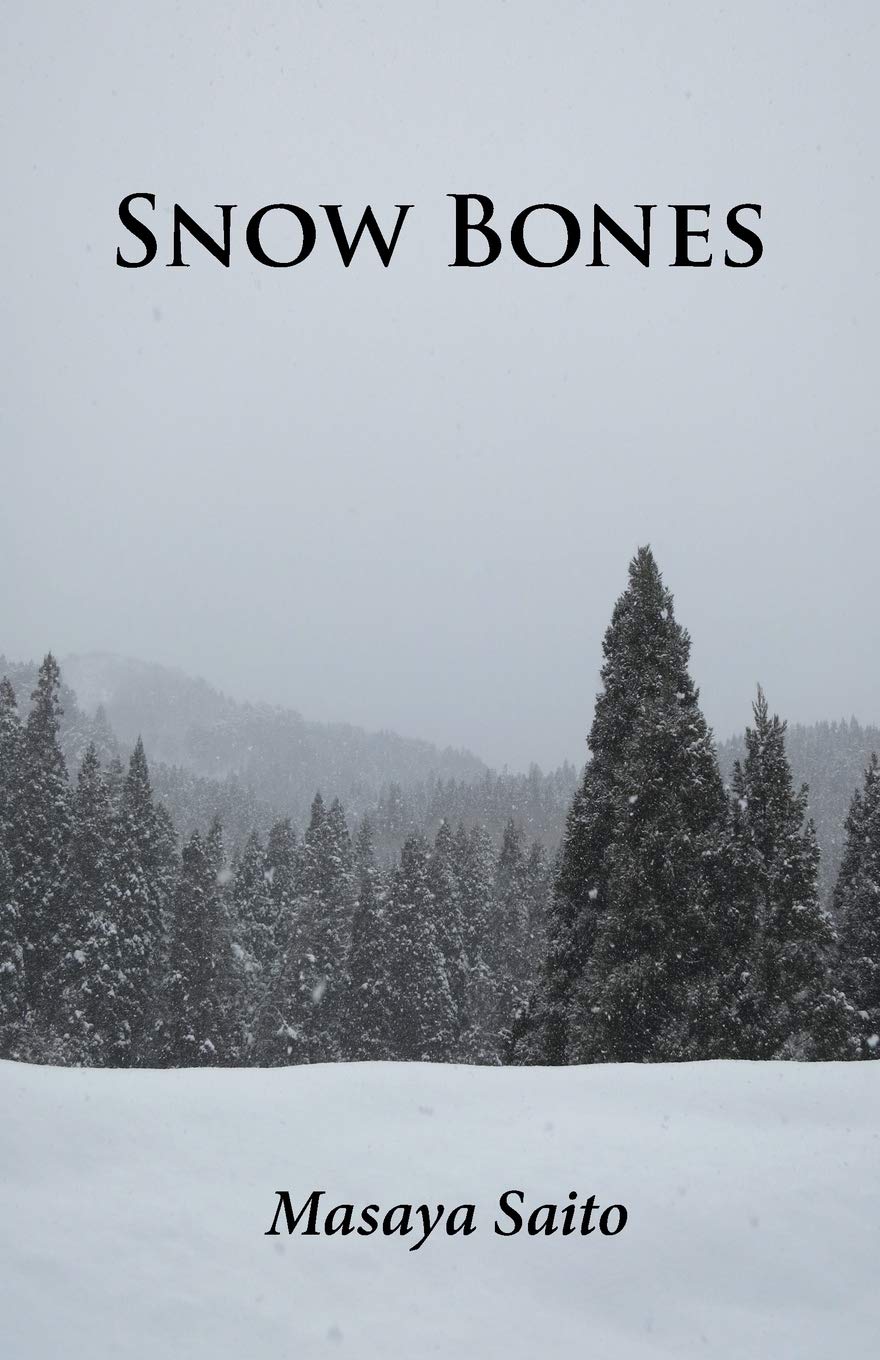
Walking Away is more straightforward and in some ways a shift towards a major key, though the subject matter might make it appear otherwise. Even the tranquil landscape on the cover reminds us that Crucefix has always had a pastoral streak: he was, after all, brought up in the West Country, which features here a good deal, if elegiacally.  The book is dedicated to his parents and it opens with a ‘Video Call’ full of tragi-comic touches (the camera is ‘angled so I catch only the crowns // of grey heads then a giant hand/reaches forward to re-adjust’) and ends with gracefully formal stanzas evoking a ‘provincial market town’ (Trowbridge, perhaps, near the Wiltshire village where Crucefix grew up?).

Fourteen of the pamphlet’s pages are occupied by the remarkable title sequence of four-line poems (drawing on ‘the vivid, condensed power of the haiku form’, as the blurb puts it, but each of a different syllable count) about the decline of the poet’s elderly mother, whose state is addressed more directly in the penultimate poem of the four in Walking Away: ‘My Mother’s Care-home Room (as Cleopatra’s Monument)’. She is portrayed unsparingly with ‘an Easter Island profile / gaunt and beaked’ but becomes a regal presence by the poem’s end as her son keeps his vigil with a final flourish of rhyme:

with all the helpless-
ness of a Charmian
at the cooling feet
of her brave Queen
the asp flung down
beneath the only chair
there has ever been

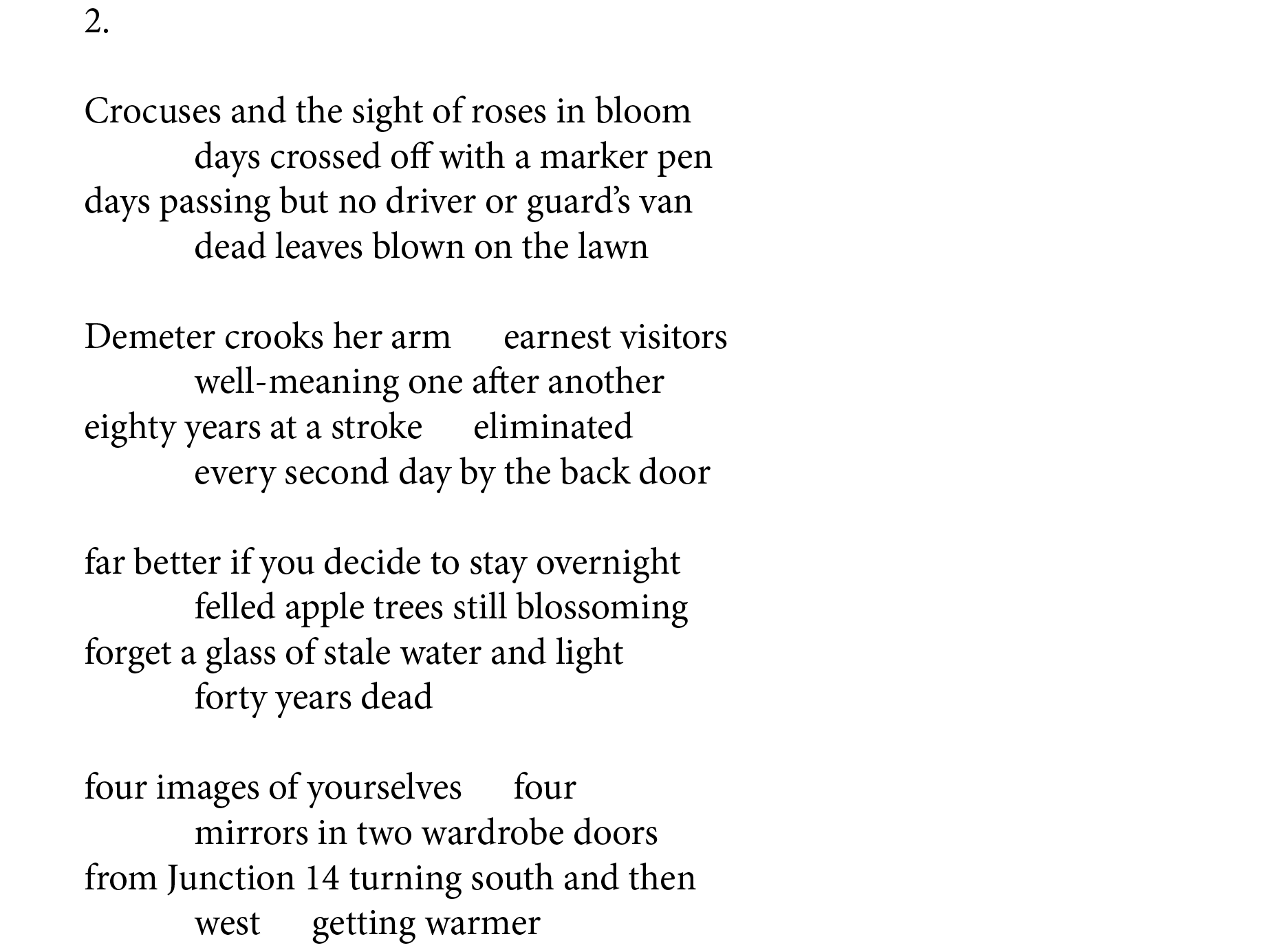
The title sequence, however, is the book’s great success, a brilliant series of vignettes, like theatre music without the play, set largely, it seems, during a period when the poet’s mother was in her own home. Some of these don’t feel like haiku, but others have that unmistakable, indefinable quality – perhaps to do with awareness of the seasons:

Turning in at your mother’s front gate
Eighty years at a stroke

Swifts no longer nesting

Crucefix knows how to find the Imagistic essence of a situation, as the form demands; and his gift for metaphor has always been considerable:

This week’s new dosette box
Grey windows not yet broken

Twenty-eight channels nothing on

Once you work out what a ‘dosette box’ is (one of those compartmentalized containers for daily tablets), the image here is potent and at least as good as ‘Petals on a wet, black bough’. For their full effect, these fragments do need each other, and they don’t often need such glossing. Take the next one, only the third in the sequence:

Telephone numerals are big and bold
The size of Scrabble pieces

A language you once knew

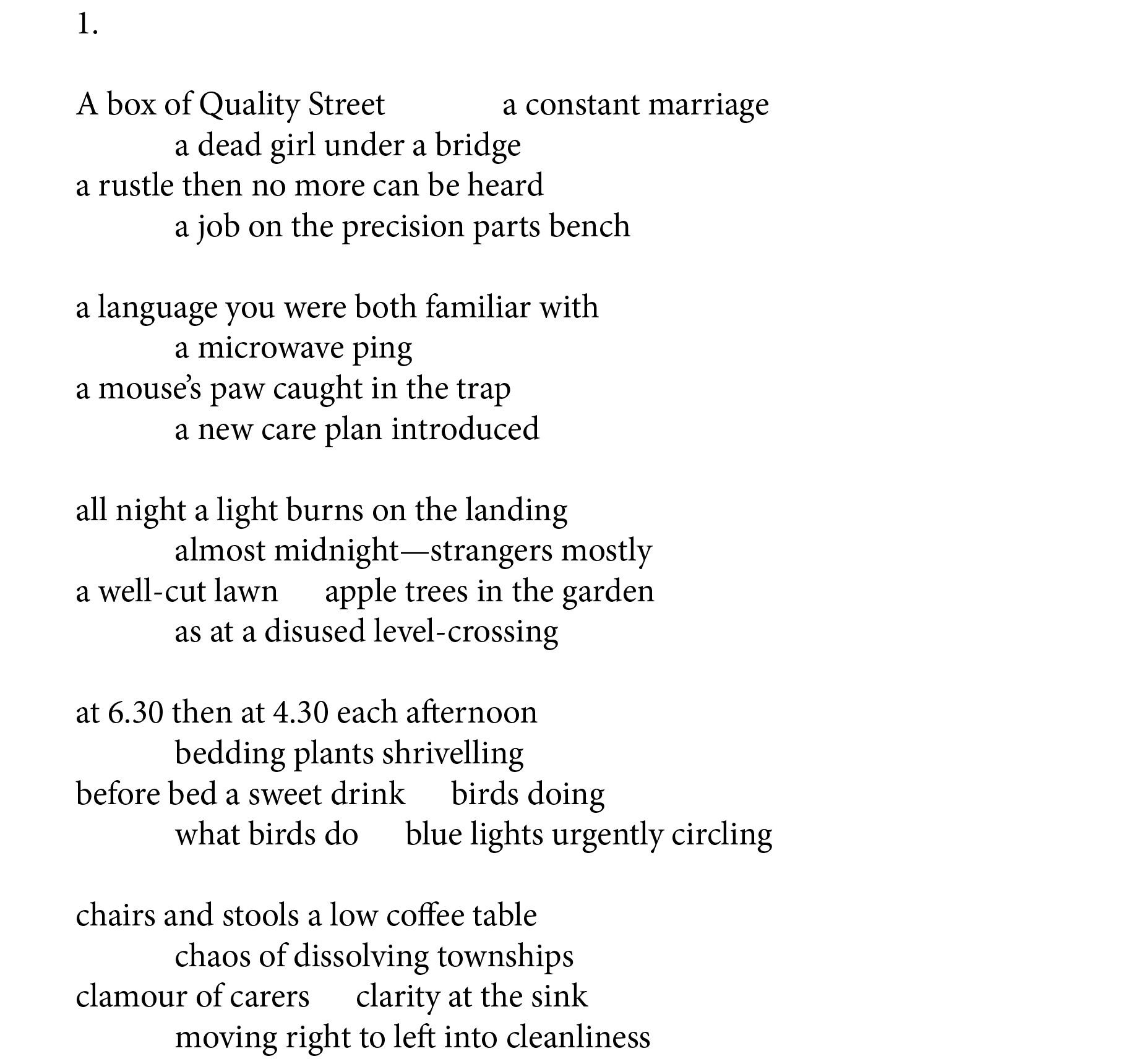
The brevity is fitting, since that’s often the way one communicates with those in decline; there is tea, a shared remark, more tea, a view of a lawn, knick-knacks on the mantelpiece, a car passing, a nap, a scratching mouse, ‘The clamour of carers / A microwave ping’. And while nothing connects with nothing, we are embraced by an intense emotion and a sense of an approaching end.  Walking Away demands to be read.

‘Walking Away’ – reviewed by Ian Brinton

This review of my recent Dare-Gale Press chapbook, Walking Away, has just appeared on Litter Magazine website. Many thanks to Ian Brinton for his insightful observations on what he calls ‘this important little volume’. Any kind of proximity to Ben Jonson, Vladimir Nabokov and WS Graham is good with me!

Language most shewes a man: speake that I may see thee. It springs out of the most retired, and inmost parts of us, and is the Image of the Parent of it, the mind’

Ben Jonson’s prose Discoveries was first printed in 1640 and the shining clarity of what these words offer is central to what we understand about the importance of language. No one person can read the mind of another and it is language that permits us to recognise what is going on in another person’s vision of the world. As Martyn Crucefix bids a farewell to his parents he recognises in the title poem to this deeply-moving sequence that ‘Walking Away’ leaves a world behind:

      Chaos of a dissolving township
      A vacant heathland

      I’ve no map to your mind

The twenty pages of poetry in this beautifully produced chapbook are dedicated ‘in memory of my parents’ and open with an epigraph from Masaya Saito’s Snow Bones which had been published by Isobar Press in 2016. Saito’s four narrative haiku sequences had also been dedicated to his parents and far from being lamentations of stasis they were delicate records of movement as the poet prepared to leave a landscape in which much of his past had resided:

      In the snow country
      my parents gone

      a pendulum swinging

The print on the white pages of Saito’s volume appears like footsteps in snow and there is a quiet seriousness in the sound of one of the seven different voices as it outlines

      A misty night

      I exist
      as footsteps

In Martyn Crucefix’s volume there is a humble awareness of the passing of time which does not resolve itself into an easily achieved sense of regret. If the connection between the Then and the Now wavers with time’s passing and ‘faces split to stained glass / or cubist fragments or fairground mirrors’ those human figures so close to the poet are ‘still talking blithely asking me still / if I can see these crocuses.’ The repeated use of the word ‘still’ conveys both a settled sense of the past being beyond us, unmoving, and the enduring quality of its presence.

The central poem in this sequence is made up of fifty-eight three-line haikus and the ironies of absence and presence are held with a quiet sense of the bowed head:

      Something where nothing was
      Nothing where something stood

      Ten thousand nothings

In the riddle of all riddles nothing is an actual something and if you look at zero you will see nothing but if you use it as an eye you will see the world. The circular hollows of nothing may range from an open mouth to the faintly outline dark of the moon and from craters to wounds. As it was suggested by Nabokov ‘Skulls and seeds and all good things are round.’

      A large print calendar
      Days crossed in black have passed

      No footprints mark the snow ahead

As W.S. Graham’s ‘Malcolm Mooney’s Land’ puts it ‘footprint on foot / Print, word on word’ is ‘always a record of me in you’ and in ‘Walking Away’ Martyn Crucefix questions his dead parents

      Why show me these photographs?
      You point to strangers

      Once upon a time I was there

In the final poem in this important little volume, ‘In This Quiet One-way West Country Town’,  the vivid sense of loss is caught as ‘your hand slips mine before I’ve the chance / to say I’m sorry I was not there to help’ and the poet is left

      under cloudless skies a gull driven too far
      inland to return now it’s closing time
      all across this quiet provincial one-way
      west country town turning for home before dark

Home is where we live and the footprints left in snow, marks upon the page, remain as a reminder of who we are in relation to how we got there.

How Poems Slowly Get Written – from haiku to abecedary

Bloodaxe poet, editor and tutor, Chrissy Williams, set up and edits PERVERSE poetry. Her site’s strap-line for publication is that she’s looking for “deliberate, obstinate, unreasonable or unacceptable poems, contrary to the accepted or expected standard or practice”. A willful outlier, in other words, looking for experiments and/or orphans. Some of you – if you subscribe to her site or keep an eye on social media – may have seen three pieces I’ve written which PERVERSE published last week. These were the opening three poems from a sequence of twelve and the Note published with them by PERVERSE explains a good deal (I’ll put the poems themselves at the end of this post).

Note: these poems are from a sequence in the form of an abecedary, a calendar of 12 pieces. Carolyn Forche’s ‘On Earth’ first interested me in this form. She associates its inclusiveness (from A-Z) with the pleroma, the fullness of God’s creation, the One. The fullness I have aimed at in this case was the difficult last years of my parents’ lives. Drawing on notes I made between 2016 – 2018, the disjointed nature of this particular totality reflects their growing illness and confusion; but I hope the whole exudes what it was written with, love.

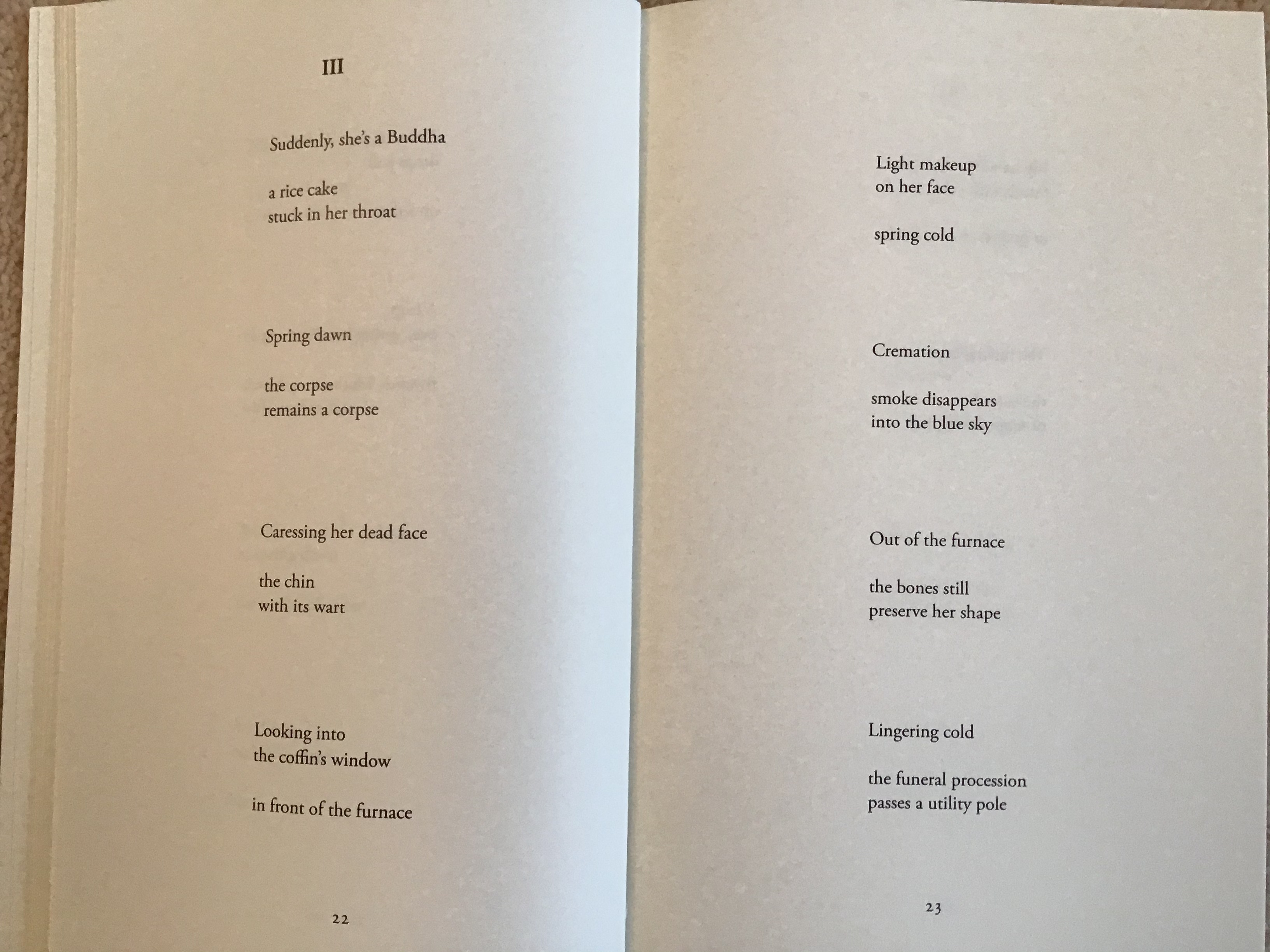
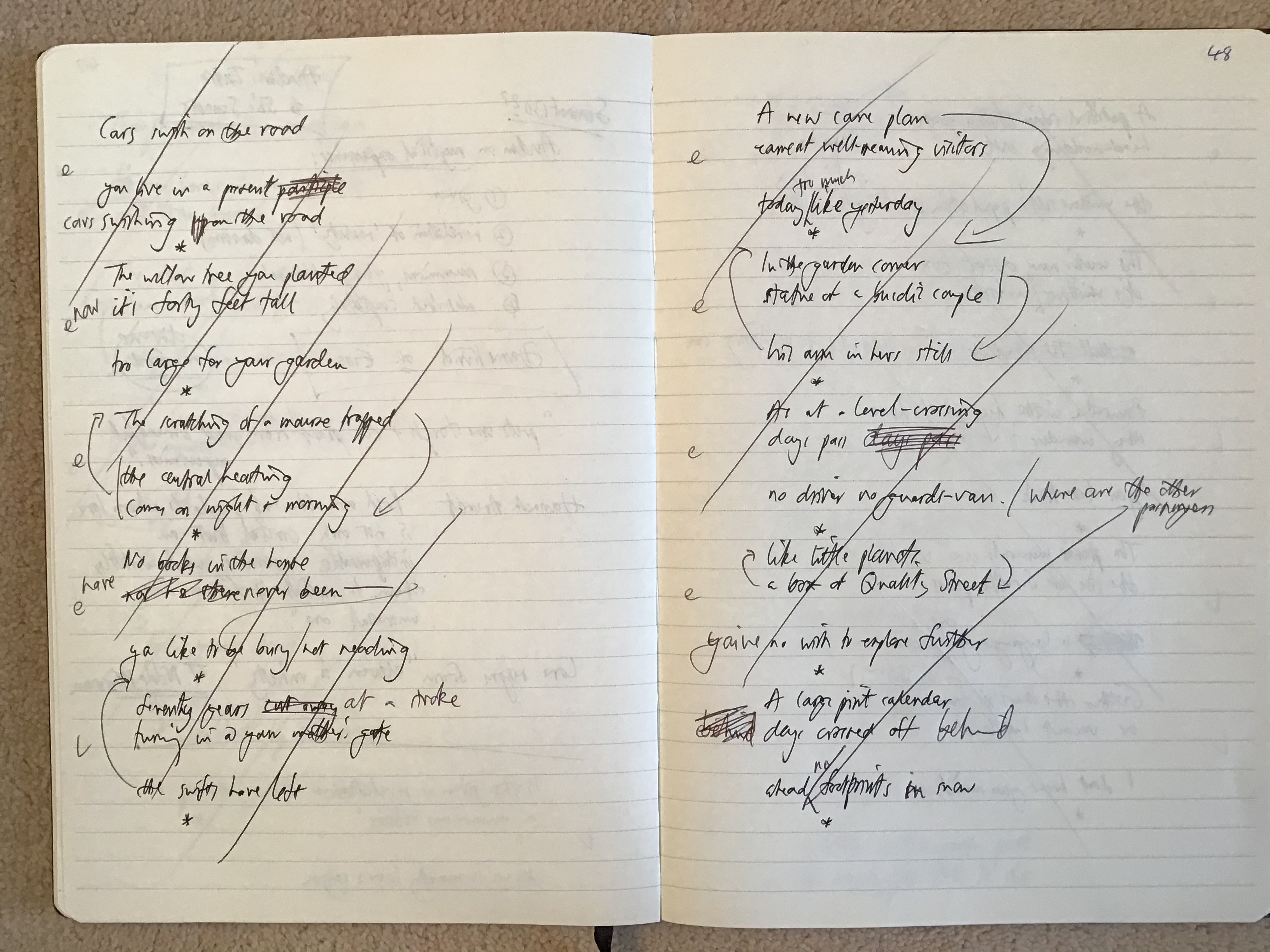
On the theme of ‘how poems come to be written’, today I’m posting images of a couple of the pages from my notebook of the time. You’ll see phrases and images which made it through to the final poems. As can perhaps be seen from the scribbles, what I had originally in mind was something close to the form of haiku. I’d been reading and admiring Masaya Saito’s book of haiku called Snow Bones. This had just been published in 2016 by Paul Rossiter’s Isobar Press (I think maybe I’d bought the book at the Poetry Book Fair that year). Snow Bones consist of four narrative haiku sequences, spoken by several different voices. Saito writes in both English and Japanese (these poems are all in English). Two of these sequences focus on the death and funerals of parents and what I admired was the way in which the compression of the form allowed the poet to express the powerful emotions of love and grief. Between 2016-18, my mother and father were going through a decline in both mental and physical health, eventually moving into a care home, sadly both dying within 18 months of each other. So I had my own powerful feelings to deal with and one of the ways of coping was to try to write about these experiences.

Here’s a couple of pages from Saito’s book. You’ll see he does not approach the haiku form in the rather rigid syllabic way that we often think of it. Also I liked the way in which – of the 3 lines – he always sets one off, either opening or closing. This creates drama and tension even within such a short space.

So then here’s a page from my notebook of the time – the crossings out indicate that I have used the text going forward. Initially I tried to maintain my hopes of a haiku sequence. I can see here phrases that made it into the final poem (in such a different form): the box of Quality Street chocolates, the days passing as at a level crossing, the introduction of a new care plan while they were still living at home. I remember taking a dozen or so of these haiku pieces to a writing workshop. The response was polite, even some enthusiasm, but I felt this was in part a response to the personal nature of the subject matter as much as to the success of the choices I’d made as a poet. (These are always very difficult moments in a workshop – depth of involvement on the writer’s part often makes more cool, critical observations hard to bring forward).So I wasn’t sure. The texts stayed in another notebook. This is what happens (for me at least). I’d then often be browsing back through the notebook at those bits of text not yet crossed through as having been advanced to the next stage. I’m re-reading to see if there remains any life in these fragments left in limbo. I kept reading these haiku and thinking there was a lot of good writing, but they had certainly not found their right form.

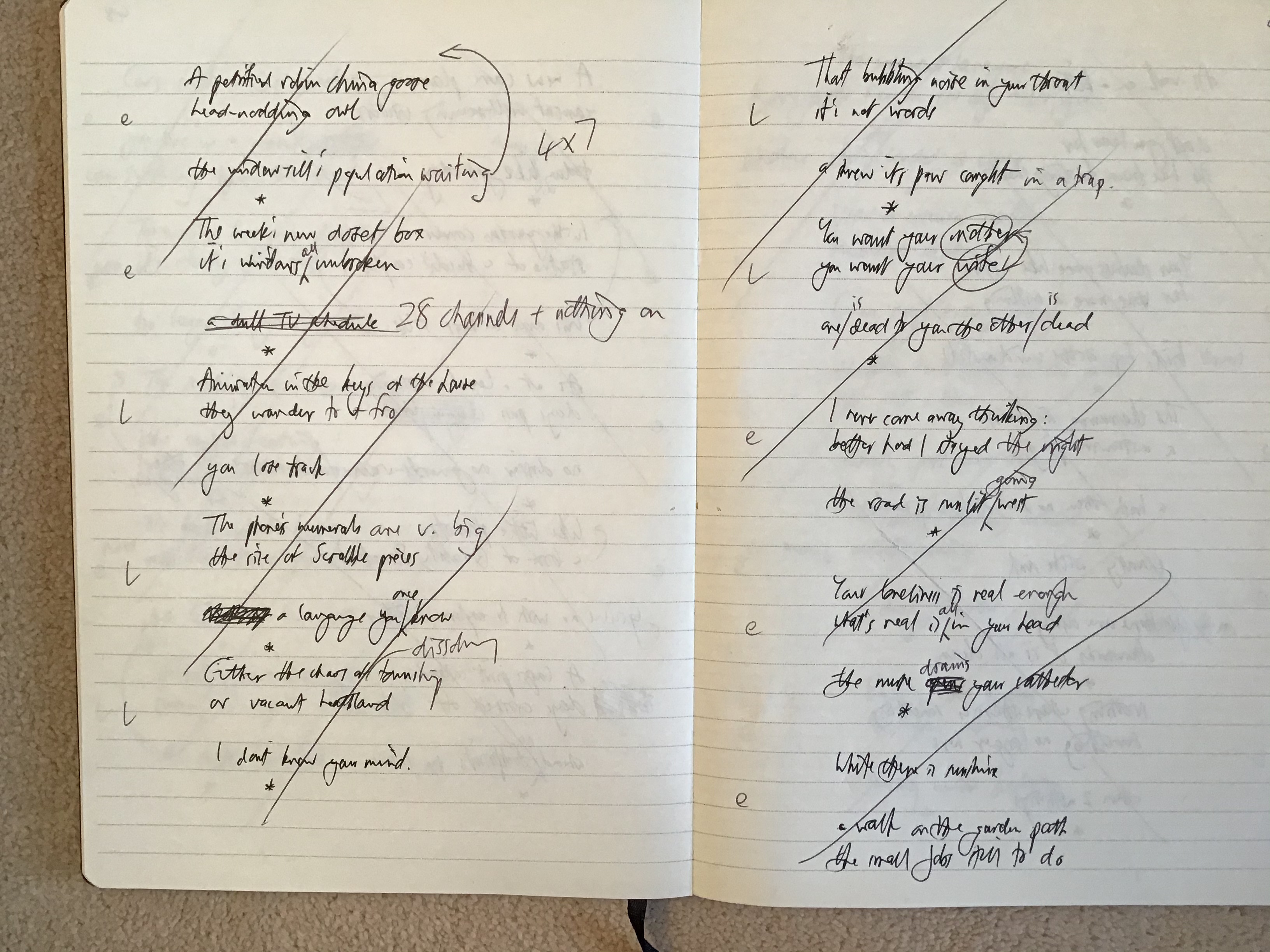
Here’s another image of an original page.

The fourth haiku here I still like:

The phone’s numerals are very big

the size of Scrabble pieces

a language you once knew

In the final poems, the image of a “language” re-emerges rather changed. The sixth haiku poem here has an image of “a shrew its paw caught in a trap” which is itself an echo of a line from the previous page (“The scratching of a mouse trapped”) – the relevance of these recurring images of entrapment is obvious given my parents were pretty well confined to their house by physical weakness and mental uncertainties. Such images surface in the final poems, in the first poem’s opening quatrain, as “a mouse’s paw caught in the trap”.

I don’t remember when the final choice about these poems was made – the one that decided an abecedary form would be appropriate. Those who have followed this blog for a few years will have heard me ruminating on this form before and on my discovery of it via Carolyn Forche. In rational terms, I felt the systematic coherence imposed on phrases by the alphabetical sequence would be effective in an ironic way because most of the fragmented material I had assembled spoke to an incoherence rooted in the way my parents were now living. Is it too much to say that I was hoping to piece things together for Mum and Dad in a way that they were unable to themselves? There are other (more conventional) poems about my parents in my most recent full collection, The Lovely Disciplines.

The re-shaping of the text worked (to my mind). Assembling something like this is a thrilling balance of chance (the sequence of the alphabet) and choice (the poet retains the right to trim and edit phrases). The title I’ve given the sequence comes from the last haiku in the first image above:

A large print calendar

days crossed off behind

ahead no footprints in the snow

I remember buying them a large print calendar so they could follow the days passing more easily. Often – but not always – they’d cross through the days passed. When we cleared the house eventually, the calendar was still hanging up, the crossed off days having stopped at a certain point; the future days left blank and pristine. The walls of the house have not been literally demolished. But it has been sold on to another family and so for me and my brothers the walls might as well have been demolished. The lives lived out there are gone, except for what we can remember (some of which can be written down).

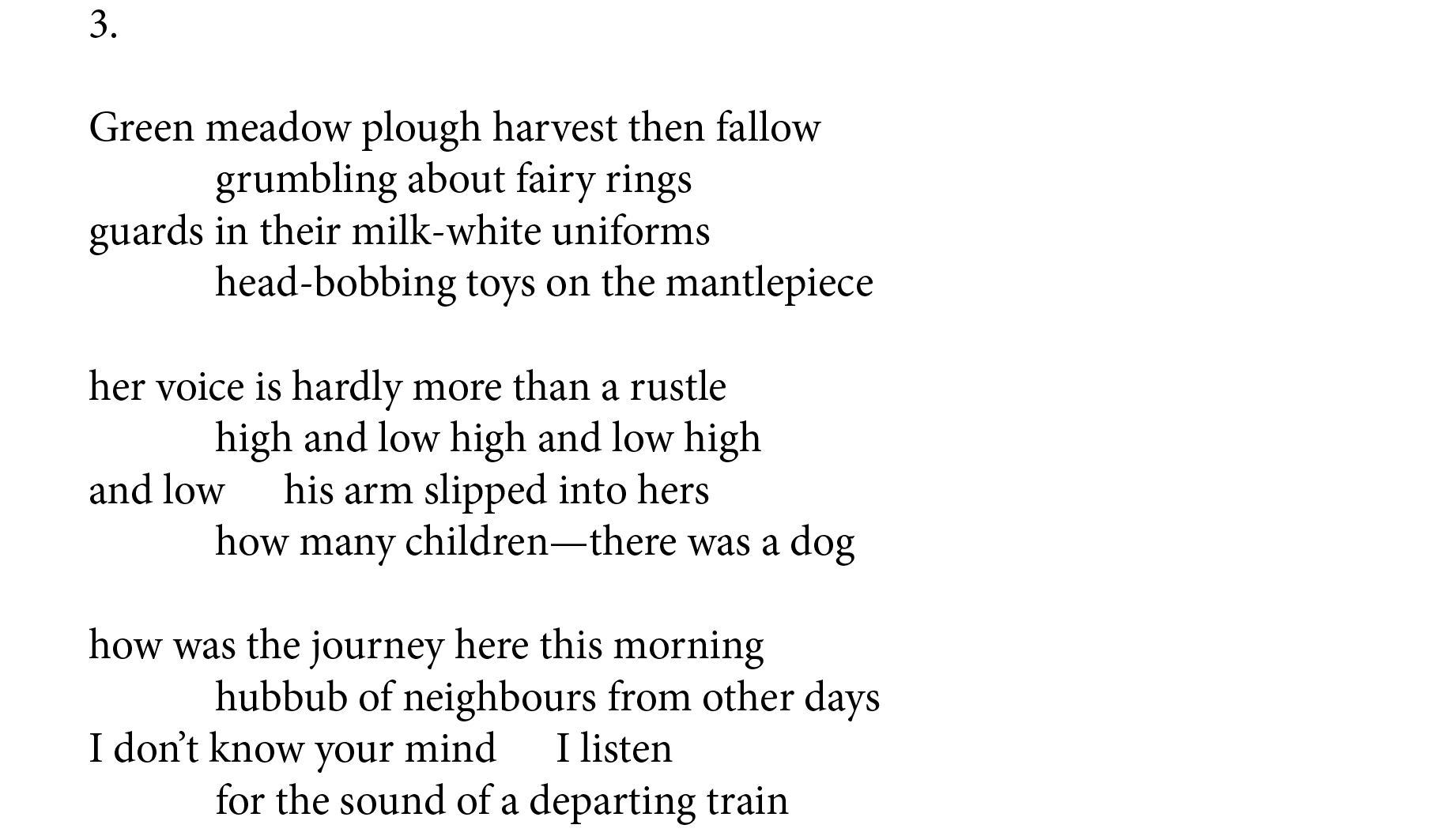
Here are the three poems in the sequence (from A to I) that have so far been published:

from Notes on a calendar (hung on a demolished wall)