More than 10 years of blogging on poetry and translation – over 39,000 views in 2024 – now captured and preserved at the UK Web Archive: 'one of the top 10 poetry blogs' (Rogue Strands)
I will be contributing to an event in London next week which will mark 100 years since Rilke’s death. I will read from my translations of Rilke as published in Change Your Life (Pushkin Press, 2024).
To quote from the Goethe-Institut’s publicity for the evening: Please join us us for a vibrant evening celebrating Tanzt die Orange —a groundbreaking new anthology that brings Rilke’s poetry into the language of today. Curated by award-winning poets Jan Wagner and Norbert Hummelt, the collection features reinterpretations of Rilke’s verses by 75 leading voices in contemporary German-language poetry.
At this special London event, Wagner and Hummelt will read selections from the anthology and discuss the enduring resonance of Rilke’s work. Co-presenting the event are the acclaimed translators Karen Leeder and Martyn Crucefix, who will guide the conversation and provide English translations of the poems, opening a dialogue between Rilke’s legacy and today’s poetic voices. The event will be presented in both German and English. Tickets £6, £3 concessions and for Goethe-Institut language students & library members. For more information and booking click here.
Venue: Goethe-Institut London Library, 50 Princes Gate, Exhibition Road, London SW7 2PH
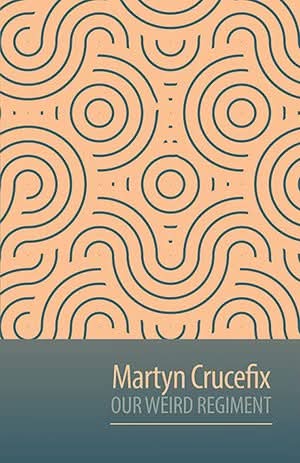
Also on the horizon is the launch reading for my new full collection of original poems, Our Weird Regiment (Shearsman Books). This will take place on Tuesday 10th March at 7.30pm at the Swedenborg Hall, 20/21 Bloomsbury Way, London WC1A 2TH. (See map here.) Admission is free.
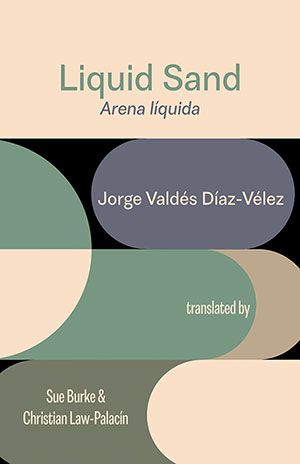
The reading will be hosted by Tony Frazer, publisher of Shearsman Books, as one of Shearsman’s regular programme of launches and readings. I will be reading alongside Jorge Valdés Díaz-Vélez.
The Atlantic recently posted a link to a site which can be used by authors of any stripe to check to see what, if any, of their works have (already) been used by Meta to train AI. For the last few weeks, social media have been full of understandably irate authors who discover this is exactly what has (already) happened. It looks to me as if prose works (fiction and non-fiction) as well as critical writing of all kinds – perhaps more than that ‘difficult’ genre poetry – have particularly fallen victim to the process. Indeed, Meta does seem to have taken some of my own writing – more critical than poetic – for its dubious purposes and it has done so without any kind of indication that this was happening, nor any request for permissions after the event, and – the harvesting of material being so vast – it’s hard to anticipate any after-the-event compensation or successful legal action. Even though, as The Atlantic‘s link has shown us, there ARE records of what has been done, a footprint, a guilty fingerprint, an undeniably smoking gun.
It’s hard not to feel that the horse has bolted on this one and – with the peevish idea of being able to mock at the anticipated results – since some of my own creativity has been stolen, I thought I’d ask ChatGPT to write a poem in the style of me. It was horribly polite in response and within a few seconds had produced a piece of writing it said was in the style of my own work and which it briskly summed up as ‘contemplative and precise [in] style, often rooted in quiet observations of the everyday, nature, and memory’. I posted this on Facebook – indicating the way this had come about – and wondering what people thought. The results surprised me as there was a mild round of applause for ChatGPT: it’s true, it did sound like a poem, it wasn’t utter nonsense (as I think I’d hoped). I don’t think anyone felt it sounded like me, but observations were made along the lines that ‘plenty of worse pieces of writing are submitted to magazines on a daily basis’.
But there was also a strong kick back against the whole process (even at my engaging with AI at all – though I really do think that horse and rider has bolted, in talking to friends (by no means all writers) and my own kids, AI has already made its way into the mainstream of work and study). There was also a strong reaction insisting that AI cannot write creatively because it does not have the human qualities out of which true (true?) creative writing emerges: the flaws, the emotions, the relationships, the memory, the history. I’m inclined to this side of the argument – though I’d also suggest it’s a kind of Doctor Who argument.
I thought it’d be worth spending a few moments looking at what ChatGPT actually produced for me. The title it chose, ‘The Last Light’, is inoffensive enough, if more Edward Thomas than Martyn Crucefix (in my view) and the form of the poem – free verse – is rather well done, though the line lengths are shorter than I think I’d have used myself. The opening stanza runs:
The hill is a shoulder—
pressed up against the sky’s slow retreat.
Beyond it, something waits:
not death,
but the unspoken
name of a tree I once knew
before its bark peeled
like old paper
from the spine of a life
I’ve half-forgotten.
That opening image is quite intriguing with its personification of both the ‘hill’ and the ‘evening’. The use of the long em dash after line 1 is something I think of as one of my techniques (though I’d not have used it there). In context of the ‘last light’ the ‘sky’s slow retreat’ is an effective phrase I’d be happy to own. I’m less happy with the next few lines, with the rather grandiose (overdramatic) ‘something waits’ (though I again hear some Ed Thomas in there) and ‘not death’. Is the latter a response to the possible (though here denied) metaphorical reading of ‘last light’? I think to suggest ‘the unspoken / name of a tree’ is what waits there is silly because it wouldn’t matter if it was spoken or not, because the ‘name’ is a thing known (it seems) and the tree bark peeling like ‘old paper’ is a poor image (what do you see there visually? compare bark to old paper?). This is compounded by suggesting the bark/paper is being peeled from ‘the spine of a life’. For a moment I see (distractingly) a human spine, then it’s replaced by the spine of a book (surely what is intended?) but this book spine seems to be from a book of ‘a life’ – or the life. Ugh no no no – the imagery there is all of a muddle which is not countered by the slightly emotive indications of ageing, loss, the past etc. To then say – as the poem does – that whatever has been said in the preceding few lines is actually ‘half-forgotten’ makes a mockery of the whole thing so far – this is like a bad poet attempting some elusive suggestiveness without really understanding (or being clear – poetry has to be clear in itself) what is being said. There is – AI critics would surely say, and I’d agree – an inhuman muddle going on in the opening 10 lines. But that is not to say that a not-very-talented human poet might have done something similar.
The poem proceeds…
A bird—
small enough to miss in motion—
cuts across the field.
x
Not for me, not even for itself,
but for the thread
it must continue.
The parenthetical ‘small enough to miss in motion’ doesn’t work for me. Again it seems to be yearning as it were for a sort of liminal effect – just on the edge of sense – but either it has been missed in which case it’s not been seen at all or it has been caught sight of in which case it has not been missed. The latter sentence is what I’d be arguing with myself were this actually my poem. I’d cross it out or re-write. The negatives of line 13 (‘Not for me, not even…’) again seem to be reaching for an edge of perception sort of impression, something is not known. I’d accept this as one of Crucefix’s recurrent ideas but (I hope) I don’t do it like this which is not so much a struggle to perceive, more a double blocking negative: if it’s not this and not that… then what is it? To go on to suggest there is a ‘thread’ being followed (by the seen/unseen bird? really?) And that the continuation of this ‘thread’ is something the bird is compelled to do (‘must’) is verging on the ridiculous. There are suggestions of motives, compulsions, but looked at more closely they make no sense whatsoever.
The poem’s final two stanzas are as follows:
I place my hands in the grass.
It is cold with what the earth
has kept secret all day.
x
I wonder
if this is what love is:
a silence left
after something essential
has flown.
The placing of hands ‘in the grass’ is rather good and the finding of ‘cold’ there is ominous (again ‘last light’?) and indicative of a death of sorts and to suggest the earth has kept this ‘secret all day’ is also a phrase – even an idea – I’d be happy to acknowledge my own (it’s not). But I can’t recall ever using the phrase ‘I wonder’ in a poem (no doubt I have) and I don’t like it. It seems to be AI’s attempt at a sort of ‘poetical’ tone and mood. In this context it feels rather cheap. And that is cheapened even further by what is wondered: ‘if this is what love is’. Where the hell did that come from? AI is using tropes which it thinks evoke the poetique…. love is a surefire winner of course…. But I can’t see how it forms any kind of ‘whole’ with what has come before. I find myself insisting this is what AI cannot really do – which a live human can potentially – create language in forms which achieve some sort of integrity, a wholeness, even out of contradictory materials, and the glue that binds them together has to be feeling, an emotional experience which lies at the root, powerful but usually not articulated in any other form than in the form of the poem itself.
The AI poem’s last fling is the colon which may or may not suggest that what follows is ‘what love is’. I think the AI mind will mean this. Once again I hear Edward Thomas more than me in this conclusion (see what ET remembers at the end of ‘Old Man’: ‘Only an avenue, dark, nameless, without end’) but the muddling of metaphors occurs again. There is a ‘silence’ left after something ‘essential’ has flown away but my reader response is straining here at the flighted thing (a motion) which is somehow abandoning an aural experience (the silence) and in leaving it something ‘essential’ has been lost (with wings?). Again AI is picking up the way poetry wants to get to the ‘essence’ of things but the words written here are merely an indication of that wish, not at all a real live accessing of it, or even a genuine gesturing towards it.
Having written this I have convinced myself – even more than I had been before – that what AI has written is a ‘hide’, a cover for a poem, making use of words and ideas that it has found associated with poems (perhaps even my own poems) but which it doesn’t itself ‘get’ (how could it?). On the other side of the desk sits the reader. The question for the reader is: how well do we read any poem that comes before us? Do we accept its (often) feeble gestures towards significance as the real thing? Out of a hundred poems we read in magazines and on-line, how many of them ARE the real thing? I’d bet my AI generated poem would find its way into a UK magazine (eventually). It has the aura of a poem, it has many of the familiar gestures of a poem, it doesn’t really make proper sense (which some think is the mark of a real poem), it doesn’t have the heart of a true poem (but lots of poems I read don’t either because they too are copying, mimicking tropes and phrases from other poems).
Martyn…. your own poetry is born of time, experience, tragedy and celebration, as well as from the inner harvest of your accomplished literary translations. This collection of admittedly impressive sounding images has been reaped from a database in nano seconds and cobbled together in some deceiving facsimilewhich claims to be your style. And like the macabre chitty bang bang child catcher with his tempting lollipops, it’s ‘all free today’. Like a painting let us say by Edvard Munch reconstituted by a skilful fraudster based in High Wycombe, it may appear in every way to be Munch, but it isn’t Munch. For it was the process of creation (which is unique to every individual and cannot be rationalised by densities of data capture or meticulous replication) that was invested in the original painting and by implication your poem, which counts. AI is not a creator out of inwardness, it is a skilful and persuasive designer, an artisan. It only wants to succeed and aims almost grotesquely at perfection. Genuine poets aim at expressing authentically from a deep point, and are explorers who cling to the cliff face of their poem’s construction… failure is quite possible which is why only a human can be an artist because humans alone with their insufficient organs (see Maupassant le Horla) are shaped by fear, doubt, failure, wild joy and excess. What I am trying to say is that it is as much about what we miss in a work of art to make it complete or perfect that makes it unique with its beautiful imperfection!
Please Note: this blog and website are now captured and preserved at the UK Web Archive held at The British Museum. Many thanks to them.
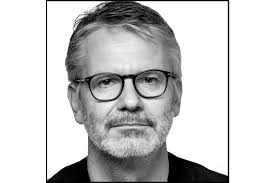
The highlight of last week was attending Durs Grünbein’s reading at The Goethe- Institute, where he was in discussion with his English translator, Karen Leeder. At the beginning of the evening, Grünbein joked that he’d not been in the UK for a few years and this was the first time he’d had to produce his passport (the blessings of Brexit). Interestingly, in the light of last weekend’s German election results, Grünbeinhas often been described as a poet of the reunified Germany, having been born in Dresden and now living with his family in eastern Berlin. Grünbein’s poetry is witty, wry, perceptive, and influenced by a broad range of literary texts and often presents the disillusionment of having grown up in East Germany and explores Germany’s identity in post-Cold War Europe. He has been very vocal in recent years on the issues of immigration and the defence of Ukraine. Helen Vendler commented on the ‘sardonic humour, the savagery, the violent candor—all expressed in lines of cool formal elegance’ and Philip Ottermann, in The Independent, noted ‘Grünbein loves to jump from one register to another—one moment he is the street poet of Berlin, the next … all marble and ancient philosophy’.
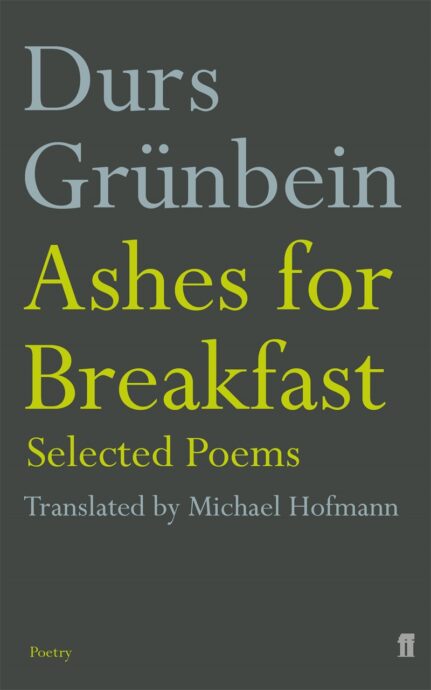
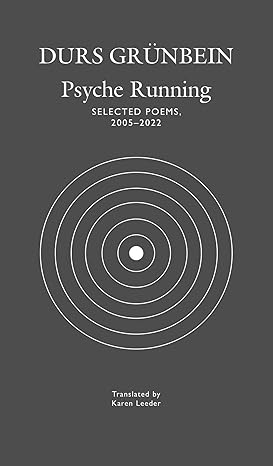
Grünbein’s earlier poems were translated into English by Michael Hofmann and published in Ashes for Breakfast: Selected Poems (Faber, 2005). Karen Leeder has now published Psyche Running, a selection of more recent poems from 2005–2022 (Seagull Books). During the evening, Grünbein commented on the process of those earlier translations as ‘strange’ and the results (as is Hofmann’s wont) as being very free, very sparky, and Leeder suggested there was a particular excitement in the ‘to and fro’ between author and translator to be found in them. She then suggested her approach has been rather different, perhaps a more dutiful one, still needing to make the poems ‘live’ in the target language, but also demanding a fidelity, to capture the original’s form and architecture as closely as possible. The work read during the evening suggests that her translations triumphantly achieve these goals.
Leeder said that his work can have a ‘marble’-like quality, a firm (unbending?) Classicism, and also that he has himself been labelled a ‘poeta doctus’, given the learned, wide-ranging references he incorporates. Grünbein rather demurred at these descriptions and (an idea he repeated a couple of times in slightly different forms) any interesting poem must be the result of two steps, the first poetic, the second, a more critical, a process of reflection (a later formulation suggested the two steps were ‘perceptual’ and ‘conceptual’). These two phases result in the finished poem as ‘a form of knowledge’; Grünbein pointed out that philosophy arose out of poetry in Classical times (not the other way round). The first poem he read, ‘Childhood in the Diorama’, does have a ‘marble’-like quality to it: longish, unrhymed lines in a solid verse paragraph and the child’s preference for the posed scenes of a museum’s diorama, their ‘inert’ quality. But on one occasion, the boy sensed some movement, a ‘draught, perhaps, had blown through the displays’, perhaps suggestive of the child’s development into a more unstable, fluid view of the world.
Other poems read that evening included ‘Nee Wachtel’, ‘Exaltations in Sleep’, and ‘Inspector Kobold’ which is a ‘Martian’ sort of piece describing seahorses, in ‘their whalebone corsets, like ‘tiny ocean Lipizzaners’ (here’s an alternative translation by Michael Eskin). If we are to take Grünbein’s poems as ‘forms of knowledge’ then they certainly range widely through the natural sciences, language, science more generally, astronomy, history and politics. He felt what binds all this together is the one individual life, the single life perspective, poetry as a sort of anthropological study, at which Leeder suggested there was a ‘fragility’ to much of his work, the vulnerability of the single life as much as all life (ecologically?). The poet was happy to agree to this, suggesting ‘marble’ was not at all the right term for his poetry, that there was always something ‘flowing’ about it, multiple angles and perspectives. He once claimed not to be a ‘German’ poet, but simply someone who wrote in the German language. This evening he stood by that statement: his own identity is wrapped up in language use, the mother’s language, used daily for years, and is not a function of birthplace alone (remember Grünbein grew up in East Germany and now lives in the unified Germany).
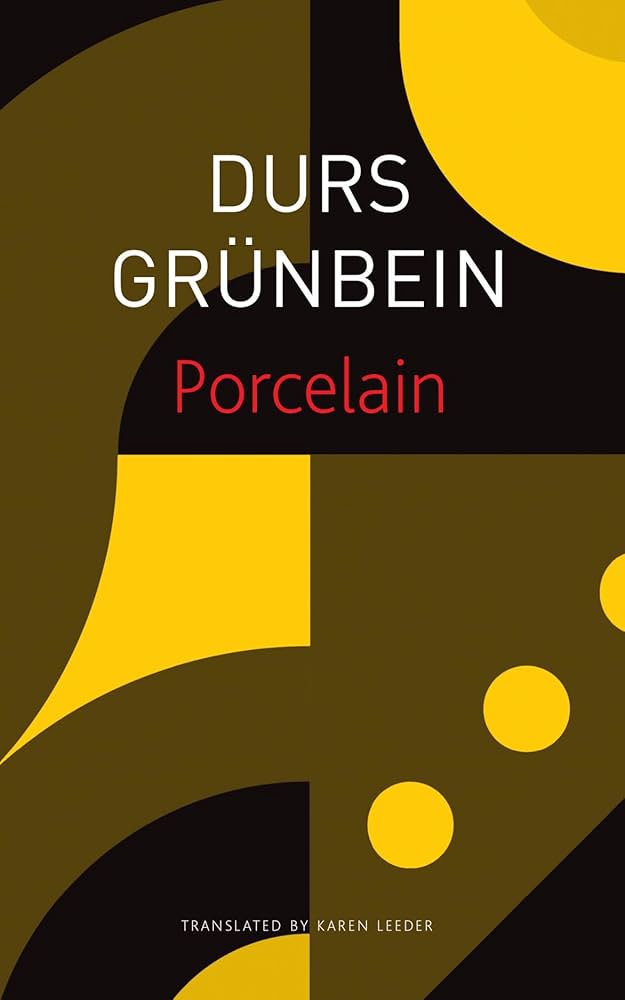
But his birthplace has been undoubtedly important in Porcelain (Seagull, 2020), the long sequence of poems (written slowly, we learned, on the February anniversaries of the Allies’ bombing of his hometown, Dresden). I reviewed this book here, when it was published). Grünbein read 10 poems from this sequence (some poems were read only in German with the English translation projected above), other poems read in both languages. Porcelain is an elegy the poet suggested, a Classical form, longing for what is lost. Poem #7 is one of the most remarkable, another museum visit by the young poet, who’d stare at a cherry stone from the 16th century, carved with 185 tiny heads. The poem comes to regard the curious object as an ‘emblem of the future’ of Dresden, presenting as it seemed to, faces, ‘eyes wide with terror, on every tiny screaming face, / inferno on a needle tip’.
The poet suggested the whole sequence of poems is also a kind of ‘sound system’ containing echoes or samples of other poets’ work, including Paul Celan, with Grünbein’s title (Porce-lain) being a pun on the earlier poet’s name. Leeder added that it should not be read in a narrowly nationalistic fashion, that a lot more (bombed) cities than just Dresden were alluded to by the poem (Coventry, Warsaw, Odessa, Guernica). She asked Grünbein what was it that kept drawing him back to Dresden as a subject matter for poems. He thought it had something to do with the moment when he realised that his own childhood was ‘historical’, in the sense of being intimately connected to major historical events. He recalls seeing truckloads of Russian soldiers passing where he grew up, heading to the nearby Russian military barracks. This produced a sense in the young boy that much in (his) life had been determined before his arrival on the scene. In this sense, his hometown acquired a ‘mythic’ quality.
KL: You mean it was a ‘world place’?
DG: Yes – I realised it was a reference point, worldwide, its splendour and its ruins. From the city of Dresden one can draw out a lot of history, a seed point, or like a jigsaw, that can be slowly pieced together.
Perhaps half a dozen more poems were presented from more recent collections. ‘Flea Market’ is a peerless poem about German history, starting from the bric-a-brac found in such markets – the spoons, brooches, bird cages, tables – and wondering ‘what / do they say, what do they hide’? Quiet allusions to ‘uniforms and daggers of honour’, seque into the next, even more troubling, question: ‘How can one’s thoughts not go astray / faced with the piles of glasses, / and old leather suitcases?’ The poem ‘Lumière’ also alludes to the Holocaust and starts out from descriptions of the Lumière brothers’ 1896 film of a train pulling into a station. The first film-goers were frightened at the image of the train’s approach, ‘but not yet the horror / at all the implacable trains / that have criss-crossed the century, / the endless rows of sealed trucks.’
Asked where his poetry might be heading, Grünbein surprisingly suggested that he felt a more prose-like quality entering his work – not so Classical then! A soberness in some ways – but with flashes of magic, magic spells even. His earlier suggestion that the good poem is a 2-step process – perceptual, conceptual – seems to be still important, though in the final result (I’m guessing Grünbein would agree with this) the two stages must be simultaneously present in the reader’s experience.
I have to say, one of the great pleasures of the evening was the way in which both participants took the poetry seriously and gave it a good outing. This may sound odd for a poetry reading, but often these days, I find too many readings/launches contain too little poetry and rather too much gossiping, drinking and networking (all of which can be excluding for those not in the swim). Can I make a plea for more reading at readings, a little less career-building? Of course, at The Goethe-Institute we were listening to two writers at the very top of their game and what they are creating – in German and in English – is vital, lasting stuff. But, if we are publishing poetry, we should not be shy of reading it (remember, not everyone attending will be able to afford to buy the book and take it home).

 Martyn Crucefix