Where’s My Master Gone – Don Paterson v Li Po

Don Paterson’s 1997 book, God’s Gift to Women (Faber) includes a poem sporting the title ‘On Going to Meet a Zen Master in the Kyushu Mountains and Not Finding Him’. The reader’s eye hops off the perch of this lengthy title only to flutter down, looking in vain for a foothold, for a line, even a word – it’s a completely blank page. In a collection that includes a poem called ‘Postmodern’ and another on ‘The Alexandrian Library’, the joke is obvious enough. Any search for ‘masterly’ advice in the Kyushu Mountains or closer to home in a post-modern, relativist world in which language hides as much as it might reveal, must draw a blank. I remember seeing the poem – probably heard Paterson ‘read’ it too – the long title building expectation, a too-long pause, the announcement of the next poem (cue laughter) – and something bothered me. I think now I know what it was.
imgres

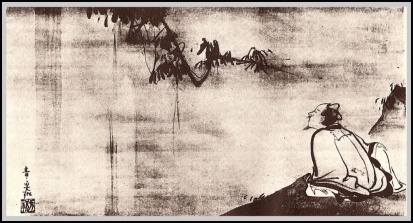
I wondered if Paterson had been reading the Penguin Classics selection of Li Po and Tu Fu (tr. Arthur Cooper, 1973). The Li Po selection opens with the poem ‘On Visiting a Taoist Master in the Tai-T’ien Mountains and Not Finding Him’. Cooper’s note tells us that ‘Visiting a Hermit and Not Finding Him’ is actually a very common theme in Chinese poetry. Such a poem (we are told) is not just an excuse for a “nature poem” but relates to the frequent “spirit-journeys” that Li Po was fond of writing. Here is Cooper’s translation:


Where the dogs bark

by roaring waters,

whose spray darkens

the petals’ colours,

deep in the woods

deer at times are seen;


the valley noon:

one can hear no bell,

but wild bamboos

cut across bright clouds,

flying cascades

hang from jasper peaks;


no one here knows

which way you have gone:

two, now three pines

I have leant against!
3-li-po

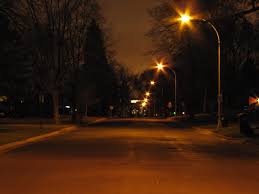
I had come across this poem while compiling my first book, Beneath Tremendous Rain (Enitharmon, 1990). I liked it for reasons I didn’t then understand and, in a very simple form of translation, I wrote an up-dated version:


Looking for an Old Man


Where red dogs bark

on the sodium ring-road

and traffic noise

blackens adjacent houses,

I’ve come to seek you.


In each garden I pass,

pale heads of bindweed.

The night is undistinguished.

The savour of coalsmoke

flattens across the kerb.


No-one here knows

which way you have gone:

two, now three lampposts

I’ve leant against.
images

Li Po is the more Daoist of the two poets presented as a complementary pair in this Penguin book. Now, with a bit more understanding of this tradition, I’m sure that 26 years ago I was responding to something at the heart of the poem. The fact that the Daoist master cannot be found by the searching student is precisely the point since the Daoist teacher teaches “in the absence of words” (Chapter 43, ‘Best Teaching’) as I translated it in my version of the Daodejing (Enitharmon, 2016).

Interestingly, Li Po’s poem expresses this not with a blank page but (as Cooper says) through further encounters with “nature” (petals, woods, deer, valley, bamboo, clouds) or, in my version, the natural and urban world (ring-road, traffic, houses, garden, bindweed, coalsmoke, kerb). Whether we designate this a ‘spiritual’ journey or not, the point remains that the student’s search for knowledge in the form of a direct download from some master must be denied. The student’s anxious search for guidance is reflected in the number of pines/lampposts he leans against as well as the geographical over-specificity of the titles of such poems. The student’s dependency and naïve optimism is the satirical butt of the poem as he is directed back to the source of all knowledge (the world surrounding him) even as he wanders in search of his master. So Paterson’s 1997 version achieves three things: it misrepresents the spirit of the original, it’s more dramatic (comic), it’s more superficial.
imgres

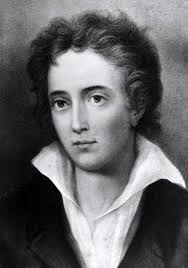
When I first read Li Po’s poem I was coming off the back of doctoral work on the Romantics, especially Shelley whose ‘A Defence of Poetry’ (1821) argues that the “poetry in [our] systems of thought is concealed by the accumulation of facts and calculating processes [. . .] we want the creative faculty to imagine that which we know”. This is succinctly put in Keats’ idea of Negative Capability, defined as a passive openness to the fullest range of human experience (“uncertainties, Mysteries, doubts”) without any imposition of preconceived notions, ideas or language: “without any irritable reaching after fact & reason”. The student in Li Po’s poem seeks just such certainties and facts and is gently deflected back into the world of observation where (I take it) he is encouraged to pursue a more full-blooded, full-bodied, open-minded encounter with the 10,000 things which (in Daoism) constitute the One, ‘what is’.

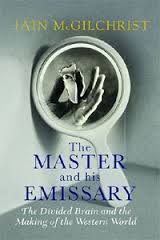
The two attitudes to knowledge here are really two ‘ways of being’ as Iain McGilchrist’s fascinating book, The Master and his Emissary (Yale, 2009) phrases it. McGilchrist argues that right and left human brain hemispheres deliver quite different kinds of attention to the world. The left perceives the world as “static, separable, bounded, but essentially fragmented [. . .] grouped into classes”. Shelley described this in 1821 and linked it to the processes of Reason and this is the attitude to knowledge and education that the anxious student of Li Po’s poem possesses. In contrast, what Shelley calls Poetry or the Imagination is what McGilchrist associates with the right brain. It tends to perceive “the live, complex, embodied, world of individual, always unique beings, forever in flux, a net of interdependencies, forming and reforming wholes, a world with which we are deeply connected”.
imgres

Without doubt, this is also the viewpoint of the Daoist master whose teaching evokes the uncarved block, the One, and who teaches best without words. Ordinary language usage is dependent on conceptual thought which is left-brain work – ordering, categorising, re-presenting the minute particulars of the world as they are perceived by the right brain. I imagine that Li Po’s master-teacher and sage is deliberately hiding somewhere beyond the bamboo canes – and this is part of the student’s lesson.

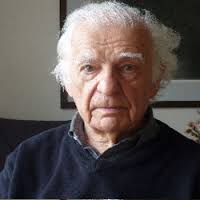
So Don Paterson’s blank page bothers me because – as McGilchrist expresses it – it represents a rather glib, post-modern position, a scepticism about language which is in danger of throwing out the interconnected real world along with the suspect tokens and counters of left-brain language: “To say that language holds truth concealed is not to say that language simply serves to conceal truth [. . .] or much worse, that there is no such thing as truth” (McGilchrist, p. 6). I’m also reminded of Yves Bonnefoy, engaging in his own battle with the early stirrings of French post-modernism. He writes: “This world here exists, of that I am certain [. . .] It is simply with us. In what can be felt and sensed”. In The Tombs of Ravenna (1953), he names this underlying truth, not as existence, but as “presence”. The right brain knows this; the left brain sets about fragmenting it, making use of it, disappearing it.
images
Yves Bonnefoy

Review of ‘The Pity’: new war poems commissioned by the Poetry Society

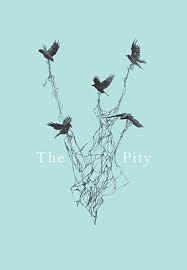
On National Poetry Day (October 2014) four contemporary poets performed new work about the legacy of the First World War. Two months later the Poetry Society published The Pity as a limited edition anthology. Given free to Society members (it has just now come through my letterbox with the new issue of Poetry Review) it is also available to purchase online.

 imgres

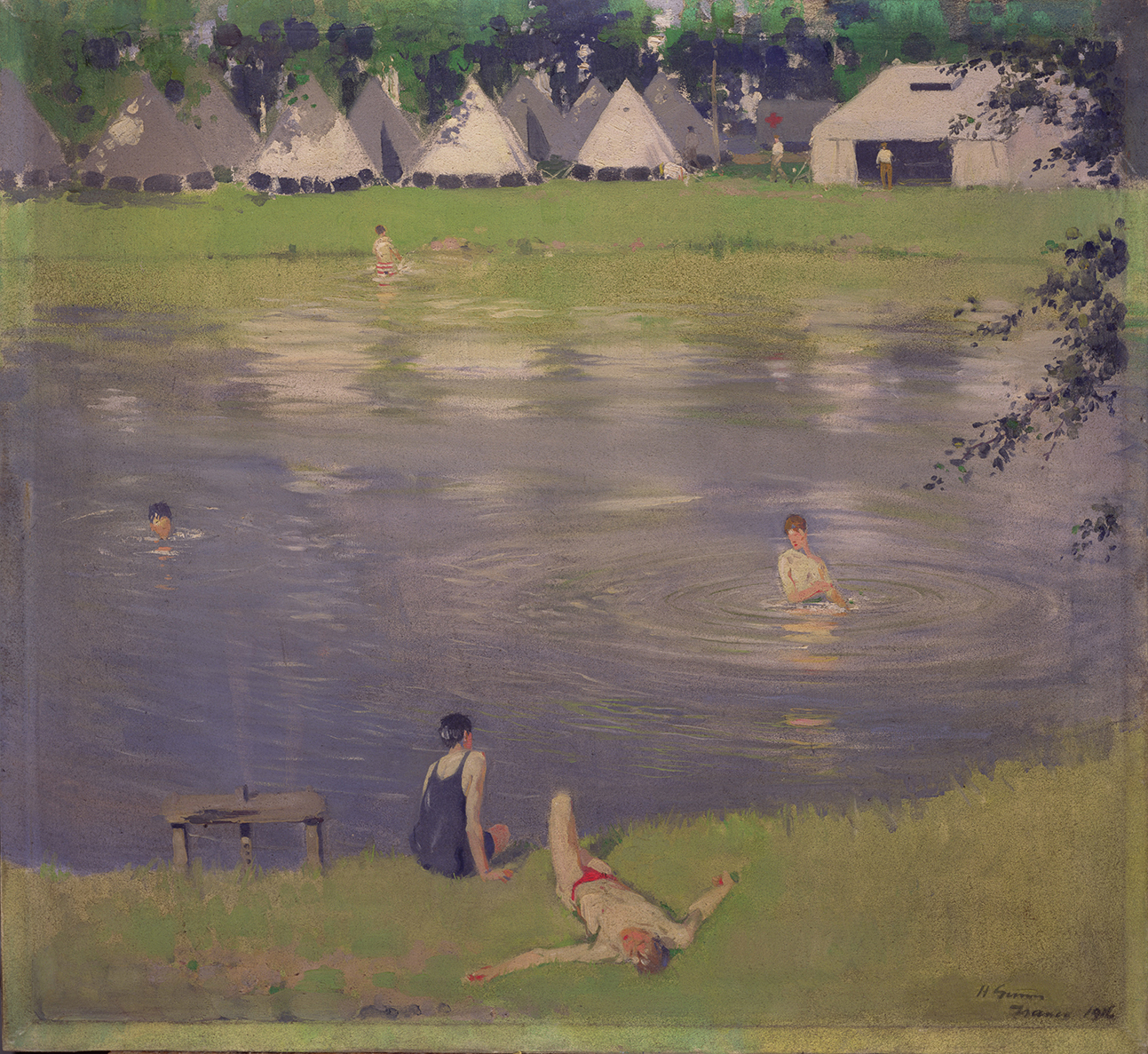
So The Pity contains substantial poems commissioned by the Poetry Society, in which Steve Ely, Zaffar Kunial, Denise Riley and Warsan Shire (chosen to represent “different poetics and perspectives”) respond to the centenary and legacy of the First World War. The Pity was published in collaboration with Cockayne – Grants for the Arts and The London Community Foundation to mark the centenary of the First World War. John Glenday’s poem, ‘The Big Push’ is also included, providing a short coda to the volume. His poem takes inspiration from Sir Herbert James Gunn’s 1916 painting, ‘The Eve of the Battle of the Somme’, held in The Fleming Collection of Scottish Art.

In this blog, I will discuss only the contributions of Ely and Glenday; on another occasion, those of Kunial, Riley and Shire.

Steve Ely’s ‘How dear is life’ is a sequence in 7 parts mixing literary, historical and personal materials to very powerful effect. He presents nothing less than a vision of war and its causes, the careful placing of the comma in the title of the first section – ‘Business, as usual’ – indicating where he wants to lay the blame:

This time it’s oil, not markets.

This time it’s oil, not borders.

This time it’s oil, not ideas.

This time it’s money and power –

like last time and every time before.

Ely has said the whole sequence is much influenced by Henry Williamson’s fictionalized autobiography, A Chronicle of Ancient Sunlight, which presents the First World War as a sacrifice of the innocents on the altar of capital. The sequence is intended to portray a liberation from a “world-destroying growth-and-profit system”, not merely a release from the horrors of war. Though writing with commitment (see Morning Star: http://www.morningstaronline.co.uk/a-1063-Steve-Ely-commissioned-by-the-Poetry-Society-for-centenary-of-World-War-I#.VL0uW0esWss) there are two aspects of the sequence that prevent it ossifying into predictable attitudes: one a matter of materials, the other of technique.

SteveEly-SquareWeb

Ely draws on material linked with his maternal great-grand-father, Thomas Sellars, killed on the Somme in February 1917, contrasting the glorious send-off by friends and family with his eventual fate (and the shifting attitudes of those left at home):

They stuffed his lungs with poppies and crushed him

under a cenotaph. Where they weep.

Likewise, he uses material from a more extensive time period, linked with his own background in the mining communities of Yorkshire. The pressures of economic activity which determine that (on one occasion) it will take too long to recover the body of a killed miner mean that the bereaved family is fobbed off with a “screwed down coffin            packed with the stone that / killed him” (one of 262 deaths in the pits in the twentieth century). Ely deploys this alongside the 216 deaths of Frickley and Kirkby, “ragged up through two world wars”. There are moments reminiscent of Wilfred Owen’s poems here. Owen’s ‘Disabled’ is inevitably evoked when Ely treats the plight of individuals injured in wars, sickeningly evoked in ‘The Story of my Heart’:

on spoon-fed rusk-mush

matted in my beard                 pus from a crusted wound

[. . . ]

I was more than a mouth        more than shit

once                 I was

whole

But it is the first, fifth and seventh parts of the sequence where Ely’s technical choices are fully displayed. Under the creative pressure of his unifying political vision, he draws together fragments (often separated by blank spaces on the same line) into new relations with each other, melding biblical, historical, mythical and more contemporary elements together to make his point:

and what did they see

river running red         with Empire

river running green      with Deutschmarks

sterling                        Frenchfrancs        roubles        dollars

the promissory land                 of bilk and money

Using the same techniques, ‘The Vision of the White Crow’ springs from information that Hitler (while recovering from a gas attack at Pasewalk Military Hospital in 1918) experienced episodes of ‘hysterical blindness’ in which he claimed to have seen his eventual rise to power. Ely voices Hitler’s convictions that the “Reichsblood” was being drained by “socialists democrats profiteers bankers” but then propels his vision forward into the later twentieth century, “unwritten pages of world book turning”. We are whirled through Washington, Moscow, Sarajavo, Maastricht, past John Lennon, and (maybe?) Andy Warhol, towards the X-Factor and twerking with Angela Merkel. This is heady poetry of conviction and the persuasiveness of phrase-making (phrase-making that leaves syntax and causality behind) is intoxicating but perhaps is the intoxication that Auden warned himself against in the late 1930s. But Ely is clearly on the side of Shelley, echoing ‘The Masque of Anarchy’ in the final section, urging the disenfranchised – who, the poem has made it clear are always the victims of the powerful and wealthy in both war and peace – urging them to “Rise . . .Rise  . .  Rise”.

John Glenday’s single poem is as different as could be. It is an ekphrastic piece, the pictorial inspiration being Herbert James Gunn’s 1916 painting, ‘The Eve of the Battle of the Somme’.

GUNN-Sir-James-The-Eve-of-the-Battle-of-the-Somme

Much of the poem’s impact is already evident in the image: the naked, vulnerable, beautiful figures of pale youth, relaxed, hedonistic, while across the swirl of the River Somme itself, the ominous daubs and pointed shapes of the army camp are almost – but not quite – out of sight. ‘The Big Push’, in its 7 regularly lined quatrains, rhyming ABAB, is calculated to be a more conventional poem than any part of Ely’s. It’s a dramatic monologue, perhaps spoken by one of Gunn’s swimmers and it tries on many familiar tropes we might now associate with WWI and its poetry: the singing in the face of imminent extinction, the waggish black humour of the Tommies, the football playing, the stoical resilience of the trench soldier. We even have a reference to Shelley’s ‘To a Skylark’, “like an unbodied joy”.

imgres

It’s this image, drawn from the narrator’s past, that opens the way to the final two stanzas which are a sequence of associations after taking over German-dug trenches from occupying French troops, the “tiny, brilliant flowers” blooming in that place, the speculation that, if the dead might someday return, “they’ll come back green”. The poignancy of these images returns us to the Gunn painting. The young men are at one with Nature, having passed through the horrors of the Somme are gifted a return to that pastoral scene where:

. . . all the things they suffered will mean no more to them

than the setting in of the ordinary dark, or a change of weather.

I take the irony here to be at the expense of the narrative voice, whose steady, rather plangent tone and period-shaped imagination is not yet able to encompass the horrors that a modern reader all too readily associates with the battle to commence the very next day. I’m reminded of Owen again. In ‘A Terre’ (completed July 1918), his wounded officer blackly recalls Shelley (again!): “I shall be one with nature, herb, and stone”. But Owen’s narrator re-shapes the Romantic idea of the one life by envying the lives of rats, cheese mites and microbes: he already understands the horrors that Glenday’s naïve narrator has yet to learn.

Sir John Franklin and Mary Shelley’s ‘Frankenstein’

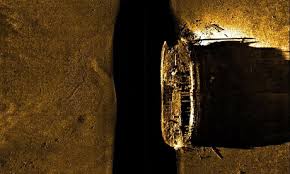
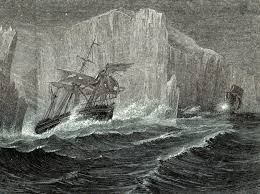
The Guardian tells us today: The grisly and mysterious tale of two British ships that disappeared in the Arctic in 1845 has baffled generations and sparked one of history’s longest rescue searches. But now, more than 160 years later, Canadian divers have finally found the remains of one of the doomed Navy vessels.

imgres

Legend has it that sailors on board the HMS Erebus and HMS Terror, who were chosen by the explorer Sir John Franklin, resorted to cannibalism after the ships became ice-bound in the Victoria Strait in the Arctic territory of Nunavut. Search parties hunted for the crew until 1859, but no sign of either ship was discovered until now. However, tantalising clues have emerged over the years, including the bodies of three crewmen, discovered in the 1980s.

The Franklin expedition’s mission to the fabled Northwest Passage had frustrated explorers for centuries and the sea crossing was only successfully made 58 years later, far further north. The original search expeditions in the 19th century helped open up parts of the Canadian Arctic for discovery. (http://www.theguardian.com/world/2014/sep/09/british-ship-1845-franklin-expedition-found-canada)

And by coincidence an AS class is today beginning to study Mary Shelley’s Frankenstein in which Robert Walton writes home to his sister, Margaret Saville, from St Petersburgh, on December 11th, 17—. One of the three aspirers in Shelley’s book, Walton also hopes to discover the Northwest Passage. He too becomes trapped in the ice but then picks up the bedraggled and wasted figure of Victor Frankenstein. Victor’s tale begins as a moral warning about the dangers of over-ambition, how the pursuit of knowledge risks destroying the “tranquillity”of life and our “domestic affections”.

This may have been Mary’s primary message, living as she did through the loss of a daughter the year before and Percy Bysshe’s roving eye and Byron’s restless wanderings. Despite her mother’s political radicalism and feminism and her father’s philosophical anarchism, I find it hard not to read the novel on one level as a rather conservative plea for a quieter life. Unlike Franklin and his crew, the ice eventually breaks up around Walton. This gives him the possibility of choice – and he chooses not to follow in Victor’s self-destructive footsteps but to turn for home, to Margaret, delivering his journal as the novel we now read.

imgres

On the other hand, deriving from a dream she had in the year with no summer, 1816, there’s plenty in the novel that may have been brimming beyond the author’s conscious control. Victor is a tragic hero of sorts. Even when he is dragged on board, close to death, Walton senses “He must have been a noble creature in his better days, being even now in wreck so attractive and amiable”. Franklin, 50 years later, was another Victor, risking all; it cost him (and his crew) all they had. A failure, but a tragic sort of failure and one long remembered. But Walton’s journal is a story of two sorts of heroism: the one that never gave up as well as the one that chose life, the life of relationships. We remember Walton because of Victor. But I think Walton knew what he was choosing and maybe thought of it with equanimity in the anonymity of his twilight years.

Mary Shelley saw her husband drowned in 1821. She died of cancer in Bournemouth in February 1851. I wonder what she thought, 6 years earlier, reading of Franklin’s abortive voyage. I imagine her re-reading the end of her great novel, the created Creature’s life ended because his creator, his only human tie to life itself, has perished: “He sprang from the cabin window [. . . ] upon the ice raft which lay close to the vessel. He was soon borne away by the waves and lost in darkness and distance”