Michael Donaghy – 10 Years On

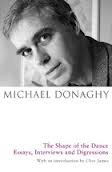
With the South Bank in London about to stage a celebration of Michael Donaghy’s work (http://www.southbankcentre.co.uk/whatson/michael-donaghy-a-celebratio-85980) and several new publications forthcoming, I remember reading with him around 1990 at that same venue. I’m sure the event was recorded but I’ve never heard it since. He was reading from Shibboleth (1988) and I must have been reading from Beneath Tremendous Rain (1990). I reviewed his posthumous book Safest (2005) for Poetry London (I think) and thought it might be appropriate to post it here unchanged. My intention was to review his work as a whole as well as commenting on the short collection that Picador had then produced.
imgres

Michael Donaghy’s death in 2004 is rightly regarded as a great loss to English poetry. With the publication of Safest – poems he had been preparing for a fourth collection – we can see his work over 30 years forming a tragically curtailed, but significant whole. I wonder if he tired of the early ‘metaphysical’ label, so easily applied to a poem like ‘Machines’ which opened his first book and remarkable in 1988 for its elegance of form and delicate wit. What is really distinctive in the first two books is his pursuit of the dramatic lyric. Donaghy is a terrific storyteller and a key part of his success is the irresistable address of his narrators. This is usually combined with astonishingly fluid transitions from colloquialism to the complexly erudite (the metaphysical bit). Drama lies in Donaghy’s precision of voice, the accessibility of character and narrative and his superb, often comic, sense of timing. His deployment of these various devices results in the other distinctive property of a Donaghy poem – the sheer distance it can travel from start to finish and the surprises on the way. Particularly for those who saw him perform, these are the elements he triumphantly combined in feast-like poems such as ‘Smith’, ‘Letter’, ‘Cadenza’, ‘Liverpool’, ‘The Hunter’s Purse’ and ‘Erratum’.

In retrospect, the traditional nature of his subjects is clear: love, art, death, time. Perhaps the absence of politics will come to be seen as a bar to real greatness, though the opening 20 pages of Shibboleth and the first two sections of Errata are very powerful evidence in his favour. Perhaps all his concerns are subsumed in his continual meditation on the temporal – how identity is composed of past events, how the past can seem more real than the present, how “the past falls open anywhere” (‘Black Ice and Rain’ from Conjure). Always restless, Donaghy’s third book seemed significantly darker in tone and contained fewer stories. What the blurb referred to as his most “vulnerable” work is a series of heart-broken love lyrics and a number of poems on his relationship with his dead father. Of the latter, ‘Caliban’s Books’ is outstanding and need give no quarter to Plath’s ‘Full Fathom Five’ in the evocation of parent/child relationships and Donaghy’s poem is full of tenderness and astringent nostalgia for the lost man and his Irish childhood.

Now Safest gives us 24 new poems – barely half a full collection – and one can only wonder at what might have been. Maddy Paxman’s note on the contents suggests these were the pieces Donaghy had approved for publication, but even so the repetition of a brief passage in two quite different poems (page 21 and 27) suggests an inevitable lack of finish. The book seems to have been shaping up more to resemble Conjure than the early work. Vintage Donaghy can be found in poems like ‘A Darkoom’, an imagined/remembered portrait of Klein, a holocaust survivor and photographer, visited in the garrulous narrator’s youth but whose memories of the man are at risk of being forgotten. The opening poem’s image of a Claude Glass (an 18th century device for creating picturesque images of landscapes that lie at the viewer’s back) is a perfect vehicle to articulate Donaghy’s retrospective habit of  “squinting to recall some fading pleasure, / or [being] blinded by some private scrim of tears” (‘Upon a Claude Glass’).
imgres

‘From the Safe House’ is another narrative tour de force, blurring the boundaries of memory and imagination, compacting time to an eternal instant in writing a letter from Reagan-era Chicago to send in the present day to a friend who has just died prematurely but imagining him a happily married father in Vera Cruz! Against all the odds this works – and is deeply moving. This is an almost baroque extension of earlier modes, but Donaghy’s bold re-writing of the original in ‘Akhmatova Variations’ looks like a new direction. As does ‘The Moko’, which reads as a hypnotic paean to some whale-like creature: “Muscles of silence are rolling miles offshore at night”. Such environmental concerns are new in Donaghy’s work and his lyricism invests these creatures with grace and nobility:

They knew the stars and steered by singing them

and when the stars were dark, by wind,

and when the winds died, by wave swell,

bird flight, swirled shoals of luminous algae,

by phosphorescence a fathom under the outrigger.

The fact that the moko turns out to be a Polynesian mythical beast of the sea only adds to the poem’s intrigue.

Donaghy’s art – as far as it was allowed to develop – owes its success to contradictory impulses. It thrives on tensions between fluid and formal, colloquial and erudite, humour and seriousness, personal and impersonal. It strikes me there was a movement over the years from the first of each of these contrasts towards the second – whether a permanent sea change or mere local turbulence we will never know. Of course, hindsight tempts us to see the darkening as prophetic but, as I have said, this was under way in his third book. Safest has its preponderance of troubled and troubling lyrics, less love-torn this time, more concerned with the dissolution of self. ‘Midriver’ is a bold language experiment in which the lyric voice is almost wholly stripped of its personal pronoun and identity seems lost in a swirl of the temporal and spatial: “so stops halfway and, neither there nor there, / but cold and rained on and intransitive”. Even more explicitly in ‘Exile’s End’ and ‘Disquietude’, it is death that lowers and Donaghy writes not with Larkin’s horror, nor Thomas’ raging, but from an intrigued distance: “No recording devices are allowed in this hall. / The lights dim . . . / for the next movement / which features no one and is silent”. (‘Disquietude’).
Teaching Edward Thomas’ ‘Adlestrop’

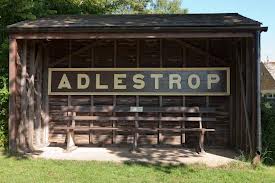
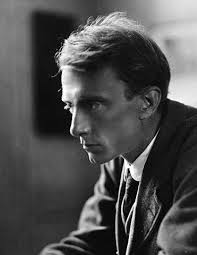
We teach the OCR exam board’s AS module F661, opting for Edward Thomas as the poet for close analysis. Oddly, the board do not include ‘Adlestrop’ in their selection of poems. So in the opening sessions, here’s a way of gentling students in to the processes of closely analysing a poem while also showing them Thomas’ most well-know piece.

imgres

Discuss with the class the idea of syllable counting in a verse line. Get them to try it by asking students to write an 8 or 10 syllable line beginning “Yes. I remember . . .”. Perhaps one of each.

For the exercise that follows (for those who want more restrictions) suggest keeping to an 8 or 10 syllable per line. Others (possibly the less able) may prefer more freedom . . .

Now . . . tell them to imagine they are travelling – some form of transport, walking, bike, train, bus. Ask around to reveal what they are imagining. Try pushing it a bit further, for more details, the car, the time of day, the scenery . . .

Now write 4 lines – a quatrain – in which you describe travelling and arrival at a particular location, at a particular time of year. They stop there. Maybe suggest they might open with “Yes. I remember . . .”. again – but not compulsory  . . .

Yes. I remember Adlestrop —
The name, because one afternoon
Of heat the express-train drew up there
Unwontedly. It was late June.

Next, write 4 lines in which you have stopped at this place – you hear a variety of noises – describe them . . .

The steam hissed. Someone cleared his throat.
No one left and no one came
On the bare platform. What I saw
Was Adlestrop — only the name

imgres

Next write 4 lines in which you give a description of what you see – first 2 lines things close by – second 2 lines things further off . . .

And willows, willow-herb, and grass,
And meadowsweet, and haycocks dry,
No whit less still and lonely fair
Than the high cloudlets in the sky.

Finally write 4 lines in which your attention continues to drift away into the distance, ever more remote from where you stopped; suggest it is wholly up to them where they stop with this one – attention may be drifting for miles, even for years . . .

And for that minute a blackbird sang
Close by, and round him, mistier,
Farther and farther, all the birds
Of Oxfordshire and Gloucestershire.

Very optional 4 lines depending on how well they are going – in which they may conclude the piece in any way they wish. Interestingly, Thomas does not make use of this option, does not conclude in any neat fashion; a point for discussion later perhaps. . .

Finally, show Thomas’ own poem. Give out copies. By this stage, students will be likely to have opinions and/or questions about the way the original piece deals with the same material they have just written about.

Homework: to type out the lines created during the lesson – taking any opportunity to alter or just tidy them up to be presented next lesson.

Next lesson – Take the poems they have typed up. Copy them and re-distribute them, one to each student (not their own poem though). Ask them to identify and annotate SIX items from the poem in front of them where they perceive the writer has made use of technical devices.

Ask each student to present and illustrate orally TWO of these devices to the rest of the class. These will range from the simple (a moment of alliteration perhaps) to the more complex (the way the writer develops over quatrain 2 and 3 a lexical field associated with illness)

The teacher might ‘mark’ the original creative piece; certainly a ‘mark’ might be derived from a student’s annotation of another student’s poem.

Re-packaging ‘percussive’ Ted Hughes

Anthologies are the reluctant poetry readers’ hedging bet. There’s a good chance that something good will turn up and prove a winner. They sell well – they are the infrequent poetry buyer’s punt for a gift that will please at least in parts. So Alice Oswald’s compilation of Ted Hughes’ animal poems into a Bestiary will certainly put more cash into the Faber vault. But few complaints – anything to get more people reading any poetry cannot be bad.

Ted-Hughes-001

Oswald discusses her approach to the selection in The Guardian: 

http://www.theguardian.com/books/2014/aug/29/ted-hughes-alice-oswald-animal-poetry-bestiary

She picks up Hughes’ own early image of his poems as creatures with a “vivid life” of their own. He condemns poems which fail to possess this coherent vitality as likely to walk with a pronounced limp – a wonderful way, I’ve found, of imaging that elusive ‘rightness’ of a poem for students and workshoppers. Interestingly though, there is a shimmering, vacillatory quality to others things Oswald writes and this comes directly from Hughes himself. His animals are very much themselves yet they are expressive of human qualities too. Oswald quotes from Moortown Diary; Hughes on the poet “getting close to what is going on, and staying close, and of excluding everything else that might be pressing to interfere with the watching eye”. Held in tension with this are other Hughes’ statements such as this, in a letter, warning of the dangers of mere observation: “When a man becomes a mirror, he just ceases to be interesting to men.”

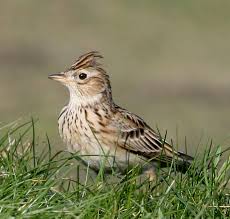
Oswald goes on to suggest that it is the “percussion” of Hughes’ language that instills such vivid life into his poems, quoting from ‘Skylarks’:

The lark begins to go up
Like a warning
As if the globe were uneasy –

Barrel-chested for heights,
Like an Indian of the high Andes,

A whippet head, barbed like

a hunting arrow,

But leaden
With muscle
For the struggle
Against
Earth’s centre.

And leaden
For ballast
In the rocketing storms of the breath.

Leaden
Like a bullet
To supplant
Life from its centre.

imgres

If it is a percussive effect that is critical here it is more Mozart than Stomp. Oswald has precious little space to develop her argument, but what I find in such a passage is Hughes’ distinctive manipulation of scale and perspective, not unrelated to his paradoxical comments above. Microcosm and macrocosm are continually leant against each other here, or – it being a more metamorphic, high-pressured process – they are spun about each other till it’s hard to pick one from the other. The tiny body of the lark is a warning to the globe; its braced, needle-thin ribs conjure images of Andean mountains; its crested, whippet head seems to speed lethally through remote forests. The three stanzas focusing on the “leaden” nature of the bird – less weight it seems to me, more loaded with quiddity, self-ness – provoke the reader to focus closely on its body, only again for our attention to be spun outwards to “Earth’s centre . . . rocketing storms”, vulnerable life beating at its “centre”.

In part, what Hughes achieves is a sense of interconnectedness – which he would have intended in both spiritual and environmental terms. What the reader experiences is a sudden inflation or deflation of scale and perspective, a magical effect, an effect created through language, an effect achieved so skillfully and instantaneously that one might well have some sense of a percussive, explosive or implosive quality. I don’t hear or feel a noise as such – my sense of the world pulses, is stretched or compressed in the most exciting fashion. An effect with a moral dimension to it as well – a serious, ludic experience, in which we see and re-see our own place in the world.

Two mindfulness narratives for Tim Parks

A fascinating and honest account of taking up mindfulness or meditation exercises by novelist Tim Parks.

http://www.theguardian.com/lifeandstyle/2014/aug/30/meditation-mindfulness-tim-parks-more-than-medicine

He says: Being simultaneously immobile, wakeful and wordless is an experience that runs contrary to all our habits, and for which there is no model in our culture, nothing we can visualise, no narrative we can follow.. . 

I’m reminded of a couple of specific chapters from the Daodejing I have been working on for the last year or so . . .

Resistance

chapter 10

Can you stop your mind from straying?

Can you hold to the one? Never let it slip?

Can you make your breath soft as a child’s?

Can you listen to its long-drawn out and in?

Can you renew the glass through which you gaze

so the world is sharp and vivid?

Can you feel love of others? And persuade them?

Yet resist the desire to dictate?

Can you latch and unlatch the doors of perception—

yet be content to play the female part?

Can your insight range, penetrate far and near,

then back away—not interfere?

Then raise them, every one—nourish them all.

Raise them, but make no claim.

Influence them, but do not dictate.

Govern them, but do not legislate.

Only this, says Berenice, can be called power.

Focus

chapter 12

The spectrum of colours

dazzles the eye.

A plethora of sounds

dulls the ear.

The palate is coarsened

by explosions of taste.

Excess of pursuit,

too much of the hunt,

leads to nothing but

the mind’s disturbance.

The much-coveted rarity,

the limited issue,

serves only to cramp

its owner’s liberty.

The teacher’s focus

is steadily within—

not on what catches

the common eye.

The truth is: she shuns

that, prefers this.

Liz Berry’s ‘Black Country’ reviewed

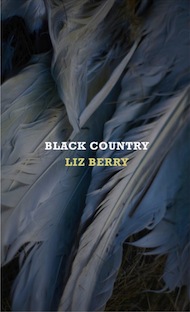
Liz Berry, Black Country (Chatto Poetry, 2014)

If a reputation can be earned through the writing of half a dozen poems of real worth then Liz Berry has probably already written them, earning her place in the landscape of early 21st century British poetry. Her debut collection (containing 14 poems from the earlier chapbook The Patron Saint of Schoolgirls (tall-lighthouse, 2010) has charm, accessibility and a humour that belies the serious ways in which she exerts pressure to counter the hegemonies of language, gender, locality, even of perception. Berry is a teacher by profession and will, no doubt, have equivocal feelings about her work appearing in classrooms – but it will rapidly and rightfully find a place there.
Liz-Berry

We resist what tries to define and suffocate us in part by declaring who we are. Berry’s confident, natural, even uninhibited use of her own Black Country dialect is one of the most superficially striking things about this book. Against “hours of elocution”, she opts for “vowels ferrous as nails, consonants // you could lick the coal from” (‘Homing’). Variously her grandmother and mother influence her in this and, in ‘The Sea of Talk’, her father also urges her never to forget the place of her birth with “its babble never caught by ink or book”. The definition of a community against the pull of a conventional linguistic centre is explicit here. Her grandmother is a frequent role model and the growing girl studies “her careful craft”. “Right bostin fittle”, the older woman declares (ie. great food – brains, trotters, groaty pudding) and the budding poet willingly touches her “lips to the hide of the past” to inherit the authentic gift.

Other poems, making it clear that locality is as much a component of who we are, record and celebrate the Black Country as “a wingless Pegasus” composed of scrub, derelict factories, disused coal shafts, yet still a “gift from the underworld” whose nature and fate is enough literally to make grown men weep (‘Black Country’). Berry takes huge pleasure in enumerating the details of her locale. “Come wi’ me, bab, wum Tipton-on-Cut” invites one poem which then takes a tour of waterways, allotments, parks, mosques, steelworks and canals (‘Tipton-On-Cut’). Similarly, ‘Christmas Eve’ seems to improvise from the great concluding paragraphs of Joyce’s story ‘The Dead’, using the ubiquitous fall of snow to lead the reader across the landscape of Beacon Hill, Bilston and Molineux.

We elude being imposed on and defined by others by changing. This, for me, is the more profound aspect of Berry’s work; so many poems unfold as processes of self-transformation. A mark of the book’s self-confidence can be found in ‘Bird’ which announces this motif of liberation: “When I became a bird, Lord, nothing could stop me”. Here, it is the mother’s voice urging, “Tek flight, chick, goo far fer the winter”. In keeping with this, the poems display a formal variety – free verse, short-lined quatrains, couplets, tercets, ballad forms, punctuation comes and goes. This is further reinforced by Berry’s bold, category-dissolving imagination which instinctively reaches for metamorphic possibilities. In ‘Birmingham Roller’ the escapee is a bird again, “jimmucking the breeze, somersaulting”; people become dogs, trees, pigs, fade to mere echoes, girls become boys. The donning of a pair of red shoes invigorates, eroticises: “rubies that glistened up a dress, / flushed thighs with fever” (‘The Red Shoes’).

Sexuality features so prominently in Black Country in part because of its potential for transgressive energy. I’m sure ‘Sow’ is anthology-bound with its “farmyardy sweet” female narrator, rejecting external definitions (“I’ve stopped denying meself”), accepting her true nature as a “guzzler, gilt. / Trollopy an’ canting”. This is a real tour de force of dialect, imaginative transformation and downright feminist self-realisation that “the sow I am / was squailin an’ biting to gerrout”, even daring the reader to “Root yer tongue beneath / me frock an’ gulp the brute stench of the sty”. Berry’s power of imaginative transformation is so powerful that the book creates mythic figures at will: the sow girl, the Black Country pegasus, the patron saint of school girls, Carmella the hairdresser, the Black Delph bride, the last lady ratcatcher. ‘Fishwife’ presents another of these figures like something from a quasi-pornographic Grimm’s tales. Attending a 17 year old girl’s wedding, she brings the gift of oysters, erotic energy, transgressive flirtation, power and ultimately pleasure:

                                            I slipped
from my bare skin
alive oh alive         all tail           all fin
how the tide tossed
until alive ohhh alive
the waves flung my shining body        upon the rock

She kisses the bride with “her tongue a plump trout” and other poems also resist categories to the extent of a sensation of gender-bending, or more accurately gender neutrality. I’ve already mentioned the girl who becomes a boy. ‘Trucker’s Mate’ reads like a homosexual “romance” and ‘In the Steam Room’ positively drips with sexuality – but of an explicitly “sexless” kind in which “any body / might give you pleasure”. ‘The Silver Birch’ achieves the extraordinary feat of evoking “sex [. . .] before sex” (eroticism before gender), “when I was neither girl or boy [. . .] a sheaf / of unwritten-upon paper”.

With so much dissolution of the normative, Berry dallies with the surreal and there can be dangers if the work does not also bear a weight of darkness. A poet like Tomaz Salamun writes in the tradition of Rimbaud’s systematic disorganisation of the senses, but combines, as Ed Hirsch suggests, “exuberant whimsy and fierce rebellion” to resist too easy a relationship with the pressures of the real. Happily, Black Country encompasses some richly productive tensions between the real and imagined, home and away, past and future, conformity and rebellion, sex and death. The latter rises to the surface through the middle of the book in poems like ‘The Bone Orchard Wench’, ‘Echo’ and the murder ballad ‘The Black Delph Bride’, acknowledging that the traffic between real and imagined contains plenty of irresolvable grit, impossible to wish away in any facile manner.

The collection concludes in more plainly autobiographical terms with the approach of the birth of a child and perhaps there is less imaginative pressure here, a risk of sentiment, “waiting [. . .] for the little creature that grew inside me”. Nevertheless, in reviewing first collections it’s traditional to look forward to achievements to come but this is inappropriate with Black Country simply because there is so much confidence, focus, shapeliness, already achieved uniqueness. Rather, this is a poet whose work presently demands our admiration. Oh yes . . . and what about those half dozen or so poems of real worth? I’d suggest ‘Bird’, ‘Bostin Fittle’, ‘Black Country’, ‘Tipton-On-Cut’, ‘The Silver Birch’, ‘Sow’, ‘Fishwife’. You’ll hear more of these in years to come.