Let Me Murmur a Few Spells for My Mother

I have spent these last several days in Wiltshire as my mother has had a fall and broken her hip. Dad is not able to look after himself around the house so we are trying to patch things as best we can for a couple of weeks. She says her feet got muddled as she turned from the microwave and went down hard on one side. The ambulance (from Bath, in these days of centralised medical care) took an appalling 2 hours to reach her. She seems pretty well considering she’s in her 90s but now the ward has been closed to all visitors due to an outbreak of Novovirus in the hospital. I have an atavistic sense that muttering a few spells about her, in trying to describe her in younger more vigorous days might help her recovery (and it sort of helps me too).

*

I am lifted then strapped into the child’s seat on the rear carrier of Mum’s bike. I remember the simple folding mechanism: the two sides inwards, then the back-rest folding forwards on top. She opens it and settles me in while the bike leans in the Passage (the covered pathway along one side of the house, outside the back door). Then I am wheeled out, up the front garden path, a little bump up the step onto the public path, now right and out to the main road. My limbs vividly remember the sense of her scooting for a few feet, gathering speed, then a more violent wobble to either side as she kicks off, begins to balance, threading her right leg through the bike frame onto the peddle. Steadying now, speeding up, the sense of her wide hips beginning to roll there before my face as we start to bowl along, lean into the left hand corner into Horse Road, heading for Trowbridge.

deaf32a26d5d3e990b449191ed45572e

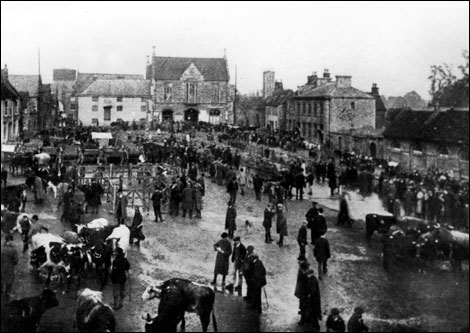
Perhaps we go to the old market hall. I have the sensation of progressing through it, through the high wrought-iron ribbed roof of the echoing hall with stalls of all kinds around. Then Mum and I emerge into sunlight out of the rear door which overlooks the old cattle market which is suddenly right there, spread out beneath us. There are steps down to the lower level; all the sounds of animals and people welling up from below. It seems a huge and dizzying prospect, an image of a far wider and utterly unmanageable society to a child unused to such things.
2880e0c5de74d08e6997f318b59d48eae3a495cf

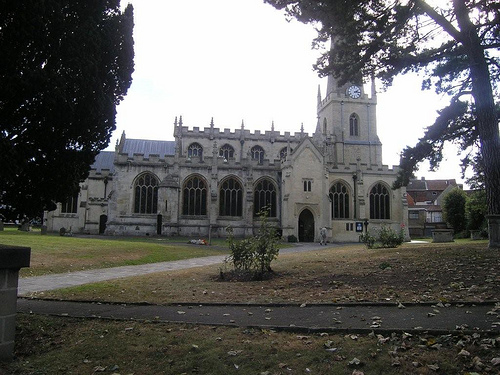
I am moving or more likely being moved in a push chair or (again) on the back seat of Mum’s bike, in through the rectory gate that stands at the corner of Church Street, across from the main gate of St James’ Parish Church. Little more than a sensation of broad lawns with a grand old house beyond them and in the foreground a gathering of people – women mostly, with their high voices – around trestle tables at some sort of sale, perhaps cakes. Perhaps it has been organised by the Young Wives group that meets in the strange narrow gothic building – accessed by a worn flight of steps – across the road.
3975485172_bc361c22dc

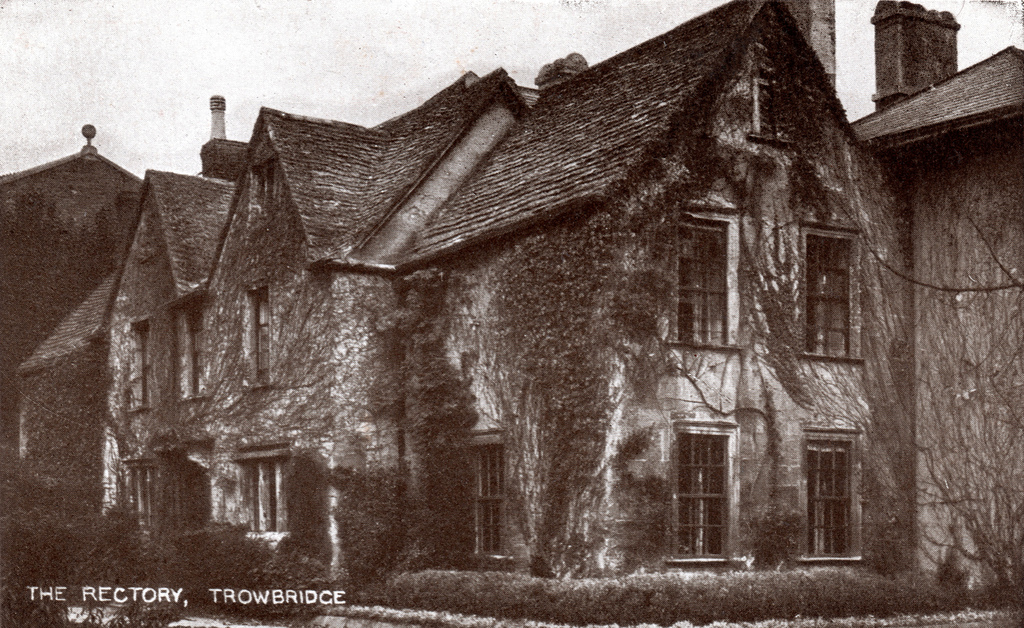
The Young Wives is more of a play group really. We go there each week and probably I have been there today but now I am being taken to the rectory, though whether we are going to buy or to help behind the stalls I don’t know. This is where the poet George Crabbe lived the last 18 years of his life as parish vicar, inspired to write whilst sitting under the mulberry tree in these rectory grounds. In one of the town’s earlier, spasmodic efforts at self-harm, the building was summarily demolished in 1964, only a year or two after this memory of the broad lawns of Crabbe’s old house.
8741286739_7da097588a_b

There is a photograph of her around the same time. We must have walked across the main road, down the lane to Oatley’s farm and then on to where the Kennet and Avon canal crosses the flat landscape. Dad has carried a deck chair or perhaps two and set it down, rakishly on the lowest rung for his wife who reclines in her white blouse and flowered skirt. A grassy field stretches into the distance – the shape of a cow, the field edged by darker trees, a brick wall and the whitewashed gable end of a house.

*

The sky is white so there is really no distinction between the upper part of the picture and the thick white border of the print. I am on her lap. Her right hand is at my back, her left reaching towards me as I seem to be twisting away to look at something out of view. Her gaze is fixed on me, mine is fixed elsewhere. Perhaps Andrew is running too far off. Or a bee is buzzing too close in what must be the summer heat. My 1960s children’s top seems the same pure white as hers but in the instant of the shutter falling all my energies are directed beyond the invisible white frame.
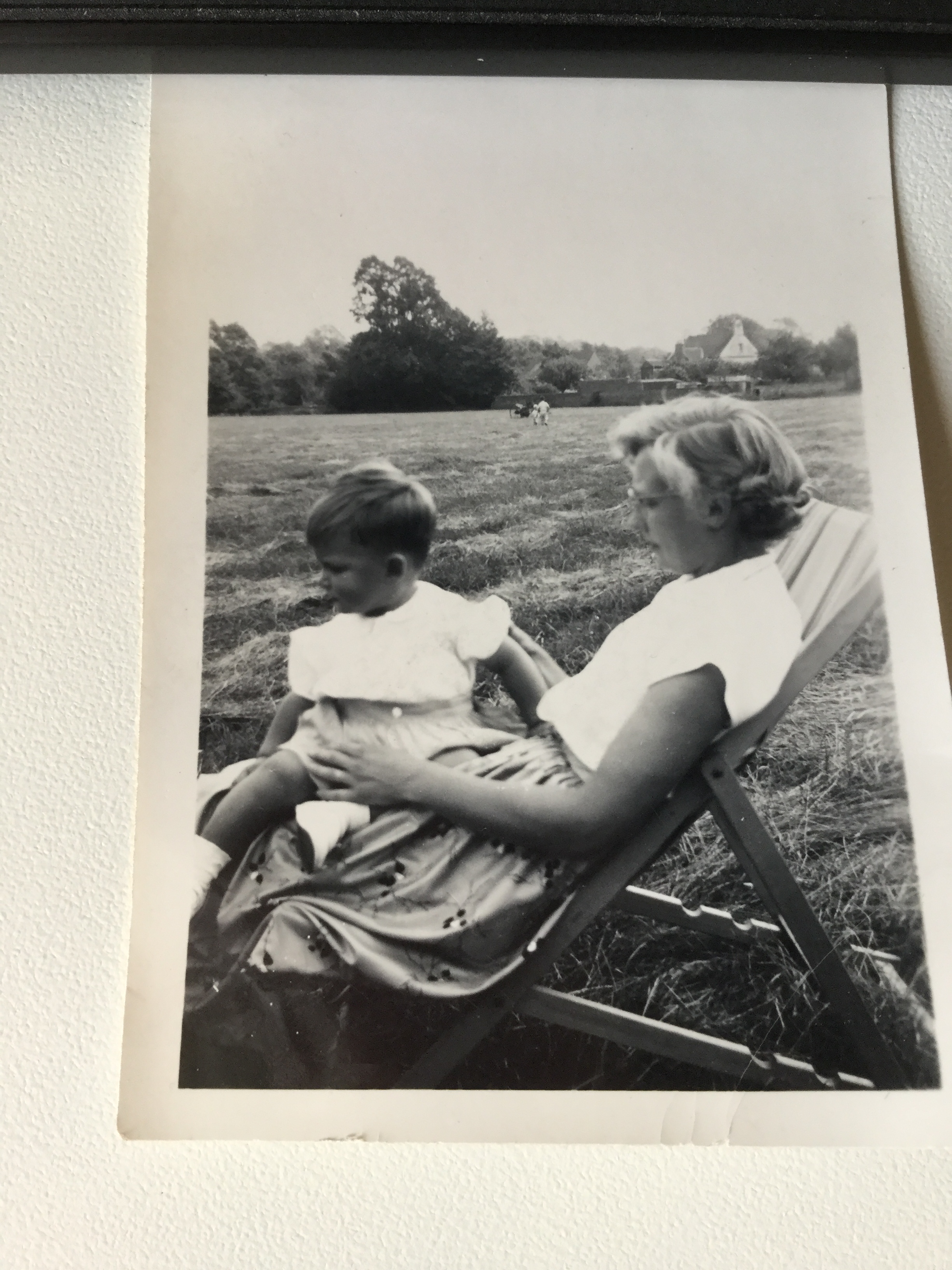
Me and Mum

There is knocking at the back door and Mum moves hurriedly, perhaps glancing a moment into the mirror on her way to open it. A figure blocks the light, wearing a brown overall or a working coat of some kind, over his right arm a huge wicker basket. Over his other shoulder, a worn leather money bag is slung. In the basket are loaves and rolls of all sorts. On a different day, a small grocer’s van is pulling up, its rear doors open and the smell of earthy potatoes spills out to where I stand, knuckles pressed to Mum’s skirt. Onions are like dusky suns, cabbages dripping with moisture and in the winter there are brussel sprouts, mushrooms still wrapped in the cold dark in which they grew. Other afternoons, a honking from the main road and the same flurry from Mum which – in hindsight – has something of a woman preparing to meet a lover about it. The callers are always men, punctuating her long days at home with the children, bringing gossip, simple treats, decisions to be made and a little flirting, merely oiling the wheels of commerce.
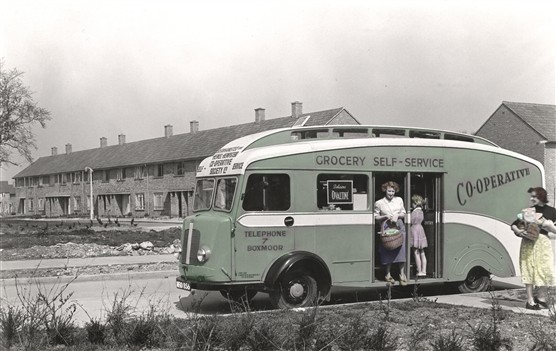
Grocery_van_in_Windmill_Road_1952.CNTHH.S371

Tuesday it’s the Co-op van stopping right outside our house. A folding step or two up into the back of the van, a high counter flap, an array of colours I can barely see. This must also have been the van that brought the pink paraffin for the living-room heater that clanked resonantly when moved and emitted a harsh warmth and oily fumes when lit. More on my diminutive level, the paraffin for sale flowed from a large container into a can Mum brought with her from the outhouse – a pink ribbon twisting and glinting like pop, its acrid smell the only sign of its poisonous combustibility.

*

Her calm rooted in humility – despite her evident brains and the few brief opportunities to exercise them. Her fear of upsetting the balance of a greater world. Her reluctance, as she will often express it while we are children, of ‘saying boo to a goose’. Shy certainly – but her social background was always part of that baggage. Extraordinary that this worked in partnership with his restive nature. That in part due to the pressures of disappointed expectations. Yet also driven by his reluctance to remain too long in one place, to forestall unwelcome thoughts, questions that might slow the skittering across the surface of himself from one completed DIY job to the next.

*

And now without her presence and without the holdfast of his own memory he skitters more and more out of control. All families nurture and elaborate their own particular myths for the hard times ahead.
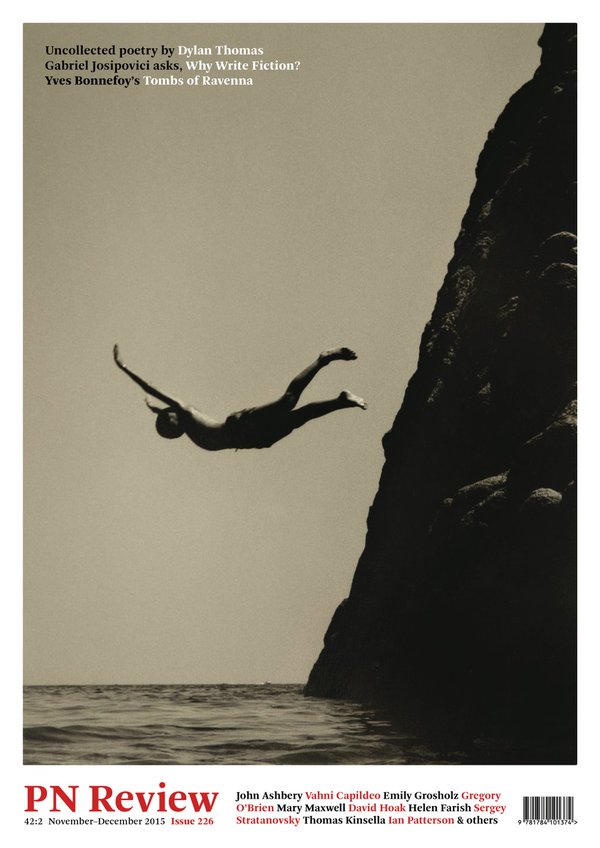
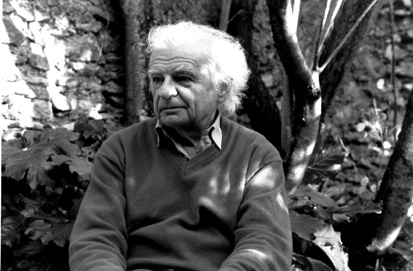
On Yves Bonnefoy’s ‘The Tombs of Ravenna’

In my last blog I was discussing Keats’ ideas about Negative Capability, provoked by a visit to Keats House and a discussion there about Negative Capability and psychoanalysis. The speakers were Dr Margot Waddell, a child psychotherapist from the Tavistock Clinic, and Dr Toni Griffiths, Trustee of the Keats Foundation. Waddell focused on the acknowledged influence of Keats’ idea on the work of psychoanalyst Wilfred Bion. In the aftermath of such major stimulation, the new issue of PN Review fell through the front door, containing John Naughton’s excellent new translation of Yves Bonnefoy’s 1953 essay, The Tombs of Ravenna. Keats and Bonnefoy melded in my mind and I was reading the latter in terms of the former as follows.

CTnk-FAUYAA5TFU

Bonnefoy observes that though many philosophers have discussed death, few have bothered to ponder the places where we traditionally lodge the dead: sepulchers and tombs. The explanation he offers introduces a key term for both his prose and poetry from 1953 to the present day: the concept. The concept, as in conceptual thinking, is a human creation, abstracted from the plentitude, the flood and flux of actual, particular human experience. It is “always a means of escape” into a more fixed abode. The concept denies time and is “a profound rejection of death”. It denies the fact of death as our inevitable fate and constructs an illusory “dwelling place of logic”, a more alluring place of “permanence and identity”. Also, and crucially, the concept is “made of words”. Language is a similar construct, also seeming to promise the same sort of escape into the timeless, the unchanging. All forms of conceptual thinking seem to promise an achievable resolution but, Bonnefoy argues, “what is pondered is no longer the real object”. Instead, we contemplate “a dubious knowledge” though it may soothe our “initial anguish and trivialises that most somber melody with words that mask the reality of death”.

Bonnefoy1

So the concept promises a “strange immortality” but only if we can “forget brutal reality” – which, of course, we can and readily do. One reason is that there are general truths in conceptual thinking and a particular kind of power derived from it. It “allows thinking” of a certain kind; it is linked with “the vast power of words”. But any gain is predicated on a significant loss, the abandonment of the actually existing “world of things”. Conceptual thinking is “systematized”, generalizing, categorizing; it’s in this that its “flight” from the real is found. The only sort of thing that can be held up to counter the concept are specific particularities of human experience: Bonnefoy asks “Is there a concept for footsteps in the night, for a cry, for a stone rolling in the brushwood? For the feeling evoked by an empty house? No [. . . ]”

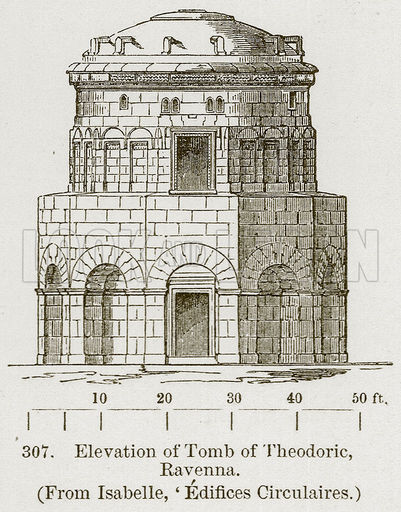
Elevation of Tomb of Theodoric, Ravenna

In his letters, Keats calls this sort of non-particular thinking “preresolved” and he encountered it especially in his friend Charles Dilke: “a man who [. . . ] has made his Mind up about every thing” (303; page numbers in brackets are to John Keats: Selected Letters (Oxford World Classics, newly revised 2002)). Dilke is one of the “stubborn arguers” who never begin on any subject “they have not preresolved upon” (303). In contrast, Keats argues the only means of strengthening one’s intellect and identity “is to make up one’s mind about nothing – to let the mind be a thoroughfare for all thoughts” (303). Keats’ best formulation of this idea arises when several things “dovetailed” in his mind after a frustrating debate with Dilke. The quality that marks out the artist – Shakespeare especially, he says – is Negative Capability. He defines this as consisting of a passive openness to the full range of particular human experience (“uncertainties, Mysteries, doubts”) without any imposition of preconceived notions, preresolved ideas or language: “without any irritable reaching after fact & reason” (41/2). Bonnefoy’s insight is that rather than being an occasional tendency, this reaching after fact and reason (conceptual thinking rather than direct, particular, various experience) is our default status. We pass our days in a delusion of resolution and systematization because if we did not we might fry our brains with the overload. In his last ever letter, Keats laments “the knowledge of contrast, feeling for light and shade, all that information (primitive sense)” as having become a great enemy to his “recovery” from his present state of illness. (369).

Yet the dully pragmatic ought not to be allowed to displace truth: Keats in better health argued this and Bonnefoy does the same in The Tombs of Ravenna. Bonnefoy’s essay for several paragraphs plays devil’s advocate, expecting to find “horror” in visiting the tombs of the dead, yet admitting that he felt “nothing but lightheartedness”. Initially, he locates this sense of up-lift in the ornamentation of the tombs, the “braids and interlacing [. . .] bows and foliage”. The essay playfully misleads its reader, suggesting that this effect of the ornamentation must be because it is comparable to the “concept” in denying the fact of death. Bonnefoy says he believed (note the past tense here) that ornamentation also abstracted towards the universal from the real, that the ornamentation presented “a closed world”, a world of “harmony”. Hence, just as the concept “seeks to establish truth without death [. . .] It seemed to me that ornamentation sought to build a dwelling place for us without death, and to have death no longer be here”. Visiting Ravenna, Bonnefoy felt lighthearted beside the tombs because its skilled and delicate ornamentation persuaded him of a world of permanence and consoling abstraction (beyond death, other than death).

20901_7280829414ee63113ca44b

But the essay now turns dramatically to deny the validity of such consoling sophistry. It’s invalid because Bonnefoy had failed to understand “the power of stone”. His insight is that it is not the ornamentation which is at the root of his lightheartedness but the very material out of which it has been carved. Stone is “unfathomable, and this abyss of plentitude, this night covered by an eternal light, is for [Bonnefoy] the exemplary form of the real”. What he means is that stone deflects the grasp of conceptual thought; conceptual thought distances itself from stone as it does from death. Stone is or represents “the difficult real” and it is or represents the “dawn of the sensory world”. Stone’s resistance, its very hardness, gestures towards the fullness and particularity of human experience (what Keats calls a “Life of Sensations”), towards “everything that has flesh, heartbeat, immanence”. The stone leads us towards the “truth tenaciously present beneath the truth of the concept”. And it is the latter ‘truth’ that Bonnefoy declares he must “tenaciously contest”.

The battle in Bonnefoy’s thought between the sensory world and the concept reflects Existentialism’s concern for existence rather than essence. His faith in a world resistant to and actually prior to the draining, withering forces of the intellect, his resistance to post-modernism, are reasons why he strikes many as such an inspiring figure. He says: “This world here exists, of that I am certain [. . .] It is simply with us. In what can be felt and sensed”. In The Tombs of Ravenna he names this underlying truth, not as existence, but “presence”. It is “what is perceived by the senses” and it was a dimly stirring awareness of this truth that constituted the “lightheartedness” he felt before the tombs of Ravenna. Through an encounter with the stone from which the tombs are constructed, the resistance of both life and death to the abstracting processes of conceptual thought was made clear and the pleasure induced arose from his closer approach to a fundamental truth.

Just as for Keats, such ideas have consequences for art and poetry. For Bonnefoy, poetry seeks to represent the real particular truths of human experience, to convey what it can of the “dawn of the sensory world”, as opposed to succumbing to the lure of conceptual thinking, even that conceptual thinking inherent in the very fabric of language itself. This specific paradox is not explored very far in The Tombs of Ravenna in which he confines himself to declaring that we require “another language than that of the concept” to articulate such truths. He concludes poetry’s only concern is “for that spot in the world I can sense” and because it must, as far as possible, resist the lure of conceptual truths (truth without death) it follows that “poetry and journey are of the same substance, the same blood”.

SONY DSC

What such a poem might look like is suggested in those few moments when Bonnefoy himself resorts to “minute particulars”. On one such occasion, drawing from his own life, he tells us of “the cry of a bird I heard as a child, at the crest of a kind of cliff. I don’t know where that valley is anymore, or why or when I was there. The light is the light of dawn or of evening, it doesn’t matter. Through the brushwood runs the pungent smoke of a fire. The bird sang. Rather I should say, to be exact, it spoke, raucous on its misty height, for a moment of perfect solitude”.

Or as Keats put it in 1819, having listened to a nightingale singing on Hampstead Heath:

Adieu! adieu! thy plaintive anthem fades

Past the near meadows, over the still stream,

Up the hill-side; and now ’tis buried deep

In the next valley-glades:

Was it a vision, or a waking dream?

Fled is that music:—Do I wake or sleep?

730052102

Keats’ Negative Capability Clearly Explained

Recently I went with some teaching colleagues to Keats House, London, to hear a discussion about the poet’s idea of Negative Capability and psychoanalysis. The speakers were Dr Margot Waddell, a child psychotherapist from the Tavistock Clinic, and Dr Toni Griffiths, Trustee of the Keats Foundation. Both were fascinating, condensing whole areas of scholarly knowledge into accessible (if intense) 45 minute talks. Waddell focused on the acknowledged influence of Keats’ idea on the work of psychoanalyst Wilfred Bion.

imgres

I’m not sure I feel very qualified to comment on that intriguing area without a good deal further reading, but a memorable phrase arose from it: Waddell argued that Bion saw the way that preconception obstructs perception and how this must adversely affect the therapist/patient relationship. Toni Griffiths’ elegant and economical discussion of Keats’ work (not merely the Negative Capability idea) set off several days of thought for me and has produced what I think will be two blog posts. Firstly, and perhaps largely for myself, I wanted to clarify my own understanding of Keats’ idea which has long meant a great deal to me. In my next post, I want to explain how those thoughts have “dove-tailed” (Keats’ own brilliant phrase in the Negative Capability letter to his brothers George and Tom, December 1817) with a recent translation of Yves Bonnefoy’s 1953 essay The Tombs of Ravenna (in the most recent PN Review (No. 226, Nov-Dec 2015, pp. 58-63).

This second blog is now available to be read here.

What follows below is my assemblage of observations from Keats’ letters, hopefully into a clear argument, indeed, into Keats’ coherent theory of poetic achievement and practice (though Negative Capability of course eschews all such systematizing). Page numbers in brackets are to John Keats: Selected Letters (Oxford World Classics, newly revised 2002).

imgres

In his 1817 letter to Benjamin Bailey, Keats wishes for “a Life of Sensations rather than of Thoughts!” (36). Just a year later, in a letter to James Hessey, he clarifies this distinction, suggesting that poetry is not “matured by law & precept, but by sensation and watchfulness” (146). The language use Keats associates with law and precept is evidently a fixed, a “preresolved” (303) language. What he seeks inits place is rather a language sufficiently flexuous and responsive to “watchfulness”, to attentiveness and often, when Keats discusses this, there is a strong sense of passivity. Writing to Bailey, characteristically using the phrase that an idea had “pressed upon” him (35), he says it has “increased my Humility and capability of submission”. The idea he is referring to is that artists (“Men of Genius”) “have not any individuality, any determined character”, as opposed to “Men of Power” who are replete and resolved in “a proper self” (35).

Keats’ distrust of such self-confident preresolution famously emerges in the 1818 letter to John Reynolds, as his dislike and distrust of poetry that has a “palpable design” on us (58) and to Bailey he contrasts this with an alertness to the “holiness of the heart’s affections and the truth of Imagination” (36/7). Preresolution pre-packages or pre-limits our emotional and spiritual life, whereas Keats is intent on welcoming “all”. This is what he means in the phrase “a Life of Sensations”, the latter word (rather misleadingly) encompassing both emotional and spiritual life as well as a full, open and alert response to the world about us. Such a full engagement with present experience is where we feel Imagination at work: Keats asks Bailey if he has not felt this in even such common experiences as listening to “an old Melody” and in the “elevation of the Moment” Keats declares we are “mounted on the Wings of Imagination” (37).

730052102

This ideal of a radical openness to present experience and its passive acceptance, was further clarified for Keats in his later dealings with his friend, Charles Dilke, who was becoming something of a political bore (spouting Godwinian philosophy and politics), a man who had resolved upon most issues. Keats again links this state to identity: Dilke is “a man who cannot feel he has a personal identity unless he has made his Mind up about every thing” (303). Dilke is one of the “stubborn arguers” who never begin upon any subject “they have not preresolved upon” (303). In contrast, Keats argues the only means of strengthening one’s intellect and identity “is to make up one’s mind about nothing – to let the mind be a thoroughfare for all thoughts” (303).

Keats’ best formulation of this idea arises when several things “dovetailed” in his mind after another frustrating debate with Dilke. The quality that marks out the artist – Shakespeare especially, he says – is Negative Capability. He defines this as consisting of a passive openness to the full range of human experience (“uncertainties, Mysteries, doubts”) without any imposition of preconceived notions, preresolved ideas or language: “without any irritable reaching after fact & reason” (41/2). Once again, the best way to understand this is through Keats’ word “watchfulness”, an attentiveness to the true nature of experiences. In yet another foray into these ideas, he experiments with the word “disinterestedness”. This again implies the absence of a forceful or dominating self, full of preconceived ideas, words, precepts. Writing to his brother George, he says “complete disinterestedness” is a difficult goal. He admits he is himself “far” from it though personally and in social terms he believes it “ought to be carried to its highest pitch” (213).

female-house-sparrow-on-gravel

Such moments of disinterested perception occur in his observation of a sparrow picking about on the gravel (37). Approached with Negative Capability this mundane moment becomes something that “startles” and Keats says “I take part in its existince [sic]” (37). In this way, the poet is continually “filling some other body” (148). Such is the truth in a “Life of Sensations”, fuelled by Imagination, and one of the delights of a human life is that these happy moments will continue to be “repeated in a finer tone and so repeated”. The mind develops in this way through the repetition “of its own silent Working” (36). These refinements of the mind can occur only when experience is encountered openly, nakedly, even dangerously. To Reynolds, Keats wrote that to become fully “fit for this world”, with all its pains and hardship, a man would have to have “the fine point of his soul taken off” (39). But the poet or artist cannot afford to be so blunted by experiences but must remain radically open, even submissive to them. In the same letter to Reynolds, Keats quotes Shakespeare’s Venus and Adonis: “As the snail, whose tender horns being hit, / Shrinks back into his shelly cave with pain”. Such a reaction of withdrawal must not be countenanced by the would be artist. To Richard Woodhouse, Keats wrote “What shocks the virtuous philosopher, delights the camelion [sic] Poet” (148). The work of the poet experiences “no harm from its relish of the dark side of things any more than from its taste for the bright one” (148).

John_Keats_by_Benjamin_Robert_Haydon

Keats recognizes and accepts the personal, experiential conclusion of such thoughts as he records his own sensation of feeling annihilated in a crowded room because “the identity of every one in the room begins to press upon me” (148). Yet this absence of a resolved self (pushing and barging over-confidently outwards) leaves room for such delicate encounters as that with the sparrow and on other occasions, catching a glimpse “of a stoat or fieldmouse peeping out of the withered grass – the creature hath a purpose and its eyes are bright with it” (213). Keats regards such escape from or evasion of this confinement to self as a form of purification: “there is an ellectric [sic] fire in human nature tending to purify” (213). He names Socrates and Jesus as perfections of this state, though “it is to be lamented that the history of the latter was written and revised by men interested in the pious fraud of Religion” (214). Of course, poetry must also aspire to this state and (as David Constantine has argued in his Bloodaxe lectures, A Living Language 2004)) Keats’ “gymnastics” in trying to broaden his native language-use (with its preresolutions) through a variety of foreign poetic experiments suggests he knew this well enough.

imgres

By the spring of 1819, Keats was further developing his ideas about the role and nature of the self with the letter discussing life as a “vale of Soul-making”. He dismisses naïve ideas of the “perfectibility” (232) of mankind, even doubting the real progress made by any “seldom appearing Socrates”. He jokes that fish are as likely to “philosophise the ice away from the Rivers” as man is likely to arrive at a perfect state because “the nature of the world will not admit it” (232). However much happiness a man can experience, there will still be worldly elements that “prey upon his nature”. It is from this conviction that Keats proposes – in stark contrast to any Christian reading of man’s life –the idea that we are born as intelligences (“sparks of the divinity” or “atoms of perception” (232)). Then through a system of “Spirit-creation”, the intelligence develops into a Soul by refining an individuality or identity. This process is an educative one, fuelled by Negative Capability, in that the world is allowed to impact fully on the human heart which is led to “feel and suffer in a thousand diverse ways” (233). Man can never achieve a state of perfection but as the world’s school of hard knocks is openly, vulnerably embraced so the process of individuation occurs via emotional experience. It follows that the human heart is “the teat from which the Mind or intelligence sucks its identity” (233). As various as the lives of all individuals are, so “various become their souls” since individual emotional experiences are the “fortifiers or alterers” of our ever-developing nature (234).

So Keats’ ideal poet must possess Negative Capability to fully experience the world before him without preresolution. Armed with sufficient language skills to express the plenitude of these experiences, the poet’s role is then to re-present them to the reader in such a way that the poem itself contributes to the reader’s own developing emotional life. The work of art is therefore an important contribution to the reader’s own on-going process of Spirit creation or individuation (though this is only going to occur if the reader too is possessed of Negative Capability and is not someone who opens a book of poems with firmly preresolved expectations and ideas).