An edited (shorter) version of this review first appeared in Poetry Salzberg Review in June 2025. Many thanks to the editor, Wolfgang Görtschacher, for commissioning the writing of it. The collection, Rhizodont, was shortlisted for the TS Eliot Prize in 2024.
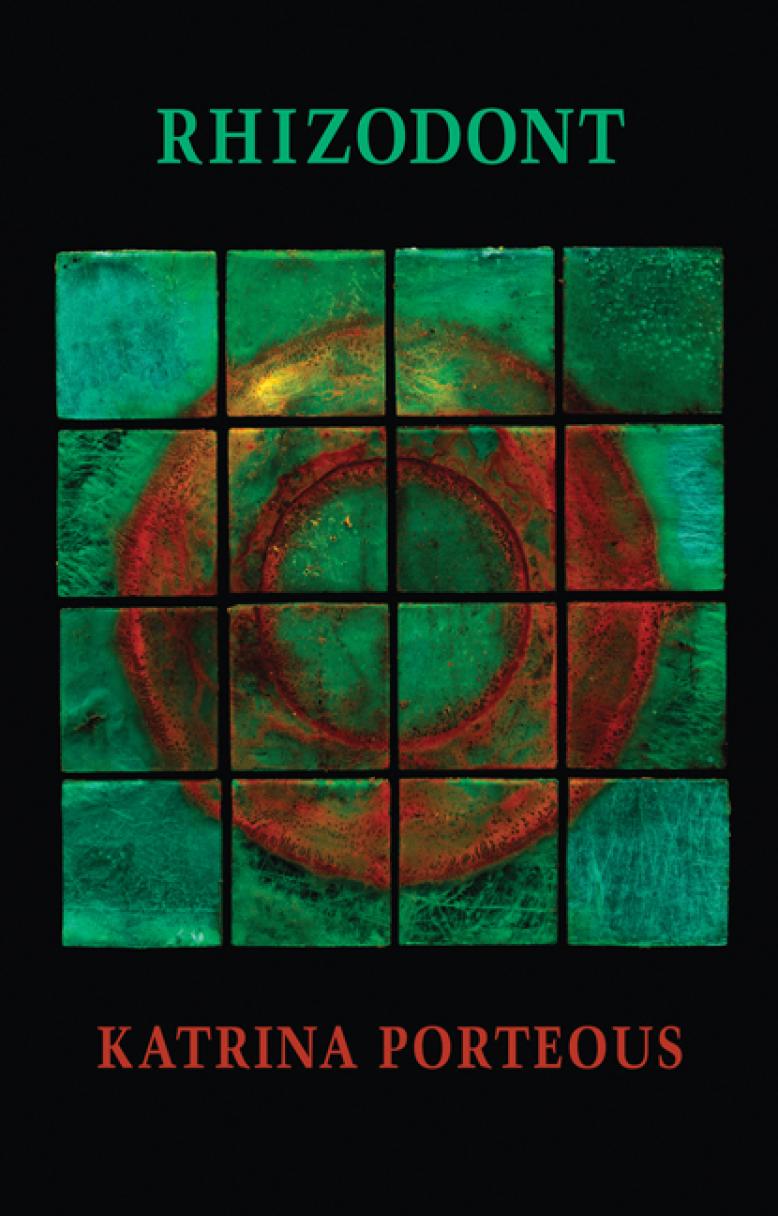
The ‘rhizodont’ which provides the title for Katrina Porteous’ fourth collection (Bloodaxe Books, 2024) is not some niche root-canal dental work, but a large predatory species of fish, which became extinct 310 million years ago. It’s thought to be the first creature to transition from water to land and hence the ancestor of all four-limbed vertebrates (including humans). The poems here are divided into two superficially very separate books (titled ‘Carboniferous’ and ‘Invisible Everywhere’) but what Porteous insists holds them together is her exploration of this notion of transition. As ‘#rhizodont’ puts it, ‘We’re all on a journey’, and the ambition of this book touches upon transformations various: geological, natural, industrial, cultural (and linguistic) and technological. There can be no faulting the ambition of this and there are many fine poems, though Porteous insists on Notes explaining a great deal of what she is doing/writing about which gives the whole a rather teacherly quality that will divide her readership. Here’s the title poem in full, plus a video of the author reading it:
#rhizodont
Then, in a flash,
It claps shut – an ambush –
Teeth, fangs, tusks – crunch, rip,
x
Snap. The rhizodont,
Dragging itself out of water.
The old world sinks and slips
x
Beneath its tilted strata.
We’re all on a journey.
This one’s about us
x
Unearthing ourselves from a place –
Somatic, interlaced –
To be conjured from light, and sent
x
Invisible, everywhere,
For everyone to possess.
The children stare at their phones,
x
A fervent, lit up,
Incorporeal congregation,
Some deep, residual
x
Root in a life everlasting
Outlasting them, like a fossil
Sarcopterygian fish.
The longer ‘Carboniferous’ section is loosely glued together by a geographical journey from the former coalmining communities of East Durham, moving up the Northumberland coast to Holy Island. This is familiar territory, important to Porteous’ earlier collections, and she again writes well (with great local knowledge) of the geological conditions that have eventually given rise to the important fishing and mining industries (and cultural communities) in the area. Both industries are now in decline and in ‘A Short Walk from the Sea’s Edge’, while the older folk still use ‘old words’ (like stobbie, skyemmie, and gowdspink), the younger generation ‘checks in with Insta before school’. This also illustrates Porteous’ belief that the post-war generations’ transition ‘from analogue to digital technologies’ is a particularly dividing and challenging shift such that ‘the analogue island we lived on’, will seem as incomprehensible as ‘Latin and Greek’ to future generations (‘Hermeneutics’).
The poems also portray the natural wildlife of the region – dragonflies, sandhoppers, crabs and a wide variety of birds and plants. Despite coastal erosion and industrial pollution, Porteous focuses on such ‘small and local’ species as have been around for (often) millions of years. The glowworms in ‘Tiny Lights’ are ‘alien, ancient’ and for most residents of the area, completely ignored, though their continuing existence offers some sense of a continuity amidst vast change. The sounds and sights of the birds in ‘Goldcrests’ are marvellously observed, and they serve both to mark the season and, ‘bringing // Wildness’, they remind us of the natural world’s wider perspectives. The ‘Grey Heron’ is likewise superbly captured in the course of 18 shortish lines, but does the poem really need its 25 line prose Note, detailing the setting’s geographical history, the life cycle of Atlantic salmon, conservation measures being taken and the poet’s intention to place ‘the timeless drama of the ‘prehistoric’ grey heron against [the town of] Amble’s history, first as a coal port then as a salmon fishing harbour, and depict the bird as an explorer, venturing into Amble’s still-to-be-decided future’? I’m not convinced, though you don’t have to read them, and it’s true Porteous’ stated intent is merely to inform, and stimulate further reading.
But can a poet’s commitment and enthusiasm spill over too much? Rhizodont contains 111 pages of poetry and 30 pages of Notes and explicatory Introduction, containing lots of interesting facts and figures, but also a good deal of over-explanation as in the Note to the poem ‘Wishbone’: ‘The poem juxtaposes recent cultural evolution with this enormous timescale, and asks what we, with our plastic waste, will leave behind us’. Most poets would leave such interpretation up to the reader and Porteous’ (admirable) compulsion to write about things she believes are important, is also conducive to poems being written under less than compelling conditions, perhaps to fill a gap in a sequence, or to make a point not yet covered elsewhere. It’s almost certainly deliberately excluded, but this reader misses a bit more of the poet’s involvement, either personally, as in ‘Begin Again’ in which, confronted with the vastness of geological time and Nature’s endurance, the speaker’s suddenly ‘ glad / Of tea-cups, hands, companionable laughter’, or of the poet’s love of words and music as in the several balladlike pieces included here ( like ‘The Tide Clock’ and ‘Low Light’).
The collection’s second section ‘considers aspects of the latest waves of industrial and technological revolution’ and, rather than dwelling on alternative energy sources, Porteous writes about technologies which ‘extend human senses and reasoning’, by which she means remote sensing devices, robotics, autonomous systems and AI. She is unusually optimistic about such developments, arguing (in poems and Notes) that such technology will be used to ‘understand more’ about the world we live in (but there’s precious little here about the commercial exploitation of such developments). And the poems themselves? They often suffer from the abstract nature of scientific terminology and don’t convincingly convey much emotion about the tech. It’s interesting how often personification / anthropomorphism is used in these poems; the Antarctic ice speaks, or is spoken to, and here is the voice of a Miniature Robot for Restricted Access Exploration (‘MIRRAX’): ‘Omnidirectional – versatile, nimble, [I] glide / On four independent wheels, weasel my way / In continual metamorphosis, changing form, // Amorphous’. Other poems versify descriptions of analytical processes (‘Sample Analysis on Mars’) or praise certain aspects of the natural world from which science gains understanding (‘Cosmogenic Nuclide’, ‘Basal Shear’). It is this ingenuity that is the point, but the poems fall short on informativeness (hence the need for Notes), but also fall short on emotional engagement (poetry?), failing in the end to convey Porteous’ stated intention: to reflect ‘in awe and wonder that human consciousness is able to gather and interpret [all this] information’ [my italics]. The people and landscapes of ‘Carboniferous’ are far more successful as poems to be read and enjoyed, while ‘Invisible Everywhere’ is a bold, well-intentioned experiment that fails.
 Martyn Crucefix