The new book from the innovative and enterprising Hercules Editions – launched at the LRB Bookshop in London’s Bloomsbury last week – contains poetry by Helen Mort, images by Emma Stibbon, a conversation with composer William Carslake and an essay from Manchester Met academic David Cooper. What holds these diverse components together (within 40 pages) is a trip Mort, Carslake and film-maker Richard Jones made to south-eastern Greenland in 2016. You can see the original Kickstarter post here.
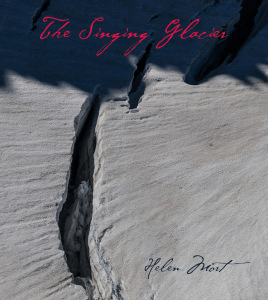
So The Singing Glacier project is truly inter-disciplinary and the Hercules book is making available Mort’s poetic contributions to it. Mort’s conversation with Carslake serves to introduce the origins of the project in 2012 when the composer looked down from a plane to see Greenland’s regressing glaciers “like a hand with fingers”. More evocatively, and much closer, he talks of standing beside crevasses and moulins and listening to the sounds emanating from them, “like hearing a Welsh male voice choir singing from this great big hole in the ice!” The Hercules book has photos of Carslake’s notebook, clusters of notes and a few words jotted on the spot. Mort disarmingly says how she envied this seeming directness of acoustic transcription as her role was to come up with words and inevitably much of what she initially wrote down “was just cliché”. She wonders whether cliché is a reasonable response to the vast and alien landscapes they were moving through, sights before which “linguistic originality can almost seem a little arbitrary”. This is not her final conclusion, but her comment does raise one of the fascinating issues in this beautiful little book – what a poet does with the tensions between speech and silence, more abstractly between sound and its absence.
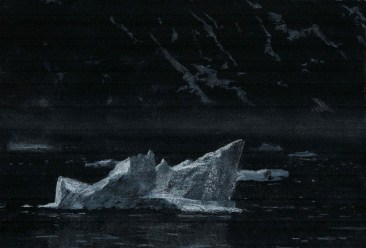
In a review of Mort’s first book, Division Street, I thought her “love of landscape [was] profound and, like Wordsworth, her hills and skies remain a locus for, as well as an image of, the process of self-exploration”. On that basis she would be a good poet to send to Greenland but – she confesses – she was sometimes reduced to wanting simply to cry and – this hesitantly expressed – it felt “like being in the presence of a god”. These are unmistakable encounters with the sublime and the urge to anthropomorphise such a vast alien landscape is quick to arise, so any efforts at self-exploration might seem worse than arbitrary, positively disrespectful. But how then to engage? ‘In Defence of Cliché’ takes off from Mort’s honestly expressed concerns about inadequate linguistic responses to this landscape:
I write: ice in the fjord as pale as thought
then hear the calving face crash through my language
with a sound (like what?) like cannon fire
![moulin-glacier-11[2]](https://martyncrucefix.com/wp-content/uploads/2018/05/moulin-glacier-112.jpg?w=352&h=264)
Similarly, the moon fails to be adequately captured by images of “petal, snowball, sleeping moth”. She quotes Hopkins on the way observations of nature can correct our “preoccupation” with the world – again walking the fringes of the divine here – becoming a way in which we learn humility. Mort ends the poem cleverly. Our best word for this sort of experience is “awe” but the word baldly used would not possess enough freshness or fire (thank you Gerard Manley) to carry the weight of feeling. So Mort goes for a down-to-earth metaphor followed by a phrase that manages both to say and not-say it simultaneously:
… we stand like nothing, shaken
from the pockets of our lives, our mouths
stuck on the silent word for awe.
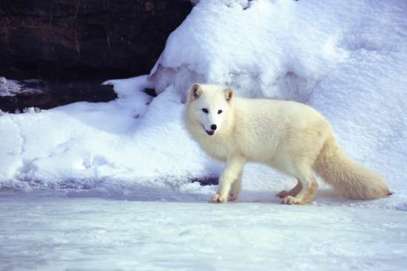
The poem, ‘Arctic Fox, August’, is more reminiscent of Mort’s favourite poet, Norman MacCaig. The creature is acutely observed in its colours and hesitant movements around the campsite but the poem ends with a series of rather coercive, descriptive metaphors: “a hunger-striker . . . a gathering memory . . . the habit you thought / you’d kicked”. For me these images circle and knot ever more tightly onto the observing human consciousness, almost doing violence to the creature so well observed at the start. The poem ‘Polynya’ – the word signifies an area of open water surrounded by sea ice – reverses this tendency to humanise the natural by naturalising the human:
Surely the heart
must have polynya –
places where it’s never
hardened into ice.
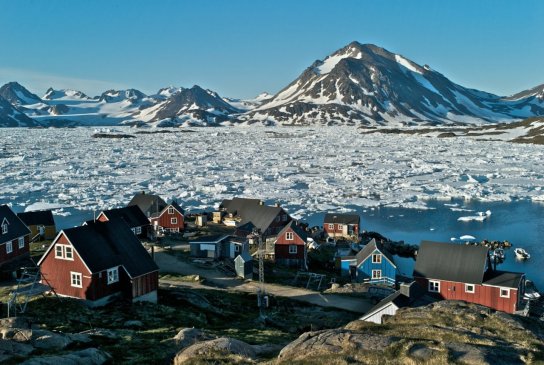
The image of the partially melted heart turns easily into a love poem. Another method Mort adopts to try to respond to the Greenland landscape is through found language. So ‘And Noah’ arose from a conversation with an inhabitant of Kulusuk (though I think Mort said at the LRB launch that much of the detail came from the little museum in that town). The result manages to suggest something of the way of life in this landscape, a work place – the found nature of the phrases enabling the poet to avoid too strong a sense that neither she nor her work are an “imposition”.
David Cooper’s essay on acoustic geographies and poetry of place takes a more academic look at the multi-media project, suggesting that it – like a lot of recent geographical creative writing – sets out to challenge the easy domination of the visual sense by accentuating the acoustic or aural. This is partly because sound “reminds us of our own embodied situatedness and inextricable embeddedness within the world”. The eye puts us at the controlling centre; the ear is more often passively assailed from all sides. The eye easily steps back and away; the ear is within the sensed world (I’ve discussed similar ideas of within/without or within/above in relation to Holderlin’s novel Hyperion in another blog post). Mort’s best work in this little book is done when she listens in to these sounds and silences. ‘The Glacier Speaks’ does succumb to the kind of anthropomorphism Mort says she was wary of. But it works well since the voice of the glacier is such a challenging, even taunting, one: “Go on then / says the glacier – / how are you going to score my silences?” The glacier reminds the poet of its silence through noting the kind of sounds which book-end it or by comparing its absence of sound with more familiar moments of silence such as that between lovers, between a mother and a daughter. Here the comparisons work not through similitude but dissimilitude – my silence, the glacier says, is nothing like these. I thought an odd note was struck at the end of this poem when the humans are described as impressed by such silence (“more like a vigil”) yet the glacier suggests they are each “trying / to get back to me”. This is intended, I presume, to evoke human puniness, a Lawrentian “pettiness”, but it also smacks a little of the glacier’s over-anthropomorphised self-regard.
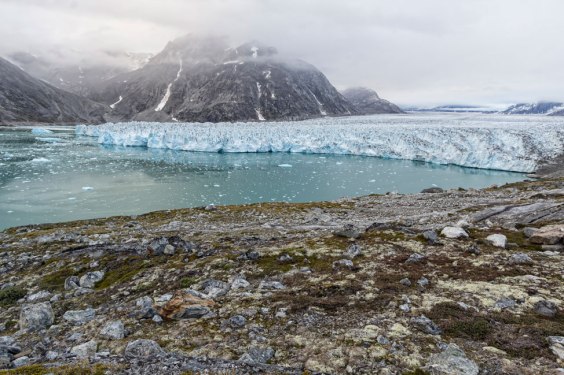
But the poem ‘Glacier Song’ is magnificent. Not the right word I’m sure, but it approaches the Greenland landscape – the Knud Rasmussen glacier in particular – with a right sense of decorum. Silent is what the glacier is again – a “library of absences” – and this is conveyed partly by suggesting that the nearby fjord is more talkative, more full of songs. But Mort then cunningly withdraws this idea: even the chatty fjord is really silent – how much more silent then is the glacier! Later, the Arctic light – remember Cooper’s discussion of the predominance of sight – interrogates the glacier like an airport security check, quizzing and questioning because light always knows better, light always wants the last word. But “The glacier carries on / rehearsing privately”. The final section of this longer poem alights on the distant figure of a woman (the poet?) who, herself, wants to be singing. Here, we feature as the little, forked animal, stuffed full of language bursting to get out, trying to communicate something about glacier climbing, about ptarmigans, the Northern Lights, even about the glacier itself. But the ice remains mum to the last:
The glacier has not slept
for centuries.
The glacier is restless, lithe,
insomniac
articulate
and doesn’t need
a word for itself.
 Another young female narrator deliberately stays at home while her parents (conventionally) go to church on Sundays. She’s a teenage rebel without a cause as “The truth is I’m not sure what I did / those mornings”. The poem is built from a list (one of Littlefair’s favourite forms) of what she did and did not do. Littlefair is almost always good with her figurative language and here the girl is variously an undone shoelace, an open rucksack, a blunt knife. The urge to non-conformity outruns her imagination as to how she might spend her growing independence and there is an interesting tension at the last as her parents return, “whole” having “sung their hallelujahs” while the young girl is till restlessly revising her choice of nail polish, as yet unable to find what she’s after.
 I think I find this with some other poems too, though it’s partly because Littlefair is admirably intent on presenting the working world, the world of labour, as routine in contrast to the allure of a more adventurous life. ‘Assignment brief’ presents itself as an old familiar’s introduction to a new girl’s routine office job; the lists and proffered options are funny but they slowly run out of steam. Likewise, the promisingly titled ‘Usually, I’m a different person at this party’ flags latterly. I’m imagining this as narrated by an older version of the girl who half fell in love with Tara Miller. Here, she shadow-boxes the risks of conventionality by over-insisting on her own sweeping and glamorous life, in the process claiming all sorts of ‘interesting’ aspects of herself: “I only ever have large and sweeping illnesses. / My lymph nodes swell glamorously. I never snuffle”. But the contrasts here are again rather roughly hewn and, in the end, close to cartoonish.
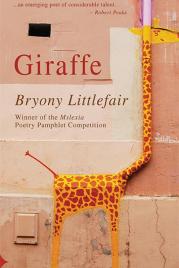
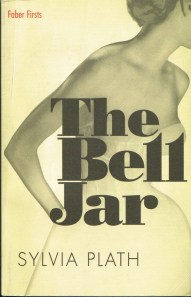 The latter view is more than a possibility given that Littlefair’s poems also boldly explore the self’s relation with itself. The encounter between self and future self is plainly and humorously told in ‘Visitations from future self’ and it finds the present self in trouble, pleading “I can’t go on / like this, my life a tap that won’t / switch on”. Here, the present self’s cliched and optimistic hopes for a “rain-before-the-rainbow thing” are denigrated and stared down by the future self. ‘Sertraline’ echoes Plath’s The Bell Jar in its evocation of a summer spent on an anti-depressive drug. And ‘Giraffe’ itself is a prose poem (there are 3 prose pieces in the whole book) in which a voice is offering reassurances to someone hoping to “feel better”. In a final list, images of a return to ‘health’ are offered. Particularly good is the idea that suffering will remain a fact but “your sadness will be graspable, roadworthy, have handlebars”. And lastly, “When you feel better, you will not always be happy, but when happiness does come, it will be long-legged, sun-dappled: a giraffe.”
 The designation ‘a young poet to watch’ is over-used but on this occasion it needs to be said loudly. Giraffe contains a number of fresh, intriguing and fully-achieved poems. It’s well worth seeking out. I well remember reading and being very impressed by Liz Berry’s 2010 Tall Lighthouse debut chapbook, the patron saint of schoolgirls, and this selection from Bryony Littlefair’s early work runs it close. My review of Liz Berry’s subsequent, prize-winning full collection,
  Martyn Crucefix