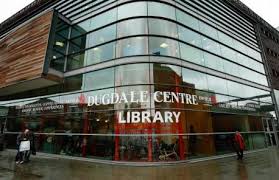
Life should be full of swerve is what I have been thinking recently. It’s how I prefer my days to unfold and certainly one of the main reasons why I value poetry. In dipping and swooping from this to that, swerve serves to exercise our capacities in terms of tension, torque, balance and force. I’m talking emotionally and psychological here, of course, though last Saturday evening did find me doing swerving obeisance to the sat nav woman as I drove up to the Dugdale Centre in Enfield, north London.
It had also been a pretty swervy week in the more serious sense too. My brother and I have been emailing trying to organise a Lasting Power of Attorney in regard to our nonagenarian parents, alongside my daughter’s final events in the Sixth Form, filled with promise and talented and beautiful friends. A liking for swerve also accounts for why I have always loved that moment in The Winter’s Tale when the Old Shepherd talks of meeting both things dying and things new-born.
As it’s also the end of my teaching year, the week had also been spent revising what I think of these days (thanks for nothing Sam Riviere) as my ‘81 Laozis’: my new versions of the 81 chapters of Laozi’s Daodejing which Enitharmon will be publishing next Spring. There’s a good deal of swerve in the poems’ urging towards openness, flexibility, sense of balance:
[to be] circumspect as a man
who crosses a stream in winter
watchful and alert to danger on all sides
respectful as on a first visit
yielding like ice when the thaw sets in
blank as a piece of uncarved wood
receptive as a valley cut through hills
I think of what the Daodejing proposes as the exact opposite of the (too much blood-stained) rigidities of fundamentalism. As I said, this is why I love poetry’s ability to swerve quickly, often without transition, from one thing to another, one emotion or image to another. And so, I was off to Enfield where Alan Murray runs the meetings of Enfield poets at the unprepossessing Dugdale Centre which – as its name might suggest – contains a Lidl store, an Argos store, a multistory car park and a theatre and arts complex. The readings on Saturday took place in a municipal box within a municipal box but even that didn’t spoil the event (poetry does make something happen when it’s read and shared like this).
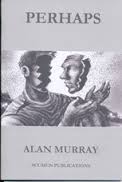
Alan (whose thoughtful book Perhaps was published by Acumen in 2013) introduced floor readers then handed over to Patricia Oxley as the three main poets were Acumen magazine related. John Greening first, whose quiet, measured delivery belies the time he has spent teaching literature to classes of schoolchildren. Dressed in chinos and pale shirt (yes, I’m doing the fashion notes too this time), I grudgingly admit (being a teacher myself) that he looked like a teacher, suggesting nothing of the real powerhouse of writing, editing, anthologising, reviewing and social-medi-ing that Greening is beneath that mild Clark Kent exterior. Born and raised in Hounslow he read ‘Heath Row’ from To the War Poets.
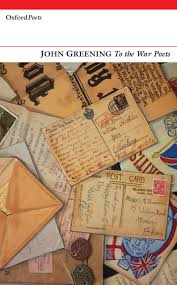
Topical, given the recent scandalous report suggesting a third runway to plague the poor citizens of west London, the poem reverses time’s arrow, unearthing what lies beneath tarmac and terminals, back to the original heath and bog, to sarsen stones and druidic rites, back further to a time when “the earth shudders, floods, howls, ignites”. His most recent book is threaded with addresses to the First World War poets and each short poem cunningly, often wittily, says something about the work of each. ‘To Edward Thomas’ notes: “You died at an observation post. / You looked and looked, and saw the detail / we do not”. Greening has also just published a major anthology, Accompanied Voices, with one of the world’s great music-publishing companies, Boydell Press. He read his own ‘Field’ from it, about poor John Field (inventor of the Nocturne) and the artistic irony that it was Chopin who superceded him, or as the poem puts it with all the brutality of the historical process, he “walked all over him”.

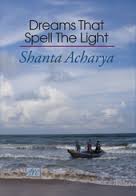
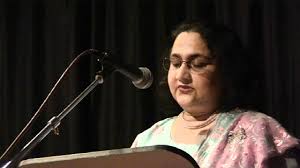
Shanta Acharya’s poems often record the phenomena of the natural world in part for themselves but also, as (her DPhil subject) Emerson suggests, because they can be read as the language of the “Universal Being”. Set in the artistic beauty of a Catholic church, the opening lines of ‘Italian Prayer’ ask: “How does one accustomed to the cold candour of stones / bend one’s knee in reverence”. Acharya’s work is, as Mimi Khalvati has said, “unafraid to take on the abstract, metaphysical, spiritual”. Dressed in an exquisite ivory-cream shalwar-kameez she also read the poem ‘Somewhere, Something’ from Dreams That Spell The Light (Arc Publications, 2010) that argues we do not travel “to explore another country / but to return home fresh, bearing gifts”. In fact, these gifts are for the self because all true experiences – thus discounting those of the ‘mere’ tourist – inevitably change us. The poem concludes, “Let’s fly free, not nailed to a mast; / see the universe with new eyes / not blinded by shadows that light casts”.
She also spoke of the Sanskrit phrase ‘neti neti’ (the title of an earlier collection) meaning ‘not this, not that’ as a definition of God or spiritual experience. This provoked a later discussion on the link between this idea and Laozi’s Daoist ideas, then The Cloud of Unknowing, followed by the writings of Julian of Norwich. Good swerves all. Lidl and Argos were well closed by this time of night.
My maternal grandmother would look sceptically up to a cloudy sky on occasions and make a meteorological call on the basis of whether or not there was enough blue sky to make a man’s pair of trousers. Well, those very trousers were being worn by Alan Brownjohn last Saturday evening, teamed with an unthreatening-cloud-coloured pale shirt. Brownjohn’s delivery is also very quiet, words seeming to emerge more from the side of his mouth, confirming that his tongue is often firmly in his cheek, doing deconstruction and the humour of post-modern irony before it was called such. Yet he manages to load poems with a weight of emotion too; he burns away sentiment, but still moves his readers.

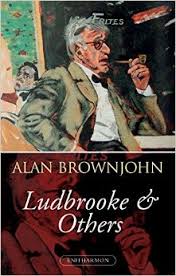
I was pleased he read several of the Ludbrooke & Others poems, 13 line sonnets for our austere age and an anti-hero-loser who nevertheless somehow gets our sympathy. Ludbrooke boasts of his “transformative” love-making in ‘His Classic Modesty’ (he persuades us it “is like the Acropolis”). In ‘His Jealousy’ he wants to persuade us (and himself, of course) that he has “deconstructed” and “junked” that emotion, only to feel the full force of it around line 12 to 13. We recognise a commonality at the same time as being allowed the space to imagine ourselves better than Ludbrooke. See the setting, re-setting, re-positioning of the powerful swerve going on there? That feeling you get after vigourous physical exercise of being stronger, more balanced, more capable? Poetry makes that happen to your heart – the figurative one.

 Martyn Crucefix