An edited (shorter) version of this review first appeared in Poetry Salzberg Review in June 2025. Many thanks to the editor, Wolfgang Görtschacher, for commissioning the writing of it. The collection, The Penny Dropping, was shortlisted for the TS Eliot Prize in 2024.
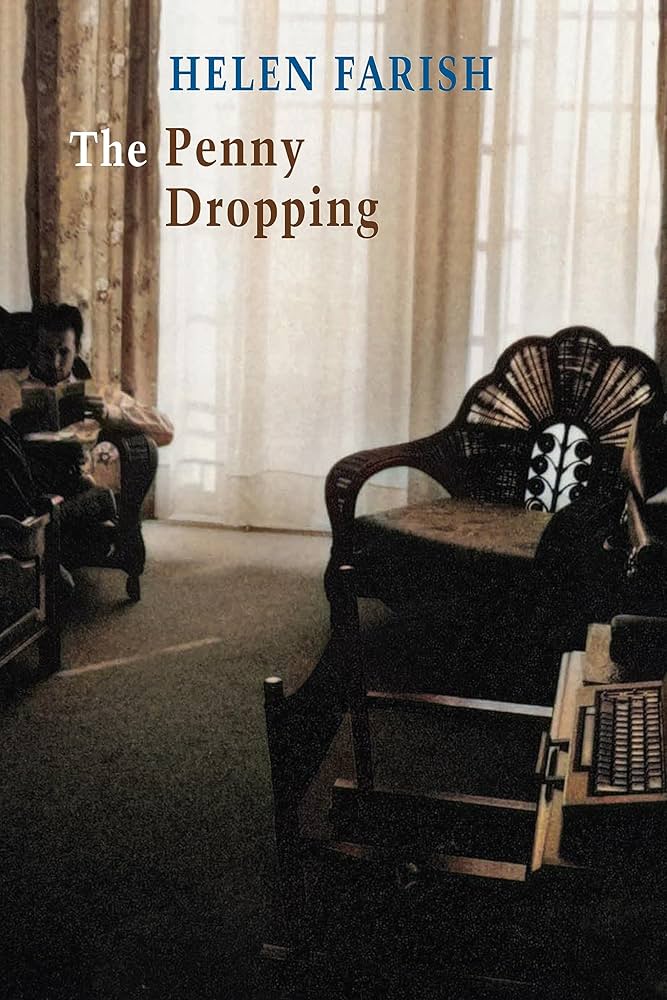
Tennessee Williams once wrote that ‘memory takes a lot of poetic licence’, but Helen Farish’s memory poems in The Penny Dropping (Bloodaxe Books, 2024) declare from the outset that their intention is to set things (here quoting TS Eliot) ‘in order’, by settling ‘life accounts bravely in the face of now and then, and [to] settle them honestly’ (here quoting Charlotte Bronte’s Villette). This is quite a task given the love affair the book recalls and reflects on occurred almost 40 years ago (the absence of mobile phones, internet and social media is particularly striking and hence evokes the ‘period’). But how ‘honest’ these poems are, of course, we cannot tell, though Farish’s commitment to autobiographical fidelity means any potential reviewer must be warily self-conscious – we do not want to criticise a (real) life, with all its choices good and bad, but to focus on the artistry of the poems. This commitment to honesty also has implications for the poet: a plain-speaking truth demands (as did Othello’s) a plain, unvarnished re-telling.
Indeed, Farish’s lyric poems are very plainly told (readers tiring of a lot of contemporary poetry’s tricksy obfuscation and language ‘breaking’ will be delighted to read poems here which are immediately direct and accessible) and formally they are unrhymed, irregularly lined verse paragraphs, attuned to the colloquial, the storytelling. But, with its age-old narrative (girl meets boy, they fall in love, fall out of love, difficult break up) and insistence on plain-speaking, Farish runs the risks of cliché. Often, she does not steer clear of very (over-) familiar phrases such as ‘pick up the pieces’, ‘a weight off his mind’ (‘Premonition’), ‘on the breadline’, ‘when push came to shove’ (‘Qui e Li’), ‘winning smiles’, doing ‘things by the book’ (‘The Butcher’s Boy’). Moreover, the male love interest is stereotypically a ‘hero’ in the poem of that name, is even designated ‘Tall, Dark, Handsome’ (‘Thanking the Universe’), and the rather feeble title of the collection – the penny dropping, the realisation of the end of the relationship – seems all rather too familiar for contemporary poetry (in fact, Farish is better than this and the penny that drops is not quite so obvious – more of this later).
So, the collection traces – in old-fashioned chronological order – the start, middle, end, and aftermath of a decades old love relationship. It’s a little bit Shirley Valentine, a little bit The End of the Affair, though the role model Farish herself suggests is Woody Allen’s Annie Hall. Despite the long distance recall, there is a vivid, sensuous immediacy to the writing. In lesser hands, a likely recourse would be to old photograph albums, but Farish is as liable to start a poem from an old map, still in her possession, on which the young lovers scribbled notes for their anticipated, future return (which never happened). And there must have been a lot of maps, as the book unfolds in an almost picaresque fashion with the lovers meeting in Morocco, travelling to Italy, and Sicily, onto Greece, and Crete, before a return to the UK in Oxford. One of the key methods Farish uses to convey the thrill, freedom and passion of early love is through these exotic locations, the colours and customs, the names, the booze, the food. ‘Things We Loved’ – the book’s first poem – does this via Morocco’s markets, rose sellers, taxis, tagines, its acrobats and a dilapidated cinema. In Palermo, we’re along the Via Maqueda, sampling gelato, or polishing off a bottle of Donnafugata in bed (‘Mozart’s 233rd Birthday’). Later in the book, the woman – now looking back over the decades – finds it’s still a bold Italian red, penne, gorgonzola, and oranges that conjure those long-lost days in true Proustian fashion (‘Pasta alla Gorgonzola’).

Bernard O’Donoghue praises The Penny Dropping not only as a book of poems but also as possessing the ‘coherence of a novel’. There is a clear narrative, but the characterisation of the male lover is very sketchy and, if the genders were reversed, surely we’d be railing against the male writer’s disservice to the female figure’s reality? Though a photograph (in ‘Exposure’), taken in Fez, is said to have caught him unawares, with his ‘own barriers down’, we never get much more about him than that he is sociable (more than the woman), is ‘too much the gentleman’ (‘May Day’), is good with children (and wants them; she doesn’t), has bouts of unexplained illness, and is eventually unfaithful to her. Bloodaxe’s unattributed cover image – in shadowy, ‘memoir’ sepia – has a self-absorbed, book-reading man almost out of frame and this seems about right. But, fair enough, the book is (a la Bronte) the author’s settling of her own accounts and Farish really does do this with tremendous honesty and an astonishing absence of blame (though plenty of self-criticism).
Even in the early days of the affair, she is conscious of the couple’s differences. At a Greek Orthodox Easter celebration, he is at ease and happy, ‘good with the little ones’ but she has ‘said no to the tripe and only joined in / for one glass of tsikoudia / before going back to [their] room to write’ (‘Christ Has Risen! He Has Risen Indeed!’). In ‘May Day’ he ‘would have joined in’ another local celebration and (in retrospect) she berates herself: ‘I should have said You go’. The self-blame here feels truthful, and is so commonly gendered, and the same perhaps for her (perceived) faults of passivity and sense that ‘I always had guilt inside’ (‘Scapegoat’). ‘In Seville That Spring’, at the moment of crisis (you ‘couldn’t go on, / you wanted space’) the woman again regrets and self-lacerates: ‘I should have made you talk to me, / I should have fought for you, stomping my feet [. . .] Instead, British-style, I drove north, / three hundred miles’.
These are painful poems in the end and the reader may well share in some of the criticism Farish levels at herself. But we are often wrong-footed. In the book’s title poem, there are two pennies dropping: one is the man’s sudden realisation that the relationship (in his view) is finished, but the other (in the poem, presented as an explicatory parallel to his realisation) is Farish’s sudden grasping that her mother is terminally ill. And it’s not until close to the end of the book, in ‘Beauty Spot’, that we are given to understand that her mother’s early death traumatised Farish, so much so that (speaking of herself), ‘she’ll lose you if she doesn’t absorb / how self-absorbed she is, / [. . .] you’ll look elsewhere’. Perhaps this is what happened. The story valorises truth, rather than being any sort of role model narrative for young women (or men for that matter). This is admirable and it’s in these final few poems that the emotional complexity of the relationship really emerges, the woman, now in her sixties, is left with a Goethean ‘blessed longing’, an emotional state, ‘not sorrow, and more sinuous than sadness’, not resolved, no longer rawly anguished, but with a desire to place, to settle, what has happened, to ‘have the memory / and be through the loss itself’ (‘That Selige Sehnsucht Feeling’).
That Selige Sehnsucht Feeling
I’d name it Selige Sehnsucht, that feeling
my home gave me yesterday, words
you used once in a note –
I must have forgotten something,
I have that Selige Sehnsucht feeling.
It’s an indefinable ache – not melancholy,
ot sorrow, and more sinuous than sadness –
a feeling on a journey, picking up
strands of other like-hearted feelings on its way.
Is it possible to be sick for home while still there?
I think you were saying you missed me
before you’d even left. And yesterday,
as the red sun lowered, picking up other reds
on its way – flame red, orange red, ember red –
I ached for what I was looking at:
the long tawny-brown grass which,
from across the field, the house seemed
to grow out of putting me in mind
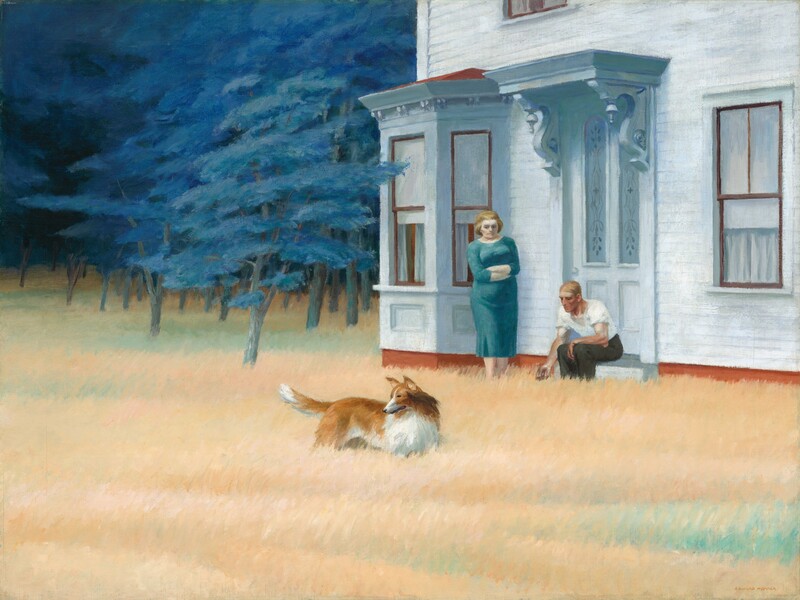
of an Edward Hopper house in a timeless
American field and the house retreating
into itself in the restful silence.
The bats came out. A barn owl flew close.
And the wind which often stirs at the end
of a summer’s day stirred. Take the place from me,
I almost thought, so I can have the memory
and be through the loss itself.
Was it something similar, a feeling in the same family
of feelings, that prompted your use of Selige Sehnsucht
in that long-ago note? I must have forgotten something,
you wrote, though whatever it was that was
taking you away for a few nights hadn’t even begun:
Or is it just that I love you so?

 Martyn Crucefix