This is a new, major – 200 page – selection and translation of Rilke’s poetry from 1899 through to 1926, published in Spring, 2024, from Pushkin Press, much praised by Victoria Moul here (The Friday Poem): ‘I wished there were more of this wonderful book. Whether you know and love Rilke already, or are new to him, do get hold of a copy!’
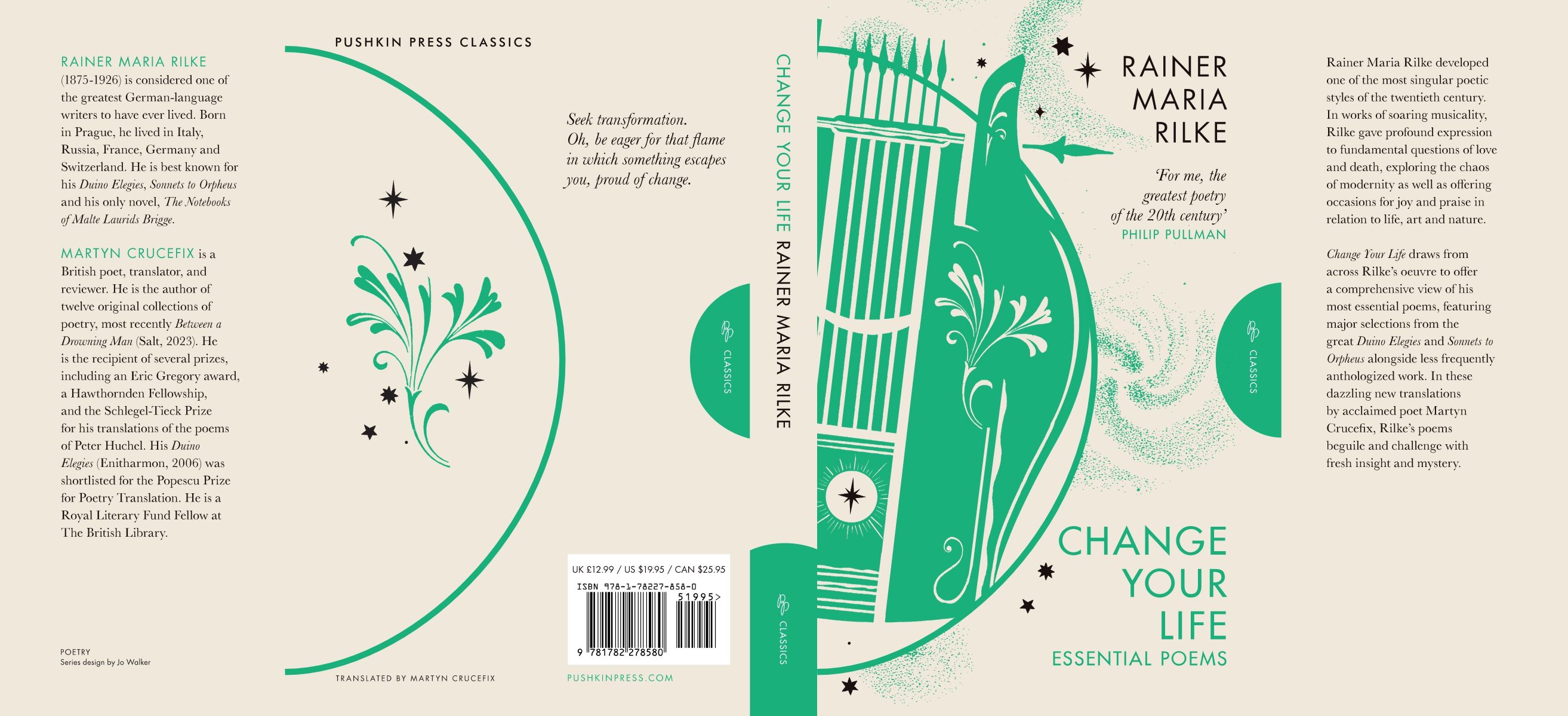
As translator, Martyn Crucefix has commented: ‘This selection of Rilke’s poetry has been made with regard to three criteria: those poems a new (or more experienced) reader might reasonably expect to find in such a book, plus those poems that I felt were important to a rich and comprehensive view of Rilke’s poetic achievements, plus those individual poems that I felt especially in tune with.
These three criteria were bounded (as they must always be) by the particular translator’s competence and confidence in their ability to bring Rilke’s German over into English. Given these restraints, I trust this final selection succeeds in including a generous choice of his ‘early’ poems from 1899-1906, through the artistic breakthrough of the New Poems (1907/1908), his ‘Requiem for a Friend’ for Paula Modersohn-Becker (1909), and the not-so-fallow years of 1910 to 1921, a publishing hiatus spectacularly broken in 1922 by the storm of inspiration that completed the Duino Elegies and the Sonnets to Orpheus. The selection also includes a number of the jewel-like, haiku-like poems Rilke wrote in French in his more settled, brief, final years before his death in 1926′.
Sample Poems
from The Book of Monastic Life (1899)
I live my life in ever widening rings,
encompassing everything, and though I
may not be able to achieve this last thing,
still, I mean to try.
x
Around God I circle – that age-old, towering form –
a circling thousands of years long;
and still I do not know: am I a hawk, a storm,
or a mighty song.
x
from New Poems I (1907)
in the Jardin des Plantes, Paris
With pacing the bars back and forth, his gaze
grows so tired there is nothing it can hold.
To him, there appear to be a thousand bars
and beyond the thousand bars, no world.
x
The lithe, smooth steps of his powerful gait
that, within the smallest of circles, spins round,
is like a dance of power about a point
at which an immense will stands, stunned.
x
Only in moments does the pupil’s curtain
slide noiselessly open – then an image enters,
passing through the tense silence of each limb
into the heart, where it disappears.
 Martyn Crucefix